Five golf club groove sharpeners compared on material, sharpness and club compatibility, each with a spec table and a checklist.
All five tools below are in stock on Amazon right now, and every figure comes from the manufacturer. The field runs from a six dollar steel head to a CNC ground tungsten carbide tool near a hundred dollars, and the honest answer is that the cheap ones clean grooves while the expensive one recuts them to spec.
The best golf club groove sharpener: five picks at a glance
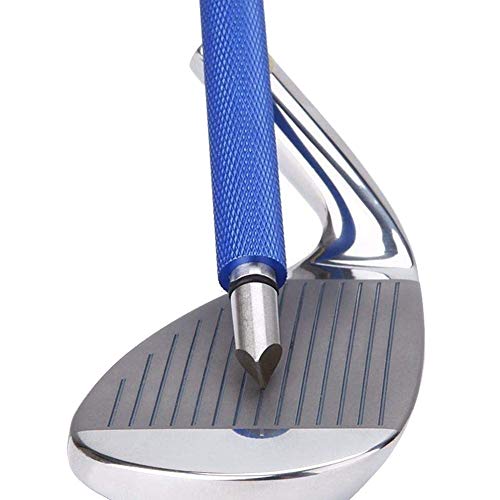
A groove sharpener is a hardened cutting tip you draw along the grooves of a wedge or iron. What separates these five is the hardness of that tip, measured on the Rockwell scale, and whether the tip matches the groove profile of your clubs. Most heads here handle both U-grooves and V-grooves; only one holds a published groove geometry.
Below you get the short version first: three picks for the most common cases, then the full table with all five, then every tool in detail with specs, strengths and weaknesses.
- The one to buy if you only want oneHIFROM 6-Head Groove Sharpener
- Cheapest tool that does the jobBulex Groove Sharpener
- Sharpener plus a full cleaning kitVIPMOON Golf Club Cleaner Kit
- Real carbide, cut to conforming specGrooVex High Precision Carbide


| Sharpener | Material | Hardness | Heads | Best for |
|---|---|---|---|---|
| Bulex Groove Sharpenerbest budget | Vacuum heat treated tool steel | Not published | One tip, U and V | Cleaning grooves on a small budget |
| HIFROM 6-Head Groove Sharpenerbest overall | Vacuum heat treated steel | 65 Rockwell | 6, three U and three V | One tool that lasts several seasons |
| VIPMOON Golf Club Cleaner Kitfull kit | Heat treated steel plus nylon and steel brush | Not published | 6 cutters plus a flat tip | Replacing a whole bag of cleaning gear |
| Betgod Groove Sharpenerbest warranty | Hardened steel tip in an aluminum body | Not published | One tip, U and V | Buyers who want a written guarantee |
| GrooVex High Precision Carbidebest premium | C2 sub-micron solid tungsten carbide | 92 Rockwell | One sharpening end plus a cleaning end | Recutting grooves back to conforming spec |
The five groove sharpeners in detail
- Materialhigh grade precision tool steel, vacuum heat treated
- Groove typesU-grooves and V-grooves
- Clubswedges, irons and other clubs
- Second usedoubles as a groove cleaner
- Sizecompact enough for a bag pocket
- Colorblue
Best for: A golfer who wants worn grooves cleaned out and does not want to spend more than a sleeve of balls
This is the tool that makes the argument for owning a groove sharpener at all. Grooves fill with dirt and go round at the edges after a couple of seasons, spin drops, and wedge shots stop checking. A few passes with a hardened steel tip pulls the packed material out and puts an edge back on the groove wall.
What you get for the money is a vacuum heat treated tool steel tip that works on both U and V profiles, plus enough bulk in the handle to hold it steady. What you do not get is a published hardness number or a second cutting head. Treat it as a consumable: use it, and when the edge stops biting, buy another.
Pros
- Under ten dollars, which makes it a bag accessory rather than a purchase
- Vacuum heat treated tool steel is the same base material the more expensive steel tools use
- Handles U-grooves and V-grooves, so it fits whatever iron set you already own
- Small enough to live in a bag pocket and be used between holes
Cons
- Bulex publishes no Rockwell figure, so the hardness of the tip is unknown
- A single cutting tip means that when the edge dulls the tool is finished
- No cleaning brush, so packed dirt has to come out before you cut
- Materialhigh grade precision tool steel, vacuum heat treated
- Hardness65 Rockwell
- Heads6, with a U shaped and a V shaped cutting end
- Shaftlichi textured surface for grip
- Clubsall irons plus pitching, sand, lob, gap and approach wedges
- In the boxsharpener and a clear PVC tube
Best for: Anyone who wants one tool that keeps working after the first edge goes dull
The HIFROM is the sensible middle of this field. It is built as a hexagonal head with six cutters, three ground to a U profile and three to a V, so one tool covers both modern square grooves and older V grooves, and you rotate to an unused edge when the one you have been using stops biting.
Sixty-five Rockwell is the number that matters. That is harder than the stainless in a wedge face, which is what allows the tip to cut rather than skate, and it is the only hardness figure published by any of the steel tools here. The lichi textured shaft is a small thing that turns out to matter: sharpening takes real hand pressure, and a smooth handle rolls in the palm.
Pros
- Six cutter heads mean five fresh edges after the first one wears, at roughly the price of two single-tip tools
- 65 Rockwell is a published figure, which none of the cheaper steel tools here give you
- Two cutting profiles on the heads, one U and one V, so you match the tool to the club
- The textured shaft holds in a wet or gloved hand, which is where smooth handles slip
Cons
- Rotating heads has to be done carefully or you cut a groove with the wrong profile
- 65 Rockwell is hard steel but well below the carbide tool in this list
- The PVC tube is the only storage, and it is easy to lose in a bag

- Contentstwo sharpeners and one retractable brush
- Sharpenersone hexagonal 6-cutter and one flat tip
- Cutters3 for U grooves, 3 for V grooves
- Brushdouble sided, soft nylon and steel wire, with spikes
- Reachhook and loop cord stretches to 60 cm
- Materialvacuum heat treated tool steel
Best for: A golfer who currently has no cleaning gear at all and wants to solve the whole problem in one purchase
The VIPMOON is sold as a kit and should be judged as one. The two sharpeners are conventional: a hexagonal head with six cutters split between U and V profiles, plus a flat tip for a different groove shape. Neither is unusual on its own.
The brush is what justifies the price. Grooves fill with a paste of grass and soil, and running a cutter through that just packs it deeper. The double sided brush, nylon on one face and steel wire on the other, clears the groove before the tool goes in. It hangs off a hook and loop cord that stretches to 60 cm, so it stays clipped to the bag and gets used, which a loose brush does not.
Pros
- Cleaning before cutting is the step most people skip, and this kit puts the brush in the same box
- The retractable cord clips to a bag and stretches 60 cm, so the brush stays attached
- Two sharpener shapes, hexagonal and flat, cover both narrow and wide grooves
- Two plastic storage boxes keep the cutters from blunting against other bag hardware
Cons
- No Rockwell figure is published for either sharpener
- Three separate items means three things to lose rather than one
- The steel wire side of the brush will mark a soft face if you use it hard

- Tiphardened steel
- Bodyhigh grade aluminum
- Groove typesU-grooves and V-grooves
- Functiongrinds and cleans in the same pass
- Warranty12 months
- Returns90 day money back guarantee
Best for: Someone buying their first sharpener who wants a written fallback if the tip fails early
The Betgod sits in the same price bracket as the Bulex and takes a slightly different approach: a hardened steel tip mounted in an aluminum body rather than a one-piece steel tool. The practical differences are weight and corrosion, both in the aluminum's favor, and dent resistance, which is not.
What genuinely separates it is the guarantee. A 90 day money back window and a 12 month warranty are unusual on a ten dollar accessory, and on a product where nobody publishes a hardness figure, a warranty is the only assurance you get. If the tip stops cutting inside the year, you have a route to a replacement.
Pros
- A 12 month warranty and a 90 day return window, which the other budget tools do not offer
- An aluminum body is lighter than a solid steel handle and does not rust in a wet bag
- Cuts and cleans in one pass, so a routine wipe-down does not need two tools
- Under ten dollars, in the same bracket as the Bulex
Cons
- No published hardness for the tip, so you are trusting the warranty rather than a spec
- A single tip with no spare edges
- An aluminum body dents if it takes a hard knock against club heads in a bag
- MaterialC2 sub-micron solid tungsten carbide
- Hardness92 Rockwell
- Groove geometry0.035 in wide, 0.020 in deep, 0.010 in edge radius
- ToleranceCNC ground to plus or minus 0.001 in
- Functionsharpening end plus a cleaning end
- Recommended intervalre-sharpen every 10 to 12 rounds
Best for: A player who tracks spin numbers and wants grooves cut back to the maximum the rules allow
The GrooVex is the only tool here that recuts grooves rather than just cleaning them out. Solid tungsten carbide at 92 Rockwell is hard enough to machine club faces without the edge rolling over, and GrooVex CNC grinds that edge to a stated 0.035 inch width, 0.020 inch depth and 0.010 inch edge radius, held to a thousandth of an inch.
Those numbers are the point. They describe the most aggressive groove the rules of golf allow, which is what a new wedge leaves the factory with and what wears away over a season. Two or three passes per groove restores it. The manufacturer suggests doing that every 10 to 12 rounds. At around 97 dollars this only makes sense if you play enough that wedge spin is something you notice, but at that level it costs less than replacing a wedge.
Pros
- Ninety-two Rockwell tungsten carbide is far harder than any heat treated steel tool here, so the edge lasts
- The groove geometry is published to a thousandth of an inch, so you know what shape you are cutting
- Two or three passes is enough on a worn groove, against a dozen with a steel tip
- The cutting profile is the most aggressive groove the rules permit, so it maximizes spin without going non-conforming
Cons
- Around 97 dollars, roughly ten times what a steel tool costs
- A carbide edge cuts fast, which also means a careless pass removes more face material than you meant to
- One cutting profile only, so it is built around a single groove spec rather than every club in the bag
Checklist: What makes a great Golf Club Groove Sharpener
- Material: Look for a sharpener made of high-quality, durable materials. They typically feature high-grade precision steel or vacuum heat-treated steel, ensuring a long-lasting tool that consistently delivers excellent performance.
- Sharpness: Opt for sharpeners that offer suitable hardness and efficiency for quick and effective cleaning, grinding, and regrooving. Some designs take the edge with features like six head designs or ‘most aggressive grooves permitted’.
- Size and weight: Lightweight and compact groove sharpeners are preferable as they are easy to carry during golf rounds, allowing you to restore your clubs whenever you deem fit.
- Compatibility: Check to see if the golf club groove sharpener is suitable for the type of clubs you use. Some are versatile and can be utilized on both U-grooves and V-grooves, fitting for a variety of golf clubs including wedges and irons.
- Extra Features: Some golf club groove sharpeners may come with extra offerings like a secure grip for intensive cleaning or possibly a lifetime guarantee on the sharpening end. These features add bonuses to the overall usage and lifespan of the product.

FAQ
Why do I need a Golf Club Groove Sharpener?
A golf club groove sharpener helps restore and maintain optimal performance of your golf clubs, extending their lifespan and saving money on expensive replacements.
What should I consider when buying a Golf Club Groove Sharpener?
Consider the sharpener's materials, sharpness, size, weight, compatibility with your clubs and any extra features like a secure grip or a lifetime guarantee.
Can the same Golf Club Groove Sharpener be used for different types of golf clubs?
Yes, some golf club groove sharpeners are universal and compatible with different types of golf clubs, including both U-grooves and V-grooves.