Seven drysuit undergarments compared on material, insulation and fit, each with a spec table and a checklist for layering under a drysuit.
Every garment in this list is available on Amazon right now, and every figure below comes from the manufacturer. Prices run from under 30 dollars for a thin fleece lined swim top to around 460 dollars for a full dive undersuit, and the spread is that wide because these are three different products: a one-piece undersuit, a separate top and bottom set, and a plain thermal base layer.
Best drysuit undergarments: the seven picks at a glance
A drysuit keeps water out and does almost nothing to keep you warm. The undergarment does that job, and it has to do it while compressed under a shell, while wicking sweat away on the surface, and without bunching when you pull the suit on. That is why the details that matter here are unglamorous: stirrups and heel straps so the legs do not ride up, flatlock seams so the shoulder straps of a BCD do not chafe, a double-slider zipper so you can vent without undressing, and a smooth outer face so the drysuit slides on instead of dragging.
Searches that land on this page split cleanly in two. Most people are looking for the best undergarment for a drysuit outright, and for them the answer is a one-piece with a water repellent outer face. A smaller group is looking for a budget drysuit undergarment, and that request is honest: not every dive or paddle needs a 250 dollar fleece. Both cases are covered below, the outright pick first and the cheap entry last, with the layering sets in between.
- The one most divers should buySEAC Unifleece Insulating Undergarment
- Warmest in the fieldSCUBAPRO K2 Extreme One-Piece Undersuit
- Best layering setBare Ultrawarmth top and pants
- Cheapest entry worth owningSplash About Thermaswim Thermal Top


| Undergarment | Type | Material | Key detail | Best for |
|---|---|---|---|---|
| SEAC Unifleece Insulating Undergarmentbest overall | one-piece | two-layer fleece, water repellent outer | double-ended front zipper, ankle stirrups | Cold water diving without overthinking it |
| SCUBAPRO K2 Extreme One-Piece Undersuitwarmest | one-piece steamer cut | breathable stretch dual fleece | compression padding on shoulders, chest and knees | Genuinely cold water and long bottom times |
| Bare Ultrawarmth Base Layer Women's Topbest layering piece | separate top | 230 g Celliant infrared stretch fleece | retractable thumb loops, Microban odor control | Building a set you can dial up or down |
| Fourth Element Arctic Men's Leggingsbest technical bottom | separate leggings | 80 percent recycled polyester outer, recycled fleece inner | single-layer lower legs, pee-valve compatible | Warmth in the legs without bulk at the ankles |
| Bare Ultrawarmth Base Layer Women's Pantsmatching bottom | separate pants | 230 g Celliant infrared stretch fleece | contoured waistband with continuous drawcord | Pairing with the Ultrawarmth top as a set |
| Sharkskin Chillproof Front Zip Undergarmentalternative one-piece | one-piece | Sharkskin Chillproof laminate | front zip entry | Divers already on Chillproof who want the full suit |
| Splash About Thermaswim Thermal Topcheapest worth owning | separate top | brushed fleece lined 4-way stretch | close fit, sized by chest measurement | Cold water paddling and swimming on a budget |
The seven undergarments in detail
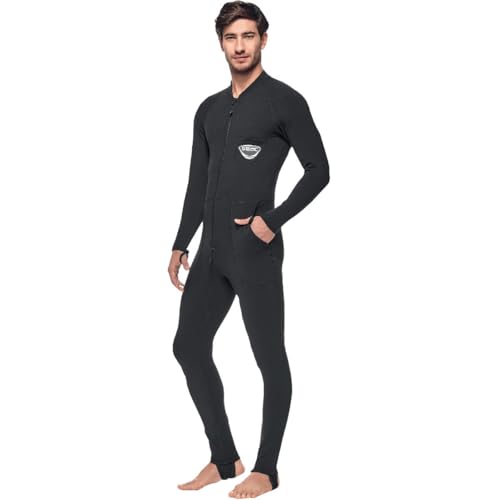
- Typeone-piece drysuit undergarment
- Constructionlightweight, breathable, two-layer
- Outer layerrepels water to help keep you dry
- Entrydouble-ended front zipper
- Legsankle stirrups to stop bunching
- Storageeasy-access zippered pockets
Best for: A diver who wants one garment that covers most cold water conditions and does not want to assemble a set
This is the sensible middle of the field. At around 130 dollars it costs a quarter of the SCUBAPRO and buys the same basic idea: a full body fleece with a smooth water repellent face, cut as one piece so there is no waistband to bunch under a drysuit belt.
The details are the argument for it. A double-ended front zipper means you can open the suit from the bottom, ankle stirrups keep the legs anchored while you fight a drysuit over them, and the outer layer sheds the moisture that inevitably ends up inside a dry shell. What SEAC does not give you is a number. There is no stated fabric weight anywhere in the listing, so how warm this is compared with a 230 g fleece is a question the manufacturer leaves open.
Pros
- A water repellent outer layer, which matters more than it sounds: the inside of a drysuit is damp from sweat and condensation, and a face that sheds moisture keeps the fleece working
- A double-ended zipper opens from the bottom as well as the top, so you can vent or reach a pee valve without stripping the whole suit off
- Ankle stirrups are the difference between a leg that stays where you put it and one that rides to your knee while you pull a drysuit on
- Zippered pockets are rare on an undergarment and useful on the boat before the suit goes on
Cons
- SEAC publishes no fabric weight or thickness, so the insulation cannot be compared numerically against the Bare or Fourth Element garments
- No thumb loops, so the sleeves can ride up at the wrist while donning
- Stock on this listing is limited
- One-piece means you cannot dress down for a mild day the way a top and pants set lets you
- Typeone-piece steamer cut undersuit
- Materialbreathable, stretchy dual fleece
- Paddingcompression padding on shoulders, chest and knees
- Entryfront double-slider zipper
- Wristselastic wrist loops
- Anklesheel straps to prevent ride-up
Best for: Cold water, long dives, and a diver who has already decided that warmth is worth paying for
This is the expensive answer and it is expensive for reasons you can point at. The material is a stretchy dual fleece cut as a one-piece steamer, patterned after SCUBAPRO's Everflex 1.5 mm line, and the compression padding on shoulders, chest and knees addresses suit squeeze rather than just adding loft.
The fit engineering is what separates it from the cheaper one-pieces. Elastic wrist loops at the top, heel straps at the bottom, and a front double-slider zipper in between mean the suit stays where you put it through the whole process of donning a drysuit and then venting it on the surface. If you dive cold water regularly this is the garment in the list built for that; if you dive warm water occasionally, almost anything else here is a better purchase.
Pros
- Compression padding on the shoulders, chest and knees is the one feature in this list aimed at suit squeeze, and it doubles as protection where a harness and a boat deck do the damage
- Dual fleece construction, so there is an insulating face and a wicking face rather than one fabric asked to do both jobs
- Elastic wrist loops and heel straps together, which no other garment here offers, and between them they stop the suit riding up at both ends
- A double-slider zipper vents from the bottom, which is what you want when you are geared up and overheating on the surface
Cons
- At around 460 dollars it costs more than the SEAC, the Sharkskin and the Splash About combined
- SCUBAPRO publishes no fabric weight either, only the comparison to the 1.5 mm Everflex garment line
- Stock on this listing is limited and this is the medium
- One-piece and heavily insulated means it is the wrong choice for mild water, with no way to dial it back
- Typeseparate base layer top
- Material230 g Celliant infrared stretch fleece
- Facessmooth face for easy layering, fleece-brushed back
- TreatmentMicroban odor control
- Seamsflatlock, to minimize chafing
- Cuffslow profile retractable thumb loops
Best for: Anyone building a layering system rather than buying one garment for every condition
This is the piece to start a set with. Bare gives a real number, 230 g Celliant infrared stretch fleece, and builds it the right way round with a smooth outer face for layering and a brushed back for warmth, plus Microban to keep an inevitably damp garment from turning sour.
The reason to prefer a top over a one-piece is range. In mild water you wear this alone under the drysuit, in cold water you add the Ultrawarmth pants below or the Fourth Element leggings, and you end up with two or three usable configurations instead of one. The trade is money and a waistband: two garments cost more than one, and there is a seam at the middle that a one-piece does not have.
Pros
- Bare is the only maker here that publishes a fabric weight, 230 g, so this is the one garment in the list whose insulation you can actually compare to something else
- A smooth outer face and a brushed inner face, which is exactly the right way round: warmth against the skin, low friction against the drysuit
- Microban odor control on a garment that spends its life damp inside a sealed shell is a practical rather than cosmetic feature
- Retractable thumb loops keep the sleeve from riding up your forearm while you push through a drysuit wrist seal
Cons
- A top only, so you need the matching pants or another bottom to cover the legs
- This particular listing is the extra-small, and sizing on base layers is unforgiving
- Quick drying is claimed but no drying time is stated
- Buying top and pants separately costs more than a comparable one-piece

- Typeseparate drysuit leggings
- Outer fabric80 percent recycled polyester
- Inner layer100 percent recycled fleece
- Lower legssingle-layer construction to reduce bulk at the ankles
- Fitintegrated foot stirrups
- Compatibilitydesigned to work with pee-valve systems
Best for: Divers who want serious leg insulation without fighting the garment into a drysuit boot
Fourth Element built these around the part of the problem most makers ignore. Insulation in the legs is easy; getting an insulated leg through a drysuit ankle and into a boot is not, and the single-layer lower leg here is a direct answer to that, with foot stirrups to keep everything anchored once it is in.
The rest is what you expect at this price: a recycled polyester outer over a recycled fleece inner, low bulk for the warmth delivered, and stated compatibility with a pee valve, which matters on any dive long enough for that to be a question. What you do not get is a number for the insulation, and at 250 dollars for a bottom half the price is a real objection.
Pros
- Single-layer lower legs is the smartest detail in this list: the ankle is where a drysuit is tightest and where a thick fleece leg turns donning into a wrestling match
- Pee-valve compatibility is stated outright, which no other garment here does and which matters on any dive long enough to need one
- 80 percent recycled outer and a 100 percent recycled fleece inner, the only garment here with a documented recycled content
- Foot stirrups keep the leg anchored, so the fleece stays over the calf instead of bunching at the knee
Cons
- At around 250 dollars these are leggings only, and a matching top pushes the set well past the price of a full one-piece
- No fabric weight published, so the insulation cannot be compared with the 230 g Bare fleece
- Stock on this listing is limited and it is the large
- Single-layer lower legs deliberately trade some warmth at the ankle for ease of donning

- Typeseparate base layer pants
- Material230 g Celliant infrared stretch fleece
- Facessmooth face for layering, fleece-brushed back
- TreatmentMicroban odor control
- Seamsflatlock, to minimize chafing
- Waistcontoured waistband with a continuous drawcord
Best for: The obvious second half if you already own or plan to buy the Ultrawarmth top
This is the other half of the Bare set and there is not much to argue about: the same 230 g Celliant fleece, the same smooth outer face and brushed inner face, the same flatlock seams, with a contoured waistband and a continuous drawcord to keep them up under a suit.
The one thing to know before buying is what is missing. There are no stirrups here, so unlike the Fourth Element leggings and the SEAC one-piece nothing anchors the leg at the foot, and getting a drysuit on over them takes a little more care. As a piece of a system it is the right buy; as a standalone bottom the Fourth Element does more for the money if bulk at the ankle is your complaint.
Pros
- The same published 230 g fleece as the top, so a set has one consistent insulation value rather than a mix of unknowns
- A contoured waistband with a continuous drawcord, which is what keeps a fleece pant from sliding down inside a drysuit
- Flatlock seams down the inside leg, where a raised seam under a compressed drysuit becomes a hot spot on a long dive
- Buying the pants separately means you can run the top alone in mild water and only add the legs when you need them
Cons
- No stirrups, unlike the Fourth Element leggings and the SEAC one-piece, so the legs can ride up while donning
- Stock on this listing is limited and it is the extra-large
- Around 100 dollars for the bottom half alone, on top of the price of the top
- Bare states no drying time, only that the fabric dries quickly

- Typeone-piece drysuit undergarment
- LineSharkskin Chillproof
- Entryfront zip
- Useworn under a drysuit for diving
- Sizing on this listing2X-Small
- Published detailAmazon lists no feature bullets for this item
Best for: Divers already using Chillproof tops or vests who want the same fabric as a full suit
Sharkskin's Chillproof is a familiar fabric to a lot of divers, and this is that fabric as a full front zip one-piece rather than the tops and vests the line is better known for. The cut is the main argument: one piece, front zip, nothing at the waist to bunch under a drysuit.
The reason it sits here rather than higher is documentation. The Amazon listing for this item carries no feature bullets, which means the things that decide how warm an undergarment is, layer count, fabric weight and seam construction, are simply not stated. That does not make it a bad garment, and the price sits reasonably in the middle of this field, but every other entry in this list tells you more about what you are buying.
Pros
- A full one-piece cut, so there is no waistband seam to bunch under a drysuit belt
- Front zip entry, which is what you want when getting dressed on a moving boat
- Chillproof is a well established line, so the fabric is a known quantity to divers who already own a piece of it
- Around 160 dollars places it between the SEAC and the Fourth Element rather than at the top of the field
Cons
- The Amazon listing publishes no feature bullets at all, so material thickness, layer count and seam type are not documented there and we will not guess at them
- No stated stirrups, thumb loops or heel straps, which the SEAC and SCUBAPRO both name
- Stock on this listing is limited
- This listing is the 2X-Small, so most buyers will need a different size page

- Typethermal base layer top
- Liningbrushed fleece inner
- Fabric4-way stretch
- Cutclose fitting to reduce drag
- Sleeveslong sleeve for heat retention
- Sizingchest 86 to 94 cm for XS/S, 96.5 to 101 cm for M/L, 104 to 112 cm for L/XL
Best for: Cold water paddling, swimming and surfing, or a first thermal layer for someone not ready to spend three figures
This is in the list because the budget question is a real one and deserves a real answer. At under 30 dollars the Thermaswim is a brushed fleece lined, 4-way stretch long sleeve top cut close enough to layer under a wetsuit or a drysuit without bunching at the shoulders, and Splash About sizes it by actual chest measurement rather than a vague letter.
Be clear about what it is not. There is no water repellent outer face, no wicking treatment, no stirrups or thumb loops, and Splash About markets it for cold water swimming, paddleboarding and surfing rather than for diving. As a first thermal layer, as a summer drysuit liner in mild water, or as the piece you hand to a friend who is cold, it earns its place. For a cold dive, buy one of the six above.
Pros
- Under 30 dollars, which is roughly a quarter of the next cheapest garment here and the only entry that answers a budget search honestly
- Splash About sizes by chest measurement in centimetres rather than by a letter alone, which is unusually specific for a garment at this price
- 4-way stretch and a close fit mean it layers under a wetsuit or a drysuit without adding bulk at the shoulders
- In stock in the normal way, unlike most of the specialist garments in this list
Cons
- This is a thermal swim top, not a dive undersuit, and Splash About does not claim drysuit compatibility
- No fabric weight and no layer count published, so the insulation is unquantified
- A top only, with no matching bottom in this listing
- Brushed fleece against the skin with no stated wicking treatment, so it will hold moisture longer than the dive specific fleeces here
Checklist: What makes a great Drysuit Undergarments
- Material Quality: Top-tier undergarments are typically made from fleece, Polyester, or technical fabrics that offer optimal warmth while ensuring flexibility and comfort during dives.
- Insulation Efficiency: Look for undergarments with proven insulative properties like 2-layer designs, Thinsulate, or ultrawarmth technologies to maintain body heat in cold water environments.
- Fit and Sizing: A proper fit is crucial for both warmth and range of motion. Options should include various sizes and should cater to different body types, ensuring a snug yet comfortable experience.
- Moisture Management: Consider undergarments designed to wick moisture away from the skin, as this helps in keeping you dry and warm throughout your dive.
- Added Features: Features such as stirrups, thumb loops, zipper pockets, and water-repellent outer layers enhance the undergarment’s functionality and convenience.
- Practicality for Diving: Look for undergarments that provide comfort without interfering with dive gear, facilitate ease of donning and doffing, and support air management to optimize your diving experience.

FAQ
What materials are ideal for drysuit undergarments?
Drysuit undergarments are typically made from fleece, Polyester, or technical fabrics for warmth, flexibility, and comfort during dives.
How do drysuit undergarments maintain warmth underwater?
Drysuit undergarments use materials with insulative properties, like Thinsulate or dual-layer designs, to efficiently retain body heat in cold water.
Are there special features to look for in drysuit undergarments?
Look for undergarments with moisture-wicking, stirrups, thumb loops, zippered pockets, and water-repellent layers for added functionality and convenience while diving.