Seven paddle boards with two chambers compared on stiffness, stability and the safety a second air chamber adds.
Multi-chamber paddle boards are rare. Five of the seven boards below state a second or third air chamber in the manufacturer’s own listing, and the other two are the premium single-chamber alternatives worth knowing about before you spend the money.
What a second air chamber actually does
A second chamber buys two things. The obvious one is safety: a puncture in one chamber leaves the other inflated, so the board still floats and still gets you back. The less obvious one is shape. Separate side chambers at a lower pressure than the main deck let a manufacturer build a wider, more stable platform without the rails folding, which is why almost every multi-chamber board on the market is a fishing board.
Be careful with the wording on listings. A great many boards advertise a dual chamber pump, which is a feature of the pump and has nothing to do with the board. Others say double layer or double wall drop stitch, which describes the fabric, not a second chamber. The only claim that counts is an explicit second or third air chamber in the board itself.
- The best-built multi-chamber boardNRS Jukdo 11.0
- Widest and most capacitySpatium 3 Chamber
- Best triple chamber for the moneyDAMA Triple Chamber
- The premium single-chamber alternativeBluefin Cruise Carbon


| Board | Chambers | Size | Capacity | Best for |
|---|---|---|---|---|
| NRS Jukdo 11.0best overall | multiple air chambers, IST | 11 ft, DropDeck rails | not stated | Serious SUP fishing |
| Spatium 3 Chambermost capacity | three air chambers | 48 in wide | 660 lb | Fishing from a swivel seat |
| DAMA Triple Chamberbest value | three air chambers | 10 ft 8 x 47 in | 661 lb | A wide fishing platform on a budget |
| CETANA Recessed Decklowest center of gravity | two air chambers | 11 ft 6 x 35 in x 7 in | 600 lb | Staying dry with gear aboard |
| ZLX 11 ft 6 x 42 intoughest rails | two side rails plus a central chamber | 11 ft 6 x 42 in | 400 lb | Rocky shorelines |
| Bluefin Cruise Carbonsingle chamber alternative | single chamber, carbon rail rods | 12 ft, twin fins | not stated | Stiffness without a second chamber |
| Bluefin Sprint Carbonsingle chamber alternative | single chamber, carbon fiber build | not stated | not stated | Speed on flat water |
The seven boards in detail
- Chambersmultiple air chambers via IST construction
- Length11 ft
- CoreZ/Blend Core
- RailsDropDeck raises the deck rails to keep volume
- Pressureinflates to 20 PSI
- DeckEVA foam pad plus an EVA grip stomp pad
Best for: Anglers who want an inflatable that behaves like a hard board
The Jukdo is the board that shows what multiple chambers are actually for. NRS uses its IST construction to create a purpose-built fishing shape, and the chambers are part of the geometry rather than a safety feature bolted on to a normal hull.
The rest of the build follows the same logic. Z/Blend Core with DropDeck rails raises the outer volume so the deck itself sits lower, which is the difference between standing on a board and standing in one. Inflated to 20 PSI it stops behaving like an inflatable at all. Traction is handled by a full EVA pad plus a grip stomp pad at the tail, so a back foot has a fixed reference when you turn.
Pros
- The multiple chambers shape the hull rather than just adding a spare, which is what makes the fishing platform work
- 20 PSI is roughly a third more pressure than any other board here reaches
- DropDeck rails keep the volume high while the standing surface stays low
- A dedicated stomp pad for the back foot is a detail only serious boards include
Cons
- It is by far the most expensive board in this list
- NRS does not publish a weight capacity in this listing
- Reaching 20 PSI needs a good pump and real effort
- Chambersthree air chambers
- Width48 in
- Capacityup to 660 lb
- Hullhigh-strength double-layer PVC brushed material
- Seat360 degree rotatable
- Fishingtwo fishing rod holders
Best for: Fishing trips where the board replaces a small boat
The Spatium is what happens when a manufacturer treats the board as a boat. Three separate air chambers, a 48 in beam and 660 lb of capacity produce a platform that simply does not react to a person walking around on it.
The fishing gear reflects that. Two rod holders and a 360 degree rotatable seat mean you can work the whole water around you from one position, which is the specific thing a normal paddle board cannot do. The hull is high-strength double-layer PVC with a brushed finish for impact and wear resistance. Standing and paddling it is possible but slow, and that is a fair trade for what it replaces.
Pros
- Three chambers means two of them can still float you if one fails
- 48 in of width is closer to a raft than a board, and it does not move under you
- A 360 degree swivel seat lets you scan and cast without turning the board
- 660 lb of capacity covers two people plus a full day of gear
Cons
- At 48 in wide it is very slow to paddle standing
- It is one of the two most expensive boards in this list
- Spatium states no board weight or length
- Chambersthree air chambers
- Size10 ft 8 x 47 in
- Capacity661 lb
- Coredrop-stitch, described as the toughest in the industry by DAMA
- Fishingtwo fishing rod holders
- Finsthree removable
Best for: A very wide fishing board without the premium price
The DAMA is the sensible triple chamber board. Ten feet eight by 47 in with 661 lb of capacity puts it in the same class as boards costing several times as much, and the three-chamber construction is stated plainly rather than implied.
What you give up is refinement. The drop-stitch core and PVC skin are good, the rod holders and three removable fins cover the basics, and there is no swivel seat or premium hull finish. For an angler who wants a stable, redundant platform on a lake and does not need to cover distance, that is the right set of compromises.
Pros
- 661 lb of capacity for a fraction of what the other triple chamber board here costs
- 47 in of width gives near-identical stability to the 48 in Spatium
- Three chambers keep the redundancy argument intact at a mid-range price
- Three removable fins let you set it up for shallow launches
Cons
- 10 ft 8 is short for the width, so it pushes a lot of water
- DAMA states no board weight
- A basic accessory package compared with the premium boards here

- Chamberstwo-chamber design
- Size11 ft 6 x 35 in x 7 in
- Capacity600 lb
- Deckrecessed, for a lower center of gravity
- Fishingrod holder plus universal mount
- In the boxseat, rod holder, leash, pump, US fin, floating paddle, phone case, 5L dry bag, backpack
Best for: Anglers who want the stability of a wide board without standing on a raft
The CETANA takes the two-chamber idea in a different direction. Instead of adding width, it uses the chambers to build a recessed deck: the rails stay high and the standing surface drops between them, so your center of gravity sits below the widest part of the board.
In practice that feels more secure than a flat deck of the same width, and it keeps spray and loose gear out of the standing area. Eleven feet six by 35 in with a 7 in thickness and 600 lb of capacity is a genuinely useful set of numbers for fishing, and the accessory list is one of the most complete here. The trade is packed size, because 7 in of drop stitch does not roll small.
Pros
- The two chambers form a wide base with a recessed deck, so you stand lower than the rails
- 600 lb of capacity on a 35 in board is high, and the width still paddles properly
- A recessed deck keeps water and gear away from your feet
- The kit is complete, down to a 5L dry bag and a floating phone case
Cons
- A 7 in thickness makes it bulky to roll and pack
- 35 in is narrower than the triple chamber boards, so it is less absolutely stable
- The listing repeats a model name from another product, so read the specs rather than the copy
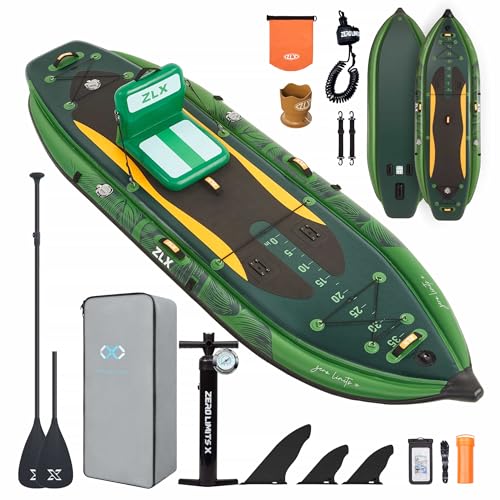
- Chambersdual reinforced side rails at 4 to 6 PSI plus a central chamber at 12 to 15 PSI
- Size11 ft 6 x 42 in
- Capacity400 lb
- Nosehard-shell nose guard
- Materialmilitary-grade PVC drop-stitch
- Warranty3 years
Best for: Rocky launches and shorelines that destroy normal inflatables
The ZLX is the one board here that uses its chambers for toughness rather than for capacity. The two side rails run at 4 to 6 PSI and the central chamber at 12 to 15 PSI, so the soft rails absorb impacts while the deck stays rigid underfoot.
Add the hard-shell nose guard and it is clearly built for launches over rock rather than off a sandy beach. The 42 in deck with a non-slip EVA pad gives kayak-like stability, and ZLX markets the hull as quiet enough not to spook fish. The fishing setup covers a rod mount, deck measurement markings, adjustable bungees and a detachable inflatable seat. Capacity is the weak point at 400 lb.
Pros
- Side rails and the deck run at different pressures, which is a real multi-chamber design
- A hard-shell nose guard protects the part that hits rocks first
- 42 in of width with a non-slip pad is stable enough to fish standing all day
- A three-year warranty backs the durability claim
Cons
- 400 lb is the lowest capacity of the multi-chamber boards here
- 42 in of beam makes it slow and hard to turn
- Three separate pressures to manage at every setup

- Chamberssingle chamber
- Length12 ft
- Finstwin fin setup
- RailsFRS with carbon rail rods
- SurfaceEXO Surface Laminate Technology
- Cargodeck space with secure bungee storage
Best for: Paddlers who want the rigidity a second chamber promises, achieved another way
The Cruise Carbon is here for the paddler who wants stiffness and assumed a second chamber was the way to get it. Bluefin solves the same problem with carbon rail rods running the length of the board inside an EXO Surface Laminate skin, which resists the bend that makes a soft inflatable feel slow.
At 12 ft with twin fins it is a touring board rather than a fishing platform, so it goes in a straight line and covers ground instead of standing still. Deck space and bungee storage are generous. If your reason for wanting two chambers is redundancy on open water, this is not the board. If it was rigidity, this is the more direct answer.
Pros
- Carbon rail rods stiffen the board along its length, which is what most people actually want
- 12 ft with twin fins tracks and glides better than any wide multi-chamber board here
- EXO Surface Laminate is a tougher skin than standard PVC
- A proper touring shape rather than a fishing platform
Cons
- It has one air chamber, so there is no redundancy if it punctures
- Bluefin does not publish a capacity figure for this build
- Sold on Bluefin rather than Amazon, so returns work differently

- Chamberssingle chamber
- Constructionmilitary-grade PVC with carbon fiber
- Railsreinforced
- Decknon-slip pad
- Buoyancyhigh, for balanced control
- Cargodeck space with bungee cord storage
Best for: Flat-water paddlers who care about speed more than platform size
The Sprint is the fastest board on this page and the least like the rest of it. Military-grade PVC with carbon fiber and reinforced rails is built for a paddler who wants the hull to stop absorbing energy from the stroke.
It belongs in this comparison as a counterpoint. Every multi-chamber board above is wide, slow and built around stability or redundancy. The Sprint gives up both to go in a straight line. If you came to this page because a friend said dual chamber boards are stiffer, this is the board that gets you the stiffness directly, with the clear caveat that a single chamber means a single point of failure.
Pros
- A carbon fiber build is the stiffest construction Bluefin offers
- Reinforced rails resist the flex that slows a long board down
- High buoyancy with a non-slip deck keeps control predictable at speed
- A touring shape, so it holds a line without constant correction
Cons
- Single chamber, so it offers none of the redundancy this page is about
- Bluefin publishes no dimensions or capacity for this listing
- The narrow, fast shape is less forgiving than anything else here
Checklist: What makes a good two-chamber paddle board
- Stability Characteristics: Look for attributes like length, width, and dual-fin designs that contribute to superior stability, ensuring a balanced and secure paddleboarding experience on the water.
- Durability Features: Seek boards with reinforced construction using materials like carbon fiber, military-grade PVC, and UV-resistant coatings to withstand extended use and environmental factors.
- Volume and Capacity: Consider the deck space and weight support, ensuring ample room for paddlers and essential gear, which is crucial for longer or more gear-intensive excursions.
- Safety Provisions: Evaluate the board's safety features such as double chamber construction that improves buoyancy and offers an extra layer of security, vital for all skill levels.
- Portability and Storage: Check for paddleboards that are compact when deflated, come with a carrying backpack, and include features like integrated handles for easy transport and storage.
- Versatility and Extras: Assess the board for multi-functional capabilities like kayak conversion, accessories mounts, and additional features like a self-regulating air valve for overinflation prevention and integrated cameras mounts for recording adventures.

FAQ
What makes two-chamber paddle boards a safer option on the water?
Two-chamber paddle boards offer increased buoyancy and an added layer of security, enhancing safety for paddlers of all skill levels.
Can two-chamber paddle boards match the performance of hard boards?
Yes, some two-chamber paddle boards rival hard boards in rigidity and glide due to advanced construction techniques, like carbon rail rods.
Are there multi-functional two-chamber paddle boards available?
Yes, certain two-chamber paddle boards are versatile, with features for kayak conversions and suitability for activities like water yoga.