


Questioning your golf shot accuracy because of slopes and undulations?
You’re not alone.
Many golfers struggle with inclines, unaware that slope measurement rangefinders can be their game-changer.
Time to elevate your game.
Learn about the elite golf rangefinders with slopes in our comprehensive guide!

Table of Contents
- #1 REVASRI Rangefinder NK1000
- #2 IEHOME X1 Golf Rangefinder
- #3 Hawkray Golf Laser Rangefinder V1
- #4 DEASON Precision Pro Slope
- #5 VQTIL CS1 Golf Rangefinder with Slope
- #6 REDTIGER Golf Rangefinder
- #7 Gogogo Sport Vpro GS24 MTL
- #8 Flysocks PF260 Golf Rangefinder
- #9 Callaway 300 Pro Laser Rangefinder
- #10 Bushnell Golf Tour V6 Shift Patriot Rangefinder
- Checklist: What Makes a Great Golf Rangefinder with Slope
- FAQ
#1 REVASRI Rangefinder NK1000
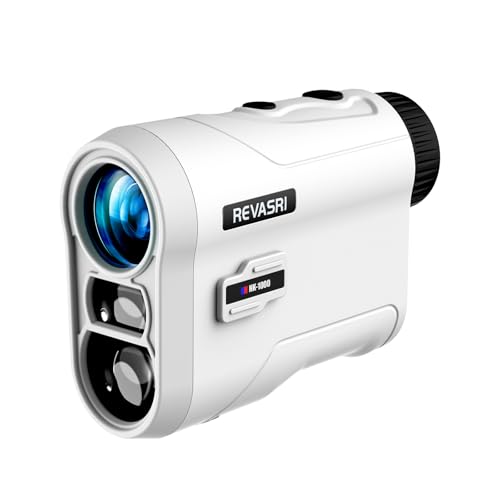
| Accuracy | ±1 Yard |
| Slope Measurement | Equipped with slope compensation and an external slope switch |
| Range | Up to 1000 yards, with a flag lock up to 250 yards |
The REVASRI Rangefinder NK1000 distinguishes itself as a top performer in the world of golf rangefinders with slope. Precision is paramount in golf, and with an accuracy of ±1 yard in measurement capability up to 1000 yards, this rangefinder stands out for its meticulous distance tracking.
Its slope measurement feature, combined with pin lock vibration, offers golfers the much-needed edge in planning the perfect shot, taking elevation changes into account. This truly elevates its status as the best golf rangefinder with slope.
Compact at merely 3.8*2.6*1.3 inches and weighing only 4.3 ounces, the NK1000 is a golfer’s ideal companion on the course, ensuring convenience without sacrificing functionality.
The built-in rechargeable lithium battery is not only eco-friendly but also user-friendly, thanks to its low battery indicator and automatic shutdown function.
With its clear 6.5x magnification and robust waterproof design, the NK1000 combines durability, efficiency, and ease of use, making it an excellent choice for golfers seeking to improve their game with reliable technology.
#2 IEHOME X1 Golf Rangefinder

| Accuracy | ±1-yard precision |
| Slope Measurement | Offers slope-adjusted distances for various shot angles |
| Range | Up to 1100 yards |
The IEHOME X1 Golf Rangefinder stands out as an exceptional tool for golfers looking to improve their game accuracy and club selection. The rangefinder’s high-precision measurement, accurate within ±1-yard and with a swift speed of less than 0.5 seconds, ensures golfers can rely on the device for exact yardages every time.
With a robust range of up to 1100 yards, you’ll easily reach the furthest of targets. The inclusion of slope measurement capabilities is particularly beneficial, providing compensated distances that consider the terrain’s incline or decline. This feature is vital for golfers playing on courses with varied elevations.
The X1’s convenience is enhanced by its rechargeable battery and Type-C connectivity, delivering an impressive 20,000 measurements per charge. In addition, the IP54 water-resistant rating promises durability through changing weather conditions.
Its 6x magnification lens, coupled with a bright LCD and multi-layer coated optics, delivers crystal-clear visuals for spotting flags, hazards, or lay-up points. Overall, the IEHOME X1 Golf Rangefinder is a reliable and feature-rich companion for any golfer aiming to make accurate, informed shots on the course.
#3 Hawkray Golf Laser Rangefinder V1
No products found.
| Accuracy | +/- 1 Yard |
| Slope Measurement | Yes, with the option to disable |
| Range | 700 Yards with 6x Magnification |
The Hawkray Golf Laser Rangefinder V1 is poised as an excellent golfing companion, touting an impressive 700-yard range bolstered by a 6x magnification capability. Its precise measurements, with an accuracy of +/- 1 yard, make it a reliable tool for golfers looking to improve their game.
Equipped with slope measurement technology, the rangefinder computes adjusted distances to account for the incline or decline of the terrain. This invaluable feature is complemented by the flexibility to deactivate slope mode during tournament play, aligning with golf regulations.
A standout feature is the unit’s robust magnetic case, coupled with IPX4 water resistance, ensuring the rangefinder remains attached to the golf cart and is operable under light rain conditions. The ergonomic design and anti-slip materials promise a comfortable, one-handed operation throughout your golf rounds.
Furthermore, the effectiveness of the Hawkray rangefinder is amplified by its flag-lock and vibration capabilities, instantly notifying golfers once the flag distance is secured. Alongside this, the USB-rechargeable 750mAh Li-ion battery, supporting up to 20,000 measurements, is both economical and environmentally friendly.
Compact, lightweight, and sporting a clear HD LCD, the Hawkray Golf Laser Rangefinder V1 is a top-tier option for golfers who value precision, portability, and the integration of modern technology onto the green. This device exemplifies a solid choice within the golf rangefinders with slope niche.
No products found.
#4 DEASON Precision Pro Slope

| Accuracy | Exceptionally precise with +/- 1-yard accuracy |
| Slope Measurement | Advanced Slope Mode compensates for inclines |
| Range | Wide range capability up to 1,300 yards |
The DEASON Precision Pro Slope rangefinder is an essential companion for any golfer looking to refine their game with accurate measurements and slope compensations. Its 7x magnification through the HD LCD optics lens means players can survey the course with crystal clear precision, seeing targets up to 1,300 yards away almost as if they’re within arm’s reach.
With a robust feature set, including Slope Mode for calculating angle-adjusted distances, and Tournament Mode in compliance with official event standards, the DEASON Precision Pro Slope adapts seamlessly to both casual and competitive play. Furthermore, the built-in magnet adds a layer of convenience, allowing golfers to attach the rangefinder securely to carts and clubs.
Energy efficiency is at the heart of its design, boasting a powerful 750mAh battery capable of up to 30,000 actuators per charge, complemented by an auto-power-saving mode. This resonates well with players who enjoy long hours on the course, ensuring that the device is ready whenever it’s needed.
Durability is not taken lightly either; with a water-resistant build and an IP54 rating, the DEASON Precision Pro Slope is more than capable of withstanding the unpredictable elements on the green. Its sturdy construction does not compromise on portability, with a sleek design that fits comfortably in the hand or in the accompanying carrying case.
Having a tool as dependable as the DEASON Precision Pro Slope certainly elevates a golfer’s ability to make informed decisions, which is key to mastering the sport. This rangefinder stands out as a remarkable option amidst its contenders, offering reliability and a wealth of features that cater to dedicated golfers aiming to perfect their shots under various conditions.
#5 VQTIL CS1 Golf Rangefinder with Slope

| Accuracy | ±0.5 yards |
| Slope Measurement | Yes, with slope correction function |
| Range | Up to 700 yards |
The VQTIL CS1 presents itself as a valuable asset for any golfer looking to enhance their game with accurate distance measurements. With its precision laser technology delivering accuracy within ±0.5 yards, golfers can trust their shots and club selection based on reliable data. It’s especially beneficial for assessing inclines and declines on the course, thanks to the slope correction feature that takes the guessing out of uphill and downhill shots.
Designed with an ergonomic body and a clear, intuitive LCD, users can enjoy straightforward operation even under the pressure of a match. Switching between yards and meters is a breeze, catering to players’ preferences in various locations. Despite its compact size of just 5 x 2 x 3 inches, the golfer-friendly VQTIL CS1 doesn’t skimp on capability, offering continuous measurement, height, and angle data.
The rangefinder’s robust build and sleek black-and-white aesthetics make it an attractive choice for golfers of all skill levels. What might go unnoticed but is incredibly useful in the field is the 6x magnification, simplifying the task of locking onto targets for a precise readout. Although batteries are not included, the USB rechargeability ensures that maintaining power for the device is convenient and eco-friendly.
Its external slope switch is a standout feature for competitive players who require a quick transformation to a tournament-legal device. While VQTIL CS1 may be our fifth selection, it represents a great combination of high performance, user-friendly design, and versatile functionality. This rangefinder is a solid recommendation for those seeking technological support without breaking the bank.
#6 REDTIGER Golf Rangefinder

| Accuracy | ±0.5 yards |
| Slope Measurement | Slope function with on/off capability for legal play |
| Range | 5 to 1200 yards |
Catering to golfers who need precise yardage on the green, the REDTIGER Golf Rangefinder is an asset that promises accuracy within 0.5 yards at a substantial range of 5 to 1200 yards. It offers a comprehensive slope compensation mode, which can be easily disabled for tournament play, providing versatility to both casual and competitive golfers.
The crystal-clear, 7x magnification equips users with remarkably crisp visuals, complemented by a user-friendly transflective LCD that ensures ease of reading measurements even in less-than-perfect lighting conditions. The convenience of its range and clarity can’t be overstated, making the REDTIGER a solid contender in its category.
With the added convenience of a magnetic mount, golfers will find it incredibly easy to attach and remove the device from golf carts or clubs. This practical feature makes it less likely to be misplaced and more accessible during play.
Furthermore, IP54 water resistance, a 30,000-measurement battery life via USB-C charging, and sturdy design all contribute to the durability and reliability expected of a high-quality golfing tool. Longevity is further ensured through a 2-year unconditional warranty and lifetime technical support, which signifies the manufacturer’s confidence in the product.
Although our sixth choice, the REDTIGER Golf Rangefinder doesn’t fall short on features or performance. It stands as a worthy investment for any golfer looking to improve their game with precise slope measurements and convenient functionality. Its impressive list of features and accessories makes it a product that merits golfers’ attention for their range-finding needs.
#7 Gogogo Sport Vpro GS24 MTL
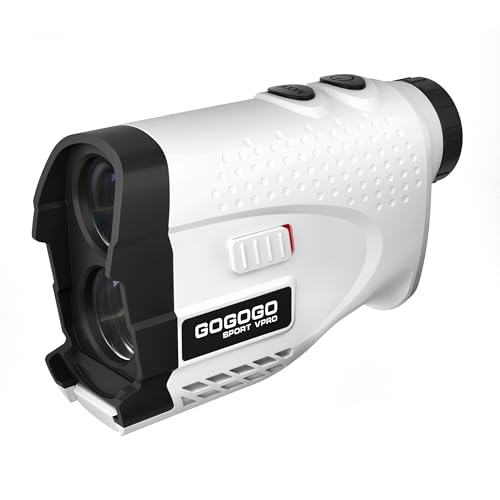
| Accuracy | +/- 1 Yard |
| Slope Measurement | Incorporates ARC for elevation-adjusted distance |
| Range | 5 to 650 Yards with 6x Magnification |
For avid golfers in search of a high-precision instrument to enhance their game, the Gogogo Sport Vpro GS24 MTL emerges as a notable contender. While it may be our Number 7 choice, it stands out for its blend of functionality and affordability. The device promises outstanding accuracy with a margin of +/- 1 yard, delivering confidence with each measurement.
The addition of slope measurement is particularly beneficial; the Gogogo Vpro GS24 MTL features Angle Range Compensation (ARC), providing golfers with true distance based on elevation changes. This is instrumental, whether you’re practicing or engaged in serious competition, and can be legally employed in tournaments thanks to the on/off slope function.
Catering to a broad range of distances, this rangefinder excels with a reach of 5 to 650 yards, enhanced by 6x magnification. Such capabilities ensure that both near and far targets are accessible, which is invaluable on courses with diverse layouts.
Optics quality cannot be overlooked, and this model doesn’t disappoint. Its fully multi-coated lenses afford a bright, clear image, further facilitated by an adjustable diopter for a sharp focus tailored to the user’s eye. Golfers can find additional reassurance in the flagpole-locking feature, which vibrates upon successful targeting—essential for confirming you’re measuring the pin, not background hazards.
Lightweight and compact, the Gogogo Sport Vpro GS24 MTL is effortless to carry along every fairway. With its competitive pricing, high-precision features, and user-friendly design, this rangefinder embodies a solid choice for golfers aiming to gain a precise edge without overspending.
#8 Flysocks PF260 Golf Rangefinder

| Accuracy | ±0.3 yards up to 300 yards, ±0.5 yards beyond |
| Slope Measurement | Slope switch technology for angle-compensated distances |
| Range | Up to 1200 yards with 7X magnification |
The Flysocks PF260 Golf Rangefinder presents a harmonious balance of performance and convenience for the discerning golfer. With its 1200-yard extensive reach, complemented by 7X magnification, distance assessment becomes a breeze, crucial for selecting the ideal club for your shot. Its precision is striking, boasting an impressive accuracy of within a third of a yard up to the first 300 yards.
Slope technology is where the PF260 shines, offering slope-adjusted distances to accommodate the contours of any course. This feature, coupled with the flagpole lock vibration, ensures your target acquisition is as pinpoint as your aim; a boon for conquering those challenging inclined shots.
Durability is a key factor in any golf accessory, and the PF260 does not disappoint. Its sturdy construction includes a waterproof and dust-resistant protection rating of IP54, ready to face the elements alongside you. The convenience of a rechargeable battery is notable, providing exceptional longevity with up to 40,000 uses on a single charge, thereby minimizing any mid-game interruptions.
Despite its solid features, the rangefinder remains impressively lightweight and portable at just 7.7 ounces, which is a welcome feature for golfers who prefer to walk the course. With this rangefinder, Flysocks provides a robust companion to help you achieve your best performance on the fairways, making it a commendable choice for golfers who value precision and reliability.
#9 Callaway 300 Pro Laser Rangefinder
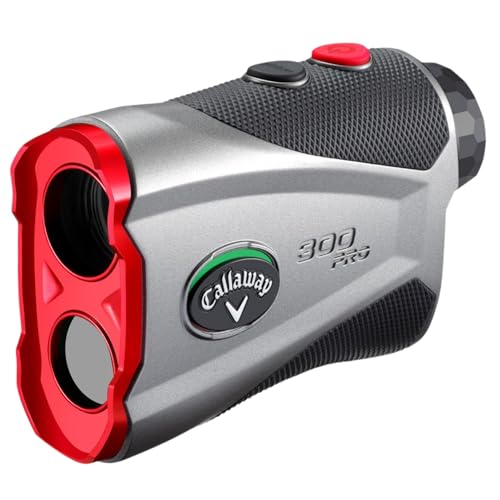
| Accuracy | +/- 1 yard |
| Slope Measurement | Yes, with external Slope On/Off switch |
| Range | 5-1000 yards |
The Callaway 300 Pro Laser Rangefinder is a noteworthy gadget crafted to enhance the golfing experience with its precision technology. Its ability to measure a range of 5-1000 yards with a remarkable accuracy of +/- 1 yard stands out for those requiring reliable distance measurements.
Golfers seeking an edge will appreciate the inclusion of Slope Measurement, which calculates elevation changes and precisely aids in club selection. The device’s seamless integration of Pin Acquisition Technology provides assurance of locking onto the pin up to 300 yards away, even amidst obstructions.
With its simple-to-use Slope On/Off switch, the 300 Pro makes transitioning from practice rounds to tournament play effortless, ensuring compliance with golf regulations. Its ergonomic design and durable construction guarantee comfortable handling throughout your round.
Furthermore, the rangefinder’s ability to withstand water and fog enhances its utility across various weather conditions, offering consistent performance when it matters most. The Callaway 300 Pro Laser Rangefinder is a competent companion on the course, providing essential data to inform your strategic play.
#10 Bushnell Golf Tour V6 Shift Patriot Rangefinder

| Accuracy | Plus or minus 1 yard |
| Slope Measurement | Enhanced slope technology with slope switch feature |
| Range | 5 to 1,300 yards, 6x magnification |
The Bushnell Golf Tour V6 Shift Patriot is an exemplary piece of technology for golf enthusiasts seeking precision on the course. With a sophisticated design and slope-switch technology, this rangefinder caters to both practice and tournament play, adapting effortlessly to the needs of the game. The robust IPX6 weather-resistant construction ensures durability and reliability in diverse playing conditions.
Not only does it excel in structural integrity, but this device also captivates with its clear LCD, fostering confidence through visual JOLT technology that indicates when the laser has pinpointed its target. It’s this marriage of tactile and visual feedback that establishes the Tour V6 as a trusty companion during a round of golf.
Despite being a highly sophisticated tool, the rangefinder remains accessible thanks to its BITE magnetic mount—practical for quick attachment to a golf cart. The utility of the Tour V6 Shift Patriot becomes apparent when the accurate readings, spanning an impressive range of 5 to 1,300 yards, come into play, enhancing strategic decision-making on the course.
With its practical dimensions and manageable weight, the Tour V6 Shift Patriot doesn’t compromise on performance or portability. Furthermore, extra-long eye relief and fully multi-coated optics assure a comfortable viewing experience, regardless of the user’s eyewear.
Finally, the Bushnell Golf Tour V6 Shift Patriot comes with the assurance of a 2-year manufacturer warranty and is packaged with all necessary accessories, adding value to this worthwhile investment for any golfer looking to refine their measurement strategy with one of the most reliable golf rangefinders with slope on the market.
Checklist: What Makes a Great Golf Rangefinder with Slope
- Accuracy: Key to improving your game, a great rangefinder should offer precise measurements within ±1 yard to ensure reliable distance calculation for every shot.
- Slope Measurement: The ability to calculate and adjust for elevation changes is crucial. Look for devices with a slope function that can be turned on or off for legal play in tournaments.
- Range Capability: A rangefinder’s utility is largely dependent on its range. A superior model should have at least a 600-yard range for golfers to accurately target distant flags and hazards.
- Magnification: Clear and detailed visuals can make a difference. Select a rangefinder with high magnification, ideally 6x or more, for easy target identification and a closer view.
- Battery Life: For uninterrupted play, consider a rangefinder with a long-lasting, rechargeable battery. Models that offer thousands of measurements per charge add convenience and value.
- Durability and Design: A waterproof and robust design ensures longevity in various weather conditions, while a compact and ergonomic build provides comfort throughout the round.

FAQ
Can a golf rangefinder with slope improve my game?
Yes, a rangefinder with slope measures elevation changes for more accurate shots, enhancing your golf game strategy.
Is it legal to use a slope-function rangefinder in golf tournaments?
Golf rangefinders with a slope function are allowed if the slope feature can be turned off during play, complying with tournament rules.
What features should I look for in a golf rangefinder with slope?
A great rangefinder should offer slope adjustment, accuracy within ±1 yard, long-range capability, high magnification, and a durable, user-friendly design.


