Ten practice golf balls compared on flight, feedback and how well each one holds up to repeated hits.
Every ball in this list is in stock on Amazon right now, and every figure below comes from the manufacturer. The field runs from a 12 pack of hollow plastic balls under six dollars to a polymer ball that spins like the real thing, so the first question is not which ball is best but how much room you have and whether you need honest ball flight or just a safe object to swing at.
Practice golf balls: the ten picks at a glance
Practice golf balls split into three types. Foam balls are the softest and the safest indoors. Hollow plastic balls with airflow holes are the cheapest and fly the shortest. Limited flight balls made of polymer or molded impact material sit above both, cost more per ball and are the only ones that give you a usable curve on a mishit.
Below you get the short version first: three picks for the most common cases, then the full table with all ten, then every ball in detail with specs, strengths and weaknesses.
- The closest thing to real ball flight in a backyardBirdieBall 12 Pack
- The foam ball most people should buyCallaway HX Soft Flight
- A third of full distance with honest spinALMOSTGOLF Point3
- Most balls for the moneyFaswin 100 Pack


| Practice ball | Type | Pack size | Size and weight | Best for |
|---|---|---|---|---|
| BirdieBall 12 Packbest overall | Polymer, limited flight | 12 | not published | Full swings with real shot shape |
| Callaway HX Soft Flightbest foam ball | Foam, HEX dimples | 9 | not published | Indoor swings and small yards |
| ALMOSTGOLF Point3most realistic distance | Cross-linked foam, .32 COR | 10 | not published | Judging strike quality by carry |
| SKLZ Limited-Flight Impacttoughest | Molded impact ball | 12 | regulation size | Hard hitters and net work |
| GoSports Foam Practice Ballsindoor pick | Foam, dimpled | 16 | not published | Garages and home simulators |
| Guirnd 20 Pack Foamcheapest foam | Soft PU foam | 20 | 41 mm, 7.8 g | Backyard reps in five colors |
| Bac-kitchen 40 Pack Foamfamily pack | Resin PU rubber foam | 40 | about 1.68 in | Shared practice with kids |
| Junkin 80 Pcs Foambulk foam | PU foam | 80 | about 1.65 in | Hitting long sets without picking up |
| Faswin 100 Packbest value | Hollow polyurethane, 26 holes | 100 | 41 mm, about 4 g | Range style volume at home |
| THIODOON Airflow Ballscheapest | Hollow polyurethane, 26 holes | 12 | 40 mm | A first pack to try the idea |
The ten practice golf balls in detail
- Typelimited flight practice ball
- Materialpolymer
- Flightpatented reverse spin technology
- Pack12 balls
- Usefull swing practice at home or in a yard
- Backgroundused at golf schools and by instructors
Best for: Golfers who want a mishit to look like a mishit instead of just going a short way
The BirdieBall is the only ball in this list built around shot shape rather than safety. Its patented reverse spin design is what lets a drawn or faded swing produce a curved flight in a space where a real ball would be dangerous, and that is the whole reason to pay three times what a foam pack costs.
The material is polymer rather than foam, which is why the maker positions it for full swings and not just short game work. What you do not get is numbers: there is no published diameter, weight or carry figure, so you have to test it in your own yard and see where it lands.
Pros
- The reverse spin design lets draws and fades show up, which no foam ball in this list claims
- Polymer construction is built for repeated full swing impact rather than chip and putt work
- The manufacturer states it spins, sounds and reacts like a real ball, so feedback is not only visual
- Twelve balls is enough for a session without a shag bag
Cons
- At around 33 dollars it is the most expensive pack here and the dearest per ball
- No published diameter, weight or carry distance, so you cannot plan a yard around a number
- Twelve balls means you pick up often compared with the bulk packs
- Typefoam practice ball
- Dimplespatented HEX pattern
- Pack9 balls
- Colorslime, orange, pink and multicolor options
- Includedmesh carry bag
- Useindoor and outdoor, safe for home use
Best for: Anyone who wants one foam pack from a name brand and does not want to think about it further
This is the foam ball to buy if you do not want to compare foam balls. Callaway put its HEX dimple pattern on it, the construction is soft enough to be sold as an indoor ball, and the mesh bag means the set stays together instead of disappearing under furniture.
The trade is quantity. Nine balls is a short set: fine for swing checks in a net or a few chips across a room, tedious if you want to hit fifty in a row. If your practice is volume rather than feel, one of the bulk foam packs further down does the same job for less per ball.
Pros
- The HEX dimple pattern is the same design language Callaway uses on its regular balls
- Soft enough that Callaway markets it as an indoor ball, so a garage or a basement works
- High visibility colors mean you find them in grass instead of hunting
- A mesh carry bag is in the box, which the cheaper foam packs mostly skip
Cons
- Nine balls is the smallest pack in this list, so you pick up constantly
- Costs more per ball than the 20, 40 and 80 packs of plain foam
- No published weight or diameter, so you cannot compare it on paper with the 41 mm packs

- Typecross-linked foam with internal pressure
- Carryabout one third of a normal golf ball
- COR rating.32, roughly one third of a regulation ball
- Pack10 balls
- Colorwhite
- Purposetrue spin, trajectory and accuracy training
Best for: Golfers who want to read strike quality from how far the ball goes, not just whether it flew straight
The Point3 is the ball for anyone who wants practice to be measurable. The manufacturer publishes both the distance ratio, roughly one third of a normal ball, and a .32 COR rating, and those two numbers are what let you turn a short yard into a usable range: a shot that carries 30 yards here corresponds to about 90 with a regular ball.
Construction is cross-linked foam with internal pressure rather than the plain molded foam in the cheap packs, which is where the price goes. The set of ten is small and white, so a bright foam pack is still the better choice for a lawn with long grass or for handing to kids.
Pros
- The one third distance figure is published, so a 90 yard yard shot becomes a 30 yard read
- A .32 COR rating is a real number you can compare, which almost nothing else in this category publishes
- Cross-linked foam with internal pressure is a construction step above plain molded foam
- White balls read against grass the way a real ball does, which keeps the practice honest
Cons
- Around 25 dollars for ten balls puts it near the top of the price range
- White is harder to find in long grass than the bright foam packs
- Ten balls is a small set for full swing sessions

- Typelimited flight impact ball
- Sizeregulation size
- Carryapproximately 45 yards
- Durabilityresistant to dents
- Pack12 balls
- Coloryellow
Best for: Hard hitters, net practice and anyone who has cracked plastic practice balls before
The SKLZ ball is the durable option. It is a molded impact ball rather than hollow plastic, sold specifically as a stronger alternative to plastic training balls, and it is rated as resistant to dents, which is the failure mode that ends most cheap practice packs.
The number that matters is the carry: approximately 45 yards. That is the longest published distance in this list and it changes what you can do with it. In a net or a big field it is the most realistic full swing ball here after the BirdieBall. In a small backyard it will clear the fence.
Pros
- A published carry of about 45 yards is the clearest distance figure in this list
- Regulation size means your eye sees the same ball it sees on the course
- SKLZ positions it as a stronger alternative to plastic training balls, so dents are less likely
- Yellow is easy to track against grass and against a net
Cons
- Around 17 dollars for twelve is mid to high per ball
- 45 yards is too much for a small yard, this one wants space or a net
- A denser ball than foam, so it is not the one to swing at indoors near windows

- Typefoam practice ball
- Pack16 balls
- Dimplestrue to life dimple texture
- Includedstorage tote
- Useindoor practice, garages and home simulators
- Flightlimited flight design for small spaces
Best for: Anyone practicing in a garage or in front of a home simulator screen
GoSports built this pack around indoor use, and that is where it makes sense. Sixteen dimpled foam balls and a storage tote cover a garage session or a simulator bay, and the limited flight design means a full swing does not put anything at risk.
It sits between the Callaway pack and the bulk foam packs in both count and price. Pick it if you want a tidy set with a tote and do not need forty balls on the floor; pick the Bac-kitchen or Junkin pack below if the point is volume.
Pros
- Sixteen balls is the sweet spot between the 9 pack and the bulk packs
- Soft foam construction is what makes it usable indoors without covering everything first
- The dimple texture is meant to mimic real ball aerodynamics, so trajectory is readable
- A storage tote is included rather than sold separately
Cons
- No published diameter or weight, so it cannot be compared on paper with the 41 mm packs
- Foam this soft gives less feedback on a thin strike than the polymer balls above
- More expensive per ball than the 40 and 80 piece foam packs

- Typesoft PU foam
- Diameter41 mm
- Weight7.8 g per ball
- Pack20 balls, 4 each in 5 colors
- Colorsyellow, white, orange, blue and red
- Surfacedimpled texture for steady spin
Best for: A backyard set where you want colors, low cost and published dimensions
Guirnd publishes what most foam packs hide: 41 mm across, 7.8 g each, twenty balls in five colors. That makes it the easiest foam pack in this list to plan around, and at under ten dollars it is also the cheapest per ball of the soft foam options.
The colors are more useful than they look. Four balls in each of five colors is exactly the setup for target drills, where each color goes to a different mark. The weight is the limitation: at 7.8 g a breeze is a real factor outdoors, so this is a calm day and small yard ball.
Pros
- 41 mm and 7.8 g are printed figures, so you know what you are hitting
- Twenty balls for under ten dollars is the best count to price ratio among the foam packs
- Five colors makes it easy to work a drill where each color is a target
- The foam compresses on impact rather than skidding, so a strike still feels like a strike
Cons
- At 7.8 g these are far lighter than a regulation ball, so wind moves them
- No carry distance is published, you find the range by hitting them
- Soft foam wears at the dimples over a season of hard swings
- Typeresin PU rubber foam
- Diameterabout 1.68 in
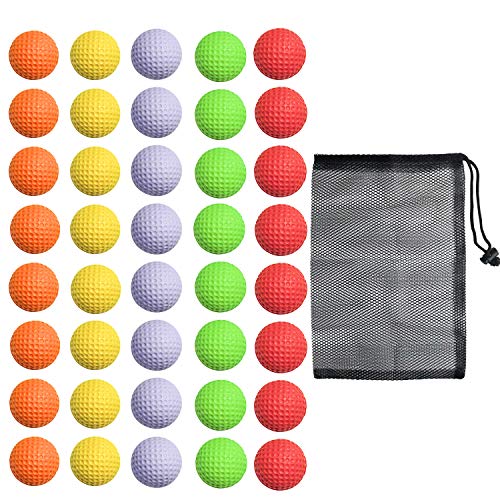
- Pack40 balls in 5 colors
- Includedmesh drawstring storage bag
- Safetywill not damage furniture or windows
- Useindoor and outdoor, approach and full shots
Best for: Households where more than one person practices, and anywhere kids are swinging too
This is the volume foam pack. Forty balls at regulation diameter, five colors, a drawstring bag to hold them, and the maker states plainly that they will not hurt furniture, windows or pets, which is the whole point of foam.
The size is what separates it from the cheaper foam sets. At about 1.68 in it matches the diameter of a real golf ball, so your eye sees the correct object at address even if the weight does not match. For a household where an adult and a child practice in the same yard, this is the most sensible pack here.
Pros
- 1.68 in is regulation ball diameter, so the ball looks right at address
- Forty balls means a long session without stopping to collect
- Soft resin PU rubber is stated as safe around furniture, glass and animals
- A mesh drawstring bag keeps forty balls from spreading through the house
Cons
- No published weight, so you cannot judge how much wind will move it
- Five colors are fun but harder to keep track of than a single color set
- The foam is soft enough that hard hitters will deform balls over time

- TypePU and foam
- Diameterabout 1.65 in (4.2 cm)
- Pack80 balls
- Coloryellow
- Propertiesdent resistant and flexible
- Useindoor and outdoor training, junior practice
Best for: Long sessions where stopping to pick up balls is the thing you want to avoid
Junkin sells this pack on count. Eighty foam balls at about 1.65 in across is enough to hit until you are tired and pick up once, which is the practical difference between backyard practice and a session that feels like a range bucket.
The material is the usual PU foam, described as soft, elastic and dent resistant, so squashed balls recover. Single color is a deliberate trade: worse for drills, better for collection, since eighty yellow balls in grass are easier to sweep up than eighty in five shades.
Pros
- Eighty balls is the second largest count here and enough for a real range style session
- A single bright yellow makes collection easier than sorting five colors
- Stated as dent resistant, so compressed balls spring back instead of staying flat
- 1.65 in is close to regulation diameter, so it still looks right on the tee
Cons
- Around 25 dollars, so it is not the cheapest per ball despite the count
- Yellow only, which rules out color coded target drills
- No published weight, and foam this size is light enough for wind to matter
- Typehollow airflow plastic
- Materialpolyurethane
- Diameter41 mm
- Weightabout 4 g per ball
- Holes26 per ball
- Pack100 balls plus a mesh drawstring bag
Best for: Anyone who wants a bucket of balls at home and does not care about feel
The Faswin pack is the cheapest way to have a bucket of practice balls at home. One hundred hollow polyurethane balls, 41 mm across, 26 holes each, plus a mesh bag, for less than twenty dollars.
What you give up is feel. A 4 g hollow shell does not compress against the clubface, so a thin strike and a good one feel closer together than they should, and any wind takes the ball. As a set to warm up with, work on tempo or fill a net, that hardly matters.
Pros
- One hundred balls for under 20 dollars is by far the lowest price per ball in this list
- The 26 hole airflow pattern keeps the ball from running out of the yard
- Polyurethane is stated not to split, crack or dent easily, which is the usual failure of hollow balls
- Comes with a mesh bag, so the hundred balls have somewhere to live
Cons
- At about 4 g these are the lightest balls here and the most affected by wind
- White only, which is the hardest color to find in long grass
- Hollow balls give the least honest feel of the three types in this list

- Typehollow airflow plastic
- Materialnon-toxic polyurethane
- Diameter40 mm
- Holes26 per ball
- Pack12 balls
- Colorspink, red, yellow, blue, green and white
Best for: A first pack to find out whether backyard practice works for you before spending more
This is the entry ticket. Twelve 40 mm hollow balls with 26 holes each, in six colors, for the price of a sandwich. If you are not sure whether hitting balls in the yard is something you will keep doing, start here rather than with a hundred pack.
The limits are the same as any hollow ball, only with a smaller set: light, no compression against the face, and a dozen balls means you stop and collect every few swings. The six colors do make it the best of the cheap packs for target drills where each color has its own mark.
Pros
- The lowest price in this list, so trying the idea costs almost nothing
- Six colors in twelve balls is the widest color spread here
- The 26 hole pattern limits distance, which is what makes a small yard workable
- Stated as crack and dent resistant polyurethane rather than brittle plastic
Cons
- Twelve hollow balls is a very short set, you will be collecting constantly
- No published weight, though hollow balls of this size are light enough to blow around
- The least realistic feel of anything in this list, this is a swing object rather than a ball
Checklist: What Makes Great Practice Golf Balls
- Durability: Opt for balls constructed from materials like resin PU rubber, soft PU, or high-strength plastic that withstand repeated use and resist dents and cracks, ensuring they last through extensive practice sessions.
- Flight Consistency: Seek balls with realistic dimple textures or hex patterns that simulate the true flight and trajectory of regulation golf balls, enhancing the effectiveness of your practice.
- Flight Limitation: Consider balls designed with limited flight for safe indoor use or confined outdoor spaces, allowing for a full swing without the risk of property damage.
- Visibility: Choose balls in bright or multiple colors that are easy to locate during practice, saving time and enabling more efficient training sessions.
- Size and Weight: Ensure the balls are similar in size and weight to standard golf balls to maintain an authentic feel and feedback during practice.
- Package Value: Assess the quantity provided in a pack, considering the balance between the number of balls and the price, to ensure you are getting good value for your investment.

FAQ
What should I look for in practice golf balls?
Choose durable materials, realistic flight patterns, limited flight for safety, bright colors for visibility, and appropriate size and weight for realistic feedback.
Are there specific practice golf balls for indoor use?
Yes, practice golf balls with limited flight are designed for safe indoor use and confined outdoor spaces, preventing property damage while allowing full swings.
How does the weight and size of practice golf balls impact training?
Using practice golf balls similar in weight and size to standard balls ensures authentic feel and feedback, crucial for effective practice and skill development.