Seven distance golf balls compared on carry, durability and the swing speeds they suit, each with a spec table and a checklist.
Every ball in this list is in stock on Amazon right now, and every spec below comes from the manufacturer. The field runs from a 36 ball Wilson box to a Titleist Velocity dozen, and the split that decides your purchase is swing speed: three of these are low compression balls for slower swings and the rest reward a fast one.
The best distance golf balls, and what actually makes them long
A distance ball is a two-piece ball with a large, fast core and a hard ionomer or Surlyn cover. The core provides the energy transfer, the cover keeps spin low so drives do not climb and curve, and the dimple pattern decides how the ball behaves in wind. That combination costs you greenside spin, which is why nobody plays these on tour and why they are the right ball for most amateurs.
Below you get the short version first: three picks for the most common cases, then the full table with all seven, then every ball in detail with specs, strengths and weaknesses.
- The distance ball most golfers should buyTitleist Velocity
- Longest for the moneyTaylorMade Distance+
- Straight distance rather than raw distanceBridgestone e12 Contact
- Most balls in one boxWilson Profile Distance, 36 of them

| Ball | Core | Cover | Dimples | Best for |
|---|---|---|---|---|
| Titleist Velocitybest overall | High speed LSX | NAZ plus | 350, spherically-tiled octahedral | Maximum distance with a high flight |
| TaylorMade Distance+ Yellowbest value | React Speed Core | Ionomer | 342 | Distance at the lowest price per dozen |
| Bridgestone e12 Contactstraightest | Efficient energy transfer core | Contact Force Dimple surface | Contact Force pattern | Straight flight and greenside spin |
| Honma D1 Distancebest budget dozen | Low spin rubber core | Durable Surlyn | 368, extended flight | A cheap dozen with an alignment aid |
| Vice Drivefor slower swings | Cut-resistant soft core | Two-piece | 368 | Low to medium clubhead speed |
| Callaway Warbirdthe classic | Warbird distance core | Ionomer | Not published | Golfers who already know the Warbird |
| Wilson Profile Distancemost balls | High energy core, low compression | Inner cover tuned for less spin | Spin reducing pattern | Losing 36 balls slowly |
The seven distance golf balls in detail
- Corehigh speed LSX core designed for maximum distance
- Coverfast NAZ plus cover
- Dimples350 in a spherically-tiled octahedral design
- Flighthigh ball flight trajectory
- Short gameplayable greenside feel from the cover
- Packone dozen
Best for: Golfers who want the most complete distance ball and are not chasing the lowest price
Velocity is Titleist's distance line and it is the reference point for the category. The core is the high speed LSX, built specifically to convert clubhead speed into ball speed, and the flight is deliberately high, because carry distance is where amateurs lose yards rather than roll.
The dimple design is worth a second look. Titleist describes it as a spherically-tiled 350 octahedral pattern, which means the dimples are laid out on the faces of an eight-sided solid mapped onto the sphere, giving even coverage without a seam. The NAZ plus cover is fast rather than soft, but Titleist still claims playable greenside feel, and that is the compromise this ball is aimed at.
Pros
- The LSX core is Titleist's dedicated distance core rather than a softened version of a tour core
- A spherically-tiled octahedral 350 dimple design is a specific aerodynamic layout, not a generic pattern
- Titleist claims playable greenside feel from the NAZ plus cover, which most hard-cover distance balls do not attempt
- High ball flight is what turns speed into carry, which is where distance is actually gained
Cons
- The most expensive dozen in this list
- A distance ball is still a distance ball, so it will not check on a full wedge
- Titleist publishes no compression number for this model
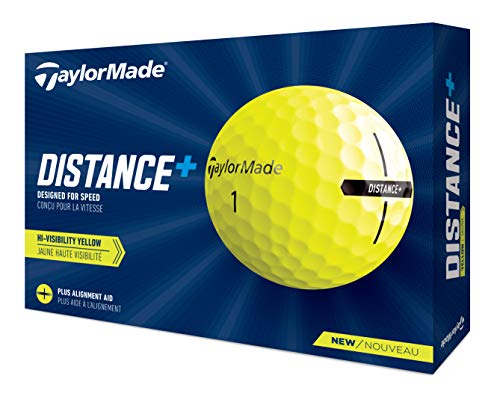
- CoreReact Speed Core
- Dimples342 aerodynamic pattern
- Constructiontwo layer with an ionomer cover
- Flightmid launch with mid to high spin
- Feelsofter feel than a typical hard distance ball
- Packone box, four sleeves of three, 12 balls
Best for: Golfers who want maximum distance without paying Titleist prices, in a color that is easy to follow
Distance+ is the value benchmark in this category. TaylorMade puts its React Speed Core in a two layer ball with an ionomer cover and sells it for roughly twenty dollars a dozen, which undercuts every other named brand here.
Two things separate it from the cheaper balls. The launch is tuned mid rather than low, which keeps carry respectable, and TaylorMade specifies mid to high spin, so approach shots hold the green instead of releasing over the back. In yellow it doubles as one of the more visible balls you can play, and the yellow version costs the same as the white.
Pros
- The lowest price per dozen among the branded balls here
- React Speed Core is TaylorMade's distance core and this is the cheapest ball it appears in
- Yellow is the easiest color to track against sky and treeline, and there is no price premium for it
- Mid to high spin is unusual for a distance ball and helps approach shots stop
Cons
- A mid launch flight rather than the high flight of the Velocity, so less carry in still air
- Two layers only, so no urethane-style wedge spin
- The 2021 version, with newer Distance+ boxes now on the shelf
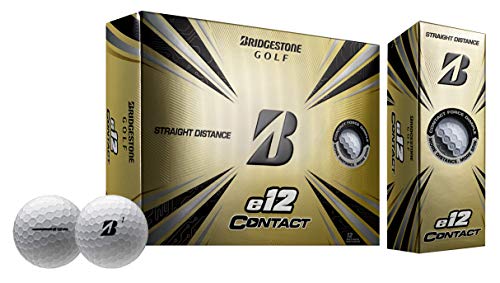
- DimplesContact Force Dimple with a raised inner section
- Contact area38 percent more surface contact between ball and clubface
- Flightlonger and straighter flight with the driver
- Short gameincreased friction for more spin around the green
- Energymore efficient energy transfer at impact
- Pack12 count, 2021 model
Best for: Golfers who lose distance sideways rather than through lack of speed
Bridgestone attacked the problem from a different direction. Instead of shaping the dimples purely to reduce drag, it added a raised section inside each dimple so more of the ball touches the clubface at impact, and it published the number: 38 percent more surface contact.
The consequence runs in both directions. Off the driver, better contact means more efficient energy transfer and a straighter flight, which is where the distance claim comes from. Around the green, the same extra contact means more friction, so this ball spins more on a wedge than a hard two-piece distance ball normally does. That combination is why the e12 Contact reads oddly on a spec sheet and plays well.
Pros
- The Contact Force Dimple is the only genuinely different design idea in this list
- Bridgestone publishes the figure outright, 38 percent more surface contact between ball and clubface
- More contact area means more efficient energy transfer, which is a mechanism rather than a marketing phrase
- The same design also increases friction on wedge shots, so it spins more around the green than a typical distance ball
Cons
- Distance gained from straightness is not the same as distance gained from speed, so a straight hitter will see less benefit
- The 2021 model, with newer e12 versions since
- More expensive per ball than the TaylorMade or the Honma

- Corelow spin rubber core that compresses for soft feel and energy rebound
- Coverdurable Surlyn
- Dimples368 in an extended flight pattern with a concave surface
- Alignmentdual-line aid, thin lines for face direction and thick lines for target
- Flighthigher ball flight with fast ball speed
- Approvalconforms to USGA and R and A rules
Best for: Golfers who want a full-spec distance ball for around twenty dollars a dozen
Honma is a Japanese maker with a strong reputation at home and almost none in the American amateur market, which is why the D1 is the value surprise here. The specification is complete in a way the cheap balls in this list are not: a low spin rubber core, a durable Surlyn cover, and 368 dimples in what Honma calls an extended flight pattern.
The alignment aid deserves the mention it gets. Honma prints two line weights, thin lines to square the clubface and thicker lines to visualize the target line, which is more thought than most balls at twice the price put into their markings. It conforms to USGA and R and A rules, so nothing about the price limits where you can play it.
Pros
- 368 dimples in an extended flight pattern is one of the highest counts here, aimed at cutting air resistance
- The dual-line alignment aid is genuinely useful, with thin lines for squaring the face and thick lines for the target line
- A low spin rubber core with a Surlyn cover is the textbook distance construction, done at a low price
- USGA and R and A approved, so it is legal in competition
Cons
- Honma is far better known in Japan than in the United States, so resale and familiarity are low
- Surlyn is durable but hard, so greenside feel is the weakest here
- The concave dimple surface claim comes without a measured figure attached

- Targetplayers with low to medium clubhead speed
- Coreextremely tough and cut-resistant soft core
- Dimples368 dimple design
- Constructiontwo piece
- Behaviorlonger roll and softer feel
- Sales modelsold direct by Vice, packaging may vary
Best for: Golfers who do not swing fast enough to compress a firm ball and lose distance because of it
Vice built the Drive around an admission most makers avoid: if you do not swing fast, a firm ball never compresses and you lose distance no matter what the cover claims. So the Drive uses a soft core aimed at low to medium clubhead speeds, and it gets its distance from roll rather than from carry.
That matters when you choose a course. On firm summer fairways the extra roll is real yardage; on a wet spring course it disappears and you are left with a soft ball that flies short. The 368 dimple design and the cut-resistant core are both good news, and Vice's direct sales model is why the price sits well under the branded dozens here.
Pros
- Explicitly built for low to medium clubhead speed, which is the swing most amateurs actually have
- 368 dimples is tied for the highest count here
- A cut-resistant soft core is an unusual combination, since soft cores normally scuff faster
- Longer roll is the honest distance mechanism for a slow swing, which cannot generate carry
Cons
- Longer roll does not help on soft fairways or when you need to carry a hazard
- Vice packaging varies by batch, so the box you get may not match the photo
- The softest ball here also holds up worst against a bladed iron
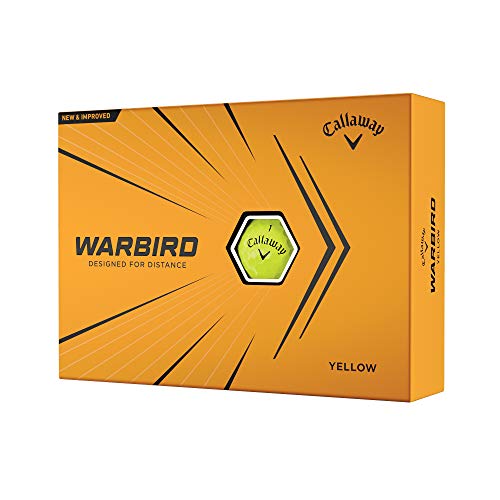
- LineWarbird, Callaway's long-running distance ball
- Version2021
- Coloryellow
- Pack12 ball pack
- Typerecreation ball
- Originmade in China
Best for: Golfers who have played Warbirds for years and want the same ball again
The Warbird is here on reputation. It is one of the oldest distance ball names still in production and generations of amateurs have played it, which is a reasonable basis for buying the same thing again.
What it is not is a ball you can research. Callaway's listing for this version gives package dimensions, weight and country of origin, and nothing about the core, the cover or the dimple pattern. If you want to know why a ball flies the way it does, buy the Titleist or the Bridgestone above. If you already know how a Warbird feels off your driver, that is the only data you need.
Pros
- One of the longest-running distance ball names in golf, so the feel is a known quantity
- Yellow at no extra cost, which helps if you lose balls in rough
- A standard 12 ball pack from a major manufacturer
- Callaway distribution means it is easy to find on the shelf as well as online
Cons
- Callaway publishes almost nothing about this listing beyond the packaging details, with no core, cover or dimple information
- The 2021 version, with newer Warbird boxes available
- Stock on this specific color and version is thin
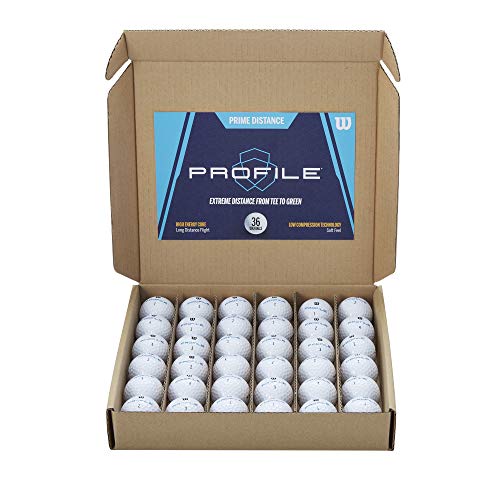
- Pack36 balls
- Corehigh energy core for long distance flight
- Compressionlow compression technology for a soft feel
- Inner coverspecially designed to create less ball spin
- Dimplesspin reducing dimple pattern to reduce hooks and slices
- Usehigh volume play and practice
Best for: Golfers who go through balls quickly and want the lowest possible cost per ball
The Profile Distance is bought by the box. Thirty six balls at around a dollar each changes the arithmetic on a course with water, and the specification is better than the price suggests.
Wilson does two things here worth noting. There is a separate inner cover tuned to reduce ball spin, which is a construction idea usually reserved for three-piece balls, and the dimple pattern is described as spin reducing specifically to cut hooks and slices. Combined with a low compression core, this is aimed at the golfer whose miss is sideways and whose swing speed is moderate. The gap in the data is the dimple count, which Wilson does not publish.
Pros
- Thirty six balls in a box, three times the count of every dozen here
- A high energy core paired with low compression, so it suits slower swings without giving up distance
- Wilson uses a separate inner cover tuned to cut spin, which is a three-piece idea at a two-piece price
- The spin reducing dimple pattern is aimed specifically at hooks and slices
Cons
- Wilson publishes no dimple count, so the pattern claim cannot be compared
- A 36 ball box is a commitment if you do not like how it plays
- Feel is firm off the putter despite the low compression claim
Checklist: What makes great Distance Golf Balls
- Distance: The whole point of distance golf balls is to optimize your long game. Thus, look for balls that promise maximum distance. Consider features like dimple patterns and core composition, which can affect how far the ball travels.
- Durability: Since golf is a game that inflicts a fair amount of wear on the balls used, durability is important. Keep an eye out for golf balls that are designed to withstand rigourous play, such as those with a durable ionomer shell or cover.
- Swing Speed Compatibility: Different golf balls perform differently with various swing speeds. You should look for golf balls that are compatible with your swing speed. Some options are suitable for all swing speeds, while others are better suited for high or low speeds.
- Feel and Control: Balancing distance and control is critical to excelling in golf. Even if a ball gives great distance, it should not compromise on the feel or control it offers. Look for golf balls that offer a balanced, soft, and responsive feel.
- Aerodynamics: The aerodynamics of the golf ball can also impact its distance and flight behavior. Features like dimple patterns can reduce drag and hence affect the ball's trajectory and roll. It's essential to consider this factor while shopping for distance golf balls.
- Visibility: This factor might not directly influence the performance but can certainly enhance your playing experience. Brightly colored or gloss-finished golf balls can be easy to spot during your golf rounds, providing added convenience.

FAQ
What features should be considered while buying distance golf balls?
One should consider factors like maximum distance, durability, swing speed compatibility, feel and control, aerodynamics, and visibility while buying distance golf balls.
Why is swing speed compatibility important in choosing distance golf balls?
Swing speed compatibility is crucial because different golf balls perform differently with various swing speeds, affecting the distance and control.
How do the aerodynamics of a golf ball affect its performance?
The ball's aerodynamics, like dimple patterns, can impact distance and flight behavior by reducing drag, influencing the ball's trajectory and roll.