Ten golf rangefinders compared on accuracy, measuring range and features, each with a spec table and a buying checklist.
Every unit here is in stock on Amazon right now, and every figure below comes from the manufacturer. The field runs from a 40 dollar laser with a slope switch to a 350 dollar Bushnell, and the honest answer is that all of them will read a flag at 150 yards. What you pay for higher up is glass, lock speed and how well the reading holds when your hands are cold.
Best golf rangefinder: the ten picks at a glance
Four things separate these ten: maximum range, magnification, whether slope can be switched off for tournament play, and how the unit tells you it has locked the flag. Slope is the feature that matters most in practice, because it converts a raw yardage into the distance you actually have to hit, and most lasers here carry an external switch to turn it off when the rules require it.
Below you get the short version first: three picks for the most common cases, then the full table with all ten, then every rangefinder in detail with specs, strengths and weaknesses.
- The one most serious golfers end up buyingBushnell Tour V6 Shift
- Best value at the mid priceCallaway 300 Pro
- Best cheap laser with a slope switchMOESAPU F-1000S
- Distance plus wind and strategyArccos Smart Laser


| Rangefinder | Max range | Magnification | Slope | Best for |
|---|---|---|---|---|
| Bushnell Tour V6 Shiftbest overall | 1,300 yards | 6X | Yes, external switch | Players who want the tour standard |
| Callaway 300 Probest mid price | 1,000 yards | 6X | Yes, external switch | A serious laser at half the Bushnell price |
| MOESAPU F-1000Sbest budget | 1,200 yards | Not published | Yes, external switch | A first rangefinder under 40 dollars |
| Gogogo Sport Vpro GS03golf and hunting | 1,200 yards | 6X | Yes | Doubling as a hunting unit |
| REDTIGER Rangefindermost modes | 1,200 yards | 7X | Yes, on and off switch | Six measurement modes and a magnet |
| DEASON GR08longest battery | 1,300 yards | 7X | Yes, tournament mode | 30,000 readings per charge |
| Arccos Smart Laserwind and strategy | Laser plus GPS | Not published | Yes, toggle | Plays-like distance including wind |
| VyKure Rangefinderweather sealed | 1,200 yards | 7X | Yes | IP54 rating for rain and dust |
| Acer Golf Rangefindersteadiest reading | 800 yards | 6X | Yes | Shaky hands and slow locks |
| Izzo Swami KISS 2.0GPS instead of laser | 38,000 course maps | GPS, no optics | Not applicable | Front, center and back yardages |
The ten golf rangefinders in detail
- Range1,300 yards
- Magnification6X
- Slopeslope-adjusted distances with an external switch
- LockPinseeker with Visual JOLT, red ring plus vibration
- MountBITE magnetic mount
- In the boxpremium case, veteran coin, microfiber cloth, CR2 battery
Best for: Golfers who play often enough that lock speed and glass quality are worth three figures
This is the rangefinder most people buy once they have decided they are not going to buy another one. The reading itself is not ten times better than the budget lasers here, but everything around it is faster: the glass is clearer in flat light, the lock is quicker with trees behind the flag, and the confirmation is unambiguous.
Visual JOLT is the feature worth the money. A vibration alone can be confused with the button click; a red ring flashing in the display at the same time cannot. Add the BITE magnet, which keeps the unit stuck to the cart bar instead of rattling in a pocket, and it becomes the one you actually use on every shot rather than every third shot.
Pros
- Visual JOLT flashes a red ring and vibrates, so you get confirmation you can see as well as feel
- The BITE magnet holds it on a cart bar, which is where a rangefinder should live during a round
- 1,300 yards of range and 6X glass, the clearest optics in this list
- An external slope switch keeps it legal in competition without a menu
Cons
- At around 350 dollars it costs nearly nine times the MOESAPU for the same core reading
- It uses a CR2 battery rather than USB-C charging
- The Patriot Pack styling is a fixed choice, not an option
- Range5 to 1,000 yards
- Accuracyplus or minus 1 yard
- Magnification6X
- Slopeexternal slope switch, calculates slope-adjusted distance
- Pin lockP.A.T. to 300 yards with Pulse vibration
- MountMagnahold magnet, hard carry case included
Best for: Players who want a golf brand and full slope function without paying Bushnell money
The 300 Pro is the sensible middle of this list. It has the two things that separate a golf rangefinder from a generic laser, an external slope switch and a pin acquisition system that ignores the trees behind the flag, and it costs half of what the Bushnell does.
The 300 yard pin lock figure is the number to look at. Total range means little on a golf course, since no shot needs 1,200 yards, but the distance at which the unit will pick a thin flagstick out of a background is what determines whether you get a reading on a long par five. Callaway publishes 300 yards, matched in this list only by the Gogogo below.
Pros
- Pin acquisition out to 300 yards, the longest published flag lock figure here
- An external slope switch, so switching to tournament mode is a physical action you cannot forget
- A Magnahold magnet plus a molded hard case with a carabiner, which the cheaper units do not match
- Plus or minus 1 yard accuracy from a brand with a service network
Cons
- 1,000 yards of total range, less than the 1,200 and 1,300 yard units below
- Battery powered rather than rechargeable
- At 170 dollars it is four times the price of budget lasers that lock a flag at the same distance
- Range1,200 yards
- Accuracywithin 0.7 yards, reading in 0.5 seconds
- Slopeexternal slope switch, off for tournament rounds
- Lockflagpole lock with vibration confirmation
- Modesgolf, hunting and archery scanning
- PowerUSB-C rechargeable
Best for: A first rangefinder, or a spare that lives in the bag you do not want to risk
This is the unit that makes the argument against spending more. Under 40 dollars buys a 1,200 yard laser with flag lock, vibration confirmation and an external slope switch you can flip off before a competition round, and the published accuracy of 0.7 yards is inside the tolerance that matters on an approach shot.
What is missing is everything around the reading. There is no magnification figure, no weather rating, and no magnet, so it lives in a pouch on your bag rather than stuck to the cart. If you are still deciding whether you will use a rangefinder at all, this answers that question for the price of a sleeve of premium balls.
Pros
- An external slope switch at under 40 dollars, which is the feature budget units usually leave out
- 1,200 yards of range and a published accuracy figure of 0.7 yards
- USB-C charging rather than a coin cell, so no spare batteries to buy
- Continuous scanning with vibration on lock, so you can sweep across a green complex and feel the flag
Cons
- MOESAPU does not publish a magnification figure
- There is no magnet, so it lives in a pouch rather than on the cart bar
- Plastic housing with no published weather rating
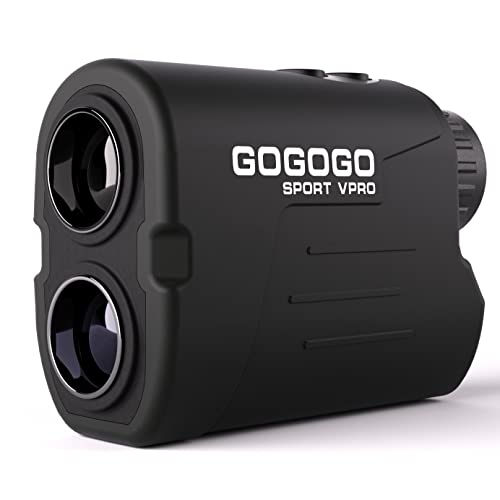
- Rangeup to 1,200 yards
- Accuracyplus or minus 1 yard
- Magnification6X with a high transmission LCD
- Slopebuilt-in slope compensation for uphill and downhill
- Flag lock300 yards with vibration feedback
- ModesScan, Golf and Speed
Best for: Anyone who wants one laser for the course and for hunting or the range
The GS03 is the crossover unit. It reads golf distances with slope compensation and a 300 yard flag lock, and it also has Scan and Speed modes for hunting and the range, which is why it turns up in both categories.
For golf specifically, the useful numbers are the 6X magnification, the plus or minus 1 yard accuracy and the vibration on flag lock. The thing to check before a competition is the slope switch: this listing describes slope compensation but not an external toggle, and tournament rules require slope to be switchable off.
Pros
- Scan, Golf and Speed modes make it usable well outside golf, unlike the single-purpose units here
- 300 yard flag lock with vibration, matching the Callaway at a third of the price
- 6X glass with a high transmission LCD, which stays readable in bright light
- Slope compensation gives the true playing distance on elevated tees
Cons
- Gogogo does not publish an external slope switch on this model, so tournament use needs checking
- Speed mode is of no use on a golf course and adds menu steps
- The 1,200 yard figure is a hunting number, not a golf one

- Range5 to 1,200 yards
- Accuracy0.5 yards
- Magnification7X
- Displaytransflective LCD
- Slopeslope switching on and off
- Modessix, including slope, flag lock, horizontal and height
- PowerUSB-C, around 30,000 uses per charge
Best for: Players who want 7X glass and a magnet without going over 100 dollars
The REDTIGER is the specification-per-dollar pick. At under 100 dollars it has 7X glass, a transflective LCD, a magnetic mount, USB-C charging and a slope switch, which is a list that reads like a 200 dollar unit.
The transflective display is worth calling out. It uses ambient light rather than fighting it, so on a bright afternoon the numbers stay readable, which is exactly when cheap backlit displays disappear. The cost of the feature list is menu depth: six modes cycled from one button means you will occasionally take a reading in the wrong one.
Pros
- 7X magnification, more than the Bushnell and Callaway units above
- A transflective LCD stays legible in direct sun, where backlit displays wash out
- A magnetic strip for the cart plus USB-C charging rated to about 30,000 uses
- Slope switches off, so it is usable in competition
Cons
- Six modes on two buttons means cycling through menus you will never use
- 0.5 yard accuracy is a laser specification, not a promise on a windy flag
- No published weather rating

- Rangeup to 1,300 yards
- Accuracyplus or minus 0.5 yards
- Magnification7X
- Slopeslope mode plus a tournament mode
- Battery750 mAh lithium-ion, up to 30,000 clicks per charge
- Extrasbuilt-in magnet, belt clip, carrying case
Best for: Golfers who forget to charge things and want a unit that survives a season of rounds
The GR08 is built around not running out of power. A 750 mAh lithium cell rated at 30,000 clicks means a golfer taking thirty readings a round gets hundreds of rounds between charges, which in practice means you charge it when you remember rather than when you need to.
The rest of the specification tracks the REDTIGER: 7X glass, 0.5 yard accuracy, six modes, and a magnet for the cart. The difference is range, 1,300 yards against 1,200, and a separate tournament mode alongside slope. Check stock before planning around it, since this listing does not always hold quantity.
Pros
- A 750 mAh cell rated to 30,000 readings, the largest published battery in this list
- 1,300 yards and 7X, matching the Bushnell for range at a third of the price
- Six modes including slope compensation, flag lock and height measurement
- Magnet, belt clip and case all included rather than sold separately
Cons
- Stock on this listing has been running down to single figures
- DEASON is not a golf brand, so service and warranty are thinner than Callaway or Bushnell
- A white housing shows every mark from a cart bar

- Readinglaser distance plus a plays-like distance
- Adjustmentsslope and live weather, including wind
- Mapsgreen maps and hole layouts for over 40,000 courses
- Slopetournament-legal toggle to disable plays-like
- Lockpin lock with vibration
- AppArccos app, smart sensors not required
Best for: Players who already think about wind and want the number calculated rather than guessed
The Arccos is the one device in this list doing something different. Every other unit converts a laser reading and an angle into a slope-adjusted number. This one adds live weather, so the plays-like distance accounts for the wind you are standing in as well as the hill you are shooting up.
That comes with two conditions. It is tied to a subscription and to the Arccos app on your phone, and without those it is an expensive plain laser. If you already play with a phone in your pocket and think in terms of playing distance rather than yardage, the green maps and hole layouts for over 40,000 courses make it a yardage book as well as a rangefinder.
Pros
- It is the only unit here that folds live wind into the playing distance, not just slope
- Green maps and hole layouts turn it into a digital yardage book for over 40,000 courses
- The plays-like adjustment can be toggled off, keeping it legal in competition
- Pin lock with vibration works as a plain laser when you ignore the extras
Cons
- It is a subscription product, so the ongoing cost is not in the purchase price
- The full feature set needs a phone with the Arccos app running
- At 240 dollars it costs more than any laser here except the Bushnell

- Range3 to 1,200 yards
- Accuracyplus or minus 0.5 yards
- Magnification7X
- Displaytransflective LCD
- WeatherIP54 rated for rain, fog and dust
- Modessix, including slope compensation and flag lock
- Mountbuilt-in magnetic strip
Best for: Golfers who play in weather and want a published water rating rather than a promise
Most rangefinders in this price range describe themselves as weather resistant without saying what that means. VyKure publishes IP54, which is a defined rating covering dust and water spray from any direction, and on a course that is the condition you actually meet.
Beyond the sealing it is a well-specified budget laser: 7X magnification, a transflective LCD that stays readable in sun, 0.5 yard accuracy, a magnetic strip for the cart and a minimum reading distance of 3 yards. What VyKure does not publish is the flag lock distance, which is the figure that matters most on a long hole.
Pros
- An IP54 rating is the only published weather figure in this list
- 7X glass and a transflective LCD at around 65 dollars
- Measures from 3 yards, so it also works for short chip distances
- A magnetic strip and a compact ABS housing shaped to sit in the palm
Cons
- IP54 covers splashes and dust, not immersion, so it is not a wet-weather guarantee
- VyKure publishes no flag lock distance, only total range
- Six modes on one button, the same menu problem as the REDTIGER

- Range800 yards
- Magnification6X
- Stabilizationanti-shake technology for steady readings
- Slopeslope compensation, six modes
- Lockflagpole locking with vibration alert
- PowerUSB-C rechargeable, magnetic mount
Best for: Anyone whose readings jump around because holding a laser steady on a flag is harder than it looks
The failure mode of a budget rangefinder is not accuracy, it is holding it still. At 6X magnification a slight tremor moves the aiming reticle several yards either side of a flagstick, and the unit reads whatever is behind it. Acer's anti-shake processing is aimed squarely at that.
The rest is conventional: 800 yards of range, flag lock with vibration, six modes, USB-C charging and a magnet. The 800 yard figure looks small next to the 1,300 yard units but is irrelevant on a golf course, where the longest reading you will ever take is a par five tee shot.
Pros
- Anti-shake is the only stabilization feature in this list and it is the real problem with cheap lasers
- 6X glass with flag lock and vibration confirmation
- USB-C rechargeable with a magnet for the cart
- Six modes covering slope, vertical and horizontal distance and angle
Cons
- 800 yards is the shortest range here, though still far beyond any golf shot
- Acer is a computing brand, not a golf or optics one
- No published accuracy figure in yards

- Typehandheld GPS, no laser
- Coursesover 38,000 maps with auto recognition
- Readingsfront, center and back of the green, or a simplified center mode
- Extrasi-Caddie club suggestions based on distance
- Scoringscorecard, GIR and putts per round tracking
- Mountintegrated magnets, water-resistant body, micro USB charging
Best for: Golfers who want a number without aiming at anything, especially on blind shots
A GPS unit answers a different question than a laser. It cannot tell you where the flag is, but it can tell you the distance to the front, center and back of a green you cannot see, which is exactly the shot where a laser is useless.
The Swami KISS 2.0 covers over 38,000 courses with automatic hole recognition, adds i-Caddie club suggestions based on the distance, and tracks your scorecard, greens in regulation and putts. It sticks to a cart with integrated magnets and charges over micro USB. As a companion to a cheap laser it is arguably better value than upgrading the laser.
Pros
- It gives front, center and back yardages, which a laser cannot do when the green is not visible
- No aiming, no shake and no lock failure, since the distance comes from GPS
- Tracks scorecard, greens in regulation and putts, so it replaces a pencil
- Integrated magnets and a water-resistant body at under 100 dollars
Cons
- GPS is accurate to the green, not to the pin, so it cannot give you the flag position
- No magnification and no laser, so it is useless for measuring anything off the course
- Micro USB rather than USB-C charging
Checklist: What makes a great golf rangefinder
- Accuracy: A cornerstone of effective rangefinding, precision within ±1 yard is crucial. Options that offer slope compensation with pin-seeking tech enhance accuracy across varied terrains.
- Magnification: Quality optics with 6x or higher magnification ensure that the target is brought into sharp focus, pivotal for analyzing distances and making informed club selections.
- Range Capability: A rangefinder should cater to extensive distances, ideally upwards of 650 yards, to cover all possible scenarios on a golf course, from short pitches to long drives.
- Measurement Speed: Fast and responsive measurement, preferably within a second, aids in maintaining a smooth pace of play and reduces delays as golfers calculate distances.
- Design and Portability: Ergonomic, lightweight, and compact designs promote ease of carry and use on the golf course, aiding in quick acquisition without added burden.
- Weather Resistance: Considering the outdoor nature of golf, a rangefinder with water and fog resistance ensures reliability in varied weather conditions, enhancing its utility and longevity.

FAQ
Can a golf rangefinder improve my game?
Yes, a golf rangefinder can significantly improve your game by providing accurate distances to the green, which helps in better club selection and shot strategy.
What features should I look for in a golf rangefinder?
Look for features like accurate yardage within ±1 yard, slope compensation, speedy measurements, high magnification, lightweight design, and weather resistance in a golf rangefinder.
Is magnification an important factor in choosing a golf rangefinder?
Yes, magnification is important in a golf rangefinder as it helps bring distant targets into clear focus, crucial for making precise club choices and improving shot accuracy.