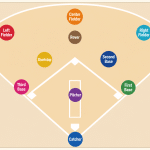
Kickball takes the shape of baseball, replaces the bat with a foot and the hardball with a rubber playground ball, and becomes a completely different defensive problem.
A kicked ball travels lower, bounces more and reaches the outfield slower, which is why kickball defences look crowded in places baseball leaves empty.
Here is what each position does and where the differences really are.
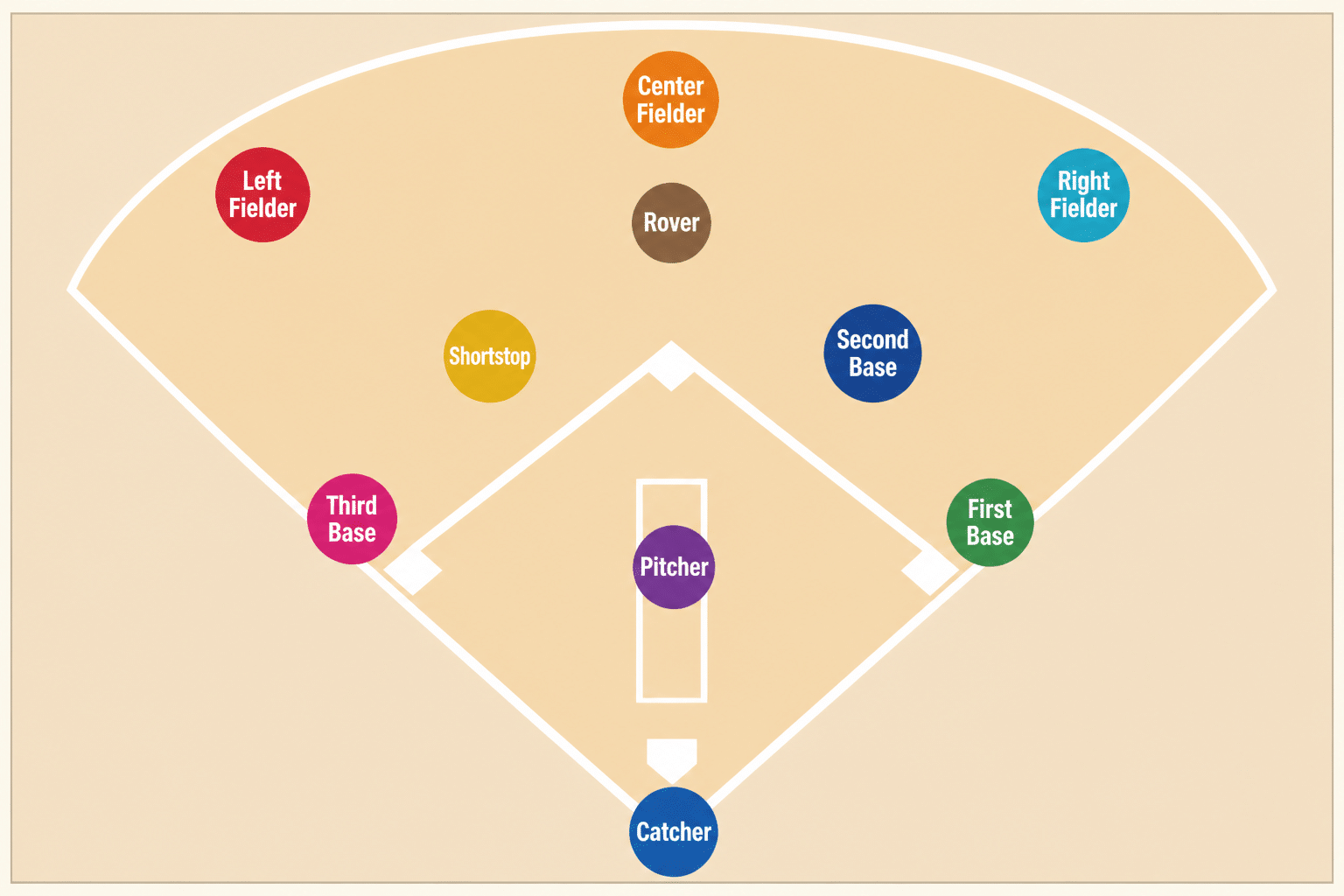
- The Pitcher rolls the ball rather than throwing it, and controls the game with spin and speed.
- The Catcher plays right behind the kicker and takes the throws at home.
- The Infielders handle the bunts and grounders that make up most of a kickball game.
- The Outfielders catch the deep kicks, which end an inning faster than anything else.
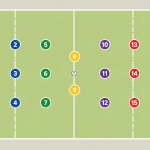
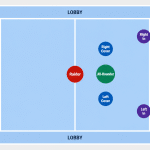
- Many leagues add a Rover, an extra fielder in the shallow outfield where kickball produces the most balls.
#1 Pitcher
The kickball pitcher rolls the ball along the ground towards home plate. Speed matters less than spin and placement, because a ball that curves away from a kicker’s standing foot is very hard to hit cleanly.
The pitcher is also the first fielder. A rolled ball invites the bunt, and the pitcher is usually closest to it, so the position needs quick reactions off the mound and a fast, accurate throw to first.
Key Characteristics or Skills:
- Spin on the roll, which is what produces weak contact.
- Consistent placement at the corners of the plate.
- Fielding bunts and slow rollers off the mound.
- Covering first and backing up throws.
#2 Catcher
The catcher stands behind the kicker, receives anything not kicked and takes the throws at home plate. Because kickball allows the ball to be thrown at a runner in many rule sets, the catcher also has to protect the plate physically.
Positioning is the whole skill. Standing too close risks interference with the kicker, standing too far back gives up a run on any throw home, and the catcher is the only fielder who can see the entire defence in front of them.
Key Characteristics or Skills:
- Clean handling of rolled and bouncing balls.
- Blocking the plate legally on a throw home.
- Calling the defence, since they face the whole field.
- A quick throw to any base from a crouch.
#3 First Base
First base takes the throws that finish most plays. In kickball a huge share of outs are ground balls fielded and thrown across, so a first baseman who can catch a poor throw saves more runs than one with a strong arm.
They also cover the bunt on their side. Kickball bunts roll slower than baseball ones, which means the first baseman charges more often and has to decide between fielding it or staying on the bag.
Key Characteristics or Skills:
- Stretching for a wide throw without leaving the base.
- Charging bunts and deciding who covers.
- Catching a bouncing ball cleanly.
- Communication with the pitcher on who takes what.
#4 Second Base and Shortstop
The two middle infielders cover the gap between first and third, take the throws at second and turn the double plays. In kickball this is the busiest part of the field, because a rolled pitch produces far more ground balls than a thrown one.
They also decide the depth of the defence. Playing shallow takes away the bunt and the infield single, playing deep takes away the hard grounder through the gap, and against a strong kicker there is no arrangement that covers both.
Key Characteristics or Skills:
- Fielding a bouncing rubber ball, which behaves unlike a baseball.
- Turning a double play with a big, light ball.
- Covering second on steals and force plays.
- Reading the kicker before the pitch to set the depth.
#5 Third Base
Third base is the closest infielder to the kicker and gets the least reaction time. Any ball pulled hard down the line arrives immediately, and the throw across the diamond is the longest in the infield.
The position is also the bunt defence on that side. Because so much of kickball strategy is placing the ball where nobody is standing, a third baseman who charges well takes away an entire half of the offensive playbook.
Key Characteristics or Skills:
- Reactions on hard kicks down the line.
- The longest infield throw, made accurately on the move.
- Charging the bunt and throwing from a low position.
- Holding the runner at third on a tag play.
#6 Outfielders
Three outfielders cover left, centre and right. A kicked rubber ball carries differently from a batted baseball: it hangs longer, spins unpredictably and drops shorter, so outfielders in kickball generally play much shallower than their baseball equivalents.
Catching a deep kick is the single most valuable defensive play in the sport, because it removes the runner and holds everyone else. Outfielders who read the ball off the foot rather than after it is in the air are worth two of anybody else.
Key Characteristics or Skills:
- Reading the ball off the foot instead of tracking it late.
- Catching a light ball that moves in the wind.
- A long, accurate throw back to the infield.
- Backing up the other outfielders on every play.
#7 Rover
Many leagues field ten or eleven players and place the extra one as a rover, standing in the shallow outfield behind second base. This is exactly where a kicked ball most often lands, so the rover fields more balls than most of the outfielders.
The rover has no equivalent in baseball, and it is the clearest sign of how differently a kicked ball travels. Some leagues instead use a fourth outfielder or a second shortstop, but the reasoning is the same.
Key Characteristics or Skills:
- Covering the shallow gap that infielders cannot reach.
- Communicating loudly, since three players can reach the same ball.
- Quick transitions from catch to throw.
- Flexibility, because the rover moves with each kicker.
Kickball Positions Compared With Baseball
Kickball borrows the baseball diamond and then rearranges the people standing on it. These are the differences that matter when you are picking a defence.
| Element | Kickball | Baseball |
|---|---|---|
| Fielders | Usually nine to eleven, often with a rover | Exactly nine |
| Pitching | The ball is rolled along the ground | The ball is thrown overhand |
| Extra position | Rover in the shallow outfield | No equivalent |
| Outfield depth | Much shallower, since kicks do not carry as far | Deep, to cover the fence |
| Getting a runner out | Many leagues allow hitting a runner with the ball | Only tags and force plays |
| Bunting | Common, and banned in some leagues for that reason | A specialist tactic |
Rules vary more in kickball than in almost any organised sport. Before setting a defence, check whether your league allows bunting, throwing at runners, and how many fielders are permitted.
Hybrid Positions
Fourth Outfielder
An alternative to the rover. Used by leagues whose kickers hit deep, spreading four players across the outfield instead of adding one shallow.
Bunt Defender
A corner infielder who plays several steps in on every pitch. Common in leagues that allow bunting, since a bunt beats a normal infield almost every time.
Utility Fielder
In social leagues, the player who rotates through several positions each inning so everyone gets a turn in the infield. A real role, and the reason kickball is so easy to organise.
Kickball is baseball with a foot and a playground ball, and the positions line up almost one to one. For the original, read our guide to baseball positions and roles.
FAQ
What are the positions in kickball?
Kickball uses a pitcher, a catcher, first base, second base, shortstop, third base and three outfielders, and many leagues add a rover in the shallow outfield when they field ten or eleven players.
What is a rover in kickball?
A rover is an extra fielder who stands in the shallow outfield behind second base, covering the area where kicked balls most often land. The position does not exist in baseball.
How many players are on a kickball team?
Most kickball leagues field between nine and eleven players at a time, with ten being the most common. Rosters are usually larger so that everyone gets a turn to kick.
Conclusion
Kickball keeps the baseball diamond and rearranges the defence around a ball that travels completely differently.
The pitcher rolls rather than throws, which turns most of the game into ground balls and makes the infield the busiest part of the field.
Outfielders play shallow because kicks hang and drop rather than carry.
The rover is the position that gives the whole thing away: an extra fielder standing exactly where a kicked ball lands.
It is the most accessible team sport there is, and the positions are still worth thinking about if you want to win.