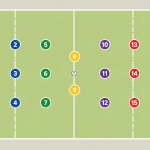
Arena football is American football played indoors on a fifty yard field, eight players a side, with padded walls where the sidelines would be.
Every dimension of the game was shrunk except the goal posts, which were made narrower, and the result is one of the highest scoring versions of football ever devised.
The positions look familiar and behave completely differently.
- The Quarterback throws on almost every down, because the field is too short to run the clock out.
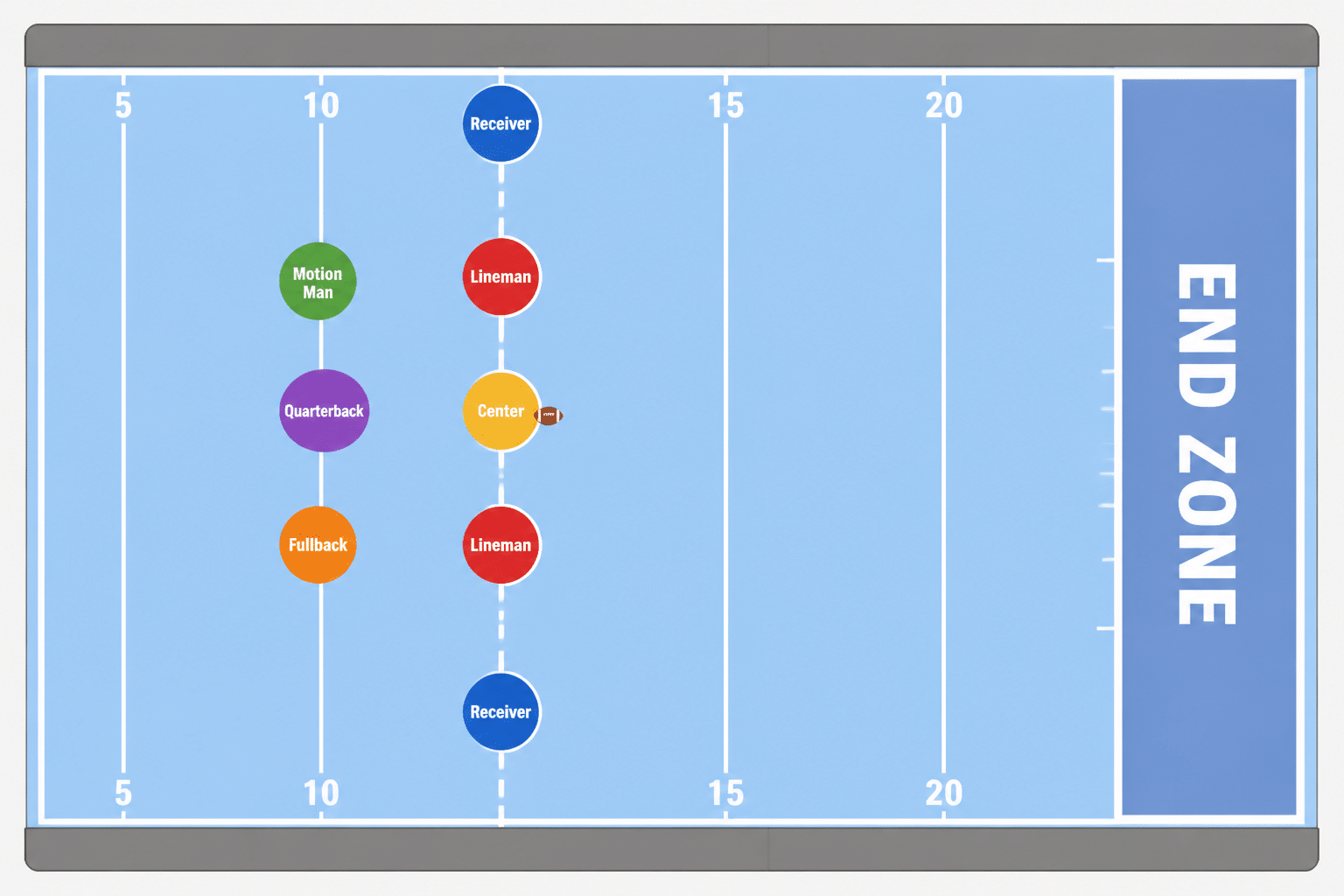
- Linemen block on a line of three rather than five, and may not pull or drop back.
- Receivers use the padded walls as an extra blocker and never run out of bounds.
- One receiver, the Motion Man, may run forward before the snap, which no outdoor rule set allows.
- For most of the sport’s history players had to play both offence and defence, which is what made the roster so small.
#1 Quarterback
The arena quarterback throws more often per drive than any outdoor equivalent. With fifty yards of field and a rebound net behind the end zone that keeps missed kicks in play, there is no version of arena football that runs the ball to kill a game.
The pocket is small and the pressure arrives fast, because a three man line cannot hold off a rush for long. Arena quarterbacks throw from a shorter drop, release quicker and take more hits than their outdoor counterparts.
Key Characteristics or Skills:
- A fast release under immediate pressure.
- Accuracy in a narrow field where windows are tighter.
- Reading a defence that has fewer players and therefore fewer disguises.
- Toughness, since the protection is thinner by design.
#2 Lineman
Three linemen block for the quarterback rather than five, and arena rules restrict what they may do. They cannot pull, they cannot drop into a deep pass set and they line up in a fixed formation, which keeps the pass rush honest and the game fast.
For most of arena football’s history these players also played defensive line, going both ways for the entire game. It made the position one of the most physically demanding in professional sport, and it is why arena linemen were usually smaller and fitter than outdoor ones.
Key Characteristics or Skills:
- Holding a block without pulling or retreating.
- The conditioning to play both offensive and defensive line.
- Hand strength in a short, immediate contest.
- Discipline, because the formation rules leave no room to improvise.
#3 Receiver
Arena receivers work a field just twenty eight yards wide with padded walls instead of out of bounds. That changes route running completely: a receiver can run into the wall, bounce off it and stay in play, and defenders have nowhere to push them out to.
Because the field is short, the deep routes of outdoor football are replaced by quick crossing patterns and back corner fades. Catching in traffic matters more than separation, and almost every arena receiving record dwarfs the outdoor equivalent.
Key Characteristics or Skills:
- Using the wall as part of the route rather than avoiding it.
- Catching in a crowd where there is no sideline to escape to.
- Quick, sharp routes in a narrow field.
- Playing defensive back too, in the eras where two way play was required.
#4 Motion Man
One offensive player, usually a receiver, is allowed to run forward towards the line of scrimmage before the snap. Outdoor football only permits lateral or backward motion, so this rule is unique to the arena game.
The motion man arrives at the line already moving at full speed, which is why so many arena plays begin with a defender already beaten. Defences answer it with a jack linebacker whose only job is to track that player.
Key Characteristics or Skills:
- Timing the run so the snap comes at full speed.
- Reading whether the defence has adjusted before the ball moves.
- Route running from a moving start.
- The ability to block on the same play if the ball goes elsewhere.
#5 Fullback
The fullback lines up behind the quarterback and is the only true running threat in most arena offences. Their carries are short, into a crowd, and used mostly to keep a defence from playing pass on every down.
The bigger part of the job is protection. With three linemen, the fullback picks up the extra rusher, and in two way eras the same player took the field as a linebacker on defence.
Key Characteristics or Skills:
- Pass protection against a free rusher.
- Short yardage running in traffic.
- Receiving out of the backfield, since the fullback is often the safety valve.
- Playing linebacker as well, in the two way format.
#6 Defensive Specialist
Arena rules historically allowed only a small number of one way players. The defensive specialist was one of them, a defensive back who never played offence and could therefore be a pure coverage player.
On a field this small, that specialisation mattered. The defensive specialist typically took the opposing team’s best receiver, which freed the rest of a two way secondary to play zone and recover.
Key Characteristics or Skills:
- Man coverage with no sideline to use as help.
- Recovery speed in a confined space.
- Playing the ball in the air against taller receivers.
- Endurance across a game with very few defensive stops.
#7 Jack Linebacker
The jack linebacker is the only defender allowed to move freely across the line before the snap in most arena rule sets, mirroring the offensive motion man. Everybody else has to stay put.
The position is therefore the defence’s answer to the arena game’s biggest advantage. A jack who reads the motion correctly can meet the receiver at the line, and one who reads it wrong is out of the play before the snap.
Key Characteristics or Skills:
- Mirroring the motion man across the formation.
- Blitzing from a moving start.
- Covering the short middle where most arena passes go.
- Instant recognition, since the decision is made before the ball moves.
Arena Football Compared With Outdoor Football
Almost every positional difference in arena football follows from the size of the field and the number of players. This is what changes when eleven a side moves indoors and becomes eight a side.
| Element | Arena football | Outdoor American football |
|---|---|---|
| Players | Eight a side | Eleven a side |
| Field | Fifty yards long, about twenty eight wide | One hundred yards long, fifty three wide |
| Sidelines | Padded walls, the ball stays in play | Out of bounds stops the clock and the play |
| Offensive line | Three linemen, no pulling allowed | Five linemen, free to pull and drop |
| Pre snap motion | One player may move forward | Motion must be lateral or backward |
| Rosters | Historically two way players on both offence and defence | Separate offensive and defensive units |
| Kicking | A rebound net keeps missed kicks live | A missed kick is dead |
The eight man roster with two way players is what shaped the sport. It kept costs down, produced very high scores, and made arena football a proving ground for players who went on to the NFL.
Hybrid Positions
Two Way Player
A player listed on both the offensive and defensive depth chart. For most of the sport’s history all but a handful of players were required to be one.
Ironman
The nickname for the era when arena rosters allowed only two one way specialists per team, and everybody else played the full sixty minutes on both sides.
Kicker
A one way specialist, and one of the few positions never asked to go both ways. Kicks off, converts and attempts field goals through a goal narrower than the outdoor one.
Arena football is the indoor compression of a much larger game, and every difference is easiest to see side by side. Read our guide to American football positions and roles.
FAQ
What positions are there in arena football?
Arena football fields eight players a side. On offence that is a quarterback, three linemen, two or three receivers including a motion man, and a fullback. On defence it is a line, linebackers including the jack linebacker, and defensive backs including a defensive specialist.
How big is an arena football field?
An arena football field is fifty yards long and about twenty eight yards wide, roughly a quarter of the area of an outdoor field, and it is bordered by padded walls instead of out of bounds areas.
Do arena football players play both offence and defence?
For most of the sport’s history, yes. Arena rules limited each team to a small number of one way specialists, so almost every player took the field on both offence and defence.
Conclusion
Arena football keeps the names of American football positions and rebuilds the jobs around a field a quarter of the size.
Three linemen instead of five, a forward motion man and padded walls turn it into a passing game by design rather than by choice.
The two way requirement is what made the sport distinctive, and what made an arena roster one of the most demanding in professional sport.
The jack linebacker and the defensive specialist exist purely as answers to those rules.
It is the same sport as the outdoor game in the way futsal is the same sport as football: recognisable, and played by different people for different reasons.