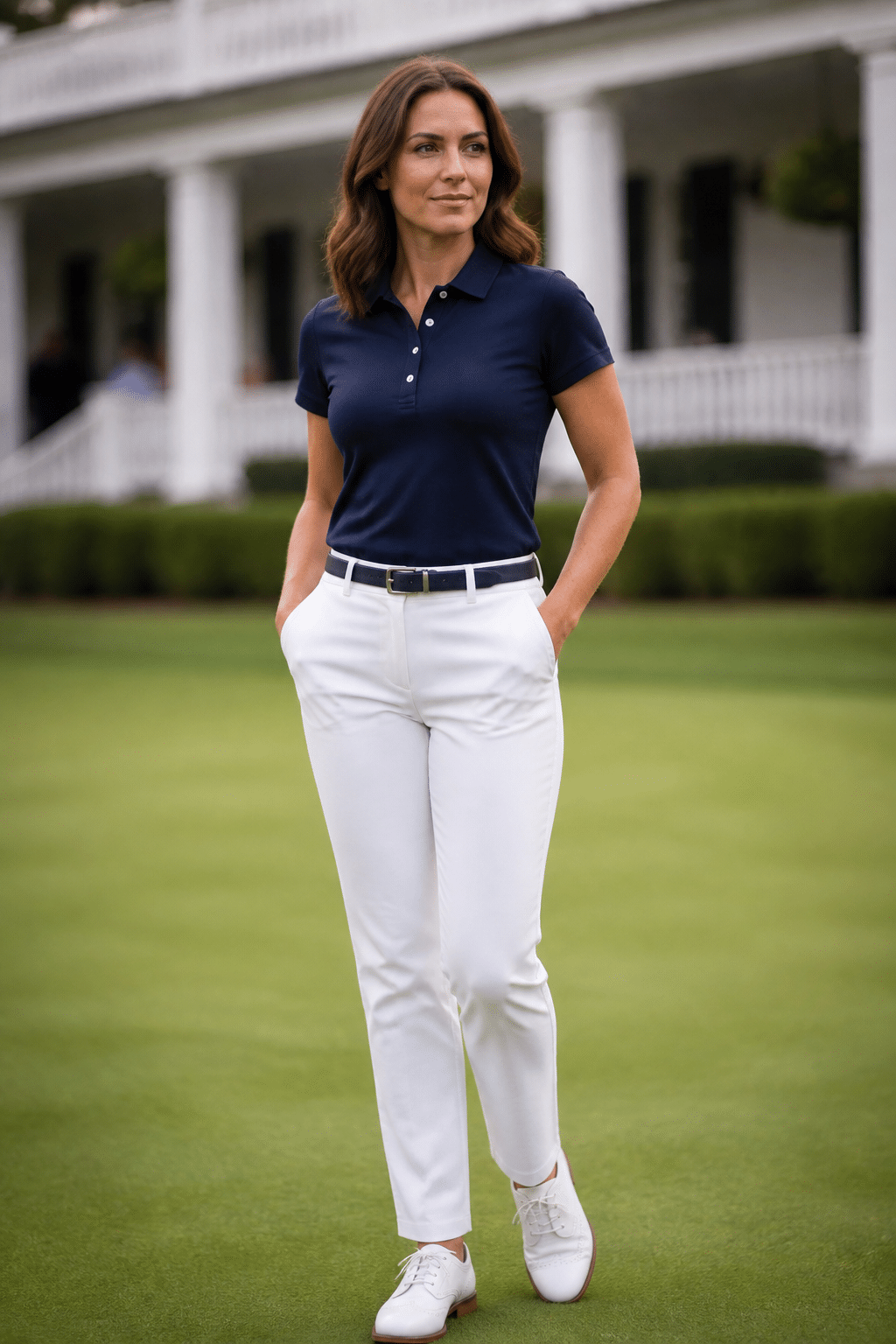
The first time I played a course with a written dress code I read it three times in the car park and still got it wrong, because the rule that mattered was not on the sign. Nobody writes down that the clubhouse expects something different from the tenth tee.
In practice the written rules are always the same: a collar or a mock neck, no denim, no visible logos beyond the maker’s own, and a hem you could walk into a dining room in. The unwritten rules are about restraint rather than formality, which is why the old money edit and the preppy list overlap so heavily with this list. Everything below clears both sets.
If you are a guest somewhere unfamiliar, wear trousers and a collar and you will never be the person being spoken to. Our guide to the best golf apparel covers what to buy.
A cream polo with a pleated navy skirt. Pleats read as traditional where a straight cut reads as modern, and traditional is the safer bet in an unfamiliar clubhouse.
A white polo with beige trousers. Two neutrals with no contrast at all, which puts the whole weight on the trousers hanging properly rather than clinging.
A fine gauge sweater with a collar showing at the neck. Almost every club that requires a collar accepts one peeking out of a jumper, which is worth knowing on a cold morning.
A navy golf dress in a longer length. Dress length is the rule most often enforced and least often written down, so err a few centimetres longer than you think.
A cream cardigan over a white polo and skort. The cardigan turns a playing outfit into a lunch outfit without changing anything else, which is the whole point.
A forest green polo with cream trousers. Deep green is the most traditional golf colour after navy and it has been quietly correct for about a century.
A wide striped polo with a white skort. Stripes are the only pattern that raises no eyebrows anywhere, provided there are no more than two colours in them.
Camel trousers with a navy polo. Warm and cool neutrals together, and it looks equally right on the first tee and at a table on the terrace afterwards.
A white mock neck with a navy skort. Mock necks satisfy the collar rule almost everywhere and they are far more comfortable than a polo in cool weather.
A navy sleeveless knit over a white collared shirt. Cool, quiet and slightly severe, and it is the most photographed shape in club golf for good reason.
A beige skort with a cream polo. Two shades of nearly the same colour, which is harder to carry off than contrast and looks considerably better when it works.
A navy quarter zip over cream trousers. The zip counts as a collar in most written codes, which makes it the most useful cold morning garment for a guest.
A sage polo with a white skort. Muted colours are always safer than bright ones at an unfamiliar club, and sage is the most flattering of the muted greens.
Grey trousers with a white polo. Plain, unremarkable and entirely correct, which is exactly what you want on a day when the golf should be the interesting part.
A white polo dress with a leather belt. Check the length before you travel, and choose leather rather than webbing because the belt is the whole outfit.
A navy polo, cream trousers and a silk scarf tied at the bag rather than the neck. A small detail, and the kind that reads as personal rather than bought.
A collared shirt, tailored trousers, one neutral palette and no logos. This is what I pack when I do not know the club, and it has never been wrong yet.