Beach volleyball gives two players a court that indoor teams cover with six, and takes away the substitutions, the coaching during play and the specialist positions.
What is left is a pair who must serve, pass, set, attack, block and dig, often within the same rally.
The positional structure is small enough to explain in a paragraph and deep enough to decide matches at the Olympics.
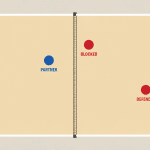
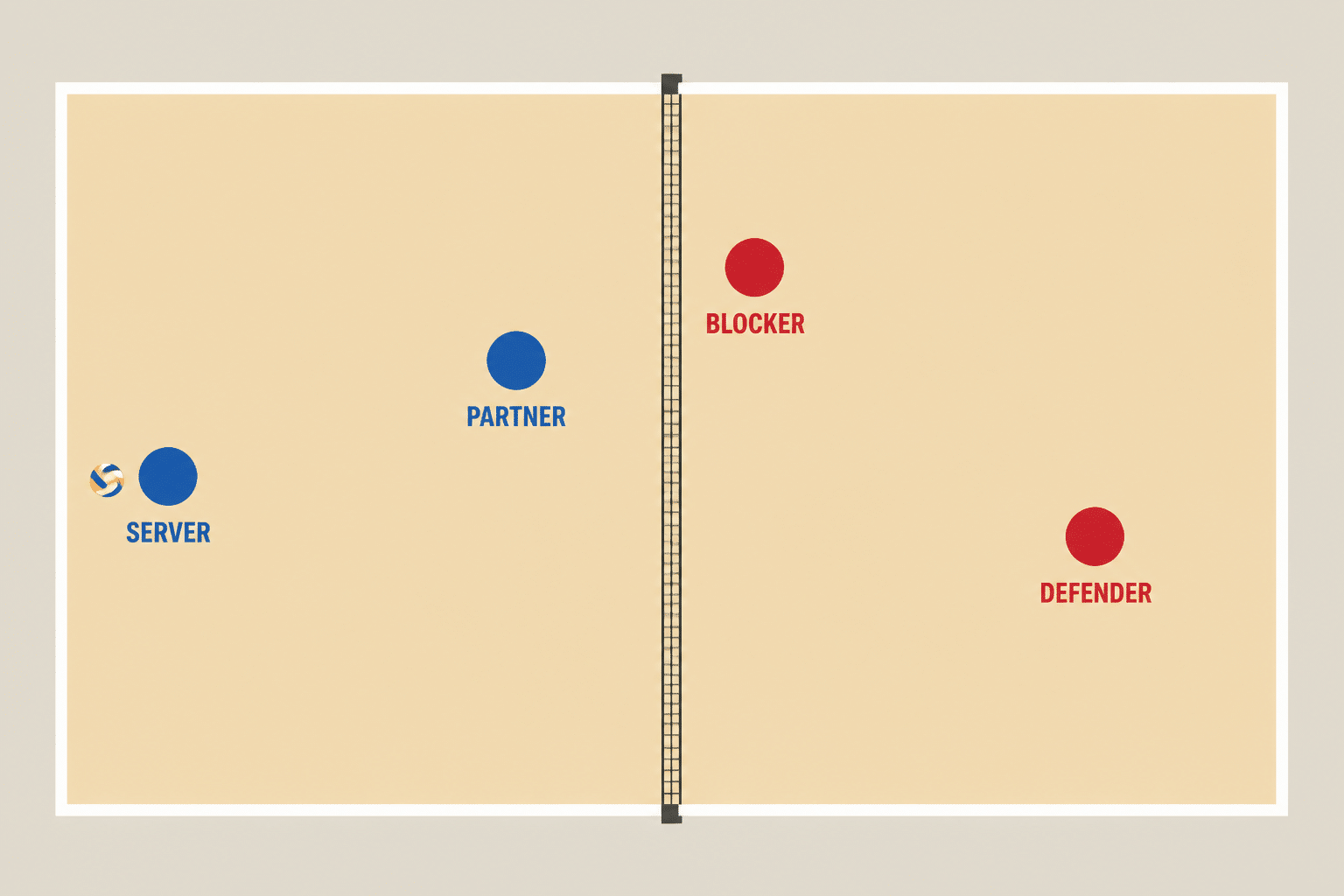
- The Blocker goes to the net and tries to stop or channel the attack.
- The Defender stays back and covers everything the block leaves open.
- Roles switch within the rally: whoever does not serve or block becomes the defender.
- There are no rotations and no positional faults once the ball is served, so players move freely.
- Every player has to do everything, which is why beach specialists are rarely one dimensional.
#1 Blocker
The blocker takes position at the net when the other team attacks. They pick a side to take away, usually the line or the angle, and either stop the ball outright or channel it into the area their partner is covering.
That second job is the important one. A block in beach volleyball is a plan agreed before the serve: the blocker signals behind their back which shot they will take away, and the defender positions for what is left. When it works, a dig looks like anticipation, but it was a decision made two seconds earlier.
Key Characteristics or Skills:
- Reading the attacker’s approach and arm swing.
- Timing the jump on soft sand, which is far harder than on a court.
- Signalling clearly and sticking to the agreed block.
- Peeling off the net to dig when the situation calls for it.
#2 Defender
The defender covers the back of the court and everything the block does not take away. Because there are only two players, that includes the sharp angle, the line if the blocker took the angle, and every short shot dropped just over the net.
The defender is also the team’s reader. They watch the setter, the attacker’s shoulders and the wind, and they move at the moment the hitter commits rather than when the ball is struck. Standing still in beach volleyball defence is the same as being out of position.
Key Characteristics or Skills:
- Digging with control, since the next contact has to be a usable set.
- Reading a hitter early enough to move before the swing.
- Chasing down short shots over the block.
- Fitness on sand, which drains legs faster than any hard surface.
#3 Server
Both players serve, alternating through the match, and the serve is the only moment in beach volleyball with no defensive pressure at all. That makes it the most controllable weapon in the sport.
Serving strategy is deliberate. Teams target the weaker passer, serve into the wind or the sun, or aim short to pull the intended attacker forward so they cannot approach for a swing. A jump serve wins points outright, but a well placed float serve wins rallies before they start.
Key Characteristics or Skills:
- A jump serve or a float serve that stays in under pressure.
- Placement into the seam or towards the weaker passer.
- Using wind and sun as part of the plan.
- Recovering into defensive position immediately after the contact.
#4 Setter
Beach volleyball has no dedicated setter. Whoever did not pass the ball sets it, which means both players need a reliable set with hands and a bump set with the forearms for the balls that arrive badly.
The rules are strict about hand setting on the beach, so many pairs bump set instead to avoid a double contact call. The set also has to account for wind, which can move a high ball two metres between the setter’s hands and the hitter’s swing.
Key Characteristics or Skills:
- A clean hand set that will not be called for a double.
- A reliable bump set from a poor dig.
- Adjusting the height and depth of the set for wind.
- Communication, because the hitter commits to an approach before the set is up.
Beach Volleyball Compared With Indoor Volleyball
The two sports share a net and a scoring system and almost nothing else about their positions. This is what changes when six players become two.
| Element | Beach volleyball | Indoor volleyball |
|---|---|---|
| Players | Two a side, no substitutions | Six a side, with substitutions and a libero |
| Positions | Blocker and defender, switching by rally | Setter, outside hitter, opposite, middle blocker, libero |
| Rotation | No rotation and no positional faults | Strict rotation order, with faults called |
| Court | Sixteen by eight metres | Eighteen by nine metres |
| Block touch | The block counts as one of the three team contacts | The block does not count as a contact |
| Coaching | Not allowed during play in most competitions | Continuous coaching from the bench |
The block counting as a contact is the rule that shapes beach tactics most. A team that touches the ball on the block has only two more contacts, so the blocker often chooses to peel back and dig instead.
Hybrid Positions
Split Blocker
A pair where both players block depending on which opponent is attacking, rather than one fixed blocker. Common when both players are tall.
Side Out Specialist
The player a team wants attacking when they are receiving serve. Opponents serve away from them, which is itself a tactic to exhaust the other player.
Option Attacker
A player who attacks from the back court after a good dig, giving a pair a second swing from unexpected distance.
Beach volleyball is the two player version of a six player sport, and comparing the two shows exactly what specialisation buys you. See our guide to volleyball positions and roles.
FAQ
What are the positions in beach volleyball?
Beach volleyball has two positional roles, blocker and defender. The blocker goes to the net when the opponent attacks, and the defender covers the back court, with the roles switching depending on who serves and how the rally develops.
Is there a setter in beach volleyball?
No. Beach volleyball has no dedicated setter. Whichever of the two players did not make the first contact sets the ball, so both players have to be able to set with hands and with the forearms.
How is beach volleyball different from indoor volleyball?
Beach volleyball is played two a side on a smaller sand court with no substitutions, no rotation and no specialist positions, and the block counts as one of the three team contacts, which it does not indoors.
Conclusion
Beach volleyball has the smallest position chart in team sport and one of the largest skill demands.
Blocker and defender is less a pair of positions than a pair of decisions made before every serve.
The signal behind the back is the whole tactical system, and it is why beach defence looks like anticipation.
With no substitutions, no libero and no coaching during play, a weakness cannot be hidden for a single rally.
Two players, one plan, and a court that is only slightly smaller than the one six people cover indoors.