Rugby league fields thirteen players instead of fifteen, and the two missing players are both flankers.
That single change opens up the middle of the field, speeds the game up and gives every position a clearer job than its rugby union cousin.
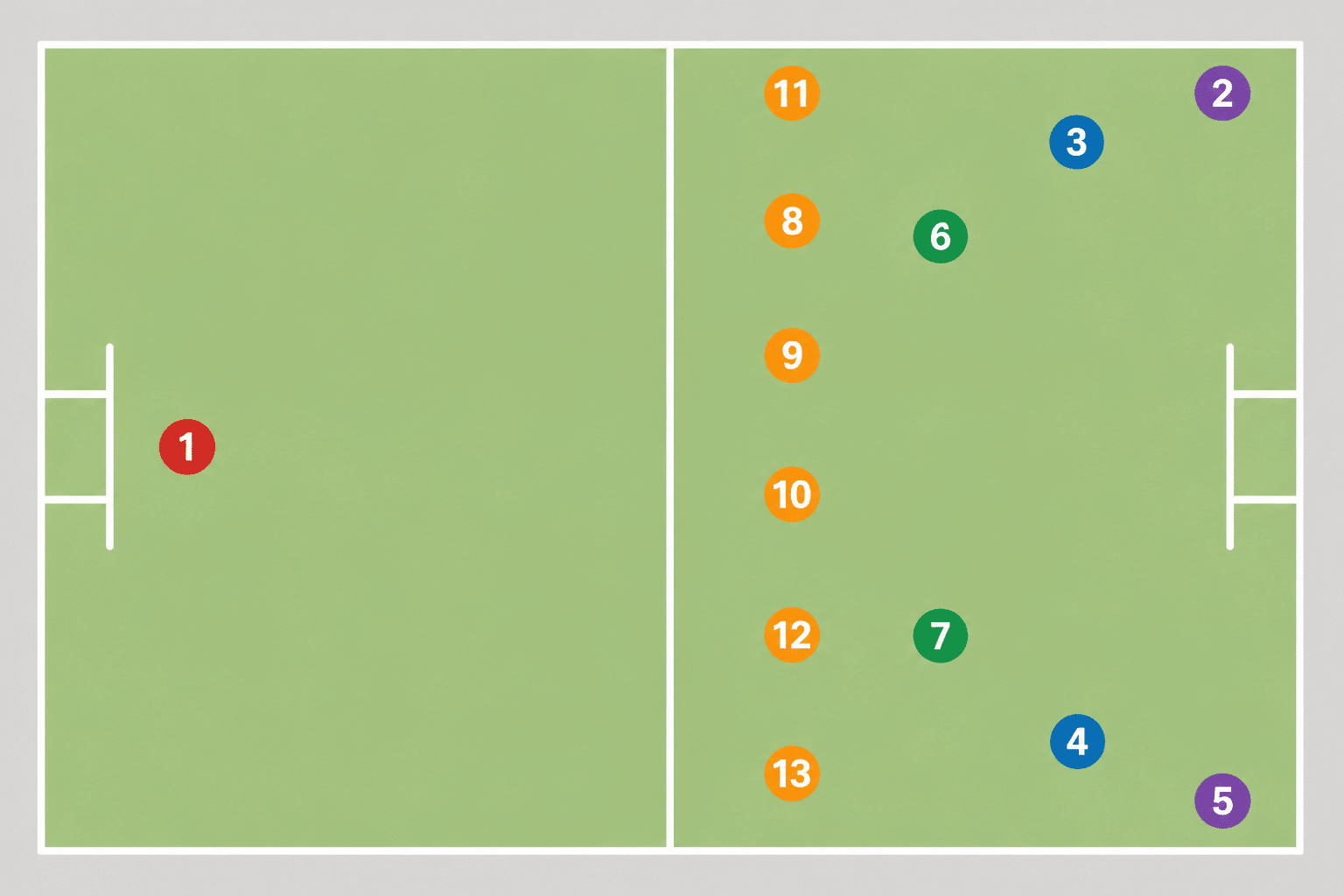
Here is what each of the thirteen does, and why the shirt number is the fastest way to read a team sheet.
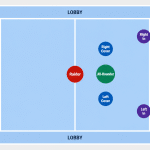
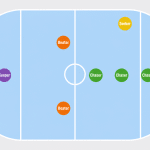
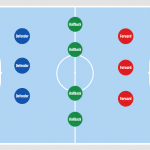
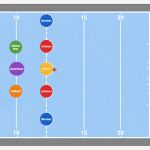
- The Fullback wears 1, covers the kicks and is often the best support runner in the team.
- The Halfback and Five-Eighth wear 7 and 6 and run the attack between them.
- The Hooker wears 9 and passes from dummy half after almost every tackle.
- The Props and Second Rowers carry the ball into contact and make the tackle count.
- Numbers 1 to 13 are tied to positions in rugby league, so the shirt tells you the role.
#1 Fullback (1)
- 🏆 Notable Fullbacks: Darren Lockyer, Billy Slater and James Tedesco
The fullback is the last line of defence and the first attacker in the counter. They field the kicks that come on the last tackle, and everything they do begins from deeper than anybody else on the field.
In attack the fullback is free to appear anywhere. Because they are not needed in the defensive line, they can run support lines off the ball carrier, hit a gap at pace and back up a break from thirty metres behind. Modern fullbacks touch the ball more often than any other player except the hooker.
Key Characteristics or Skills:
- Safe hands under a high kick with a chasing line arriving.
- Acceleration from a standing start after catching the ball.
- Positioning that anticipates the kick before it is struck.
- Support running, because the fullback should be there when a break happens.
#2 Wingers (2 and 5)
- 🏆 Notable Wingers: Ken Irvine, Brian Bevan and Josh Addo-Carr
The two wingers start on the touchlines and finish the moves that make it out that far. They are usually the quickest players in the side and the ones with the highest try counts.
The unglamorous half of the job is the yardage set. When a team starts inside its own twenty, the wingers carry the ball out of trouble on the first tackles, which is why modern wingers are heavier and stronger than they used to be. They also share the back field with the fullback under kicks.
Key Characteristics or Skills:
- Pure speed over the last twenty metres.
- Finishing in the corner, including footwork and the ability to ground the ball in contact.
- Strong early carries out of the defensive twenty.
- Aerial contests, since kickers target the wing every set.
#3 Centres (3 and 4)
- 🏆 Notable Centres: Mal Meninga, Greg Inglis and Latrell Mitchell
The centres line up inside the wingers and are the bridge between the forwards and the edges. They take the ball at pace, straighten the attack and put the winger away with the final pass.
Defensively a centre has the hardest read in the team. They must decide whether to press in on the ball carrier or stay with their own man, and a single wrong decision leaves the winger facing two attackers. Good centres talk their edge through that decision on every play.
Key Characteristics or Skills:
- A long, accurate pass thrown at full speed.
- Power to break the first tackle and offload out of it.
- Defensive reading of two attackers with one defender.
- Combination work with the winger outside them.
#4 Five-Eighth (6)
- 🏆 Notable Five-Eighths: Wally Lewis, Cliff Lyons and Cameron Munster
The five-eighth is rugby league’s second playmaker, called the stand-off in Britain. They take the ball a step deeper than the halfback and attack the defensive line directly, either running at a shoulder or passing late once a defender commits.
Most sides split the field between their two playmakers, one taking the left edge and one the right. The five-eighth is usually the more instinctive of the pair, the one who plays what is in front of them rather than what was called.
Key Characteristics or Skills:
- Running at the line to hold defenders before passing.
- A short kicking game, especially the grubber near the try line.
- Timing on the last pass, which is what turns an overlap into a try.
- Composure in the final tackle of a set.
#5 Halfback (7)
- 🏆 Notable Halfbacks: Andrew Johns, Peter Sterling and Nathan Cleary
The halfback is the general. They call the play, decide where the set finishes and take most of the kicks on the last tackle. When a team looks organised, it is usually the halfback organising it.
The kicking game is the measure of the position. A well placed bomb, a low kick into the in goal or a forty twenty that hands over field position can be worth more than any run, and every one of them is a decision made under a defensive line arriving at speed.
Key Characteristics or Skills:
- An accurate long and short kicking game off both feet if possible.
- Game management, which means knowing the score, the clock and the field position at once.
- A quick pass off the ground and off either hand.
- The authority to direct forwards twenty kilos heavier than they are.
#6 Props (8 and 10)
- 🏆 Notable Props: Arthur Beetson, Shane Webcke and Paul Vaughan
The two props are the heaviest players on the field and the ones who do the least glamorous work. They carry the ball into the middle of the defensive line early in the set to win metres, and they make the tackles that stop the other team doing the same.
Props are usually rotated in and out through the game because the collisions cost so much. Their statistics are simple and honest: metres gained per carry, tackles made and tackles missed. Winning the middle is what gives the halves the field position to play with.
Key Characteristics or Skills:
- Leg drive through contact to fall forward every carry.
- A low, dominant tackle that stops the attacker on the spot.
- Work rate in short bursts, since props play in shifts.
- Ball security, because a mistake in the middle is the most dangerous kind.
#7 Hooker (9)
- 🏆 Notable Hookers: Cameron Smith, Danny Houghton and Harry Grant
The hooker plays dummy half, which means they pick the ball up from the play the ball after almost every tackle and decide what happens next. Nobody in the team touches the ball more often.
Because scrums are uncontested in most of the modern game, the hooker’s name no longer describes the job. The real work is service: a fast, accurate pass to the right man, the occasional run when the markers are asleep, and more tackles than anyone else on the field.
Key Characteristics or Skills:
- A quick, flat pass delivered from the ground.
- Reading tired markers and taking the gap themselves.
- The highest tackle count in the team, made from the middle.
- Communication, since the hooker sees the whole defensive line in front of them.
#8 Second Row (11 and 12)
- 🏆 Notable Second Rowers: Nathan Hindmarsh, Gorden Tallis and Sonny Bill Williams
The second rowers are the edge forwards. They defend outside the middle and attack on the edge, which makes them the link between the heavy carries in the centre of the field and the speed out wide.
A modern second rower needs an offload and a decent pass, because the ball often reaches the edge through them rather than around them. They also chase kicks and clean up on the last tackle, so the position asks for more running than the props ever do.
Key Characteristics or Skills:
- The ability to carry and offload in the same movement.
- Defensive reads on the edge, alongside the centre.
- Aerobic capacity to play long minutes without rotation.
- A strong left or right side preference that the team can build around.
#9 Lock (13)
- 🏆 Notable Locks: Ron Coote, Jason Smith and Isaah Yeo
The lock, sometimes called the loose forward, is the most mobile of the six forwards. They work in the middle like a prop but with the engine of a back rower, and they often play the full eighty minutes.
Many teams now use the lock as a third playmaker. Standing at first receiver lets a big ball player attract defenders and free the halves, which is why so many current locks pass and kick as well as they carry.
Key Characteristics or Skills:
- Endurance, because the lock rarely comes off.
- Ball playing ability from first receiver.
- Tackle count comparable to the props with more ground covered.
- Support lines behind every break in the middle.
Rugby League Positions by Number
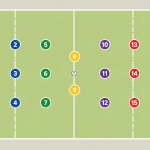
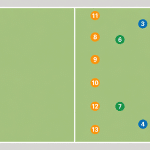
Shirt numbers 1 to 13 belong to positions in rugby league, not to players. A starting side numbers itself the same way in every competition in the world, so the team sheet doubles as a map of the field.
| Number | Position | Where they play |
|---|---|---|
| 1 | Fullback | Behind the defensive line, covering kicks. |
| 2 | Right Wing | On the right touchline. |
| 3 | Right Centre | Inside the right winger. |
| 4 | Left Centre | Inside the left winger. |
| 5 | Left Wing | On the left touchline. |
| 6 | Five-Eighth or Stand-Off | Second receiver, attacking the line. |
| 7 | Halfback or Scrum-Half | First receiver, running the game. |
| 8 | Prop | The middle of the field, carrying and tackling. |
| 9 | Hooker | Dummy half, behind every play the ball. |
| 10 | Prop | The middle, opposite the other prop. |
| 11 | Second Row | The left or right edge. |
| 12 | Second Row | The opposite edge. |
| 13 | Lock or Loose Forward | The middle, with the widest range. |
Numbers 14 upwards belong to the interchange bench. Four players sit there and can be swapped a limited number of times, which is why props are so often rotated in and out of the middle.
Hybrid Positions
Dummy Half
Not a shirt number but a job. Whoever picks the ball up from the play the ball is the dummy half for that tackle, which is usually the hooker but often a forward when the hooker has been caught in the tackle.
Middle Forward
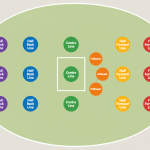
The modern collective name for the props, hooker and lock, the players who work between the two fifteen metre lines rather than on the edges.
Edge Forward
The second rowers, and any interchange forward who plays there. Defends outside the middle and needs to pass as well as carry.
Utility
A bench player who can cover hooker, halfback and fullback. With only four interchange spots, a utility is worth more than a specialist to most coaches.
Rugby league split from the fifteen a side code in 1895, and the position names still overlap. For the other set of numbers, see our guide to rugby positions and roles.
FAQ
What are the 13 positions in rugby league?
The thirteen rugby league positions are fullback, two wingers, two centres, five-eighth, halfback, two props, hooker, two second rowers and lock, wearing shirt numbers 1 to 13 in that order.
What is the difference between rugby league and rugby union positions?
Rugby league has thirteen players instead of fifteen because it has no flankers, its scrums are uncontested, and its number 6 and 7 are reversed compared with union, where 7 is a flanker and 6 is a blindside forward.
What is the hardest position in rugby league?
Hooker is usually considered the hardest position in rugby league because the player makes the most tackles in the team and also has to deliver an accurate pass from dummy half after almost every play the ball.
Conclusion
Rugby league keeps its structure in plain sight: thirteen numbers, thirteen jobs, and a shirt that tells you where a player stands.
The forwards win the middle and the field position that comes with it, and the halves decide what to do with that field position.
The fullback and the hooker are the two players who touch the ball most, from opposite ends of the field.
Watch a set of six tackles and the shape becomes obvious: heavy carries early, edges later, a kick at the end.
Learn the numbers and you can read any rugby league team sheet in the world without a programme.