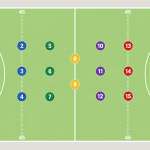
Gaelic football fields fifteen players a side, and every one of them has a number that says exactly where they start.
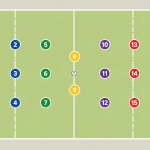
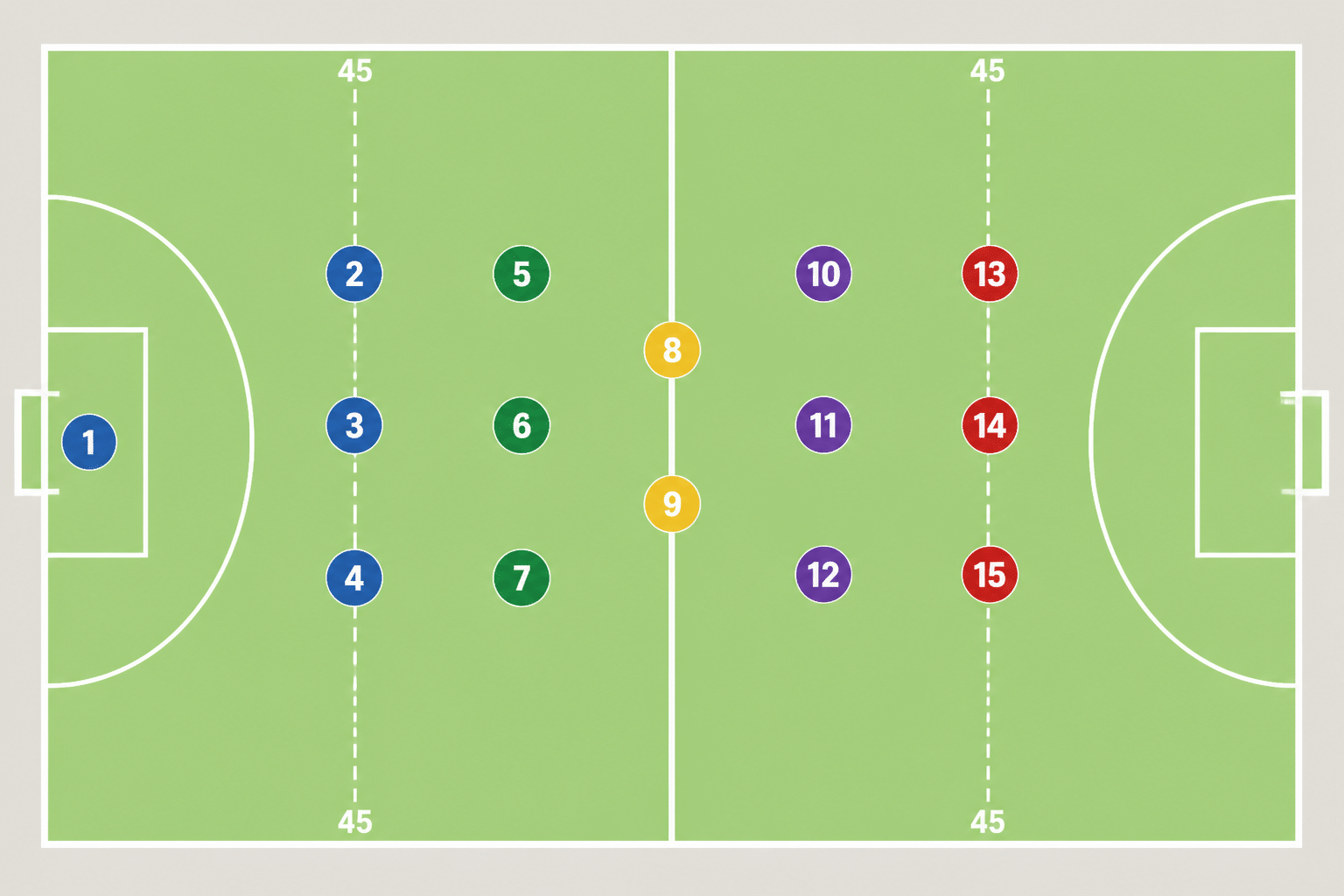
The team is built in six lines that run across the pitch, from the goalkeeper at one up to the full forward line at thirteen, fourteen and fifteen.
Modern systems drag players far from those starting spots, but the numbers still describe the shape everyone learns first.
- The Goalkeeper wears one, defends the goal and takes the kickouts that decide possession.
- The Full Back Line, numbers two to four, defends the small square and the danger area in front of it.
- The Half Back Line, numbers five to seven, breaks up attacks and drives forward with the ball.
- The Midfield pair, eight and nine, contest the kickouts and link the two halves of the team.
- The Half Forward Line, numbers ten to twelve, wins ball in space and creates the scores.
- The Full Forward Line, numbers thirteen to fifteen, scores the goals and points.
#1 Goalkeeper
- 🏆 Notable Goalkeepers: Stephen Cluxton
The goalkeeper wears number one, guards a goal with both a net and a set of posts above it, and has to deal with two different scoring threats at once. A shot along the ground is a goal worth three, a kick over the bar is a point worth one.
The modern game turned this position into a playmaker. Restarting play with the kickout means choosing between a short pass that keeps possession and a long ball into a contest around midfield, and that single decision now shapes entire matches.
Key Characteristics or Skills:
- Shot stopping low and high, since both are worth points on the scoreboard.
- Kickout accuracy over both short and long distances.
- Reading the press to find the free man quickly.
- Organising a defence that is often outnumbered.
#2 Full Back Line (2, 3 and 4)
- 🏆 Notable Full Backs: Darren Fay and Marc Ó Sé
The full back line is made up of the right corner back at two, the full back at three and the left corner back at four. They defend the area closest to goal, and each usually picks up one of the opposing inside forwards.
The full back is the anchor, covering the space in front of the small square and cutting out the ball played in. The corner backs mark the quickest forwards on the field, so pace and tight marking matter more there than physical size.
Key Characteristics or Skills:
- Man marking without conceding a free in a scoreable position.
- Reading the flight of a high ball into the square.
- Recovery pace against fast corner forwards.
- Clean, decisive clearances rather than long aimless kicks.
#3 Half Back Line (5, 6 and 7)
- 🏆 Notable Half Backs: Seán Óg de Paor and Lee Keegan
The half back line runs across the middle of the defensive half, with the right half back at five, the centre half back at six and the left half back at seven. This is where defence turns into attack.
The centre half back is one of the most demanding jobs on the pitch, marking the opposing centre forward while also protecting the space in front of the full back line. The two wing half backs are expected to break forward and often finish the move themselves.
Key Characteristics or Skills:
- Endurance to attack and defend the full length of the pitch.
- Tackling and dispossession without fouling.
- Accurate long passing to launch a counter attack.
- The confidence to carry the ball out of defence under pressure.
#4 Midfield (8 and 9)
- 🏆 Notable Midfielders: Darragh Ó Sé and Brian Fenton
The two midfielders contest the kickouts at both ends of the pitch, which makes them the first players every team looks at when possession statistics go wrong. Height and leap have traditionally decided selection here.
Between kickouts they cover more ground than anyone else on the field, dropping in to help the defence and arriving late in the attack. The role has become more about running power than about fielding alone, but a midfielder who cannot win their own kickout is still a problem.
Key Characteristics or Skills:
- Fielding a high ball cleanly in a crowd.
- Aerobic capacity to cover both halves for seventy minutes.
- Hand passing and support play at speed.
- Scoring from distance, since space often opens up in front of them.
#5 Half Forward Line (10, 11 and 12)
- 🏆 Notable Half Forwards: Maurice Fitzgerald and Ciarán McDonald
The half forward line has the right half forward at ten, the centre half forward at eleven and the left half forward at twelve. They work in the space between midfield and the inside forwards, winning ball on the move and feeding the players closer to goal.
The centre half forward at eleven is usually the creative hub of the attack, often a strong ball carrier who can also kick points from distance. The wing forwards are expected to track back, which makes this the hardest working line in a modern team.
Key Characteristics or Skills:
- Winning possession in traffic and holding it until support arrives.
- Kicking points from outside the arc.
- Work rate to defend from the front when possession is lost.
- Vision for the pass into the full forward line.
#6 Full Forward Line (13, 14 and 15)
- 🏆 Notable Full Forwards: Colm Cooper and Peter Canavan
The inside forwards are the right corner forward at thirteen, the full forward at fourteen and the left corner forward at fifteen. They play closest to goal and are judged on scores, both goals worth three and points worth one.
The full forward at fourteen traditionally holds the edge of the square, wins the ball played in and either turns to shoot or lays it off. The corner forwards live on quick movement and half chances, and often score from angles where only a point is realistic.
Key Characteristics or Skills:
- Finishing off both feet under pressure.
- Movement to lose a marker in a very small area.
- Holding possession with a defender on the back.
- Composure in front of goal when a point is the safer option.
Gaelic Football Positions by Number
Gaelic football numbers its starting fifteen from the goalkeeper forward, one line at a time. The numbers are read as if you were standing behind your own goal looking up the pitch, so right and left refer to that view.
| Number | Position | What the player does |
|---|---|---|
| 1 | Goalkeeper | Guards the goal and takes every kickout. |
| 2 | Right Corner Back | Marks the opposing left corner forward in the tightest space on the pitch. |
| 3 | Full Back | Anchors the defence and covers the ball played into the square. |
| 4 | Left Corner Back | The mirror of the right corner back on the other side. |
| 5 | Right Half Back | Defends the wing and carries the ball forward on the counter. |
| 6 | Centre Half Back | Marks the opposing centre forward and shields the full back line. |
| 7 | Left Half Back | The mirror of the right half back, usually the more attacking of the two. |
| 8 | Midfield | Contests kickouts at both ends and links defence to attack. |
| 9 | Midfield | The second midfielder, often the more mobile runner of the pair. |
| 10 | Right Half Forward | Wins ball in space and works back when possession is lost. |
| 11 | Centre Half Forward | The creative hub of the attack and a scoring threat from distance. |
| 12 | Left Half Forward | The mirror of the right half forward. |
| 13 | Right Corner Forward | Scores from half chances close to goal. |
| 14 | Full Forward | Holds the edge of the square, wins the ball in and finishes or lays off. |
| 15 | Left Corner Forward | The mirror of the right corner forward. |
Numbers sixteen upwards are the substitutes. Teams regularly switch players between lines during a game without changing shirts, so the number tells you where somebody started rather than where they are standing now.
Hybrid Positions
Sweeper
An extra defender who marks space rather than a player, usually dropped in front of the full back line. Almost every county side now uses one, even though no number describes it.
Third Midfielder
A half forward who spends most of the game around midfield to win the kickout battle. It is the most common tactical change in the modern game.
Target Man
A tall full forward picked to win the long ball into the square. Teams switch to this route when the short passing game is being pressed out of them.
Free Taker
The designated place kicker, sometimes a forward and sometimes the goalkeeper. In a sport where points are scored from frees all game, this is a selection decision of its own.
Gaelic football and hurling share the same numbering and the same shape on the pitch. See how the stick game divides its fifteen in our guide to hurling positions and roles.
FAQ
What are the positions in Gaelic football?
Gaelic football has fifteen positions in six lines: goalkeeper, three full backs, three half backs, two midfielders, three half forwards and three full forwards, numbered one to fifteen from the goal upwards.
What number is the full forward in Gaelic football?
The full forward wears number fourteen in Gaelic football, with the right corner forward at thirteen and the left corner forward at fifteen on either side.
What Gaelic football position is best for beginners?
Wing half back and wing half forward are good Gaelic football positions for beginners because they teach both attacking and defending, while corner back and full forward are specialist marking and finishing roles.
Conclusion
Gaelic football is one of the few sports where the shirt number still tells you exactly where a player lines up.
Six lines run from the goalkeeper to the full forwards, and each line has a clear job on both sides of the ball.
Midfield decides possession through the kickout, and the half back and half forward lines decide who has the energy left to use it.
Modern systems add sweepers and third midfielders that no number covers, but coaches still teach the shape through the traditional fifteen.
Learn the numbers and a fast, sprawling game becomes readable within a few minutes of the throw in.
Australian rules grew out of the same family of games and fields eighteen players on an oval. Our guide to Australian rules football positions and roles lines them all up.