

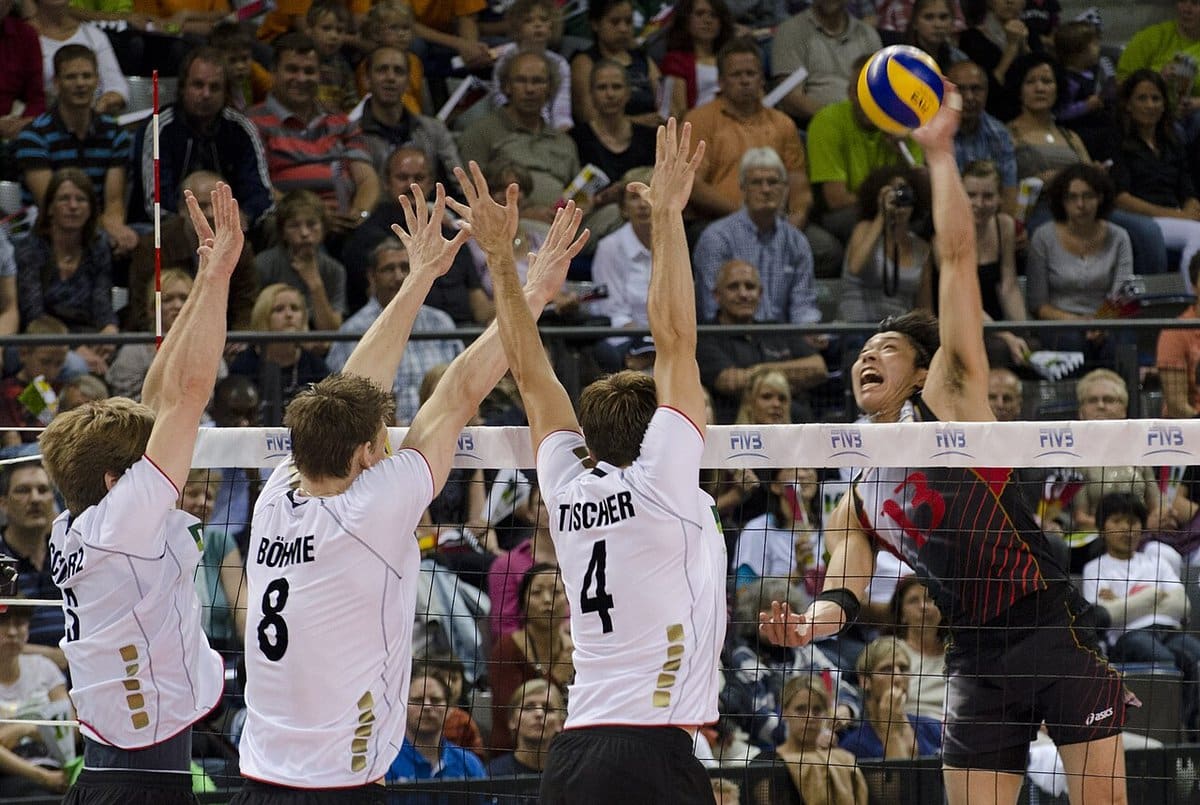
Volleyball rules explained: scoring, serving, three touches, rotation, the libero, net and line faults, plus how indoor and beach volleyball differ.
Volleyball looks fast and complicated from the stands, but most of it comes down to one idea: keep the ball off the floor on your side and put it on the floor on the other side, using no more than three touches. Every rally scores a point, so every rally matters.
This guide covers the indoor rules in the order you meet them: the court, scoring, the serve, the three touches, rotation, the libero and the most common faults. It follows the international FIVB rules, with notes on US college and high school play and a comparison with beach volleyball at the end.
Jump to:
- Volleyball Rules in 60 Seconds
- The Court and the Net
- Scoring
- The Serve
- Three Touches and Ball Handling
- Rotation and Positions
- The Libero
- Common Faults
- Indoor vs Beach Volleyball
- Tips for Watching or Playing Your First Match

Volleyball Rules in 60 Seconds
- Six players per side. Three in the front row, three in the back row.
- Every rally is a point. The team that wins the rally scores, no matter who served.
- Three touches. A team may hit the ball up to three times before it has to go over the net, and no player may hit it twice in a row.
- Sets to 25. A set is won by the first team to 25 with a two point lead.
- Best of five. The first team to win three sets wins the match. A deciding fifth set goes to 15.
The Court and the Net
An indoor court is 18 meters long and 9 meters wide, split into two squares by the center line under the net. An attack line 3 meters from the net marks the front zone. The net is 2.43 meters high for men and 2.24 meters for women, and two antennas mark the sides of the crossing space. A ball that hits an antenna or passes outside it is out.
Lines are part of the court, so a ball that touches any part of a line is in. Our comparison of a basketball court and a volleyball court puts the size in context.
Net heights, the attack line and the free zone are listed in our guide to volleyball court dimensions.
Scoring
Volleyball uses rally scoring: every rally ends with a point for one team. A team scores when the ball lands in the opponent court, when the opponent hits it out or into the net, or when the opponent commits a fault. The first four sets go to 25 points and the fifth set to 15, and every set must be won by two points, so a set can run to 26 to 24, 31 to 29 or beyond.
The Serve
- The server stands behind the end line and has 8 seconds after the whistle to serve.
- The ball must be tossed or released and hit with one hand or arm.
- A serve that touches the net and still lands in the opponent court is in play.
- If the serving team wins the rally, the same player serves again. If the receiving team wins, it gets the serve and rotates.
- Players on the serving team may not wave their arms or stand close together to hide the server from the receivers. That is a screen and a fault.
Three Touches and Ball Handling
A typical rally uses all three touches: a pass, often a forearm pass called a bump, a set, usually with the fingertips, and an attack, the spike. The ball may touch any part of the body, including the feet. What is not allowed:
- Four hits: touching the ball a fourth time before it crosses the net.
- Double contact: one player touching the ball twice in a row. On the first contact of a team, such as receiving a hard hit, a quick double touch in one action is allowed.
- Catch or lift: holding the ball or throwing it instead of hitting it cleanly.
A block at the net does not count as one of the three touches indoors, so a team can still pass, set and attack after a block touch.
Rotation and Positions
Each time a team wins the serve back from the opponent, its players rotate one position clockwise, and the player who moves into the right back position serves. At the moment of the serve, every player has to be in the right order relative to the players next to them. After the serve, players may move anywhere, which is how teams get their best hitters and their setter into position.
Back row players may not block, and they may not attack a ball that is completely above the net from in front of the attack line. They can still attack by jumping from behind the 3 meter line. Our guide to volleyball positions explains setter, outside hitter, middle blocker, opposite and libero in detail.

The Libero
The libero is a defensive specialist in a different colored jersey. The libero plays only in the back row, may not block or attack a ball that is completely above the net, and may come in and out for any back row player without using a substitution. When a libero sets the ball with the fingers from in front of the attack line, a teammate may not attack it above the net. Under FIVB rules the libero may not serve, while US college and high school rules allow a libero to serve in one rotation.
Common Faults
| Fault | What happened |
|---|---|
| Net touch | A player touched the net between the antennas while playing the ball |
| Center line | A whole foot crossed completely into the opponent court, or another body part touched it in a way that interfered with play |
| Reaching over | A blocker touched the ball over the opponent side before the opponent made its attack |
| Foot fault | The server stepped on or over the end line before hitting the ball |
| Out of rotation | Players were in the wrong order when the ball was served |
| Back row attack | A back row player attacked from in front of the attack line with the ball above the net |
Indoor vs Beach Volleyball
| Rule | Indoor | Beach |
|---|---|---|
| Players per side | 6 | 2 |
| Court | 18 x 9 m | 16 x 8 m |
| Match | Best of five sets to 25, fifth set to 15 | Best of three sets to 21, third set to 15 |
| Block counts as a touch | No | Yes |
| Open hand tip | Allowed | Not allowed, use knuckles or a closed hand |
| Side switch | After each set, and at 8 points in the fifth set | Every 7 points, every 5 in the third set |
| Substitutions | Yes | None |
More on the sand game in our guide to beach volleyball rules.
Tips for Watching or Playing Your First Match
- Watch the setter. The second touch decides where the attack comes from.
- On the serve, look at the receiving team: the best passers take most of the court.
- Call the ball loudly when you play. Most beginner points are lost to two players watching the ball drop between them.
- Pick up a few volleyball terms like kill, dig, ace and pancake.
More Reading
- Volleyball positions explained
- Volleyball lingo and slang
- Volleyball equipment list
- History of volleyball
- Basketball court vs volleyball court
- Common volleyball injuries
- Volleyball quiz

FAQ
What are the basic rules of volleyball?
Two teams of six play on either side of a net. Each team may touch the ball up to three times before sending it over, and a point is scored on every rally. Sets go to 25 with a two point lead, and the first team to win three sets wins.
How many points is a volleyball set?
The first four sets go to 25 and the fifth set to 15. A team must win by two points, so there is no upper limit.
Can you hit the volleyball twice in a row?
No, a player may not touch the ball twice in a row. The exceptions are a block, after which the blocker may play the ball again, and a quick double touch on the team’s first contact.
Is a ball on the line in or out in volleyball?
In. The lines belong to the court, so a ball touching any part of the line is good.
Can you kick the ball in volleyball?
Yes. The ball may touch any part of the body, including the feet, as long as it is a clean hit and not a catch.
What does the libero do?
The libero is a back row defensive specialist who wears a different jersey, may replace any back row player without a substitution and may not block or attack above the net.
When do you rotate in volleyball?
When your team wins a rally the other team served. All six players move one spot clockwise and the new right back player serves.
Does a block count as a touch?
Not indoors, where the team still has three touches after a block. In beach volleyball the block counts as the first of three touches.


No comments yet
What's your take?
What's your opinion, or think we got something wrong? Tell us and other readers.
Our editors read every comment.