


Track and field rules explained: false starts, lanes, relays and exchange zones, hurdles, jumping and throwing attempts, fouls, and how results are measured.
Track and field is many sports at once: sprints, distance races, hurdles, relays, jumps and throws. They share one idea, that the fastest, highest or farthest wins, and each event has its own rules on how a valid attempt looks.
This guide follows the rules of World Athletics, which USATF and, with some differences, US high schools and colleges use. It covers starts, lanes, relays, hurdles, field event attempts and the most common fouls.
Jump to:
- Track and Field Rules in 60 Seconds
- Starts and False Starts
- Lanes and Track Rules
- Relays
- Hurdles and Steeplechase
- Jumping and Throwing
- Fouls in Field Events
- High School vs Elite Rules
- Tips for Your First Meet

Track and Field Rules in 60 Seconds
- No false starts. One false start disqualifies the athlete.
- Stay in your lane. Sprints up to 400 meters are run in lanes.
- Torso crosses the line. The finish is measured by the torso, not the head or arms.
- Pass in the zone. Relay batons must change hands inside the exchange zone.
- Three attempts. Field athletes usually get three tries, the best eight get three more.
Starts and False Starts
Sprinters up to 400 meters start from blocks with the commands “on your marks” and “set”. A reaction faster than 0.100 seconds after the gun, measured by sensors in the blocks, counts as a false start. Under World Athletics rules, any athlete responsible for a false start is disqualified. Distance runners start standing.
Lanes and Track Rules
| Race | Lanes |
|---|---|
| 100 m, 200 m, 400 m | Whole race in lanes |
| 800 m | First bend in lanes, then break to the inside |
| 1500 m and longer | No lanes, waterfall start |
| 4 x 100 m relay | Whole race in lanes |
| 4 x 400 m relay | First lap in lanes, then the break after the first bend of the second leg |
Stepping on or over the inside line of your lane in a lane race leads to disqualification, although World Athletics tolerates one touch of the line on a bend if it gives no advantage and hinders no one. A second touch in the same event, or a step fully over the line, means disqualification. Pushing or blocking another runner is also a foul.
The length of every lane, the staggers and the infield are listed in our guide to running track dimensions.
Relays
The baton must be passed inside a 30 meter exchange zone. What counts is the position of the baton, not the runners. A dropped baton may be picked up by the runner who dropped it, as long as no other runner is hindered.
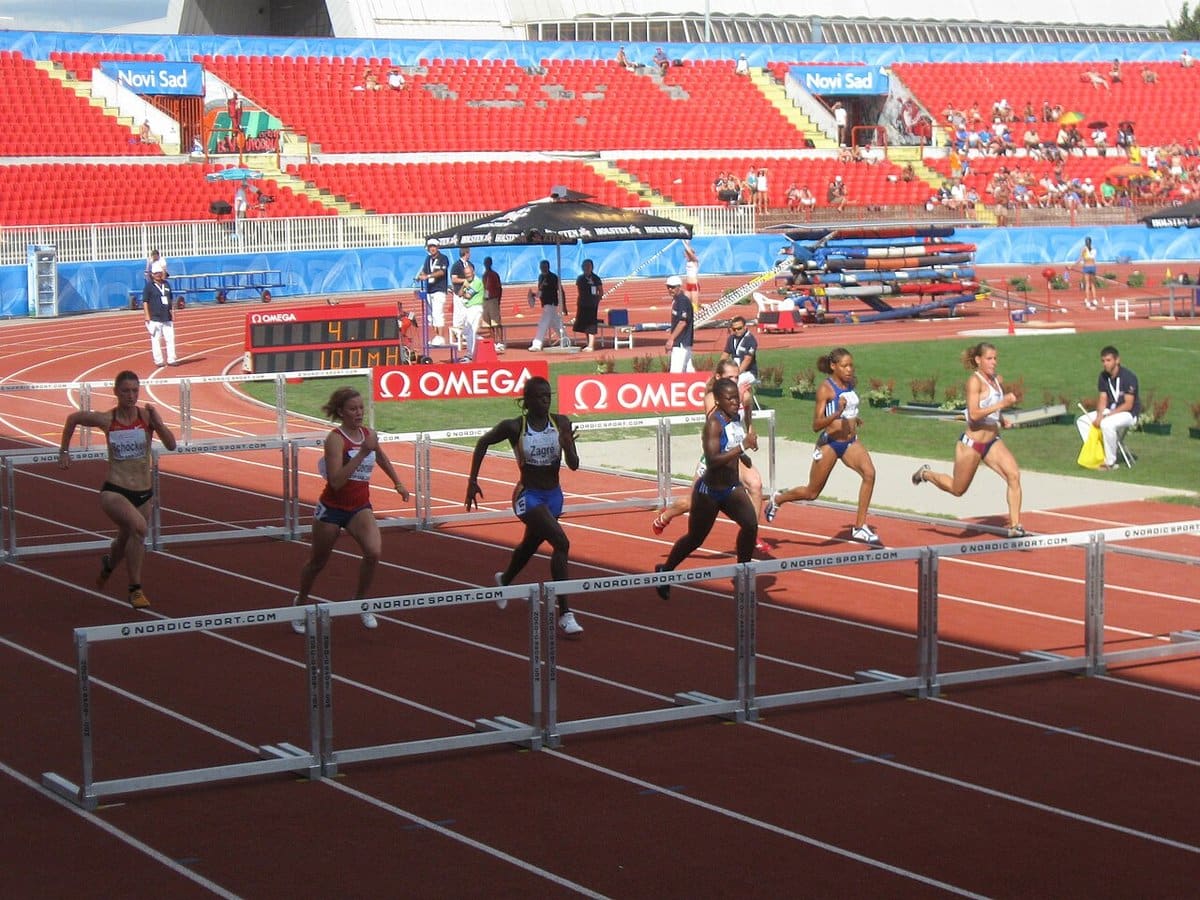
Hurdles and Steeplechase
| Race | Hurdles | Height |
|---|---|---|
| 100 m hurdles (women) | 10 | 0.838 m |
| 110 m hurdles (men) | 10 | 1.067 m |
| 400 m hurdles | 10 | 0.762 m women, 0.914 m men |
| 3000 m steeplechase | 28 barriers and 7 water jumps | 0.762 m women, 0.914 m men |
Knocking down hurdles is allowed and not penalized. Trailing a leg or foot around the side of a hurdle below its height, or knocking one down on purpose, leads to disqualification.
Jumping and Throwing
| Event | Valid attempt |
|---|---|
| Long and triple jump | Take off behind the edge of the board, measured to the nearest mark |
| High jump | Take off from one foot, three failures in a row eliminate |
| Pole vault | Clear the bar, three failures in a row eliminate |
| Shot put | From the circle, the shot stays close to the neck at the start |
| Discus and hammer | From the circle with a cage, land inside the sector |
| Javelin | Over the shoulder, tip lands first inside the sector |
In horizontal jumps and throws, athletes usually get three attempts, and the best eight get three more. In high jump and pole vault, an athlete may pass at any height, and ties are broken by the fewest failures.
Fouls in Field Events
- Stepping over the take off line in a jump.
- Touching the top of the circle rim or leaving it before the implement lands in a throw.
- Leaving the circle through the front half instead of the back.
- Running out of the time limit for an attempt, usually one minute.
High School vs Elite Rules
| Rule | US high school (NFHS) | World Athletics |
|---|---|---|
| False start | Disqualification | Disqualification |
| Implements | Lighter shot and discus | Standard weights |
| Hurdle heights | Lower for girls and boys | Standard heights |
| Field attempts | Usually 3 plus 3 for finalists | 3 plus 3 for the best eight |
Tips for Your First Meet
- Check in at the clerk early. Missing the call means missing the race.
- Learn your steps for field events and mark them on the runway.
- Run through the line. Slowing down before the finish costs places.
- Learn some track and field terms like PR, heat and split.
More Reading
- Track and field lingo and slang
- Track and field equipment list
- History of track and field
- Track and field stadium vs triathlon course
- Common track and field injuries
- Track and field quiz

FAQ
What are the basic rules of track and field?
Runners race in lanes or on the open track, jumpers and throwers get a set number of attempts, and the fastest time or best mark wins. A false start means disqualification.
How many false starts are allowed in track?
None under World Athletics and NFHS rules. The athlete responsible is disqualified.
How long is a relay exchange zone?
30 meters.
Is knocking down a hurdle a penalty?
No, as long as it is not done on purpose.
How many attempts do you get in long jump?
Three, and the best eight get three more.
How is the finish of a race measured?
When the torso reaches the vertical plane of the finish line.
Which races are run in lanes?
All races up to 400 meters, the first bend of the 800 meters, and in the 4 x 400 meter relay the first leg plus the first bend of the second leg.
How are ties broken in high jump?
By the fewest failures at the last height cleared, then the fewest failures overall.


No comments yet
What's your take?
What's your opinion, or think we got something wrong? Tell us and other readers.
Our editors read every comment.