

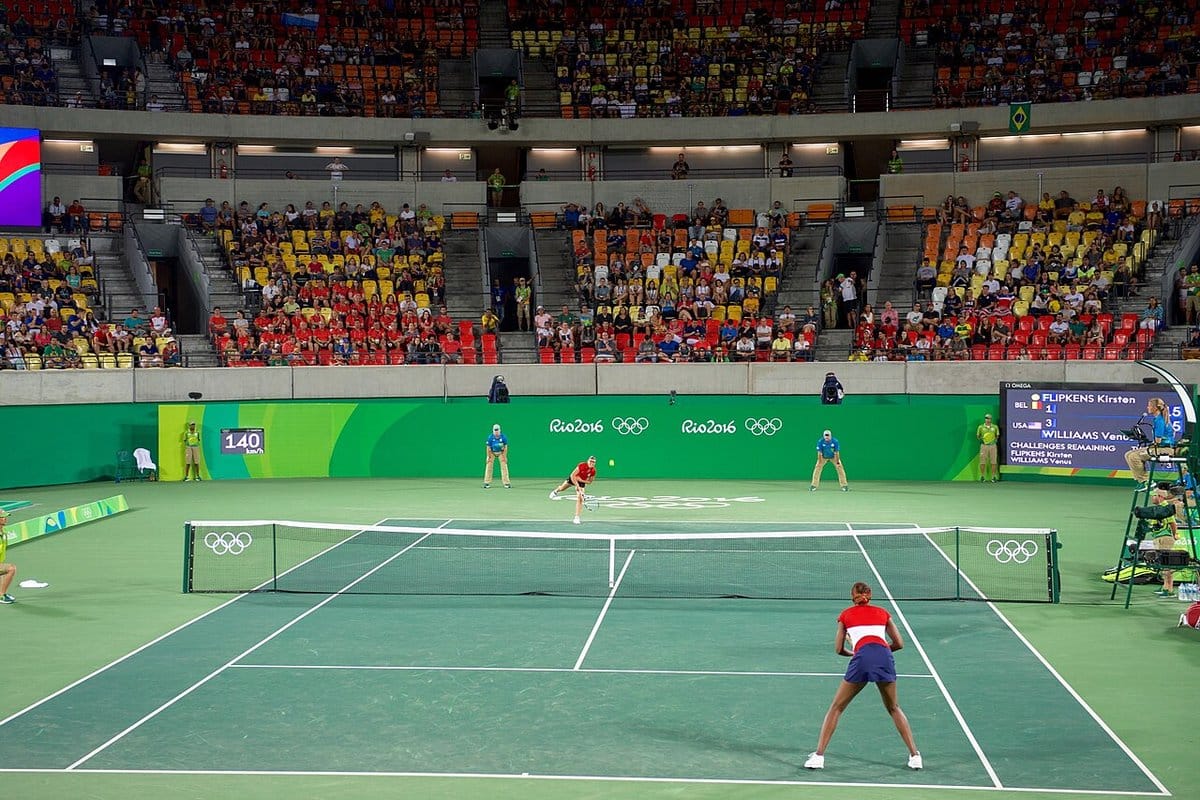
Tennis rules explained: scoring from love to deuce, sets and tiebreaks, serving, faults and lets, singles and doubles lines, plus pro and college formats.
Tennis is easy to start and strange to score. Hitting the ball over the net and into the court is the whole idea, but the scoreboard counts 15, 30 and 40, calls zero “love” and can keep a single game going for ten minutes.
This guide explains the rules in the order you need them on court: the court and the net, scoring points, games and sets, serving, what makes a ball good or out, and doubles. It follows the ITF Rules of Tennis, with a table at the end on how Grand Slams, the pro tours and college matches differ.
Jump to:
- Tennis Rules in 60 Seconds
- The Court and the Net
- How Tennis Scoring Works
- Serving Rules
- How You Win and Lose a Point
- Doubles Rules
- Etiquette and Line Calls
- Grand Slams vs Pro Tours vs College
- Tips for Your First Match

Tennis Rules in 60 Seconds
- Hit it over and in. The ball has to clear the net and land inside the opponent’s court.
- One bounce at most. You may hit the ball before it bounces or after one bounce, never after two.
- Points make games. Love, 15, 30, 40, game. At 40 all, you need two points in a row.
- Games make sets. The first player to six games with a two game lead wins the set. At 6 all, a tiebreak decides it.
- Sets make the match. Most matches are best of three sets. Men’s singles at the Grand Slams are best of five.
The Court and the Net
A tennis court is 78 feet long. The singles court is 27 feet wide, the doubles court 36 feet, because it adds the alleys on both sides. The net is 3 feet high in the center and 3 feet 6 inches at the posts. Each side has two service boxes, left and right, which only matter for the serve.
Lines count as part of the court: a ball that touches any part of a line is in. Our comparison of a tennis court and a badminton court shows how the two compare in size.
Service boxes, net height and the space you need around the court are listed in our guide to tennis court dimensions.
How Tennis Scoring Works
| Points won | Called | Notes |
|---|---|---|
| 0 | Love | The server’s score is always called first |
| 1 | 15 | |
| 2 | 30 | |
| 3 | 40 | |
| 3 each | Deuce | From here a player needs two points in a row |
| Deuce plus one | Advantage | Win the next point to take the game, lose it and it is deuce again |
A set goes to the first player with six games and a lead of two, so 6 to 4 or 7 to 5. At 6 games all, the players play a tiebreak: points are counted 1, 2, 3, and the first to seven points with a two point lead wins the set 7 to 6. In the tiebreak, the first server serves one point, then each player serves two points in turn.
Serving Rules
- The server stands behind the baseline, between the center mark and the sideline, and serves diagonally into the opponent’s service box.
- The first point of every game is served from the right side, then the server alternates sides after each point.
- Fault: the serve misses the box, goes into the net or the server steps on the baseline before hitting the ball, a foot fault. The server gets a second serve.
- Double fault: both serves are faults. The point goes to the receiver.
- Let: the serve clips the net and still lands in the correct box. It is replayed, and the server keeps the same serve.
- Players take turns serving a whole game each, and change ends after the first game and then after every second game of a set.
How You Win and Lose a Point
Once the serve is in, the rally goes on until one player cannot return the ball properly. You lose the point if:
- the ball bounces twice on your side before you hit it,
- your shot hits the net and stays on your side, or lands outside the court,
- you hit the ball before it has crossed the net to your side,
- you, your racket or your clothing touch the net or the opponent’s court while the ball is in play,
- the ball touches you or anything you wear, other than the racket.
A ball that clips the net during a rally and lands in is good and play goes on. Hitting the ball around the net post instead of over the net is also allowed.

Doubles Rules
In doubles, the alleys are in play after the serve, but the serve itself still has to land in the singles service box. Each team decides who serves first, and the four players then serve whole games in rotation: player A, then a player from the other team, then A’s partner, then the fourth player. The receiving team picks who receives on the right and who on the left, and keeps that order for the whole set. During a rally, either partner may hit the ball.
Etiquette and Line Calls
In most club and recreational tennis, there is no umpire. Each player calls the lines on his or her own side, and the rule of thumb is simple: if you are not sure the ball was out, it was in. Call the score before each first serve, wait until a point is over before walking behind another court, and return stray balls between points.
Grand Slams vs Pro Tours vs College
| Rule | Grand Slam singles | ATP and WTA tour singles | Tour doubles | NCAA college |
|---|---|---|---|---|
| Match length | Men best of five, women best of three | Best of three | Best of three, third set replaced by a match tiebreak to 10 | Singles best of three, doubles one set |
| Deciding set | Tiebreak to 10 at 6 all | Tiebreak to 7 at 6 all | Match tiebreak to 10 | Varies by format |
| Deuce | Advantage scoring | Advantage scoring | No-ad: one deciding point at deuce | No-ad scoring in dual matches |
No-ad scoring means that at 40 all the next point wins the game, and the receiving side chooses which side to receive on. Many recreational leagues use it too, because it keeps matches short.
Tips for Your First Match
- Agree on the format before you start: a full set, a tiebreak at 6 all, or a timed match.
- Aim for the middle of the court. Most beginner points are lost on shots that go long or wide, not on great winners.
- Take your time on the second serve. A slower serve that lands is better than a double fault.
- Learn some tennis terms like break point, bagel and moonball.
More Reading
- Tennis lingo and slang
- Tennis equipment list
- History of tennis
- Tennis court vs badminton court
- Common tennis injuries
- Tennis quiz

FAQ
What are the basic rules of tennis?
Players hit the ball over the net into the opponent’s court, letting it bounce at most once. Points add up to games, games to sets, and the player who wins the most sets in a best of three or best of five match wins.
Why is tennis scored 15, 30, 40?
Nobody knows for sure. The most common theory links it to a clock face with quarters at 15, 30 and 45, with 45 later shortened to 40. The rules simply keep the old names.
What does love mean in tennis?
Love means zero. A game won without the opponent scoring is a love game, and a 6 to 0 set is often called a bagel.
What happens at 6 games all?
A tiebreak is played. The first player to seven points with a two point lead wins the set 7 to 6. Grand Slams play the final set tiebreak to ten points.
How many serves do you get in tennis?
Two. If the first serve is a fault, you get a second one. Missing both is a double fault and loses the point. A let is replayed without counting.
Is a ball on the line in or out in tennis?
In. Any part of the ball touching any part of the line counts as in.
Can you hit the ball before it bounces in tennis?
Yes, that is a volley, and it is allowed on every shot except the return of serve, which must bounce first.
Do the doubles alleys count on the serve?
No. The serve must land in the singles service box. The alleys only come into play once the serve has been returned.


No comments yet
What's your take?
What's your opinion, or think we got something wrong? Tell us and other readers.
Our editors read every comment.