

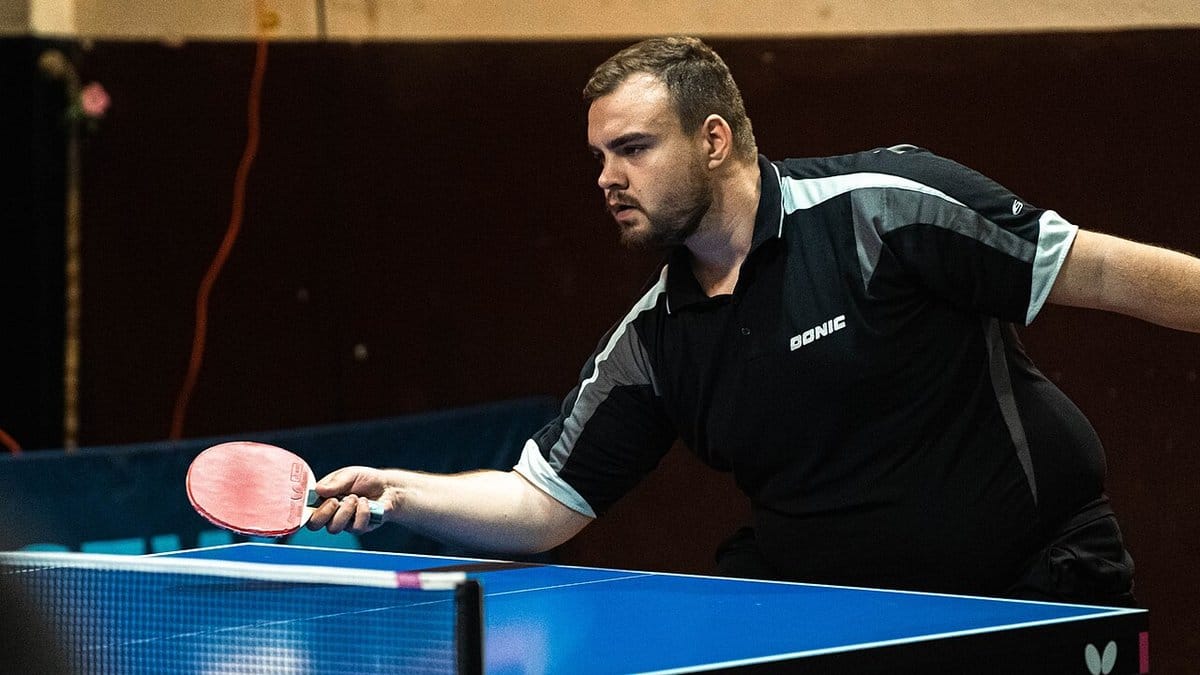
Table tennis rules explained: scoring to 11, the legal serve, who serves when, doubles order, edge balls, lets and faults, plus how official play differs.
Table tennis, or ping pong, is played in basements and garages everywhere, often with house rules that go back decades: games to 21, five serves each, or the rule that the serve has to bounce in the right half. Official table tennis changed a lot of that around the year 2000.
This guide explains the current rules from the International Table Tennis Federation in the order you need them: the table, scoring, the legal serve, the rally, doubles and the most common faults. At the end you will find a table that compares official and old house rules.
Jump to:
- Table Tennis Rules in 60 Seconds
- The Table, Net and Ball
- Scoring
- The Legal Serve
- Who Serves When
- The Rally
- Doubles Rules
- Timing and Expedite Rule
- Official Rules vs Old House Rules
- Tips for Your First Match

Table Tennis Rules in 60 Seconds
- Games to 11. The first player to 11 points wins the game, but you must win by two.
- Two serves each. Players switch serve every two points, and every point at 10 all.
- Serve with a toss. The ball goes up from the open palm at least 16 cm and bounces once on each side.
- One bounce, then hit. In a rally, the ball bounces once on your side and you return it directly onto the other side.
- Best of five or seven. Matches are won by taking three of five or four of seven games.
The Table, Net and Ball
A regulation table is 2.74 meters long, 1.525 meters wide and 76 cm high. The net is 15.25 cm high across its full length. A white center line divides each half for doubles serves. Official balls are 40 mm plastic balls, white or orange.
Table tennis needs a surprising amount of space around the table. Our comparison of a fencing piste and a table tennis court shows the whole playing area.
Table height, net height and the playing area around the table are listed in our guide to ping pong table dimensions.
Scoring
Every rally scores a point, no matter who served. A game goes to 11, and at 10 all a player needs a two point lead, so games can end 12 to 10 or 15 to 13. Players change ends after each game, and in the deciding game of a match when the first player reaches 5 points.
The Legal Serve
- The ball rests on the open, flat palm of the free hand, behind the end line and above the level of the table.
- The server tosses it nearly vertically, without spin, so that it rises at least 16 cm.
- The ball is struck as it falls, so that it bounces once on the server’s side and then once on the receiver’s side.
- The ball must stay visible to the receiver the whole time. The server may not hide it with the body or the free arm.
- In singles, the serve may go anywhere on the receiver’s side. In doubles, it goes from the right half to the right half, diagonally.
If the serve touches the net and then lands correctly, it is a let and is replayed, as many times as it happens.
Who Serves When
The right to serve first is decided by lot, often a coin toss or guessing which hand holds the ball. Each player serves two points, then the other player serves two. At 10 all, the players alternate after every point. In the next game, the player who received first in the previous game serves first.
The Rally
After the serve, each player must hit the ball after it bounces once on their side, and return it so that it lands on the opponent’s side, directly or after touching the net. You lose the point if:
- you miss the ball or it bounces twice on your side,
- your return misses the table or does not clear the net,
- you hit the ball before it bounced on your side while it is above the table or heading toward it,
- you touch the net or move the table while the ball is in play,
- your free hand touches the playing surface,
- you hit the ball twice in a row.
A ball that clips the top edge of the table is good. A ball that only touches the side of the table below the playing surface is out.

Doubles Rules
In doubles, partners must hit the ball in strict alternation: server, receiver, server’s partner, receiver’s partner, and so on. Hitting out of turn loses the point. The serve always goes diagonally from the right half, and after every two points the receiver becomes the server and the previous server’s partner becomes the receiver.
Timing and Expedite Rule
If a game is not finished after 10 minutes, unless at least 18 points have been scored in total, the expedite system starts. The players then serve one point each in turn, and the receiver wins the point if he or she makes 13 good returns in a row. It stops pushers from dragging out a game indefinitely and stays in force for the rest of the match.
Official Rules vs Old House Rules
| Rule | ITTF today | Old house rules |
|---|---|---|
| Points per game | 11, win by two | 21, win by two |
| Serves per turn | 2 | 5 |
| Serve placement in singles | Anywhere on the opponent half | Often diagonally only |
| Serve toss | Open palm, at least 16 cm | Anything goes |
| Ball | 40 mm plastic | 38 mm or 40 mm celluloid |
Tips for Your First Match
- Learn a short, low serve first. A high serve is easy to attack.
- Stand about an arm’s length from the table with your knees bent.
- Watch the opponent’s paddle at contact to read the spin.
- Learn some table tennis terms like loop, chop and pips.
More Reading
- Table Tennis lingo and slang
- Table Tennis equipment list
- History of table tennis
- Fencing piste vs table tennis court
- Common table tennis injuries
- Table Tennis quiz

FAQ
What are the basic rules of table tennis?
Players hit a light ball over the net onto the opponent’s half of the table, letting it bounce once on their own side. Each rally scores a point, games go to 11 with a two point lead, and players serve two points each.
How many serves do you get in ping pong?
Two per turn under official rules, then the opponent serves two. At 10 all, the serve changes after every point.
Does the serve have to go diagonal in table tennis?
Only in doubles, from right half to right half. In singles, it may land anywhere on the receiver’s side.
Is an edge ball a point?
Yes, if it touches the top edge of the table. A ball that only hits the side below the surface is out.
Can you touch the table in table tennis?
You may touch it with your body, but your free hand may not touch the playing surface, and you may not move the table during a rally.
Can you hit the ball before it bounces in ping pong?
No. Volleying the ball over the table or as it comes toward it loses the point.
How many points is a table tennis game?
11 points, won by two. Before 2001, official games were played to 21.
What happens if the serve hits the net?
If it lands correctly on the receiver’s side, it is a let and the serve is replayed.


No comments yet
What's your take?
What's your opinion, or think we got something wrong? Tell us and other readers.
Our editors read every comment.