


Competitive swimming rules explained: the four strokes, false starts, turns and finishes, the 15 meter rule, relays, disqualifications, and pool lengths.
A swim race looks like a simple test of speed, but each stroke has strict rules for the kick, the arms, the turns and the finish. Breaking one of them means disqualification, even for the swimmer who touches the wall first.
This guide follows the rules of World Aquatics, which USA Swimming and the NCAA largely adopt. It explains the four strokes, starts, turns, relays and the most common reasons swimmers get disqualified.
Jump to:
- Swimming Rules in 60 Seconds
- The Pool
- The Four Strokes
- Starts and False Starts
- Turns and the 15 Meter Rule
- Medley and Relays
- Common Disqualifications
- Age Group vs Elite Swimming
- Tips for Your First Meet

Swimming Rules in 60 Seconds
- Four strokes. Freestyle, backstroke, breaststroke and butterfly.
- One start only. A false start means disqualification.
- 15 meters underwater. After the start and each turn, the head must break the surface by 15 meters, except in breaststroke.
- Touch the wall. Every turn and finish needs a touch.
- Stay in your lane. Swimmers may not obstruct others.
The Pool
| Course | Length | Where |
|---|---|---|
| Long course | 50 m | Olympics and world championships |
| Short course meters | 25 m | Short course world championships |
| Short course yards | 25 yd | US high school and college |
Olympic pools have eight or ten lanes, each about 2.5 meters wide. Backstroke flags hang 5 meters from each wall so backstrokers know when the wall is close.
Lane width, pool depth, the 15 meter marks and the backstroke flags are listed in our guide to swimming pool dimensions.
The Four Strokes
| Stroke | Key rules |
|---|---|
| Freestyle | Any stroke allowed. Swimmers must touch the wall at each turn and the finish |
| Backstroke | On the back except while turning. Start in the water |
| Breaststroke | Arms and legs move together and in the same plane, no flutter or dolphin kick except one at the start and each turn |
| Butterfly | Both arms move together, dolphin kick only, no breaststroke kick |
In breaststroke and butterfly, swimmers must touch the wall with both hands at the same time at each turn and the finish. In backstroke and freestyle, any part of the body may touch.
Starts and False Starts
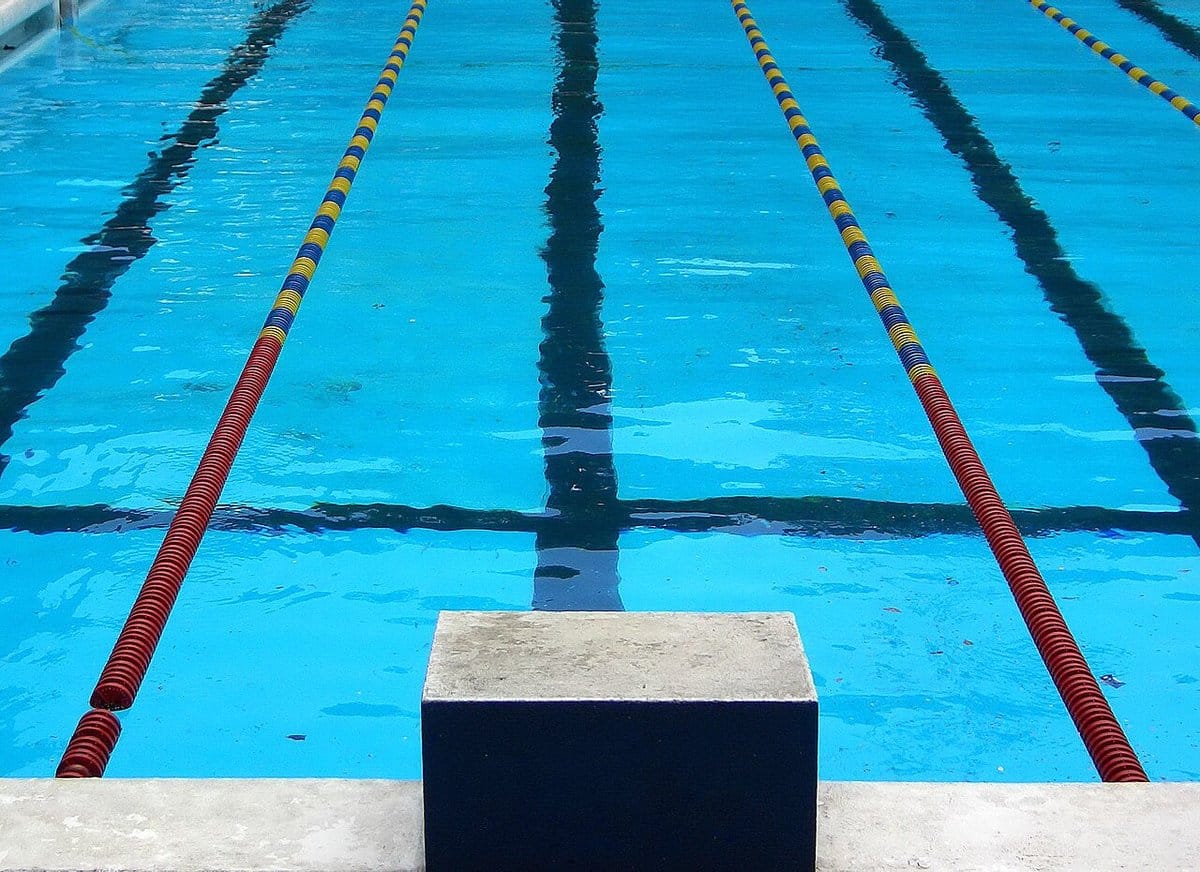
Swimmers step onto the blocks at a long whistle, and the starter says “take your mark”. They must hold still until the start signal. World Aquatics and USA Swimming use a one start rule: any swimmer who moves before the signal is disqualified, even if the race is not stopped.
Turns and the 15 Meter Rule
- Flip turns: allowed in freestyle and backstroke. The swimmer must touch the wall with some part of the body.
- Open turns: required in breaststroke and butterfly, with a two hand touch.
- Backstroke turn: swimmers may roll onto the front just before the wall, but must be back on the back after leaving it.
- 15 meter rule: in freestyle, backstroke and butterfly, the head must break the surface within 15 meters after the start and each turn.
- Breaststroke pullout: one arm pull, one dolphin kick and one breaststroke kick underwater are allowed after the start and each turn.
Medley and Relays
| Event | Order of strokes |
|---|---|
| Individual medley | Butterfly, backstroke, breaststroke, freestyle |
| Medley relay | Backstroke, breaststroke, butterfly, freestyle |
| Freestyle relay | Four freestyle legs |
In relays, the next swimmer may leave the block only after the incoming swimmer has touched the wall. Touch pads measure the exchange, and leaving too early disqualifies the whole team.
Common Disqualifications
| DQ | Stroke |
|---|---|
| False start | All |
| One hand touch | Breaststroke, butterfly |
| Flutter or dolphin kick | Breaststroke |
| Alternating kick | Butterfly |
| Past vertical toward the front | Backstroke, outside the turn |
| Surfacing after 15 m | Freestyle, backstroke, butterfly |
| Early relay exchange | Relays |
Age Group vs Elite Swimming
| Rule | Age group (USA Swimming) | Elite |
|---|---|---|
| False starts | One start rule | One start rule |
| Timing | Touch pads or hand timing | Touch pads, hundredths of a second |
| Officials | Stroke and turn judges | Full panel and video review |
| Suits | Tech suits limited for 12 and under | Approved World Aquatics suits only |
Tips for Your First Meet
- Practice your turns. Most young swimmers are disqualified on turns, not strokes.
- Listen for the long whistle and stay still on the blocks.
- Know your heat and lane before your event is called.
- Learn some swimming terms like heat, split and taper.
More Reading
- Swimming lingo and slang
- Swimming equipment list
- History of swimming
- Swimming pool vs water polo pool
- Common swimming injuries
- Swimming quiz

FAQ
What are the basic rules of competitive swimming?
Swimmers race in their own lane using freestyle, backstroke, breaststroke or butterfly. Each stroke has rules for arms, legs, turns and the finish, and a false start means disqualification.
What is the 15 meter rule in swimming?
In freestyle, backstroke and butterfly, the head must break the surface within 15 meters after the start and each turn.
How many false starts are allowed in swimming?
None. Under the one start rule, a swimmer who moves early is disqualified.
Do you have to touch the wall in swimming?
Yes, at every turn and the finish. Breaststroke and butterfly need a two hand touch.
What is the order of the individual medley?
Butterfly, backstroke, breaststroke, freestyle.
What is the order of the medley relay?
Backstroke, breaststroke, butterfly, freestyle.
Can you do a flip turn in breaststroke?
No. Breaststroke and butterfly need a two hand touch, so swimmers use an open turn.
How long is an Olympic pool?
50 meters.


No comments yet
What's your take?
What's your opinion, or think we got something wrong? Tell us and other readers.
Our editors read every comment.