

Swimming pool dimensions with diagram: 50 x 25 m Olympic pool, lane width, depth, volume in gallons, 25 yard and 25 m pools and backyard pool sizes.
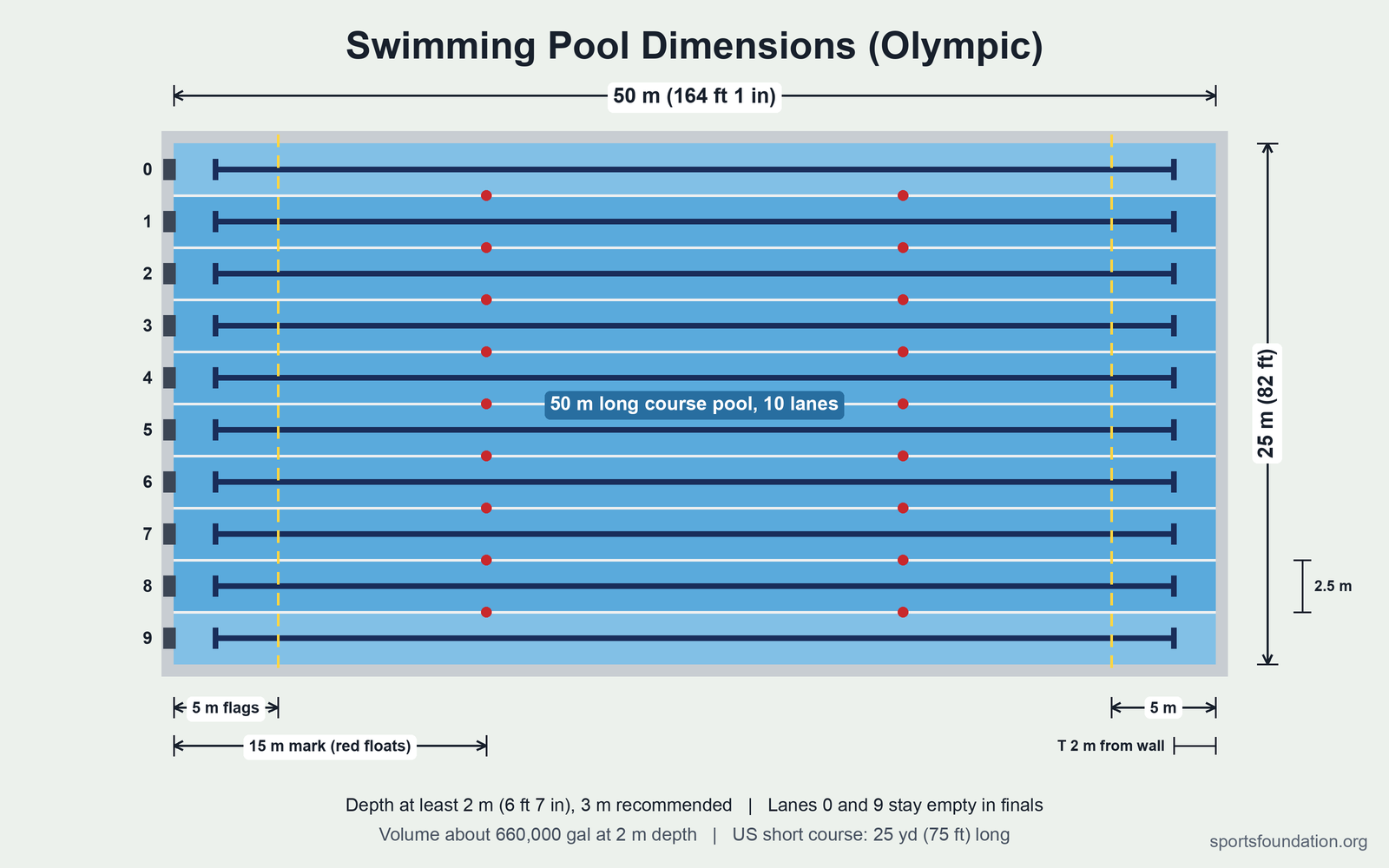
An Olympic swimming pool is 50 meters long and 25 meters wide (164 x 82 feet), with 10 lanes of 2.5 meters each. At the Olympic Games and World Championships the water must be at least 2 meters (6 ft 7 in) deep, and 3 meters is recommended. The often quoted volume of 660,000 US gallons assumes a depth of 2 meters; at 3 meters, an Olympic pool holds about 990,000 gallons.
Most competition pools in the United States are shorter. High school and college swimming takes place in 25 yard pools (75 feet), and many community pools are 25 meters long. Below are all the measurements of a competition pool, with a diagram drawn to scale, plus the common sizes of backyard pools.
Jump to:
- Swimming Pool Dimensions at a Glance
- How Long Is an Olympic Swimming Pool?
- How Wide Is an Olympic Swimming Pool?
- How Deep Is an Olympic Swimming Pool?
- How Many Gallons Are in an Olympic Swimming Pool?
- Lanes, Lines and Markings
- Short Course Pools: 25 Meters and 25 Yards
- Backyard and Residential Pool Sizes
- Swimming Pool vs Water Polo Pool

Swimming Pool Dimensions at a Glance
| Measurement | Olympic pool | Feet |
|---|---|---|
| Length | 50 m | 164 ft 1 in |
| Width | 25 m | 82 ft |
| Surface area | 1,250 sq m | 13,455 sq ft |
| Lanes | 10 (numbered 0 to 9) | 8 used in finals |
| Lane width | 2.5 m | 8 ft 2 in |
| Minimum depth (Olympics, Worlds) | 2 m | 6 ft 7 in |
| Recommended depth | 3 m | 9 ft 10 in |
| Volume at 2 m depth | 2,500 cu m | About 660,000 gal |
| Volume at 3 m depth | 3,750 cu m | About 990,000 gal |
| Backstroke flags from each wall | 5 m | 16 ft 5 in |
| Underwater limit mark | 15 m | 49 ft 3 in |
| Starting block height above water | 0.5 to 0.75 m | 20 to 30 in |
| Water temperature | 25 to 28 °C | 77 to 82 °F |
Watch: How Big Is an Olympic Swimming Pool Compared to Other Sports?
This short animation draws the Olympic swimming pool with its official lines and measurements, then lines it up with 36 other sports surfaces at the same scale, smallest to largest.
How Long Is an Olympic Swimming Pool?
An Olympic pool, also called a long course pool, is 50 meters long, about 164 feet 1 inch. World Aquatics requires exactly 50 meters between the touch pads at both ends, so the basin is built slightly longer to leave room for the electronic timing pads. A 100 meter race is two lengths and the 1500 meter freestyle is 30 lengths. One mile of swimming is about 32 lengths of a long course pool.
How Wide Is an Olympic Swimming Pool?
An Olympic pool is 25 meters wide (82 feet). That width holds 10 lanes of 2.5 meters (8 ft 2 in), numbered 0 to 9. In a final with eight swimmers, only lanes 1 to 8 are used, and the two outside lanes stay empty as a buffer that absorbs waves bouncing off the side walls. The fastest qualifier swims in lane 4. Many older 50 meter pools have only 8 lanes and are narrower.
How Deep Is an Olympic Swimming Pool?
World Aquatics sets a minimum depth of 2 meters (6 ft 7 in) for pools used at the Olympic Games and World Championships and recommends 3 meters (9 ft 10 in). Most new pools for major events are built 2.5 to 3 meters deep; the temporary pool at the Paris 2024 Olympics was only 2.15 meters deep and was widely called slow. Deep water is faster water: waves created by the swimmers lose energy before they reach the bottom and bounce back, so the surface stays calmer. For other competitions the rules allow shallower pools, with about 1.35 meters (4 ft 5 in) required in front of the starting blocks.
In US high school swimming, NFHS rules require at least 4 feet (1.22 m) of water at the starting end before swimmers may start from the blocks. In shallower pools, races start from the deck or in the water. Diving wells are much deeper, at about 5 meters (16 ft 5 in) below a 10 meter platform.
How Many Gallons Are in an Olympic Swimming Pool?
The volume of a pool is length x width x depth. At a uniform depth of 2 meters, an Olympic pool holds 50 x 25 x 2 = 2,500 cubic meters, which is 2.5 million liters or about 660,000 US gallons. That figure is the “Olympic-size swimming pool” often used as a unit for large amounts of water. The water alone weighs about 2,500 metric tons, roughly 2,750 short tons.
| Depth | Cubic meters | US gallons |
|---|---|---|
| 2 m (6 ft 7 in) | 2,500 | About 660,000 |
| 2.5 m (8 ft 2 in) | 3,125 | About 825,000 |
| 3 m (9 ft 10 in), recommended | 3,750 | About 990,000 |
Lanes, Lines and Markings
Each lane has a dark line on the pool bottom along its center, 0.2 to 0.3 meters wide. It ends 2 meters before each wall in a T with a crossbar 1 meter long, and a matching target on the end wall shows swimmers where to turn. Lane ropes between the lanes are made of spinning discs that calm the waves.
Two more markings matter for the rules. Backstroke flags hang about 1.8 meters (6 feet) above the water, 5 meters from each wall, so backstrokers can count their strokes into the turn. A colored float on each lane rope marks 15 meters from each wall: in freestyle, backstroke and butterfly, swimmers must surface before that point after the start and each turn. Starting blocks stand 0.5 to 0.75 meters above the water.
Short Course Pools: 25 Meters and 25 Yards
A short course pool is half the length of an Olympic pool. Swimming records are kept separately for each pool length, because short course races have more turns, and a push off the wall is faster than open swimming. A 100 yard race is only 91.44 meters, so yard times are not comparable to meter times either.
| Pool | Length | Where it is used |
|---|---|---|
| Long course meters (LCM) | 50 m (164 ft) | Olympics, World Championships, US summer season |
| Short course meters (SCM) | 25 m (82 ft) | Short course Worlds, most pools outside the US |
| Short course yards (SCY) | 25 yd (75 ft / 22.86 m) | NCAA, US high school, US winter club season |
Many US college pools are built as stretch pools: 50 meters long and 25 yards wide. With the lanes running the long way, they host long course meets; turned across, the same water becomes a 25 yard course. Movable bulkheads can also split a 50 meter pool into two shorter courses. Lanes in US yard pools are typically 7 to 9 feet wide, narrower than the 2.5 meters of an Olympic pool.
Backyard and Residential Pool Sizes
There is no standard size for a home pool. Rectangular inground pools are commonly built from 12 x 24 feet to 20 x 40 feet, with 16 x 32 feet a popular middle size. A typical pool runs from 3 to 4 feet deep at the shallow end to 5 to 8 feet at the deep end. To estimate the volume in gallons, multiply length x width x average depth in feet by 7.48.
| Pool size | Surface area | Gallons at 5 ft average depth |
|---|---|---|
| 12 x 24 ft | 288 sq ft | About 10,800 |
| 14 x 28 ft | 392 sq ft | About 14,700 |
| 16 x 32 ft | 512 sq ft | About 19,100 |
| 20 x 40 ft | 800 sq ft | About 29,900 |
A home lap pool is usually 40 to 75 feet long and 8 to 10 feet wide, enough for one swimmer at a time. An Olympic pool covers about 26 times the surface of a 16 x 32 foot backyard pool.
Swimming Pool vs Water Polo Pool
Water polo is played on a marked field inside a pool: since 2025, 25 x 20 meters for men and women at World Aquatics events (men played on 30 x 20 meters before), with at least 2 meters of water at the Olympics. A deep 50 meter pool has room for a full field, which is one reason new competition pools are built deep from end to end. The details are in swimming pool vs water polo pool and in water polo pool dimensions.
| Venue | Size | Area | Compared to an Olympic pool |
|---|---|---|---|
| Olympic pool | 50 x 25 m | 1,250 sq m (13,455 sq ft) | Same |
| Water polo field (since 2025) | 25 x 20 m | 500 sq m (5,382 sq ft) | 0.4 times |
| Water polo field (men, until 2024) | 30 x 20 m | 600 sq m (6,458 sq ft) | About 0.48 times |
| Basketball court (NBA) | 28.65 x 15.24 m | 437 sq m (4,700 sq ft) | About 0.35 times |
| Hockey rink (NHL) | 61 x 26 m | About 1,510 sq m (16,300 sq ft) | About 1.2 times |
The rules for starts, turns and strokes are explained in swimming rules. For other venues, see running track dimensions and basketball court dimensions.
More Reading
- Swimming rules: how races work
- Swimming pool vs water polo pool
- Swimming equipment list
- Swimming lingo and slang
- The most important swimming competitions
- Swimming quiz

FAQ
How big is an Olympic swimming pool?
An Olympic pool is 50 meters long and 25 meters wide (164 x 82 feet), with 10 lanes of 2.5 meters each.
How deep is an Olympic swimming pool?
At least 2 meters (6 ft 7 in) for the Olympic Games and World Championships. World Aquatics recommends 3 meters.
How many gallons are in an Olympic swimming pool?
About 660,000 US gallons at a depth of 2 meters and about 990,000 gallons at the recommended depth of 3 meters.
How long is a high school swimming pool?
High school and college pools in the US are 25 yards (75 feet) long. Many college pools are 50 meters long and 25 yards wide.
How wide is a lane in a swimming pool?
Lanes in an Olympic pool are 2.5 meters (8 ft 2 in) wide. Lanes in US yard pools are typically 7 to 9 feet wide.
How many lengths is a mile in a pool?
About 32 lengths of a 50 meter pool, 64 lengths of a 25 meter pool and 70 lengths of a 25 yard pool. The 1,650 yard freestyle, 66 lengths, is called the mile in US swimming.
What is the difference between long course and short course?
Long course pools are 50 meters long. Short course pools are 25 meters, or 25 yards in the US. Records are kept separately for each.
What size is a typical backyard pool?
Common inground pools range from 12 x 24 feet to 20 x 40 feet, with 16 x 32 feet a popular middle size.


No comments yet
What's your take?
What's your opinion, or think we got something wrong? Tell us and other readers.
Our editors read every comment.