

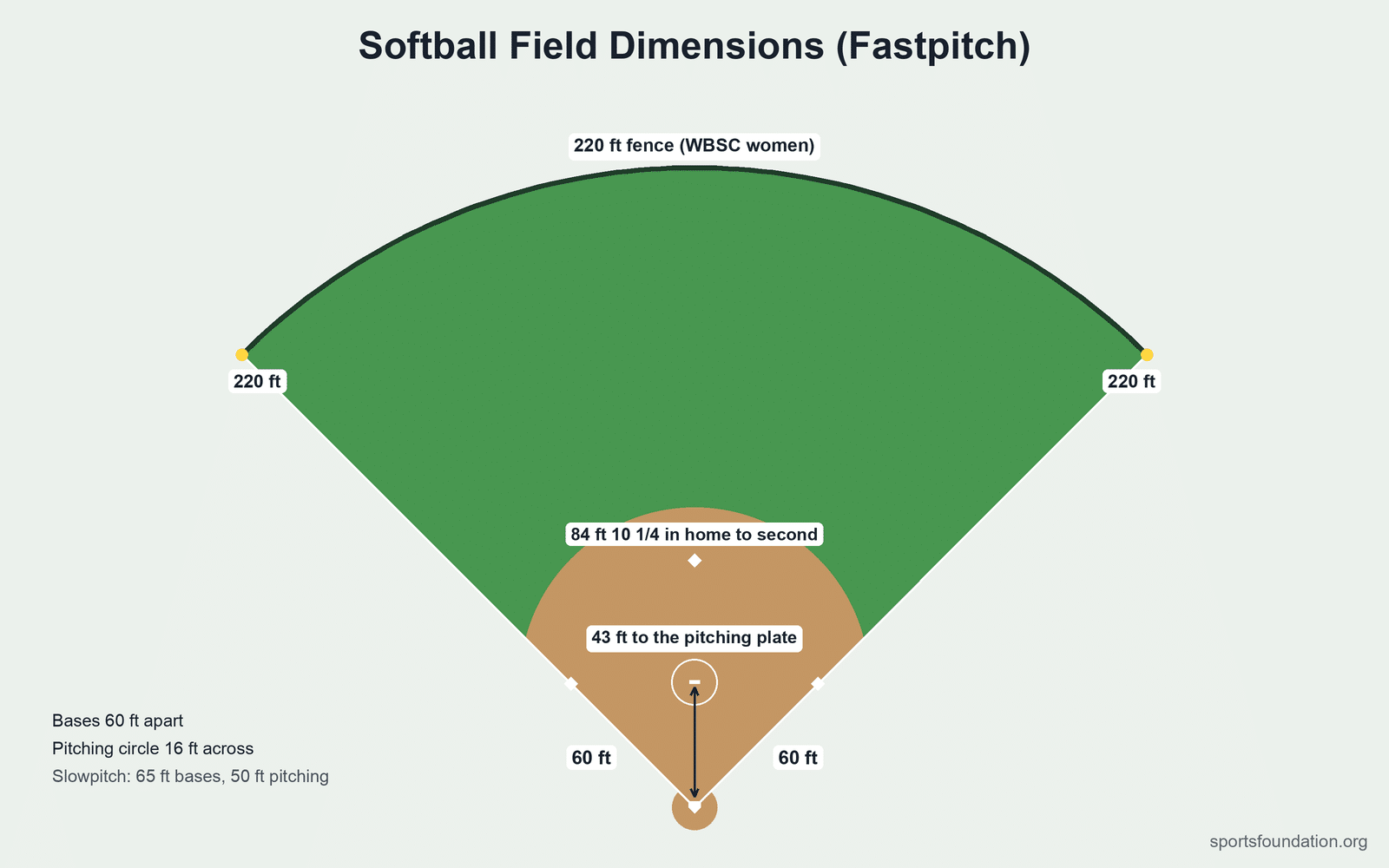
Softball field dimensions with diagram: 60 ft bases, 43 ft pitching distance, pitching circle, fence distances and how fastpitch and slowpitch differ.
A fastpitch softball field has bases 60 feet apart and a pitching distance of 43 feet for high school, college and international women’s play. Slowpitch fields use 65 or 70 foot bases and usually a 50 foot pitching distance. Outfield fences are typically between 200 and 220 feet from home plate in women’s fastpitch.
The field looks like a smaller baseball diamond, but there is no raised mound: the pitcher stands in a flat circle. This page covers every measurement, from the diamond to the fences, for fastpitch, slowpitch and youth softball.
Jump to:
- Softball Field Dimensions at a Glance
- How Far Apart Are the Bases in Softball?
- Pitching Distance by Level
- The Pitching Circle
- Outfield Fence Distances
- How Big Is a Softball Field?
- Fastpitch vs Slowpitch Fields
- Softball Field vs Baseball Field

Softball Field Dimensions at a Glance
| Measurement | Fastpitch | Slowpitch |
|---|---|---|
| Distance between bases | 60 ft (18.29 m) | 65 or 70 ft |
| Pitching distance | 43 ft (13.11 m) | 50 ft (15.24 m) |
| Home plate to second base | 84 ft 10 1/4 in | 91 ft 11 in (65 ft bases) |
| Pitching circle | 16 ft diameter | 16 ft diameter |
| Pitcher’s plate | 24 x 6 in | 24 x 6 in |
| Double first base | 15 x 30 in | 15 x 30 in |
| Fence (international women) | 220 ft (67.06 m) | Varies |
Watch: How Big Is a Softball Field Compared to Other Sports?
This short animation draws the softball field with its official lines and measurements, then lines it up with 36 other sports surfaces at the same scale, smallest to largest.
How Far Apart Are the Bases in Softball?
In fastpitch softball, the bases are 60 feet apart at every level from 10U to college and the Olympics. Slowpitch softball uses 65 or 70 feet, depending on the league and division. Home plate to second base is 84 feet 10 1/4 inches on a 60 foot diamond.
Many softball fields use a double first base: a white base inside fair territory and an orange or colored base next to it in foul territory, together 15 by 30 inches. The fielder uses the white half, the batter runs to the colored half, which avoids collisions at first.
Pitching Distance by Level
The pitching distance is measured from the back point of home plate to the front edge of the pitcher’s plate. In fastpitch it grows with the age of the players:
| Level | Pitching distance | Bases |
|---|---|---|
| 10U fastpitch | 35 ft | 60 ft |
| 12U fastpitch | 40 ft | 60 ft |
| 14U and up, high school, college | 43 ft | 60 ft |
| Men’s fastpitch | 46 ft | 60 ft |
| Adult slowpitch | 50 ft | 65 or 70 ft |
The Pitching Circle
Softball has no mound. The pitcher’s plate lies flat in the middle of a circle 16 feet in diameter. The circle matters for the look back rule: once the pitcher has control of the ball inside the circle, runners must either advance or return to a base, unless the pitcher makes a play on a runner. The pitcher’s plate itself is 24 inches wide and 6 inches deep, the same as in baseball.
Outfield Fence Distances
Under international rules, the fence in women’s fastpitch is 220 feet (67.06 meters) from home plate and 250 feet in men’s fastpitch. NCAA rules set minimums of about 190 feet down the lines and 220 feet to center field with a 6 foot fence. High school and recreation fields are often around 200 feet. Slowpitch fields need more room because the ball is hit farther, and many adult slowpitch fields have fences of 275 to 300 feet.
How Big Is a Softball Field?
With fences 200 to 220 feet away, the fair territory of a fastpitch field covers roughly 0.7 to 0.9 acres. A full baseball field has about three times as much fair territory. That is why many parks fit two or four softball fields in a cloverleaf, with the home plates in the middle.
Fastpitch vs Slowpitch Fields
The two versions share the same basic shape, but slowpitch uses a bigger diamond and a longer pitching distance. Slowpitch pitches are lobbed in a high arc, so a longer distance does not slow the game, and the longer base paths and deeper fences account for the harder contact. How each version is played is explained in softball rules.
Softball Field vs Baseball Field
A softball field is about two thirds the size of a baseball field in its base paths and roughly 60 percent in its fence distances. The full comparison is in softball field vs baseball stadium, and all baseball measurements are in baseball field dimensions.
| Measurement | Fastpitch softball | Baseball (MLB) |
|---|---|---|
| Bases | 60 ft | 90 ft |
| Pitching distance | 43 ft | 60 ft 6 in |
| Pitching area | Flat 16 ft circle | 18 ft mound, 10 in high |
| Fences | About 200 to 220 ft | 325 to 400+ ft |
More Reading
- Softball rules: how to play
- Baseball stadium vs softball field
- Softball positions explained
- Softball equipment list
- Softball lingo and slang
- Softball quiz

FAQ
How far apart are the bases in softball?
The bases are 60 feet apart in fastpitch softball. Slowpitch uses 65 or 70 feet, depending on the league.
What is the pitching distance in fastpitch softball?
43 feet for 14U and older, high school, college and international women’s softball. Younger players pitch from 35 or 40 feet.
What is the pitching distance in slowpitch softball?
Adult slowpitch is usually pitched from 50 feet.
How big is the pitching circle in softball?
The pitching circle is 16 feet in diameter, with the pitcher’s plate in the center.
How far are the fences on a softball field?
In international women’s fastpitch the fence is 220 feet from home plate. NCAA minimums are about 190 feet down the lines and 220 feet to center, high school fields are often around 200 feet.
Does softball have a pitcher’s mound?
No. Softball pitchers throw from a flat pitcher’s plate inside a 16 foot circle.
How far is it from home plate to second base in softball?
On a 60 foot fastpitch diamond, home plate to second base is 84 feet 10 1/4 inches.
What is a double first base?
A 15 x 30 inch base with a white half in fair territory for the fielder and a colored half in foul territory for the batter.


No comments yet
What's your take?
What's your opinion, or think we got something wrong? Tell us and other readers.
Our editors read every comment.