

Soccer rules explained: game length, offside, fouls, free kicks, penalties, cards, throw-ins and corners, plus small-sided rules for youth soccer.
Soccer is the easiest sport in the world to start playing: put down two goals, roll out a ball and do not use your hands. The official game adds a few rules on top, and one of them, offside, is responsible for most of the arguments in the stands.
This guide follows the Laws of the Game written by the IFAB, which apply from the World Cup down to local leagues, and explains them in the order they come up in a match: the basics, the restarts, offside, fouls, cards and how ties are decided. At the end you will find the small-sided formats used in US youth soccer.
Jump to:
- Soccer Rules in 60 Seconds
- The Field and the Ball in Play
- Kickoff and Restarts
- Offside, Explained
- Handball
- Fouls and Free Kicks
- Yellow and Red Cards
- Substitutions and Goalkeepers
- How Tied Games Are Decided
- Youth Soccer: Small-Sided Games
- Tips for Watching Your First Game

Soccer Rules in 60 Seconds
- Eleven players per side, one of them the goalkeeper.
- No hands. Only the goalkeeper may handle the ball, and only inside his or her own penalty area.
- 90 minutes. Two halves of 45 minutes, plus stoppage time added by the referee.
- Score goals. A goal counts when the whole ball crosses the goal line between the posts and under the crossbar.
- Most goals wins. League games may end in a draw. Knockout games go to extra time and penalties.
The Field and the Ball in Play
A full size field is a rectangle bounded by two touchlines on the long sides and two goal lines at the ends. Each half has a penalty area 18 yards deep with a smaller goal area inside it, a penalty mark 12 yards from goal and a center circle with a radius of 10 yards. The ball is out of play only when the whole ball has crossed a line, on the ground or in the air.
Field sizes vary within a range, which is why a soccer field and an American football field differ so much. Our comparison of an American football field and a soccer field has the numbers.
Official size ranges, the penalty area, the goal and youth field sizes are listed in our guide to soccer field dimensions.
Kickoff and Restarts
| Restart | When | How |
|---|---|---|
| Kickoff | Start of each half and after a goal | From the center mark, the ball may go in any direction and a goal can be scored directly |
| Throw-in | Ball crosses a touchline | Two hands, from behind and over the head, both feet on or behind the line |
| Goal kick | Attackers last touched the ball over the goal line | From anywhere in the goal area |
| Corner kick | Defenders last touched the ball over their own goal line | From the corner arc on that side |
| Free kick | After a foul or other offense | Direct or indirect, opponents 10 yards away |
| Penalty kick | Direct free kick offense by the defense in its own penalty area | From the penalty mark, only the kicker and the goalkeeper involved |
| Dropped ball | Play was stopped without a foul, for example for an injury | Dropped for one player of the team that last touched it |
A player cannot be offside directly from a throw-in, a goal kick or a corner kick, and a goal cannot be scored directly from a throw-in.
Offside, Explained
A player is in an offside position if any part of the head, body or feet is in the opponent half and closer to the opponent goal line than both the ball and the second to last opponent, usually the last defender, since the goalkeeper is normally the last one. Hands and arms do not count. Being level with the second to last opponent is onside.
Standing in an offside position is not an offense on its own. The assistant referee flags only when the player becomes involved in play at the moment a teammate plays the ball: receiving it, blocking the goalkeeper’s view or challenging an opponent for it. What counts is where the player stood when the pass was played, not where he or she received it. The punishment is an indirect free kick for the defense.
Handball
It is a handball offense when a player deliberately touches the ball with the hand or arm, or makes the body unnaturally bigger with the arms and the ball hits them. The shoulder does not count as part of the arm. A goal is always disallowed if an attacker scores directly with the hand or arm, even by accident.
Fouls and Free Kicks
Fouls are punished with a direct free kick, from which a goal can be scored straight away, or an indirect free kick, which has to touch a second player before a goal counts. The referee raises an arm for an indirect free kick.
- Direct free kick: kicking, tripping, pushing, holding, charging or striking an opponent, a careless or reckless tackle, and handball. Inside the defending team’s own penalty area, these become a penalty kick.
- Indirect free kick: offside, dangerous play such as a high foot near an opponent’s head, blocking an opponent without contact, and the goalkeeper picking up a ball that a teammate deliberately kicked back.
- Advantage: the referee may let play go on after a foul if stopping it would help the team that committed it.
For any free kick, opponents must be at least 10 yards away. When the defense forms a wall of three or more players, attackers must stay at least 1 yard from it.
Yellow and Red Cards
| Card | Meaning | Typical reasons |
|---|---|---|
| Yellow | Caution | Unsporting behavior, a reckless foul, dissent, delaying the restart, stopping a promising attack |
| Second yellow | Sent off | Two cautions in the same game |
| Red | Sent off | Serious foul play, violent conduct, denying an obvious goal scoring opportunity, spitting |
A player who is sent off cannot be replaced, so the team plays the rest of the game with one player fewer. In most competitions, the player also misses the next game.
Substitutions and Goalkeepers
Top level competitions allow five substitutions per team, made in no more than three stoppages during the game, with halftime not counting as one. Players who come off cannot return, except under rolling substitution rules used in youth and amateur soccer. The goalkeeper may hold the ball for only 8 seconds: if the keeper holds it longer, the referee awards a corner kick to the other team.
How Tied Games Are Decided
A draw is a normal result in league play, worth one point to each team, while a win is worth three. In knockout games, a draw after 90 minutes leads to extra time, two halves of 15 minutes. If the score is still level, the game is decided by a penalty shootout: five kicks per team, then sudden death, one kick each, until one team scores and the other misses.
Youth Soccer: Small-Sided Games
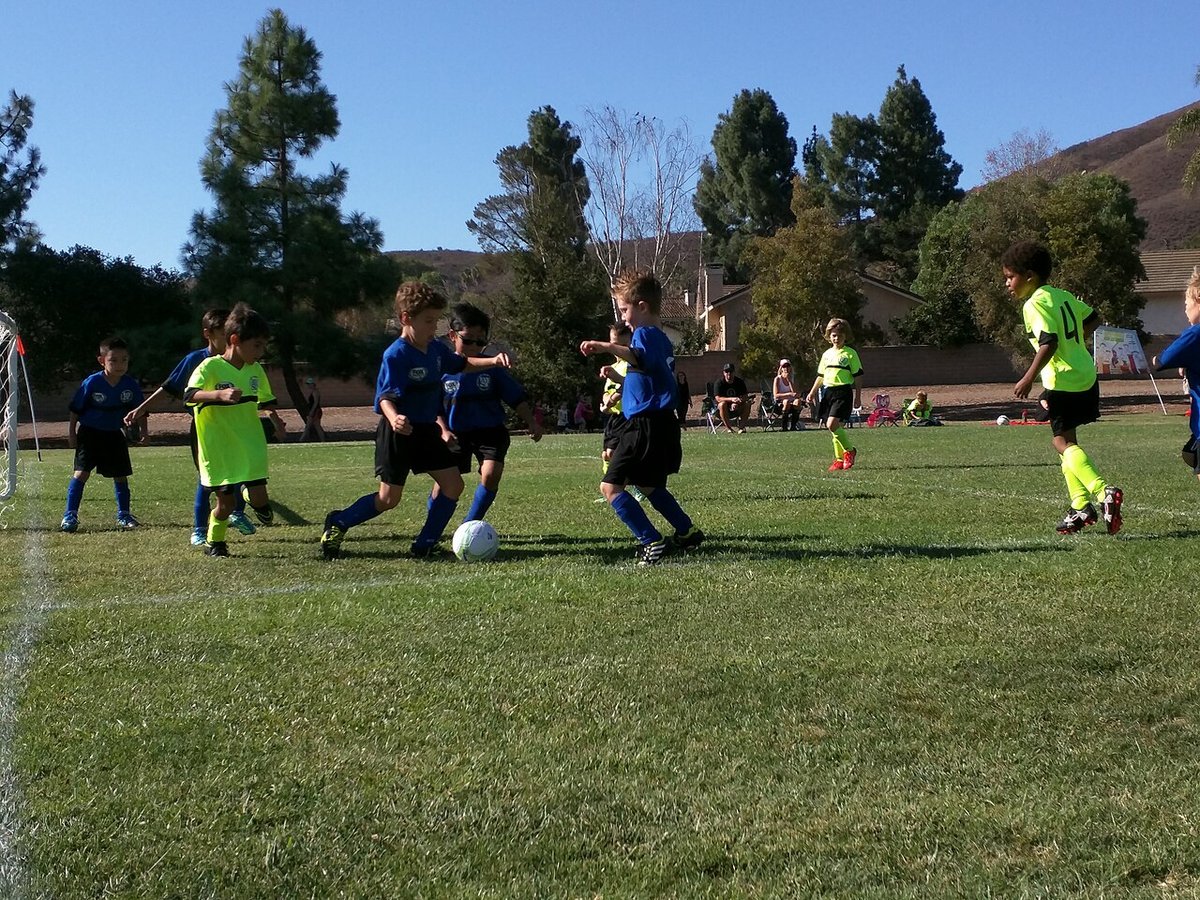
US Soccer recommends smaller teams and fields for young players, so that every child touches the ball more often:
| Age group | Players per side | Notes |
|---|---|---|
| Under 6 to under 8 | 4 v 4 | No goalkeepers, no offside, no heading |
| Under 9 to under 10 | 7 v 7 | Goalkeepers and a build-out line for goal kicks |
| Under 11 to under 12 | 9 v 9 | Larger field, build-out line, offside applies |
| Under 13 and older | 11 v 11 | Full Laws of the Game |
US youth guidelines also ban heading for players aged 10 and under and limit it in practice for 11 to 13 year olds.
Tips for Watching Your First Game
- Watch the last defender when a pass goes forward. That is where offside is decided.
- Keep an eye on the referee’s arms: one arm straight up means an indirect free kick, both arms waving forward means advantage.
- Check the stoppage time board at the end of each half. Late goals are part of the game.
- Learn some soccer terms like nutmeg, clean sheet and park the bus.
More Reading
- Soccer positions explained
- Soccer lingo and slang
- Soccer equipment list
- History of soccer
- American football field vs soccer field
- Field hockey pitch vs soccer field
- Common soccer injuries
- Soccer quiz

FAQ
What are the basic rules of soccer?
Two teams of 11 try to put the ball into the opponent’s goal without using their hands, except for the goalkeeper in the penalty area. A game lasts two halves of 45 minutes, and the team with more goals wins.
What is offside in soccer?
A player is offside when he or she is in the opponent half, ahead of the ball and the second to last defender at the moment a teammate passes, and then gets involved in play. Being level is onside.
How long is a soccer game?
90 minutes in two halves of 45, plus stoppage time. Knockout games can add two halves of 15 minutes of extra time and a penalty shootout.
What is the difference between a direct and an indirect free kick?
A goal can be scored straight from a direct free kick. An indirect free kick has to touch another player first, and the referee signals it with a raised arm.
What happens after a red card?
The player leaves the field and cannot be replaced, so the team plays with ten. The player is usually suspended for the next game too.
Can the goalkeeper pick up a back pass?
Not if a teammate deliberately kicked the ball to the keeper. Picking it up gives the other team an indirect free kick. A back header or chest pass may be handled.
Is a ball on the line out in soccer?
No. The whole ball has to cross the whole line to be out of play or to count as a goal.
How many substitutions are allowed in soccer?
Most professional competitions allow five per team in up to three stoppages. Youth and recreational leagues often use unlimited rolling substitutions.


No comments yet
What's your take?
What's your opinion, or think we got something wrong? Tell us and other readers.
Our editors read every comment.