

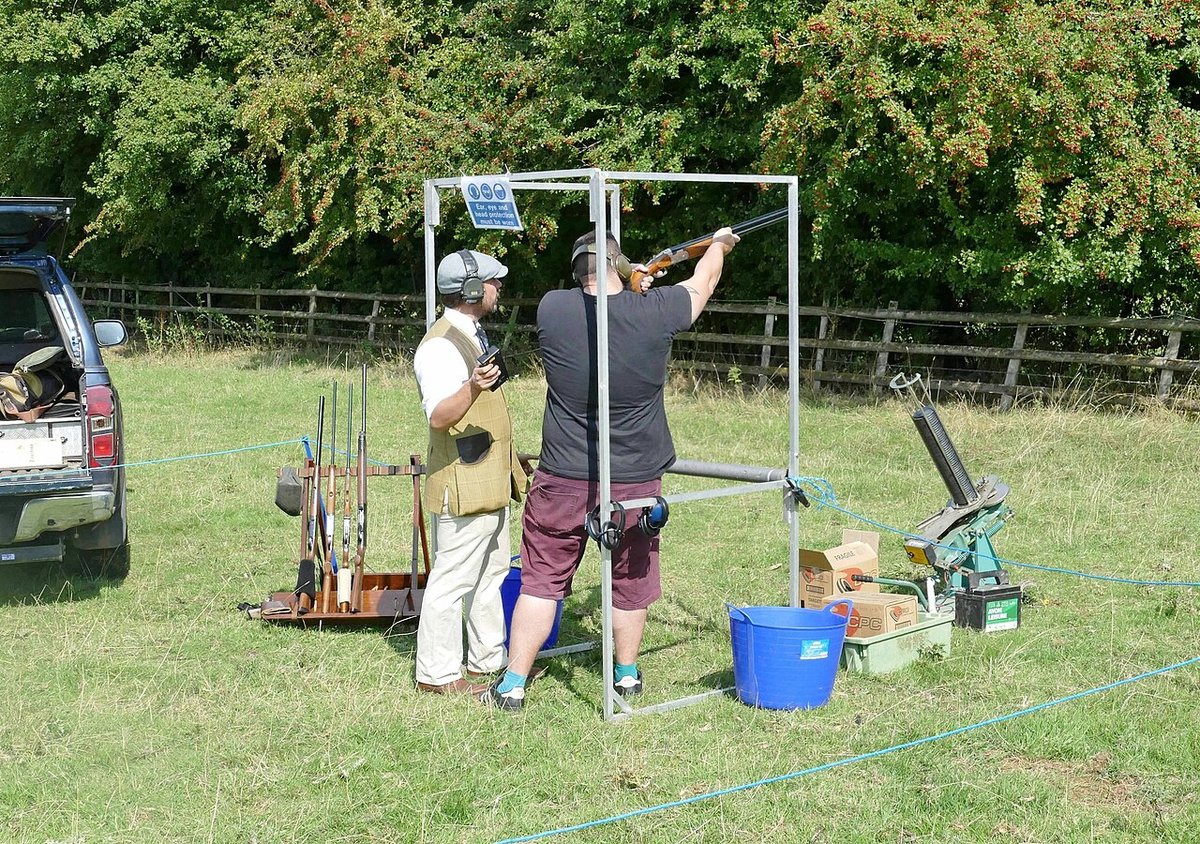
Skeet shooting rules explained: the field and eight stations, high and low house, singles and doubles, scoring a round of 25, and American vs Olympic skeet.
Skeet is a shotgun sport in which clay targets are thrown from two houses across a half circle of shooting stations. Every shooter takes the same sequence of shots, so a round is a pure test of consistency. A perfect round breaks all 25 targets.
This guide explains the field and the sequence of shots, then the differences between American skeet under the National Skeet Shooting Association (NSSA) and Olympic skeet under the International Shooting Sport Federation (ISSF).
Jump to:
- Skeet Rules in 60 Seconds
- The Field
- A Round of 25
- Scoring
- American vs Olympic Skeet
- Safety Rules
- Club Rounds vs Registered Shoots
- Tips for Your First Round

Skeet Rules in 60 Seconds
- Eight stations. Seven on a half circle and one in the middle.
- Two houses. The high house on the left, the low house on the right.
- 25 targets per round. Singles and doubles in a fixed order.
- One shot per target. A visible piece broken off counts as a hit.
- Safety first. Load only on the station, action open everywhere else.
The Field
Stations 1 to 7 sit on a half circle, and station 8 is in the middle between the two houses. The high house throws targets from about 10 feet up, the low house from about 3.5 feet. Both targets cross the same point in the middle of the field, and every station gives a different angle on them.
A Round of 25
| Station | Shots (American skeet) |
|---|---|
| 1 and 2 | High single, low single, double |
| 3, 4 and 5 | High single, low single |
| 6 and 7 | High single, low single, double |
| 8 | High single, low single |
| Option shot | One repeat of the first missed target, or a last shot |
Scoring
- A target counts as dead when a visible piece is broken off by the shot.
- A target that is not hit, or only loses dust, is lost.
- A broken target thrown by the machine or a target out of the normal path is a no bird and is thrown again.
- A gun that fails to fire through no fault of the shooter gives a new target, a limited number of times.
American vs Olympic Skeet
| Rule | American skeet (NSSA) | Olympic skeet (ISSF) |
|---|---|---|
| Gun position | Gun may be mounted before calling | Gun low, at the hip, until the target appears |
| Release | Immediately on call | Random delay of up to 3 seconds |
| Target speed | Slower | Faster |
| Gauges | 12, 20, 28 gauge and .410 | 12 gauge or smaller, almost always 12 |
| Doubles | At stations 1, 2, 6 and 7 | At more stations |
Safety Rules
- Keep the action open when not on the station.
- Load only when it is your turn on the station.
- Always point the muzzle downrange.
- Eye and ear protection are required on most fields.
Club Rounds vs Registered Shoots
| Rule | Club round | Registered shoot |
|---|---|---|
| Referee | Squad members score | Official referee |
| Classes | None | By average, AAA to D |
| Shoot off | Rare | Ties decided by shoot off |
| Records | Not kept | Scores count toward averages |
Tips for Your First Round
- Start at station 7 and 1 with an instructor. The angles are easiest there.
- Keep the gun moving through the shot. Stopping is the most common miss.
- Watch other shooters to learn where each target crosses.
- Learn some skeet terms like pull, mark and no bird.
More Reading
- Skeet shooting lingo and slang
- Skeet shooting equipment list
- History of skeet shooting
- Common skeet shooting injuries
- Skeet shooting quiz

FAQ
What are the basic rules of skeet shooting?
Shooters move through eight stations and shoot clay targets from a high house and a low house, with one shot per target. A round has 25 targets, and a visible piece broken off counts as a hit.
How many targets are in a round of skeet?
25.
How many stations are on a skeet field?
Eight, seven on a half circle and one in the middle.
What is the option shot in skeet?
In American skeet, a repeat of the first missed target, or a last shot if all targets were hit.
What is the difference between American and Olympic skeet?
In Olympic skeet the gun must be held low until the target appears, targets may be delayed up to 3 seconds, and they fly faster.
What is a no bird in skeet?
A target that breaks on release or flies off its normal path. It is thrown again.
What gauge is used for skeet?
Almost always 12 gauge in Olympic skeet. American skeet also has 20, 28 gauge and .410 events.
What does pull mean in skeet?
The call that tells the operator to release the target.


No comments yet
What's your take?
What's your opinion, or think we got something wrong? Tell us and other readers.
Our editors read every comment.