

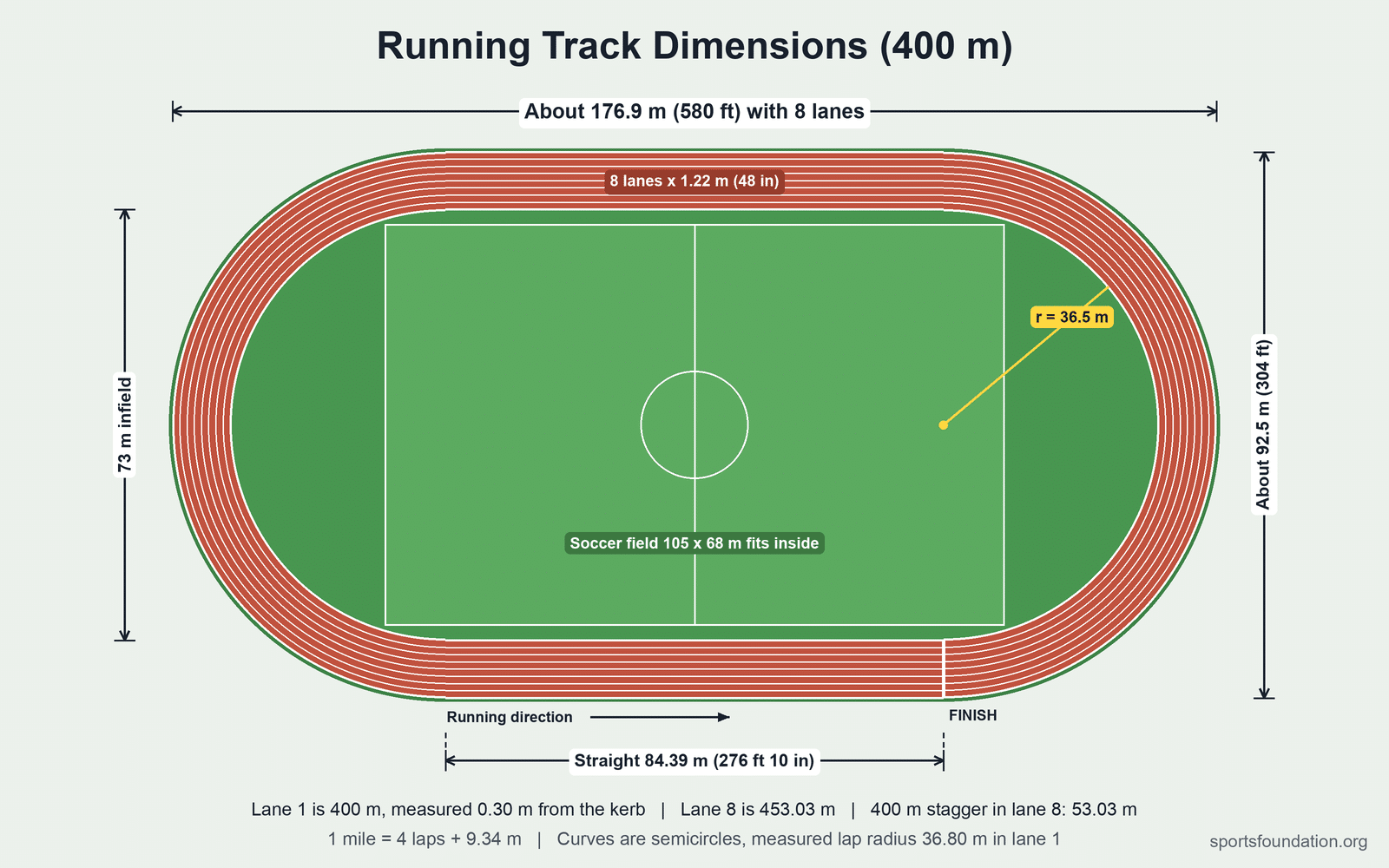
Running track dimensions with diagram: 400 m oval, 84.39 m straights, 36.5 m curves, 1.22 m lanes, lane 8 lap length, staggers and laps per mile.
A standard running track is 400 meters long in lane 1, measured 30 centimeters (12 inches) from the inside edge. It has two straights of 84.39 meters (276 ft 10 in) and two semicircular curves with a radius of 36.50 meters (119 ft 9 in), and each lane is 1.22 meters (48 inches) wide. One lap in lane 8 is about 453 meters, which is why races around the curves start from a staggered line.
Four hundred meters equals 437.4 yards, just short of a quarter mile. Many older American tracks were built to 440 yards (402.34 meters), but nearly all tracks are metric today. Below are the measurements of the World Athletics standard track, the length of every lane, the infield and the field event areas, with a diagram drawn to scale.
Jump to:
- Running Track Dimensions at a Glance
- How Long Is a Running Track?
- How Wide Is a Running Track?
- How Many Acres Is a Running Track?
- Lane Lengths and Staggered Starts
- The Infield
- Field Event Areas
- Hurdles and Relay Zones
- Indoor and Older Tracks
- Running Track vs Other Venues

Running Track Dimensions at a Glance
| Measurement | Meters | Feet |
|---|---|---|
| Lap length (lane 1) | 400 m | 1,312 ft 4 in |
| Straight | 84.39 m | 276 ft 10 in |
| Curve radius (to the inside edge) | 36.50 m | 119 ft 9 in |
| Lane width (including one line) | 1.22 m | 4 ft (48 in) |
| Lane lines | 5 cm | 2 in |
| Number of lanes | 8 standard, 9 at some venues | |
| One lap in lane 8 | 453.03 m | 1,486 ft 4 in |
| Infield width (inside edge to inside edge) | 73 m | 239 ft 6 in |
| Oval with 8 lanes, overall | About 176.9 x 92.5 m | About 580 x 304 ft |
| Area inside the outer lane | About 14,500 sq m | About 156,000 sq ft (3.6 acres) |
Watch: How Big Is a 400 m Running Track Compared to Other Sports?
This short animation draws the 400 m running track with its official lines and measurements, then lines it up with 36 other sports surfaces at the same scale, smallest to largest.
How Long Is a Running Track?
One lap is 400 meters, measured along a line 30 centimeters outside the inside edge of lane 1, where a runner hugging the curb actually runs. The math: the two straights add up to 168.78 meters, and the two curves together form a full circle with a running radius of 36.80 meters, which adds 231.22 meters. In the outer lanes the line is measured 20 centimeters from the inside lane line.
A mile is 1,609.34 meters, four laps plus 9.34 meters. That is why the mile start is a few steps behind the finish line. US high schools run the 1600 meters, exactly four laps, and the 3200 meters, eight laps. The 5000 meters is 12.5 laps and the 10,000 meters 25 laps.
How Wide Is a Running Track?
Each lane is 1.22 meters (48 inches) wide, including the 5 centimeter line on its right side. Eight lanes make 9.76 meters (32 feet) of running surface. With the infield of 73 meters between the inside edges, the whole oval measures about 92.5 meters (304 feet) across and 176.9 meters (580 feet) from end to end. Major stadiums often have 9 lanes, and some school tracks have only 6.
How Many Acres Is a Running Track?
The infield inside lane 1 covers about 10,350 square meters (2.6 acres). Including eight lanes, the oval covers about 14,500 square meters, roughly 156,000 square feet or 3.6 acres. A full stadium needs more room for the runoff areas behind the start and finish, the field event runways and the space between the track and the stands.
Lane Lengths and Staggered Starts
Every lane outside lane 1 is longer, because its curves have a larger radius. Each lane adds about 7.67 meters per lap (7.04 meters from lane 1 to lane 2, because lane 1 is measured closer to its inside edge). For a 400 meter race in lanes, the runners start from staggered positions so everyone covers exactly 400 meters.
| Lane | One lap | Stagger for 400 m |
|---|---|---|
| 1 | 400.00 m | 0 |
| 2 | 407.04 m | 7.04 m |
| 3 | 414.70 m | 14.70 m |
| 4 | 422.37 m | 22.37 m |
| 5 | 430.03 m | 30.03 m |
| 6 | 437.70 m | 37.70 m |
| 7 | 445.37 m | 45.37 m |
| 8 | 453.03 m | 53.03 m |
The 200 meters has one curve, so its stagger is half the 400 meter stagger. In the 800 meters, runners stay in their lanes only for the first curve, so the stagger is smaller. All races finish on the same line at the end of the home straight.
The Infield
The infield is 73 meters wide and 157.39 meters long between the inside edges of the track. A 105 x 68 meter soccer field fits inside, although its corners come within about 1 meter of the curb in the curves. An American football field with end zones (120 x 53 1/3 yards) fits easily. The semicircular areas at both ends, called the D zones, usually hold the high jump, the pole vault and the throwing circles.
Field Event Areas
| Event | Key measurements |
|---|---|
| Long jump | Runway at least 40 m (131 ft), 1.22 m wide; board 1 to 3 m from the pit |
| Triple jump | Board usually 13 m (men) and 11 m (women) from the pit at elite meets |
| High jump | Crossbar 4 m (13 ft 1 in) long; runway at least 15 m, 20 m at major events |
| Pole vault | Runway at least 40 m (131 ft) |
| Shot put | Circle 2.135 m (7 ft) across; landing sector 34.92 degrees |
| Discus | Circle 2.50 m (8 ft 2 1/2 in) across, inside a cage |
| Hammer | Circle 2.135 m (7 ft) across, inside a cage |
| Javelin | Runway 30 to 36.5 m long, 4 m wide, ending in an arc with an 8 m radius |
Hurdles and Relay Zones
Hurdle positions are fixed for each race. All sprint and 400 meter hurdle races have 10 hurdles.
| Race | Height | Start to 1st hurdle | Between hurdles | Last hurdle to finish |
|---|---|---|---|---|
| 110 m hurdles (men) | 1.067 m (42 in) | 13.72 m | 9.14 m | 14.02 m |
| 100 m hurdles (women) | 0.838 m (33 in) | 13 m | 8.5 m | 10.5 m |
| 400 m hurdles (men) | 0.914 m (36 in) | 45 m | 35 m | 40 m |
| 400 m hurdles (women) | 0.762 m (30 in) | 45 m | 35 m | 40 m |
In the 4 x 100 meter relay, the baton must be passed inside an exchange zone 30 meters long. World Athletics merged the old 20 meter zone and its 10 meter acceleration zone into one 30 meter zone in the late 2010s. The rules for every event are explained in track and field rules.
Indoor and Older Tracks
Indoor tracks are usually 200 meters around, with banked curves and typically 4 to 6 lanes that are about 0.90 to 1.10 meters wide. Indoor times are kept separately because the tight curves are slower. Outdoors, a 440 yard track is 2.34 meters longer than a 400 meter track, so old records in yards are not the same as metric records.
Running Track vs Other Venues
A running track is one of the largest venues in sports, about twice the area of a soccer field. A triathlon course, on the other hand, uses open roads and open water over many miles; the two are compared in track and field stadium vs triathlon course.
| Venue | Size | Area |
|---|---|---|
| 400 m track (8 lanes) | About 176.9 x 92.5 m | About 14,500 sq m (3.6 acres) |
| Speed skating oval | About 178 x 68 m | About 11,100 sq m |
| Soccer field (FIFA standard) | 105 x 68 m | 7,140 sq m (1.76 acres) |
| American football field | 109.7 x 48.8 m | About 5,350 sq m (1.32 acres) |
| Olympic swimming pool | 50 x 25 m | 1,250 sq m |
For the venues in this table, see soccer field dimensions, american football field dimensions and speed skating rink dimensions.
More Reading
- Track and field rules: all events
- Track and field stadium vs triathlon course
- Track and field equipment list
- Running equipment list
- Track and field lingo and slang
- Track and field quiz

FAQ
How long is a running track?
A standard track is 400 meters (437.4 yards) in lane 1, measured 30 centimeters from the inside edge.
How many laps around a track is a mile?
Four laps plus 9.34 meters. The 1600 meters run in US high schools is exactly four laps.
How wide is a lane on a running track?
Each lane is 1.22 meters (48 inches) wide, including the line on its right side.
How long is one lap in lane 8?
About 453 meters, 53.03 meters more than lane 1.
What are the dimensions of a 400 meter track?
Two straights of 84.39 meters and two curves with a 36.50 meter radius. With 8 lanes the oval measures about 176.9 x 92.5 meters.
How many acres is a running track?
About 3.6 acres for the oval with 8 lanes, and more for a full stadium with runoff and field event areas.
Does a soccer field fit inside a running track?
Yes. A 105 x 68 meter soccer field fits inside a standard 400 meter track, with the corners about 1 meter from the curb.
How long is an indoor track?
Most indoor tracks are 200 meters around, with banked curves.


No comments yet
What's your take?
What's your opinion, or think we got something wrong? Tell us and other readers.
Our editors read every comment.