

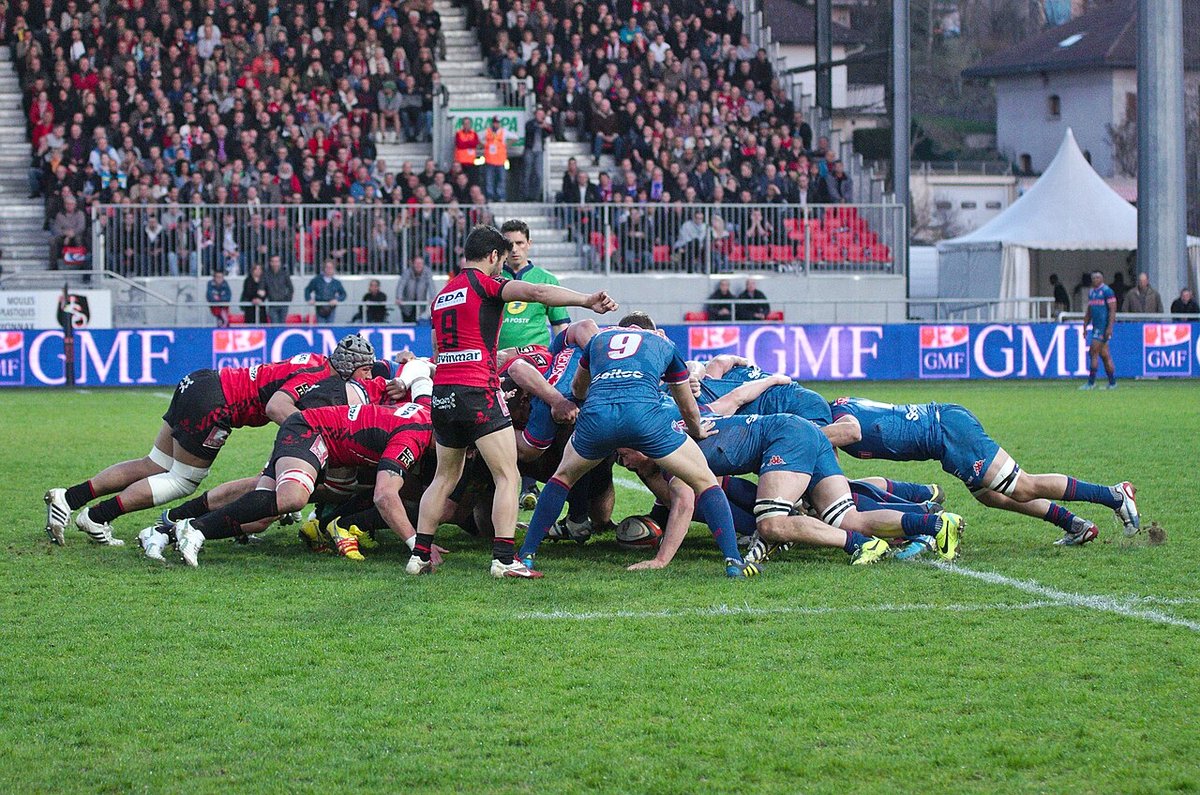
Rugby rules explained: scoring, passing backward, the tackle, rucks, mauls, scrums and lineouts, offside and cards, plus rugby union vs league vs sevens.
Rugby can look like organized chaos the first time you watch it. Underneath, it runs on a handful of simple principles: carry the ball forward, pass it only backward or sideways, and keep contesting possession after every tackle.
This guide explains rugby union, the most widely played code, in the order things happen on the field: scoring, passing, the tackle and the breakdown, set pieces, offside and discipline. It follows the Laws of the Game from World Rugby, and a table at the end shows how rugby league and rugby sevens differ.
Jump to:
- Rugby Rules in 60 Seconds
- The Field
- Scoring
- Passing, Knock-ons and Kicking
- The Tackle, Ruck and Maul
- Scrums and Lineouts
- Offside, Penalties and Cards
- Substitutions and Game Time
- Rugby Union vs Rugby League vs Sevens
- Tips for Watching Your First Game

Rugby Rules in 60 Seconds
- Fifteen players per side in rugby union: eight forwards and seven backs.
- Pass backward only. The ball may be carried and kicked forward, but every pass has to go backward or sideways.
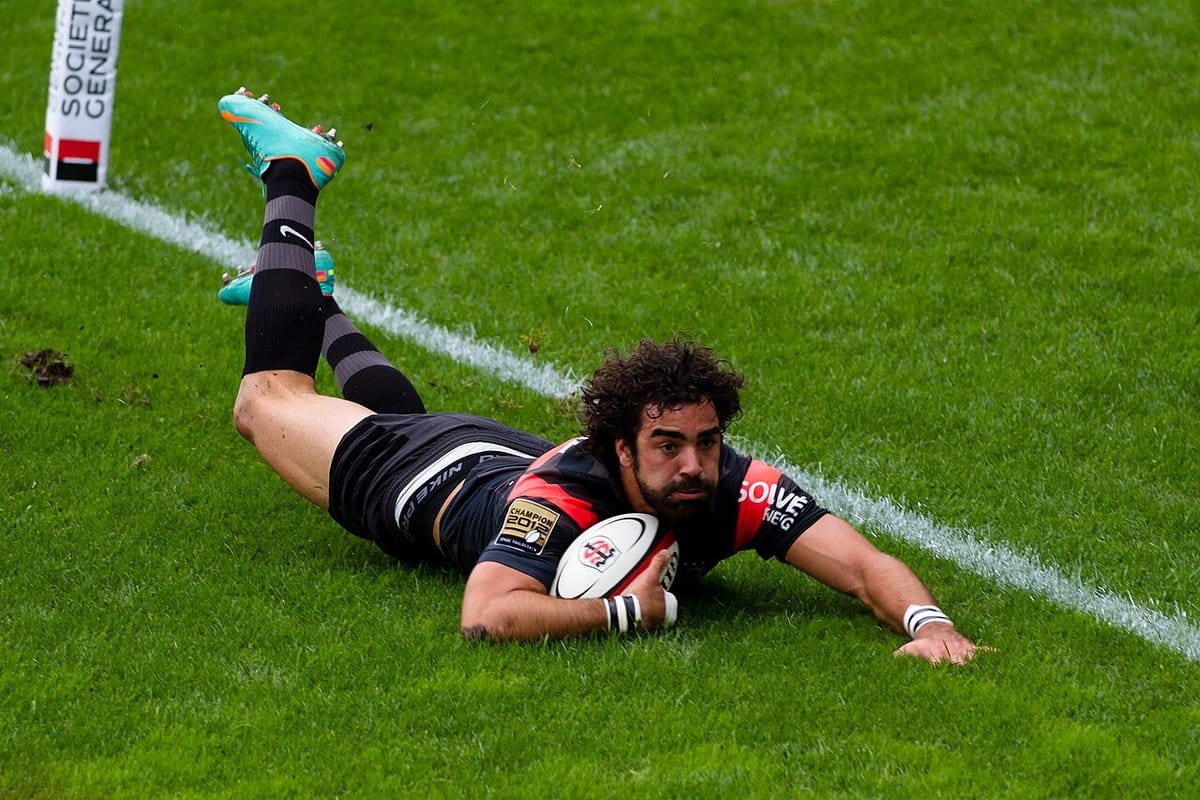
- Score tries. Grounding the ball in the opponent’s in-goal area is a try, worth five points.
- Contest every tackle. When a player is tackled, both teams compete for the ball on the ground.
- 80 minutes. Two halves of 40 minutes, and the team with more points wins.
The Field
The field of play may be up to 100 meters long between the try lines and up to 70 meters wide. Behind each try line is the in-goal area, between 6 and 22 meters deep, with the goal posts on the try line. Lines on the field mark halfway, the 10 meter lines and the 22 meter lines, which matter for kicks and restarts.
The field of play, the in-goal areas, the 22 meter line and the posts are listed in our guide to rugby field dimensions.
Scoring
| Score | Points | How |
|---|---|---|
| Try | 5 | Grounding the ball with downward pressure in the opponent’s in-goal area |
| Penalty try | 7 | Awarded when foul play stopped a probable try. No conversion is taken |
| Conversion | 2 | A kick at goal after a try, taken in line with where the try was scored |
| Penalty goal | 3 | A place kick or drop kick at goal after a penalty |
| Drop goal | 3 | A drop kick through the posts in open play |
A kick at goal counts when the ball passes over the crossbar and between the posts.
Passing, Knock-ons and Kicking
- Forward pass: throwing the ball forward is not allowed. The other team gets a scrum.
- Knock-on: dropping the ball or knocking it forward off the hands or arms so it touches the ground or another player. Also a scrum to the other team.
- Kicking: any player may kick the ball forward at any time. Teammates in front of the kicker are offside until they are put onside.
- 50:22: a kick from inside your own half that bounces in the field and then goes into touch inside the opponent’s 22 gives your team the lineout throw.
The Tackle, Ruck and Maul
Only the ball carrier may be tackled. In elite rugby, a tackle has to be below the line of the shoulders. In the community game, World Rugby lowered the limit to the waist or the base of the sternum from July 2026, depending on the national union. The tackler always has to use the arms. Once a player is tackled to the ground, the ball carrier must release or place the ball immediately, and the tackler must let go of the player and get up or roll away.
- Ruck: when the ball is on the ground and at least one player from each team is on their feet over it, a ruck forms. Players must enter from behind the last foot of their team, the gate, and may not use their hands to win the ball.
- Maul: when the ball carrier is held up by an opponent and at least one teammate binds on, a maul forms. The maul can be pushed forward, and the ball is passed back through it.
- If the ball does not come out of a ruck or maul in time, the referee awards a scrum.
Scrums and Lineouts
A scrum restarts play after minor offenses like a knock-on or forward pass. The eight forwards of each team bind together and push against each other, and the scrum half of the team that did not make the error feeds the ball in down the middle. The hookers try to strike it back with their feet.
A lineout restarts play when the ball goes into touch, over the sideline. Both sets of forwards line up a meter apart, and a player throws the ball in straight down the middle. Teammates may lift a jumper to catch it. Usually the throw goes to the team that did not put the ball out.
Offside, Penalties and Cards
In open play, a player in front of a teammate who has the ball or last played it is offside and must not take part until put onside. At rucks, mauls, scrums and lineouts, there are offside lines a set distance from the contest, and players not involved must stay behind them.
| Sanction | For | Options for the other team |
|---|---|---|
| Free kick | Technical offenses, such as delaying a scrum | Tap and run, kick, or a scrum. No kick at goal |
| Penalty | Offside, illegal tackles, hands in the ruck, not releasing | Kick at goal, kick to touch and keep the throw, tap and run, or a scrum |
| Yellow card | Repeated or cynical offenses | Player sent to the sin bin for 10 minutes |
| Red card | Serious foul play | Player sent off. In elite play under a World Rugby law trial, the team may bring on a replacement after 20 minutes unless the offense was deliberate and dangerous |
Substitutions and Game Time
International matches allow eight replacements per team, and players replaced for tactical reasons may not come back on, except to replace an injured front row player or during a head injury assessment. The clock stops for injuries and reviews. At 80 minutes, the game continues until the ball next goes dead.
Rugby Union vs Rugby League vs Sevens
| Rule | Rugby union | Rugby league | Rugby sevens |
|---|---|---|---|
| Players per side | 15 | 13 | 7 |
| Game length | 2 x 40 min | 2 x 40 min | 2 x 7 min |
| Try | 5 points | 4 points | 5 points |
| Conversion | 2 | 2 | 2, by drop kick |
| Penalty goal | 3 | 2 | 3 |
| Drop goal | 3 | 1 | 3 |
| After a tackle | Contested ruck | Play the ball, six tackles per set | Contested ruck |
| Scrums | 8 forwards, contested | 6 per side, rarely contested | 3 per side |
Tips for Watching Your First Game
- Watch the referee’s arm. A straight arm up means a penalty, a bent arm means a free kick.
- Follow the ball at the breakdown. Most penalties happen at rucks.
- When a team is awarded a penalty near the opponent’s line, watch whether it kicks for goal, kicks to the corner for a lineout or taps and goes.
- Learn some rugby terms like garryowen, sin bin and grubber.
More Reading
- Rugby positions explained
- Rugby lingo and slang
- Rugby equipment list
- History of rugby
- Common rugby injuries
- Rugby quiz

FAQ
What are the basic rules of rugby?
Two teams of 15 in rugby union try to carry, pass and kick the ball into the opponent’s in-goal area to score tries. Passes must go backward, tackled players must release the ball, and the game lasts two halves of 40 minutes.
How many points is a try in rugby?
Five points in rugby union and sevens, four in rugby league. A conversion adds two.
Why can’t you pass forward in rugby?
The laws require every pass to go backward or sideways, which forces teams to gain ground by running and kicking. A forward pass gives the other team a scrum.
What is a knock-on?
Losing the ball forward off the hands or arms so it hits the ground or another player. The other team gets a scrum.
What is the difference between a ruck and a maul?
In a ruck the ball is on the ground, in a maul it is held by a player who is on his or her feet. Both need at least one player from each team.
What happens when you get a yellow card in rugby?
The player spends 10 minutes in the sin bin and the team plays one short.
How long is a rugby game?
80 minutes in union and league, in two 40 minute halves. Sevens halves last 7 minutes.
What is the difference between rugby union and rugby league?
Union has 15 players and contested rucks after tackles. League has 13 players, uses a six tackle limit and restarts each tackle with a play the ball.


No comments yet
What's your take?
What's your opinion, or think we got something wrong? Tell us and other readers.
Our editors read every comment.