

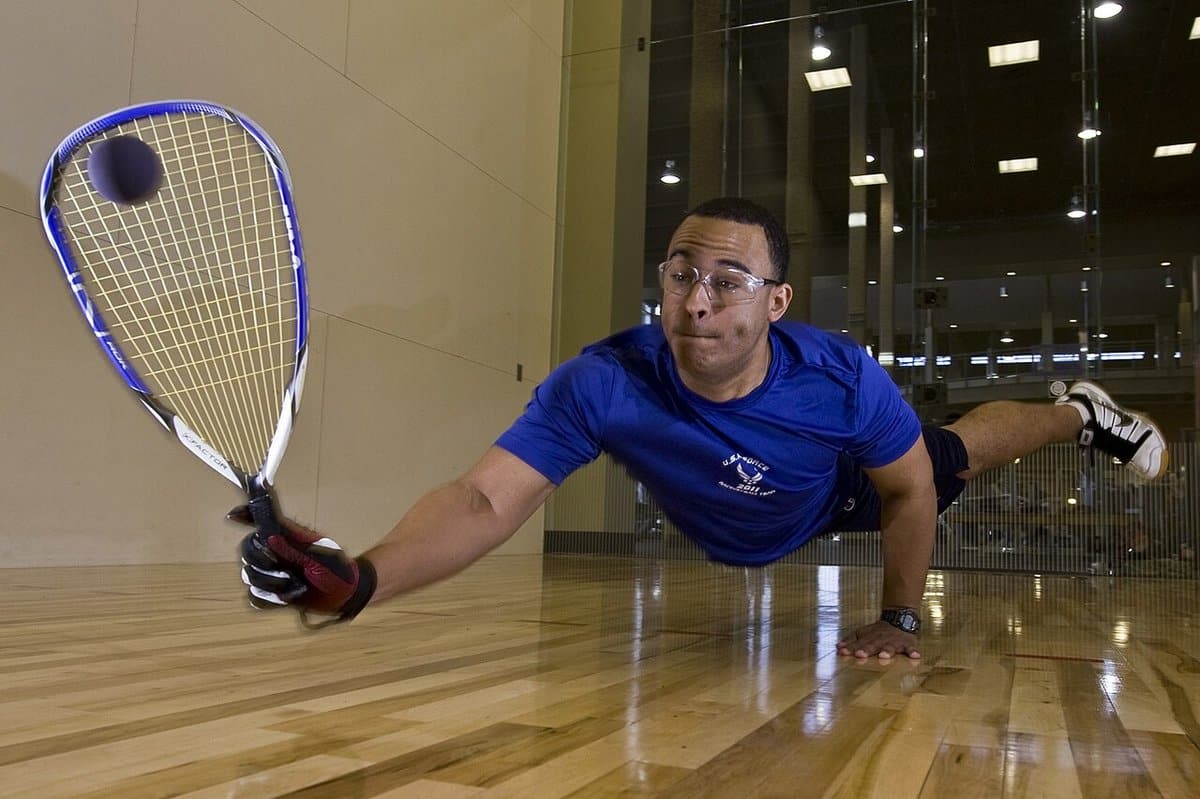
Racquetball rules explained: the court, how to serve, short and long serves, scoring to 15 and the tiebreaker, hinders, and doubles rules.
Racquetball is played in a closed court where every wall, and the ceiling, is in play. Two or four players hit a hollow rubber ball against the front wall, and the rally goes on until someone misses or lets the ball bounce twice. It is fast, easy to start and played in gyms all over the United States.
This guide follows the official rules of USA Racquetball. It explains the court, the serve, scoring, hinders and the main differences in doubles.
Jump to:
- Racquetball Rules in 60 Seconds
- The Court and the Gear
- How to Serve
- Scoring
- Rallies and Hinders
- Doubles Rules
- Recreational vs Tournament Play
- Tips for Your First Game

Racquetball Rules in 60 Seconds
- Hit the front wall. Every shot must reach the front wall before it touches the floor.
- One bounce. The ball may bounce once on the floor before you return it.
- Only the server scores. Points come only when you are serving.
- Games to 15. A match is best of three, with a tiebreaker to 11.
- Hinders replay the point. Getting in the way can also cost the rally.
The Court and the Gear
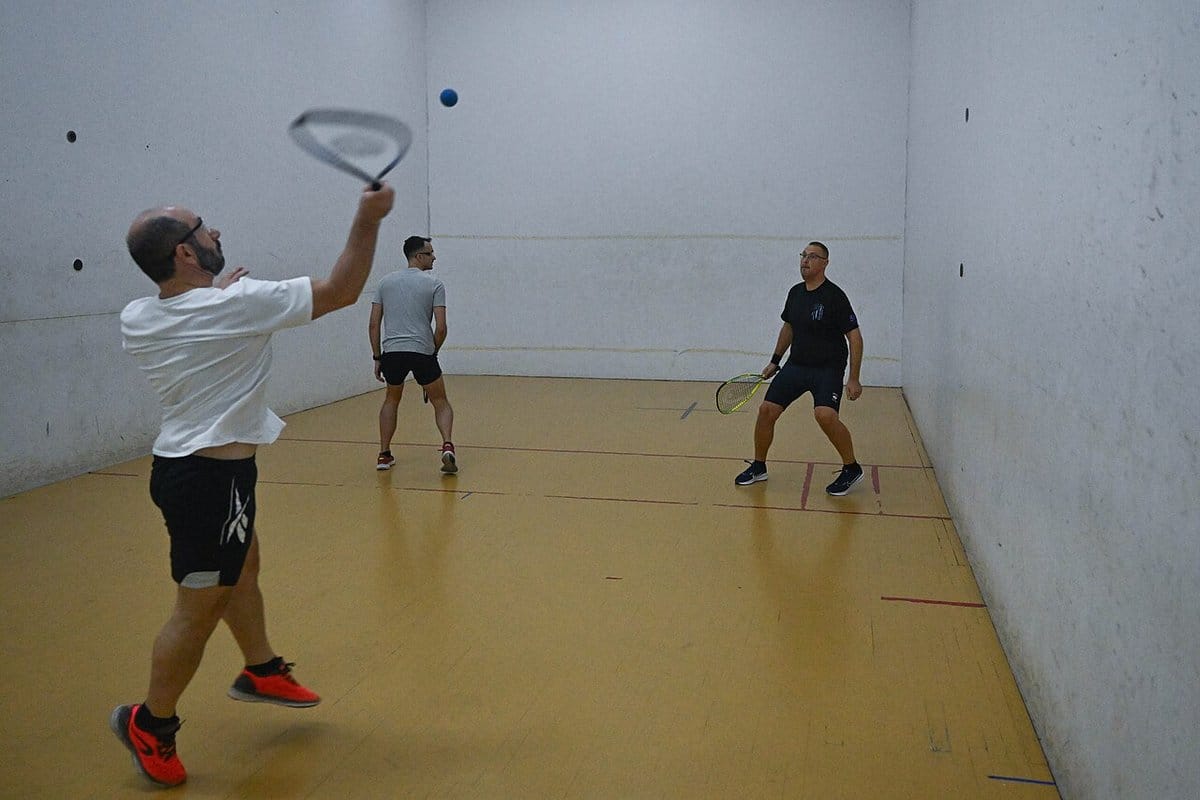
A regulation court is 20 feet wide, 20 feet high and 40 feet long. The service zone sits in the middle, between the short line, 20 feet from the front wall, and the service line, 5 feet in front of it. A receiving line 5 feet behind the short line marks how close the receiver may come before the ball bounces or crosses it.
- Racquet: up to 22 inches long.
- Ball: a hollow rubber ball 2.25 inches across.
- Eyewear: protective eyewear is required in sanctioned play.
The service zone, the receiving line and the size of every wall are listed in our guide to racquetball court dimensions.
How to Serve
The server stands inside the service zone, bounces the ball once and hits it directly to the front wall. The ball must then land beyond the short line, either directly or after touching one side wall. The server gets two tries in most amateur play, and a second fault loses the serve.
| Fault | What happens |
|---|---|
| Short serve | The ball lands on or in front of the short line |
| Long serve | The ball hits the back wall before touching the floor |
| Three wall serve | The ball touches both side walls before the floor |
| Ceiling serve | The ball touches the ceiling after the front wall |
| Foot fault | The server steps out of the service zone too early |
Some serves are outs, which lose the serve at once regardless of the first or second try, for example missing the ball, hitting the server’s own body, or hitting the floor or a side wall before the front wall.
Scoring
Racquetball uses side out scoring: only the server can win a point. If the receiver wins the rally, the receiver becomes the server, but the score does not change. Games go to 15 points, and you do not need to win by two.
| Part | Points |
|---|---|
| Game 1 | 15 |
| Game 2 | 15 |
| Tiebreaker (if 1 to 1) | 11 |
Rallies and Hinders
After the serve, the ball may touch any wall or the ceiling as long as it reaches the front wall before hitting the floor. Players must give each other room to see and hit the ball.
- Dead ball hinder: accidental interference, the rally is replayed.
- Avoidable hinder: a player blocks the shot or the view on purpose or without trying to move. The rally is lost.
- Screen ball: the ball passes so close to the server that the receiver cannot see it. On a serve, it counts as a fault.
- Safety holdup: a player who stops a swing to avoid hitting the opponent gets a replay.
Doubles Rules
In doubles, both players on the serving team serve before the serve passes to the other team, except at the very start of each game, when only one player of the first serving team serves. The server’s partner stands in the service box against a side wall until the ball passes the short line.
Recreational vs Tournament Play
| Rule | Casual gym games | Sanctioned tournaments |
|---|---|---|
| Serves | Often two | Two, a second fault loses the serve |
| Eyewear | Recommended | Required |
| Referee | Players call their own | Referee and line judges |
| Scoring | Often rally scoring to 11 | Side out to 15, tiebreaker to 11 |
Tips for Your First Game
- Wear eyewear every time. The ball is fast and the court is small.
- Get back to the center after each shot. Most rallies are won from there.
- Aim low on the front wall. Low shots are the hardest to return.
- Learn some racquetball terms like kill shot, pinch and Z serve.
More Reading
- Racquetball lingo and slang
- Racquetball equipment list
- History of racquetball
- Squash court vs racquetball court
- Common racquetball injuries
- Racquetball quiz

FAQ
What are the basic rules of racquetball?
Players hit the ball against the front wall in a closed court. It may bounce once on the floor, all walls and the ceiling are in play, and only the server scores.
How many points is a racquetball game?
15 points, and a match is best of three with a tiebreaker to 11.
Do you have to win by two in racquetball?
No. The first player to 15, or 11 in the tiebreaker, wins.
What is a short serve in racquetball?
A serve that lands on or in front of the short line. It is a fault.
Can you hit the ceiling in racquetball?
Yes, during a rally. On the serve, touching the ceiling is a fault.
What is a hinder in racquetball?
Interference between players. An accidental hinder replays the rally, an avoidable one loses it.
How big is a racquetball court?
40 feet long, 20 feet wide and 20 feet high.
How many serves do you get in racquetball?
Two in most amateur play. A second fault loses the serve.


No comments yet
What's your take?
What's your opinion, or think we got something wrong? Tell us and other readers.
Our editors read every comment.