

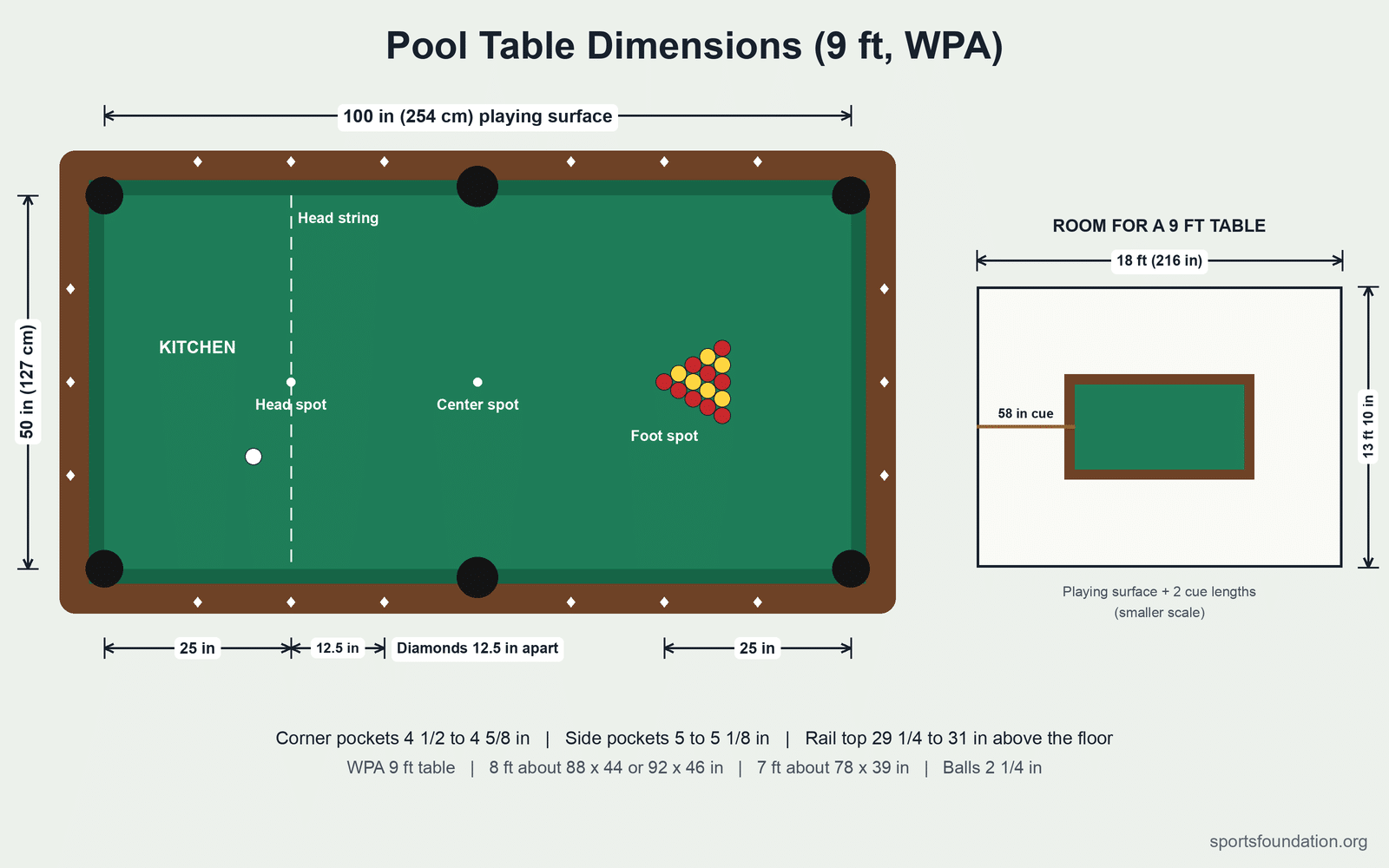
Pool table dimensions with diagram: 9 ft table with a 100 x 50 in playing surface, 7 and 8 ft sizes, pockets, table height and room size for a 58 in cue.
A regulation 9 foot pool table has a playing surface of 100 x 50 inches (254 x 127 cm), measured between the noses of the cushions. That is the size used in professional and most tournament play. Smaller tables are common at home and in bars: an 8 foot table plays at about 88 x 44 or 92 x 46 inches, and a 7 foot bar table at about 78 x 39 inches. Every size keeps the same 2 to 1 ratio.
The name of a table, such as “9 foot”, describes its rough outside length, not the playing surface. Below are the official World Pool-Billiard Association (WPA) measurements, pocket sizes, table height, a diagram drawn to scale and the room you need for each table size.
Jump to:
- Pool Table Dimensions at a Glance
- What Size Is a Regulation Pool Table?
- 7 ft vs 8 ft vs 9 ft Pool Tables
- How Tall Is a Pool Table?
- Pocket Sizes
- Diamonds, Head String and Spots
- How Much Room Do You Need for a Pool Table?
- Snooker and Carom Tables
- Pool Table vs Bowling Lane and Other Games

Pool Table Dimensions at a Glance
| Measurement | 9 ft table (WPA) | Metric |
|---|---|---|
| Playing surface | 100 x 50 in | 254 x 127 cm |
| Ratio | 2 to 1 | |
| Playing surface area | About 34.7 sq ft | About 3.2 sq m |
| Height to top of rail | 29 1/4 to 31 in | 74 to 79 cm |
| Corner pocket mouth | 4 1/2 to 4 5/8 in | 11.4 to 11.8 cm |
| Side pocket mouth | 5 to 5 1/8 in | 12.7 to 13.0 cm |
| Ball diameter | 2 1/4 in | 5.715 cm |
| Diamonds (sights) | 18, 12.5 in apart | 31.75 cm apart |
| Head string and foot spot | 25 in from the short rails | 63.5 cm |
| Room size with a 58 in cue | About 18 x 13 ft 10 in | About 5.5 x 4.2 m |
Watch: How Big Is a Pool Table Compared to Other Sports?
This short animation draws the pool table with its official lines and measurements, then lines it up with 36 other sports surfaces at the same scale, smallest to largest.
What Size Is a Regulation Pool Table?
A regulation pool table is a 9 foot table with a 100 x 50 inch playing surface. The WPA, which writes the international rules, allows a tolerance of 1/8 inch. The playing surface is measured from the nose of one cushion to the nose of the opposite cushion, so the rails are not included.
The outside of a 9 foot table, rails included, is typically about 112 x 62 inches, depending on how wide the rails are. That is why a “9 foot” table is a little longer than 9 feet on the outside and a little shorter than 9 feet on the cloth.
7 ft vs 8 ft vs 9 ft Pool Tables
| Table | Playing surface | Metric | Area |
|---|---|---|---|
| 7 ft (bar box) | About 78 x 39 in | About 198 x 99 cm | About 21 sq ft |
| 8 ft (home) | About 88 x 44 in | About 224 x 112 cm | About 27 sq ft |
| 8 ft (pro 8, WPA spec) | About 92 x 46 in | About 234 x 117 cm | About 29 sq ft |
| 9 ft (tournament) | 100 x 50 in | 254 x 127 cm | About 35 sq ft |
Only the 9 foot table has one exact standard. Seven and eight foot tables vary a few inches between manufacturers, so the numbers above are typical sizes, not rules. The 7 foot bar box is the coin-operated table found in bars and leagues. The 8 foot table is the most common choice for homes, and the 92 x 46 inch “pro 8”, the 8 foot size in WPA specifications, sits between the home 8 foot table and the 9 foot table.
How Tall Is a Pool Table?
Under WPA specifications, the top of the rail is 29 1/4 to 31 inches above the floor, about 74 to 79 cm. Most tables are built near the middle of that range. Leg levelers let the owner adjust the height and make the slate perfectly level.
The slate bed of a quality table is usually at least 1 inch thick and often comes in three pieces. The weight of the slate is why a full-size table can weigh 700 pounds or more.
Pocket Sizes
The pocket mouth is measured between the noses of the two cushions that form the pocket. WPA specifications set the corner pockets at 4 1/2 to 4 5/8 inches and the side pockets at 5 to 5 1/8 inches. With a 2 1/4 inch ball, a corner pocket is about two balls wide. Side pockets are wider because a ball enters them at a sharper angle.
Bar tables and home tables often have larger pockets than this, which makes them more forgiving. Tournament tables with tight pockets are much harder to play.
Diamonds, Head String and Spots
A pool table has 18 diamonds, or sights, set into the rails: six on each long rail (three on each side of the side pocket) and three on each short rail. On a 9 foot table they are 12.5 inches apart, which divides the long side into eight equal parts and the short side into four. Players use them to aim bank shots and kick shots.
The head string is an imaginary line through the second diamond from the head rail, 25 inches from the cushion on a 9 foot table. The area behind it is called the kitchen, and the cue ball is placed there on the break. The foot spot sits at the same distance from the foot rail and marks where the apex ball of the rack goes. The rules for the break and ball in hand are in billiards rules.
How Much Room Do You Need for a Pool Table?
The usual rule is to add the length of two cues to the playing surface: one cue length on each side, so a player can shoot with the cue ball frozen to any cushion. The table below is based on a standard 58 inch cue, with a second column for a 52 inch cue, which many players keep for tight spots.
| Table | Room size with a 58 in cue | Room size with a 52 in cue |
|---|---|---|
| 7 ft (78 x 39 in) | 16 ft 2 in x 12 ft 11 in | 15 ft 2 in x 11 ft 11 in |
| 8 ft (88 x 44 in) | 17 ft x 13 ft 4 in | 16 ft x 12 ft 4 in |
| 8 ft pro (92 x 46 in) | 17 ft 4 in x 13 ft 6 in | 16 ft 4 in x 12 ft 6 in |
| 9 ft (100 x 50 in) | 18 ft x 13 ft 10 in | 17 ft x 12 ft 10 in |
| Snooker 12 ft (140.5 x 70 in) | 21 ft 4.5 in x 15 ft 6 in | 20 ft 4.5 in x 14 ft 6 in |
All room sizes in this table assume a 58 inch cue in the first column and a 52 inch cue in the second, measured from the cushion nose, and they are the minimum clear space. Walls, furniture and a cue rack all count against it. If a room is only a little too short, a few shots with a shorter cue are a workable compromise.
Snooker and Carom Tables
A full-size snooker table is 12 feet long, with a playing area of 11 feet 8.5 inches x 5 feet 10 inches (3,569 x 1,778 mm). It uses smaller balls, 52.5 mm across, and pockets with rounded cushion openings, so it plays very differently from a pool table. Carom billiards tables have no pockets at all. A match table for three cushion is about 10 feet long, with a playing surface of about 2.84 x 1.42 meters.
Pool Table vs Bowling Lane and Other Games
A pool table is one of the smallest playing areas in sports. A 9 foot table has about 35 square feet of cloth, while a single bowling lane covers about 207 square feet from the foul line to the headpin. The two games are compared in detail in bowling alley vs billiards table.
| Playing area | Size | Area |
|---|---|---|
| Pool table, 9 ft | 100 x 50 in | About 35 sq ft |
| Snooker table, 12 ft | 140.5 x 70 in | About 68 sq ft |
| Ping-pong table | 9 x 5 ft | 45 sq ft |
| Bowling lane (to headpin) | 60 ft x 41.5 in | About 207 sq ft |
For more indoor game measurements, see ping pong table dimensions, bowling lane dimensions and dart board dimensions.
More Reading
- Billiards rules: how to play
- Bowling alley vs billiards table
- Billiards equipment list
- Billiards lingo and slang
- History of billiards
- Billiards quiz

FAQ
What are the dimensions of a regulation pool table?
A regulation 9 foot pool table has a playing surface of 100 x 50 inches (254 x 127 cm), measured between the cushion noses.
How big is an 8 foot pool table?
An 8 foot table usually has a playing surface of about 88 x 44 inches. Pro size 8 foot tables play at about 92 x 46 inches.
How big is a 7 foot pool table?
A 7 foot bar table has a playing surface of about 78 x 39 inches.
How tall is a pool table?
The top of the rail is 29 1/4 to 31 inches above the floor under WPA specifications.
How big are the pockets on a pool table?
On a WPA table, corner pockets are 4 1/2 to 4 5/8 inches wide and side pockets 5 to 5 1/8 inches, measured between the cushion noses.
How much room do you need for a 9 foot pool table?
About 18 x 13 feet 10 inches with a standard 58 inch cue, or 17 x 12 feet 10 inches with a 52 inch cue.
How much room do you need for an 8 foot pool table?
About 17 x 13 feet 4 inches with a 58 inch cue for an 88 x 44 inch table.
How big is a snooker table?
A full-size snooker table is 12 feet long, with a playing area of 11 feet 8.5 inches x 5 feet 10 inches.


No comments yet
What's your take?
What's your opinion, or think we got something wrong? Tell us and other readers.
Our editors read every comment.