

Pickleball rules for beginners: serving, the two-bounce rule, the kitchen, scoring and calling the score, faults and line calls, explained simply.
Pickleball looks simple from the outside: a small court, a solid paddle, a plastic ball with holes. The rules are simple too, once someone explains the three that confuse every beginner: the two-bounce rule, the kitchen and the way the score is called. This guide walks through all of it in the order you will meet it on court.
The rules below follow the official USA Pickleball rulebook for 2026. Recreational groups sometimes play a looser version, but if you learn these, you can join any open play session without surprises.
Jump to:
- Pickleball Rules in 60 Seconds
- The Court
- Paddles and Balls
- Serving Rules
- The Two-Bounce Rule
- Kitchen Rules (Non-Volley Zone)
- Scoring: How Points Work
- How to Call the Score
- Common Faults
- Line Calls: Is a Ball on the Line In?
- Singles and Doubles
- Beginner Cheat Sheet

Pickleball Rules in 60 Seconds
- Serve underhand and diagonally. The serve goes cross court and must land in the opposite service court, beyond the kitchen.
- Let it bounce twice. The serve must bounce, and the return must bounce. After that, players may volley or play off the bounce.
- Stay out of the kitchen when you volley. You cannot hit the ball out of the air while standing in the 7 foot zone next to the net.
- Only the serving side scores. Games usually go to 11 points, and you must win by 2.
- A fault ends the rally. Hitting out, into the net or breaking one of the rules above loses the rally.
The Court
A pickleball court is 20 feet wide and 44 feet long, the same size for singles and doubles. The net sits in the middle at 36 inches high at the sidelines and 34 inches at the center. On each side, the 7 feet closest to the net form the non-volley zone, better known as the kitchen. Behind it, a centerline splits the rest of the court into a left and a right service court.
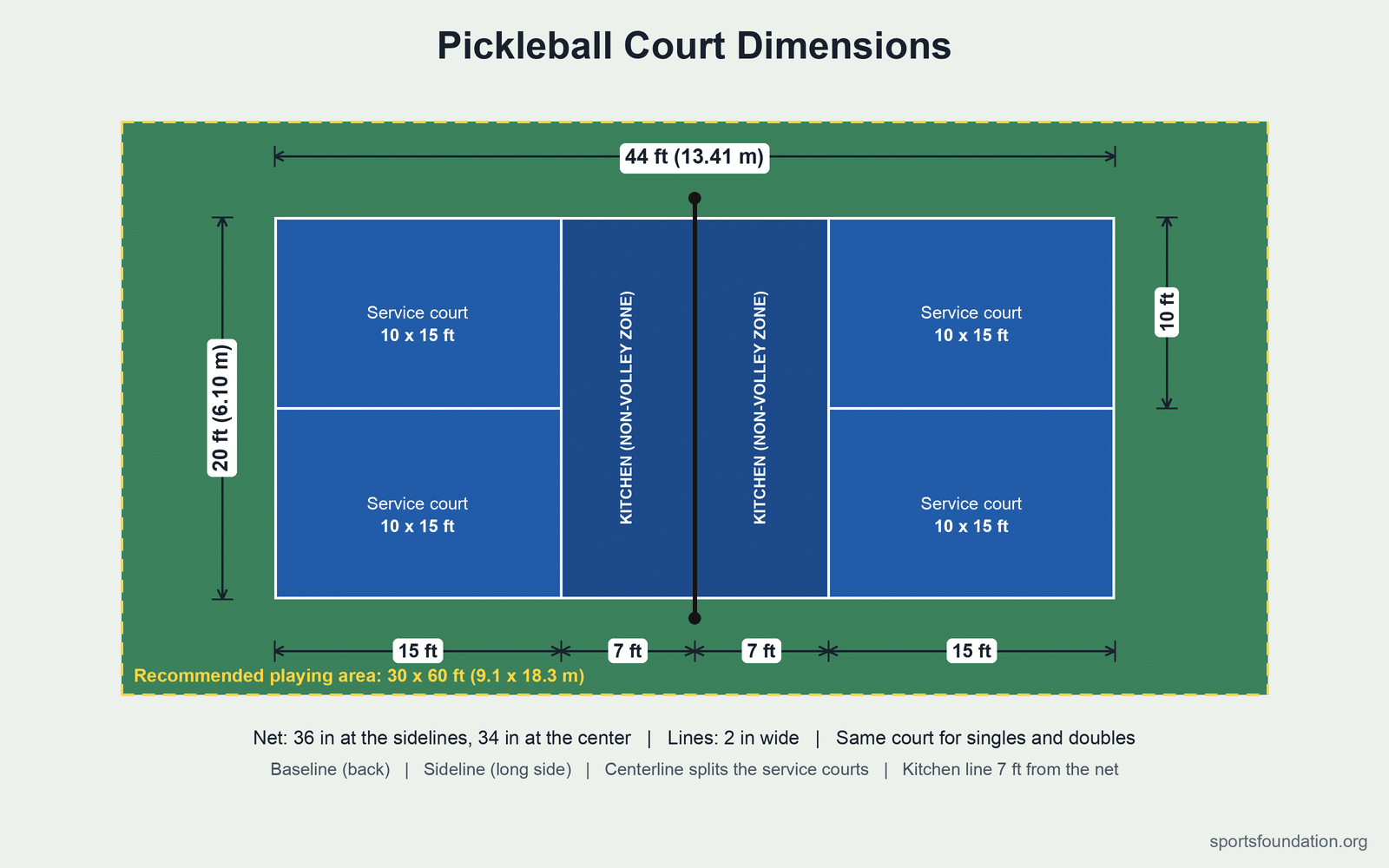
Every line, measurement and the space you need around the court is covered in our guide to pickleball court dimensions.
Paddles and Balls
Paddles are solid, with no strings. Under the rules, the length of a paddle may not exceed 17 inches, and length plus width together may not exceed 24 inches. Most paddles weigh around 7 to 9 ounces. Tournament paddles must be on the USA Pickleball approved list.
The ball is a hollow plastic ball with holes. Outdoor balls are harder and have more, smaller holes, which helps them cut through wind. Indoor balls are softer, with fewer and larger holes. Our pickleball equipment list covers everything else worth bringing.
Serving Rules
Every rally starts with a serve, and most beginner faults happen right here. These are the rules for a legal serve:
- Position: at least one foot must be behind the baseline, and neither foot may touch the baseline or the court until you hit the ball. You stand between the imaginary extensions of the centerline and the sideline.
- Direction: serve diagonally into the service court across the net. The ball must clear the kitchen, including the kitchen line.
- Volley serve: hit the ball out of your hand with an upward arc, contact below your waist, and the head of the paddle below your wrist at contact.
- Drop serve: let the ball fall from your hand, let it bounce anywhere on the court, then hit it. With a drop serve, the waist and wrist rules do not apply.
- No spin from the hand: you may not spin the ball with your hand or fingers as you release it. The once popular chainsaw serve is illegal for this reason. Spin that comes from the paddle is fine.
- One try: there is no second serve. A faulted serve ends the turn of that server.
- No lets: if the serve clips the net and lands in the correct service court, it is in play. Replaying a serve that touched the net is no longer part of the rules.
In doubles, each new service turn starts from the right side of the court. After each point the serving team wins, the server switches sides and serves again. In singles, you serve from the right when your score is even and from the left when it is odd.
The Two-Bounce Rule
The two-bounce rule, sometimes called the double bounce rule, says that each team must let the ball bounce once before hitting it at the start of a rally. The receiving team lets the serve bounce, and the serving team lets the return bounce. Once those two bounces have happened, anyone may volley.
The rule takes away the serve and volley advantage. In practice it means the serving team waits near its baseline for the return, while the receiving team can move up to the kitchen line right away. That is why the third shot of a rally, often a soft drop into the kitchen, matters so much in pickleball.
Kitchen Rules (Non-Volley Zone)
The kitchen is the 7 foot zone on both sides of the net, and the line that marks it counts as part of the zone. The rules are about volleys only:
- You may not volley while standing in the kitchen or touching the kitchen line.
- If your momentum carries you into the kitchen after a volley, it is a fault, even if the ball is already dead.
- Anything you are wearing or holding counts too: a paddle or hat that drops into the kitchen during a volley is a fault.
- You may step into the kitchen at any time to play a ball that has bounced, and you may stand there as long as you like. You just need to get out before you volley.
The myth that you are never allowed in the kitchen is the most common beginner misunderstanding. It is a no volley zone, not a no entry zone.
Scoring: How Points Work
Standard pickleball uses side out scoring: only the serving team can win a point. If the receiving team wins the rally, nobody scores, and the serve passes on. Games are played to 11 points, and a team must win by 2. Some tournaments play games to 15 or 21.
In doubles, both partners serve before the serve goes to the other team, with one exception. To offset the advantage of serving first, the team that starts the game only gets one server for its first turn. That is why the very first score of a doubles game is called as 0, 0, 2.
Rally scoring, where every rally produces a point, is an approved alternative format in the 2026 rulebook. Some leagues and events use it to keep games short, but side out scoring is still what you will meet at most courts.
How to Call the Score
The server calls the score out loud before every serve. In doubles, the call has three numbers:
| Position | Means | Example: 5, 3, 2 |
|---|---|---|
| First number | Serving team’s score | The serving team has 5 points |
| Second number | Receiving team’s score | The receiving team has 3 points |
| Third number | Server 1 or server 2 | The second partner is serving |
In singles, the call has only two numbers, the server score first. A handy check: when the serving side has an even score, the player who started the game on the right side should be serving from the right. In singles, you serve from the right with an even score and from the left with an odd score.
Common Faults
A fault ends the rally. If the serving team commits it, the serve moves on; if the receiving team commits it, the serving team scores. The usual faults:
- The ball lands out of bounds or does not clear the net.
- A serve lands in the kitchen, on the kitchen line or in the wrong service court.
- A player volleys before both bounces of the two-bounce rule have happened.
- A player volleys while touching the kitchen or the kitchen line.
- The ball bounces twice on one side before it is returned.
- The ball hits a player or anything the player is wearing or carrying, other than the paddle or the hand holding it.
- A player, a paddle or clothing touches the net or the net post while the ball is in play.
- The wrong player serves or the server stands on the wrong side.
Line Calls: Is a Ball on the Line In?
A ball that touches any line is in, with one exception: a serve that touches the kitchen line is short and therefore a fault. A serve that touches the baseline, the sideline or the centerline is good.
In recreational play, each team calls the lines on its own side of the net. If you are not sure whether a ball was out, it is in. Out calls should be made right away, and the 2026 rulebook puts extra weight on calling them promptly.
Singles and Doubles
The rules are the same in both formats, and so is the court. The differences are small:
- In singles, there is only one server per side, so the third number in the score call disappears.
- In doubles, partners only switch sides after their team wins a point on its own serve. The receiving team never switches during a rally.
- After a side out in doubles, the player on the right side of the court serves first.
Beginner Cheat Sheet
If you only remember a handful of things for your first session, make it these:
- Call the score before you serve.
- Serve underhand, cross court, past the kitchen.
- After serving, stay back and let the return bounce.
- After returning serve, move up to the kitchen line.
- Never volley with a foot in the kitchen or on its line.
- Only the serving team scores.
- If you are not sure a ball was out, it was in.
Once the rules feel natural, the pickleball lingo guide explains the slang you will hear in open play, from dinks to Ernies.
More Reading
- Pickleball court dimensions with diagram
- Pickleball lingo and slang
- Pickleball equipment list
- History of pickleball
- Who invented pickleball
- Common pickleball injuries
- Pickleball quiz

FAQ
What are the basic rules of pickleball?
Serve underhand and diagonally past the kitchen, let the serve and the return bounce once each, never volley while touching the kitchen, and only the serving team can score. Games go to 11, win by 2.
Can you step in the kitchen in pickleball?
Yes. You can enter the kitchen at any time to play a ball that has bounced. You may not volley while touching the kitchen or its line, and you may not fall into it after a volley.
Does the serve have to be underhand?
Yes. With a volley serve, contact must be below the waist with an upward arc and the paddle head below the wrist. With a drop serve, you let the ball bounce first and those limits do not apply.
Is a let serve replayed in pickleball?
No. If the serve touches the net and lands in the correct service court, it is in play. If it lands anywhere else, it is a fault.
Why does doubles start at 0, 0, 2?
The team that serves first only gets one server in its first turn, so the game starts as if the first server has already had a turn. The 2 tells everyone that this is the last server before the side out.
Is a ball on the line in or out?
A ball touching any line is in, except a serve that lands on the kitchen line, which is a fault.
Do you have to win by 2 in pickleball?
Yes. A standard game goes to 11 points and must be won by at least 2, so games can go past 11.
Can you hit the ball before it bounces?
Yes, after the first two bounces of the rally. The serve and the return must each bounce once. From the third shot on, volleys are allowed as long as you are outside the kitchen.


No comments yet
What's your take?
What's your opinion, or think we got something wrong? Tell us and other readers.
Our editors read every comment.