

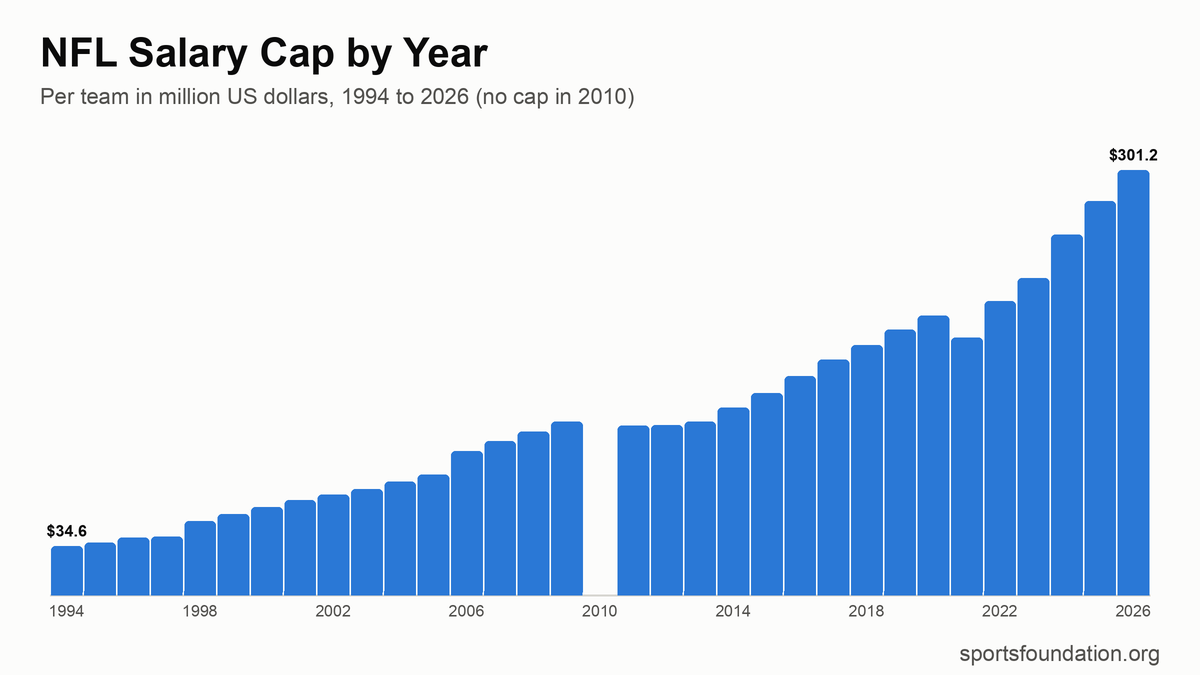
The NFL salary cap is $301.2 million in 2026. Cap by year since 1994, how it works, cap space by team, top salaries, franchise tags and minimums.
The NFL salary cap for 2026 is $301.2 million per team, the first time it has passed $300 million. It rose $22 million from $279.2 million in 2025, and it has grown by about 40 percent since the COVID dip of 2021. Below is the cap for every year since 1994, how the cap works, which teams have the most room and what the top players earn.
NFL salary cap at a glance
2026 cap: $301.2 million per team (+7.9%)
2025 cap: $279.2 million
Type: hard cap, set each year from league revenue
Players’ share: 48% of football revenue
Salary floor: teams must spend at least 90% of the cap in cash over multi year windows
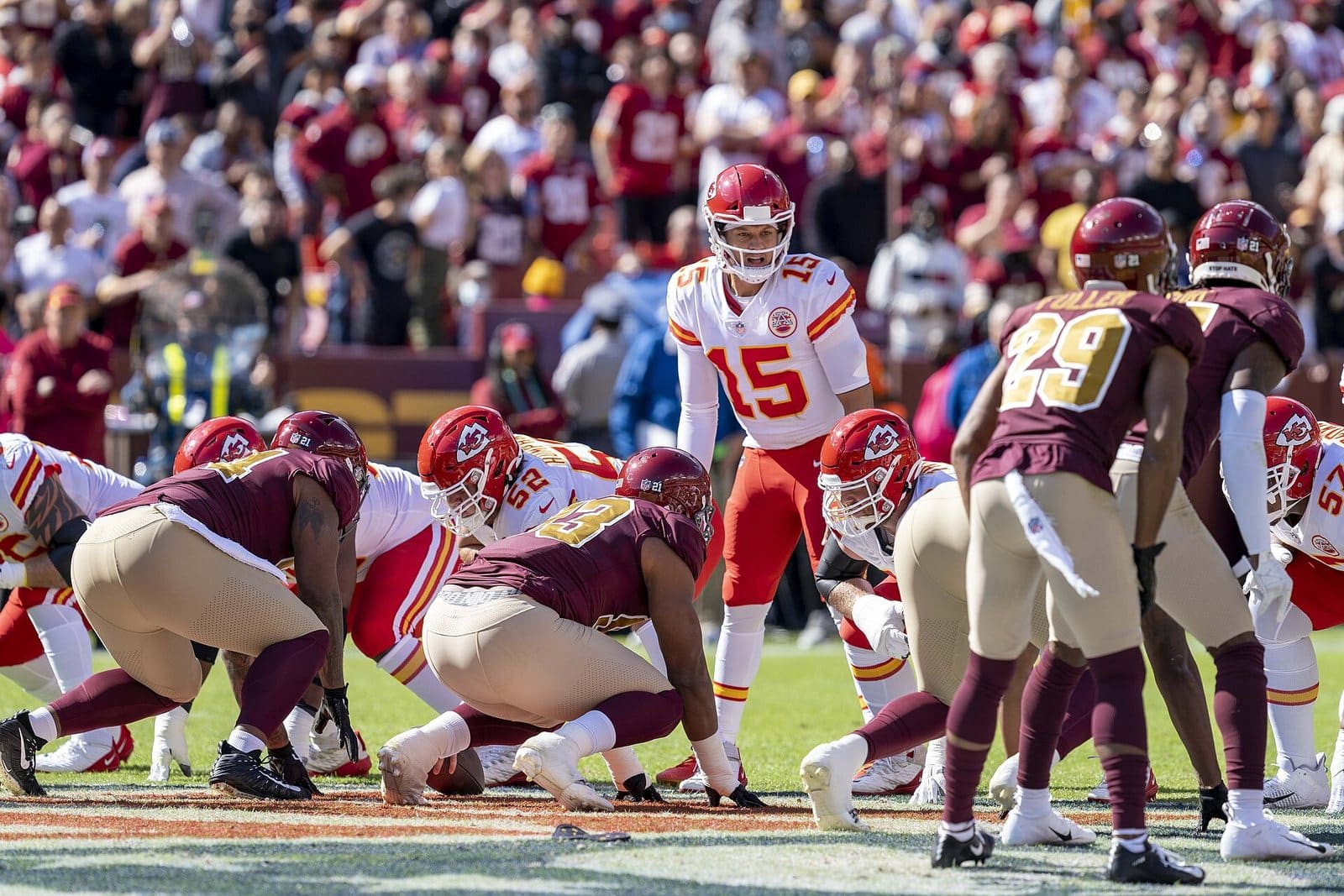
Highest average salary: Patrick Mahomes, $64 million per year
Labor deal (CBA): runs through the 2030 season
Jump to:
- NFL Salary Cap by Year (1994 to 2026)
- How the NFL Salary Cap Works
- Highest Paid NFL Players by Average Salary
- Cap Space by Team in 2026
- Franchise Tag Values for 2026
- NFL Minimum Salary in 2026
- NFL vs NBA, NHL, MLB, WNBA and MLS
- What Will the Salary Cap Be in 2027?
NFL Salary Cap by Year (1994 to 2026)
The NFL introduced its salary cap in 1994 at $34.6 million. 2010 was the only season without a cap, because the old labor deal ran out. 2021 is the only year the cap fell, after empty stadiums in 2020 cut league revenue.
| Season | Salary cap | Change | Note |
|---|---|---|---|
| 2026 | $301.2M | +7.9% | First cap above $300 million |
| 2025 | $279.2M | +9.3% | |
| 2024 | $255.4M | +13.6% | Biggest jump in dollars |
| 2023 | $224.8M | +8.0% | |
| 2022 | $208.2M | +14.1% | |
| 2021 | $182.5M | -7.9% | Only drop, COVID revenue loss |
| 2020 | $198.2M | +5.3% | |
| 2019 | $188.2M | +6.2% | |
| 2018 | $177.2M | +6.1% | |
| 2017 | $167.0M | +7.6% | |
| 2016 | $155.3M | +8.4% | |
| 2015 | $143.3M | +7.7% | |
| 2014 | $133.0M | +8.1% | |
| 2013 | $123.0M | +2.0% | |
| 2012 | $120.6M | +0.5% | |
| 2011 | $120.0M | -2.4% | Cap returns with the 2011 CBA |
| 2010 | No cap | Uncapped year | |
| 2009 | $123.0M | +6.0% | |
| 2008 | $116.0M | +6.4% | |
| 2007 | $109.0M | +6.9% | |
| 2006 | $102.0M | +19.3% | |
| 2005 | $85.5M | +6.1% | |
| 2004 | $80.6M | +7.4% | |
| 2003 | $75.0M | +5.5% | |
| 2002 | $71.1M | +5.5% | |
| 2001 | $67.4M | +8.4% | |
| 2000 | $62.2M | +8.5% | |
| 1999 | $57.3M | +9.4% | |
| 1998 | $52.4M | +26.4% | Biggest jump in percent |
| 1997 | $41.5M | +1.7% | |
| 1996 | $40.8M | +9.8% | |
| 1995 | $37.1M | +7.2% | |
| 1994 | $34.6M | First NFL salary cap |
Sources differ slightly for a few early seasons. NFL.com lists $128 million for 2009 and $63.2 million for 2000; the table uses the more widely cited values.
How the NFL Salary Cap Works
The NFL uses a hard cap: no team may go over it, and every team must be under the cap when the new league year starts in March. The number is set each year by a formula in the collective bargaining agreement (CBA), which gives the players 48 percent of football related revenue. Benefits such as pensions and insurance come on top, so total player costs per team are higher than the cap.

Signing bonuses and proration
A signing bonus is paid up front but counted evenly over the contract, for at most five years. A $10 million bonus on a five year deal costs $2 million against the cap each year. This is the main tool teams use to create cap room.
Void years
Void years are dummy years added to the end of a contract only to spread the bonus over five years. The player never plays them. When the contract voids, the unpaid share of the bonus hits the cap as dead money.
Dead money and the June 1 rule
Dead money is cap space spent on players no longer on the roster. If a team cuts a player before June 1, all remaining bonus money counts right away. With a post June 1 designation (two per team and year) it can split that charge over two seasons. Example: $5 million in proration left for four more years means $20 million in dead money now, or $5 million now and $15 million next year.
Cap hit is not the same as salary
The cap hit is what a player counts against the cap this season. The average per year (APY) is the total value divided by the years. Patrick Mahomes has the highest APY in the league at $64 million, but thanks to the structure of his deal his cap hit is lower than that of several other quarterbacks.
Highest Paid NFL Players by Average Salary
Quarterbacks own the top of the market. Will Anderson Jr. of the Texans is the highest paid player who is not a quarterback.
| Player | Team | Average per year |
|---|---|---|
| Patrick Mahomes | Chiefs | $64M |
| Dak Prescott | Cowboys | $60M |
| Josh Allen | Bills | $55M |
| Joe Burrow | Bengals | $55M |
| Trevor Lawrence | Jaguars | $55M |
| Jordan Love | Packers | $55M |
| Baker Mayfield | Buccaneers | $55M |
| Matthew Stafford | Rams | $55M |
| Jared Goff | Lions | $53M |
| Brock Purdy | 49ers | $53M |
| Justin Herbert | Chargers | $52.5M |
| Lamar Jackson | Ravens | $52M |
| Jalen Hurts | Eagles | $51M |
| Will Anderson Jr. | Texans | $50M |
Cap Space by Team in 2026
Cap room changes with every signing and release. These are the ten teams with the most space in early November 2026 according to Over The Cap. Several contenders, including the Chiefs, Ravens and Bears, have less than $2 million left.
| Team | Cap space |
|---|---|
| Titans | $36.3M |
| Colts | $35.9M |
| 49ers | $35.2M |
| Lions | $34.3M |
| Falcons | $27.9M |
| Chargers | $26.0M |
| Commanders | $24.5M |
| Cowboys | $17.1M |
| Buccaneers | $15.2M |
| Browns | $12.0M |
Franchise Tag Values for 2026
The franchise tag keeps a player for one more year on a fixed salary based on the top salaries at his position. The transition tag is cheaper but only gives the team the right to match an outside offer.
| Position | Franchise tag | Transition tag |
|---|---|---|
| QB | $43.9M | $37.8M |
| RB | $14.3M | $11.3M |
| WR | $27.3M | $23.9M |
| TE | $15.0M | $12.7M |
| OL | $25.8M | $23.4M |
| DE | $24.4M | $21.5M |
| DT | $27.1M | $22.5M |
| LB | $26.9M | $21.9M |
| CB | $21.2M | $18.1M |
| S | $20.1M | $16.0M |
| K/P | $6.6M | $6.0M |
NFL Minimum Salary in 2026
| Credited seasons | Minimum salary |
|---|---|
| Rookie (0) | $885,000 |
| 1 | $1,005,000 |
| 2 | $1,075,000 |
| 3 | $1,145,000 |
| 4 to 6 | $1,215,000 |
| 7 or more | $1,300,000 |
Practice squad players earn at least $13,750 per week in 2026, or $247,500 over an 18 week season.
NFL vs NBA, NHL, MLB, WNBA and MLS
| League | Cap | Type |
|---|---|---|
| NFL (2026) | $301.2M | Hard cap with 90% spending floor |
| NBA (2026-27) | $165.0M | Soft cap, luxury tax at $200.4M, aprons at $209.0M and $221.7M |
| NHL (2026-27) | $104.0M | Hard cap, floor $76.9M |
| MLB (2026) | None | Competitive balance tax from $244M |
| WNBA (2026) | $7.0M | Cap tied to revenue under the 2026 CBA |
| MLS (2026) | $6.4M | Salary budget for senior roster, plus GAM, TAM and Designated Players |
More on each league: NBA salary cap, NHL salary cap, MLB luxury tax, WNBA salary cap and MLS salary budget.
What Will the Salary Cap Be in 2027?
The league has not announced a 2027 number yet; it usually does so in late February or early March. If the cap grows at the same 7.9 percent as this year, it would land around $325 million. That is our own calculation, not an official projection. A bigger jump would need new media money or an 18th game.
For the calendar behind all this, see the 2026 NFL season dates, or test your knowledge with the hard NFL trivia.
More Reading
- NFL Stadiums Ranked
- NFL Season 2026 Key Dates
- NBA Salary Cap
- WNBA Salary Cap
- NHL Salary Cap
- MLB Salary Cap and Luxury Tax
- MLS Salary Cap
- NFL Teams by Division
- NFL Teams Map
- Super Bowl Winners by Year
- NFL Quiz
- Hard NFL Trivia
- American Football Rules
- American Football History
FAQ
What is the NFL salary cap for 2026?
The 2026 salary cap is $301.2 million per team.
What was the NFL salary cap in 2025?
$279.2 million per team.
Is the NFL salary cap a hard cap?
Yes. Teams cannot exceed it, unlike the NBA, which uses a soft cap with a luxury tax.
Who is the highest paid NFL player?
Patrick Mahomes of the Kansas City Chiefs has the highest average salary at $64 million per year.
Is there a salary floor in the NFL?
Yes. Teams must spend at least 90 percent of the cap in cash, measured over multi year windows.
What is dead money?
Cap space charged for players who are no longer on the roster, usually leftover signing bonus money.
When did the NFL salary cap start?
In 1994, at $34.6 million per team.
What is the NFL minimum salary in 2026?
$885,000 for a rookie, rising to $1.3 million for veterans with seven or more seasons.


No comments yet
What's your take?
What's your opinion, or think we got something wrong? Tell us and other readers.
Our editors read every comment.