

NASCAR rules explained for beginners: race format and stages, points, the 2026 Chase, flags, cautions, restarts, overtime and pit road rules in plain English.
A NASCAR race looks like 40 cars going left for a few hours, and in a way it is. Underneath, though, sits a set of rules that decides who scores points, when the race slows down, how restarts work and who wins the championship. Once you know a handful of them, a broadcast stops being noise and starts being a story.
This guide covers the Cup Series, NASCAR’s top level, and follows the 2026 season. The sport changed its championship format for 2026, so older explanations of elimination rounds no longer apply. Everything below is written for someone who has never watched a full race.
Jump to:
- NASCAR Rules in 60 Seconds
- The Basics: Cars, Drivers and the Field
- Race Format and Stages
- How Points Work
- The 2026 Chase Format
- NASCAR Flags and What They Mean
- Cautions and Restarts
- Overtime: The Green-White-Checkered Finish
- Pit Road Rules
- Common Penalties
- Beginner Cheat Sheet

NASCAR Rules in 60 Seconds
- The first car across the line wins. The race runs a set distance, and the checkered flag goes to the winner first.
- Every race has three parts. Two stages end with a short caution, and the last stage runs to the finish.
- Points are handed out three times. Drivers score at the end of each of the first two stages and again at the finish.
- The top 16 race for the title. After 26 regular season races, the top 16 in points start a 10 race Chase with no eliminations.
- Yellow means slow down. A caution freezes the order, the field follows the pace car and the race restarts side by side.
- Speeding on pit road is penalized. Each track has a pit road speed limit, and breaking it costs you track position.
The Basics: Cars, Drivers and the Field
A Cup Series race starts with a field of up to 40 cars. Thirty-six of them hold a charter, which guarantees a team a starting spot in every points race, and the remaining spots go to open teams that have to race their way in. Every car in the series is the Next Gen car, a spec design used since 2022, so teams compete on setup, strategy and driving more than on who built the fastest chassis.
Races take place on ovals of all sizes, from short tracks like Bristol and Martinsville to superspeedways like Daytona and Talladega, plus a handful of road courses. The starting order comes from qualifying, and the format varies by type of track.
Race Format and Stages
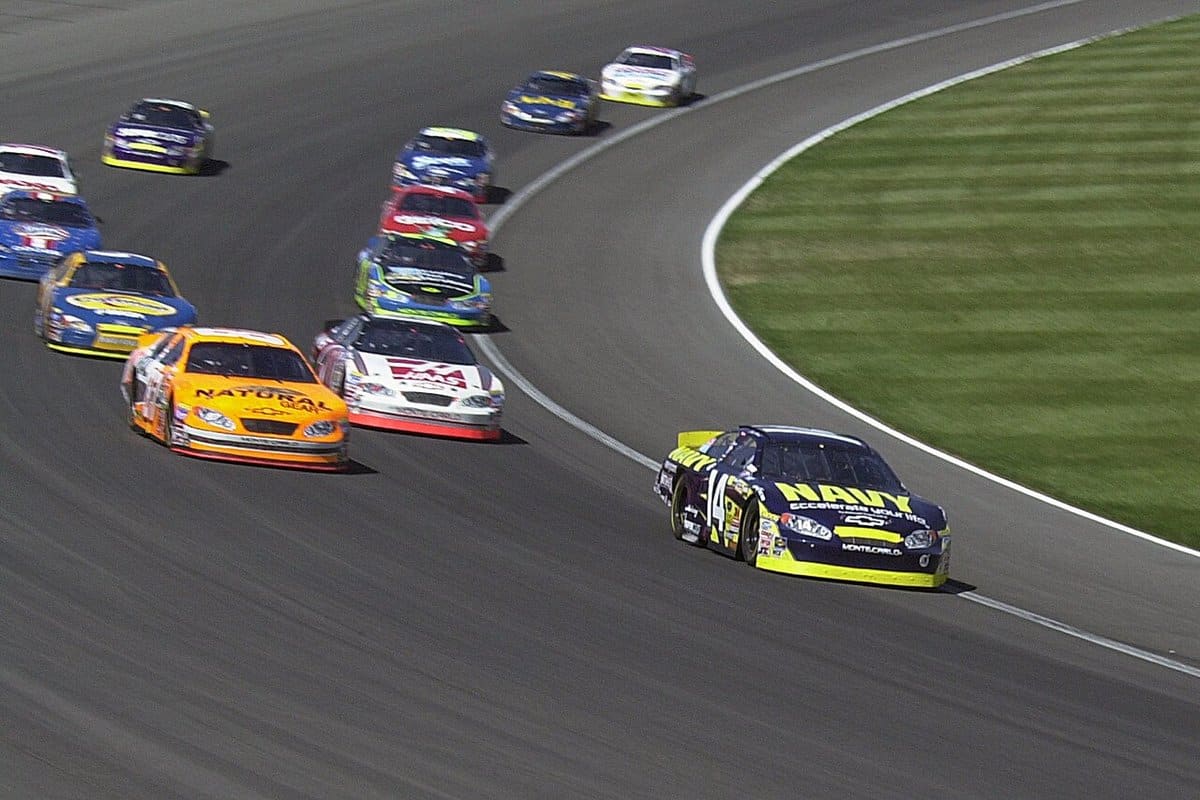
Every Cup race is divided into three parts: stage 1, stage 2 and a final stage. The first two stages end with a stage break. When the stage ends, a caution flag waves, the field slows down and teams usually pit. Then the race goes green again for the next stage. The final stage has no break and simply runs to the checkered flag.
The point of stages is to give drivers something to race for in the middle of an event. Instead of waiting for the finish, drivers push for the top 10 at the end of each stage, because that is where stage points are paid.
How Points Work
In the 2026 system, points come from two places: stage results and the finishing order.
| Source | What it pays |
|---|---|
| Stage 1 and stage 2 | Top 10 in each stage score 10 points down to 1 point |
| Race win | 55 points |
| Second place | 35 points |
| Third place | 34 points, then one point less for each position |
| 36th to 40th place | 1 point each |
A driver who wins a race and also finishes in the top 10 of both stages can collect a maximum of 75 points. Drivers who lead the field without finishing well gain nothing for it, so consistency across all three parts of a race matters.
The 2026 Chase Format
NASCAR returned to a championship format called the Chase for 2026, replacing the elimination rounds that had decided the title in earlier seasons. The new system has two parts.
- Regular season: 26 races. The top 16 drivers in regular season points qualify for the Chase. A race win alone no longer guarantees a place.
- The Chase: 10 races with no eliminations. Points are reset once before the first Chase race. The regular season leader starts with 2,100, second place with 2,075 and third with 2,065. Each driver after that starts 5 points lower, down to 2,000 for 16th.
- The title: after the 10th and final race, the driver with the most points is the champion. The 2026 finale is at Homestead-Miami Speedway on November 8.
Because there are no eliminations, a bad day does not end a title run the way it did in the old format. But it does cost points, and the gaps from the reset are small enough that every race in the Chase can swing the standings. The 2026 Chase began at Darlington on September 6 and also includes stops at WWT Raceway, Bristol, Kansas, Las Vegas, Charlotte, Phoenix, Talladega and Martinsville.
NASCAR Flags and What They Mean
| Flag | Meaning |
|---|---|
| Green | The race starts or restarts. Go racing. |
| Yellow | Caution. Slow down, hold your position and follow the pace car. |
| Red | The race is stopped, usually for a major crash or heavy track repairs. Cars park on the track or pit road. |
| White | One lap to go. |
| Checkered | The race is over. The first car to take it wins. |
| Black | A driver must report to pit road, often for a penalty. |
| Blue with a diagonal yellow stripe | A faster car is approaching. Lapped drivers should let it pass. |
The flag stand sits at the start/finish line, and officials also use lights around the track, so drivers can see the same message from every corner.
Cautions and Restarts
A caution comes out when something on the track makes it unsafe to race at full speed. Typical causes are a crash, a spun car, debris or fluid on the surface. The moment the yellow flag waves, the running order is frozen and the field follows the pace car at reduced speed. Most teams use the time to make a pit stop.
Two rules decide which cars gain from a caution:
- Free pass: the lapped car running closest to the leader gets its lap back. It no longer counts as a lap down.
- Wave-around: lapped cars running ahead of the lead-lap cars are waved past the pace car and rejoin at the tail of the lead lap, which gives them their lap back.
The restart itself happens in two lines. The leader usually chooses which lane to start from, and the green flag waves once the leader accelerates in the restart zone near the start/finish line. Restarts are where positions change quickly, which is why you hear so much commentary about them.
Overtime: The Green-White-Checkered Finish
NASCAR does not allow a race to end under caution if it can be avoided. When a caution comes out near the end of a scheduled race, the race is extended with a green-white-checkered finish: a restart with two laps to go, one green lap and then the white flag and the finish.
There is no limit on the number of attempts. If another caution waves before the field reaches the overtime line at the start/finish stretch, the field lines up and tries again. If a caution comes after the leader has taken the white flag, the race is over and the finishing order is frozen at that moment.
Pit Road Rules
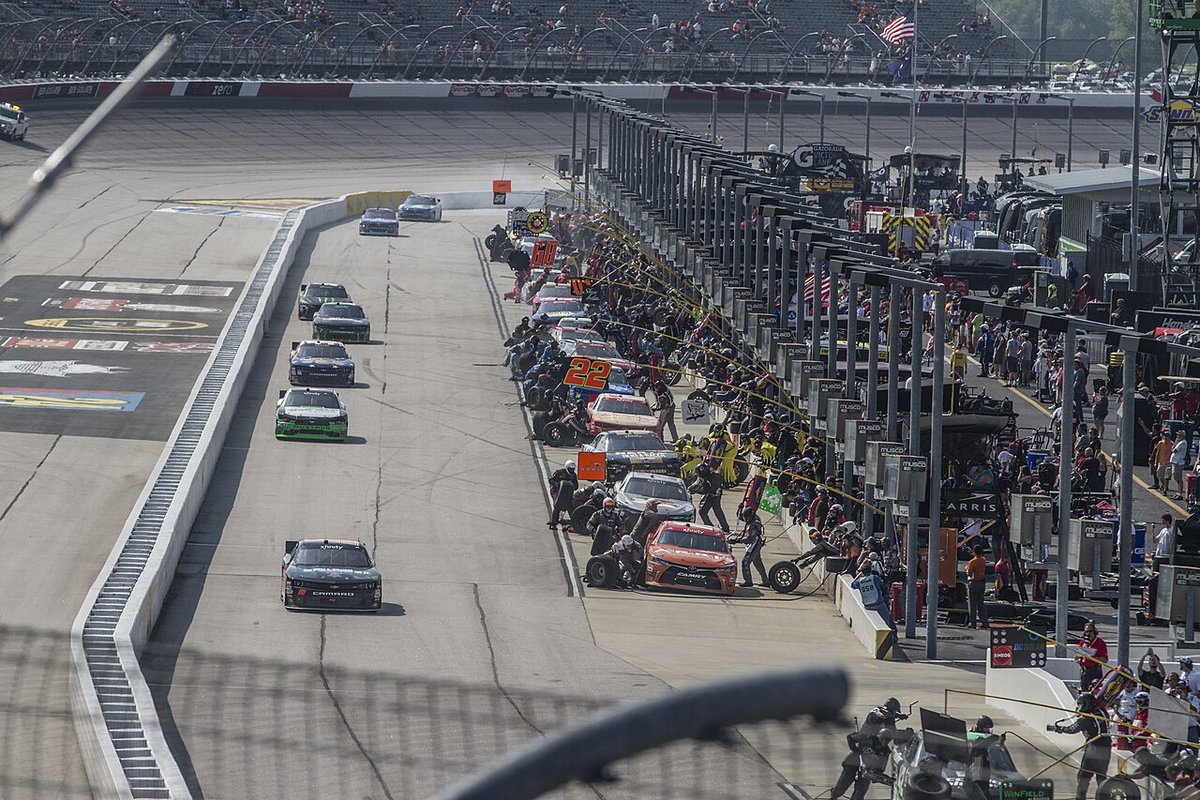
Pit stops decide many races, and pit road is a tightly regulated place.
- Speed limit: every track has its own pit road speed limit, and cars are timed between sections on pit road. Speeding under green is typically penalized with a drive through.
- Pit box: a car must stop in its assigned box. The crew works only inside it.
- Crew size: five crew members may go over the wall to service the car.
- Loose wheels: leaving the pit box with a wheel that is not secured is penalized.
- Leaving pit road: cars must exit in their lane and may not cut the pit road exit line.
Under caution, a driver who speeds on pit road can also be sent to the back of the field, so a mistake there can turn a leader into a back marker.
Common Penalties
- Speeding on pit road: usually a drive through under green.
- Too many crew members over the wall.
- Loose wheel: a wheel not properly fastened when the car leaves the pit box.
- Jumping a restart: starting before the green flag waves, which can mean a trip through pit road.
- Rough driving or unsafe contact: officials can penalize drivers who wreck others on purpose.
- Failed inspection: cars that do not meet the rules after inspection can be penalized, and serious cases can mean disqualification.
Penalties often cost positions rather than points, which is why they are so decisive in a Chase race where gaps are small.
Beginner Cheat Sheet
If you remember only a few things for your first race, make it these:
- Most races have two stages and a final stage (the Coca-Cola 600 has four stages in all).
- Stage winners score; so do the top 10 of each stage.
- A win is worth 55 points.
- The top 16 in points make the 10 race Chase.
- Yellow flag: order is frozen, cars pit and the field restarts side by side.
- Blue with a yellow stripe means let the faster car by.
- Overtime means as many attempts as it takes to finish under green.
- Watch the pit road speed: it can lose a race.
When the vocabulary starts to pile up, the NASCAR lingo guide explains terms like drafting, loose and tight, and the lucky dog.
More Reading
- History of NASCAR
- Who invented NASCAR
- NASCAR lingo and slang
- Best NASCAR drivers of all time
- Most important NASCAR races
- Racing sports list
- NASCAR quiz

FAQ
What are the basic rules of NASCAR?
The first car across the finish line wins. Most races have two stages and a final stage, drivers score points at the end of each stage and at the finish, and cautions freeze the field while the track is cleaned up. A race that would end under caution is extended with a green-white-checkered finish.
How does the 2026 NASCAR Chase work?
After 26 regular season races, the top 16 drivers in points enter a 10 race Chase with no eliminations. Points are reset once, with the regular season leader starting at 2,100 and 16th place at 2,000. The driver with the most points after the final race at Homestead-Miami is champion.
How many points is a NASCAR win worth in 2026?
A win is worth 55 points. Second place gets 35, third gets 34, and each position after that gets one point less, down to 1 point for 36th through 40th. Drivers can also score up to 10 points in each of the first two stages.
What are stages in NASCAR?
Stages split a race into three parts. A caution waves at the end of stage 1 and stage 2, and the top 10 cars in each stage score points. The final stage runs to the checkered flag.
What is a free pass in NASCAR?
Under caution, the lapped car running closest to the leader gets its lap back. This is called the free pass, and it is the modern name for what fans used to call the lucky dog.
What happens if there is a caution on the last lap?
If a caution waves after the leader has taken the white flag, the race ends under caution and the running order at that point is final. If it comes earlier in overtime, the field lines up and tries another green-white-checkered finish, with no limit on attempts.
What does the blue flag with a yellow stripe mean?
It tells a lapped driver that a faster car is coming up behind and should be allowed to pass without a fight.
Is NASCAR racing the same on every track?
The rules are the same, but the racing is not. Pit road speed limits differ by track, short tracks produce more cautions and contact, superspeedways produce big packs, and road courses add turns in both directions.


No comments yet
What's your take?
What's your opinion, or think we got something wrong? Tell us and other readers.
Our editors read every comment.