

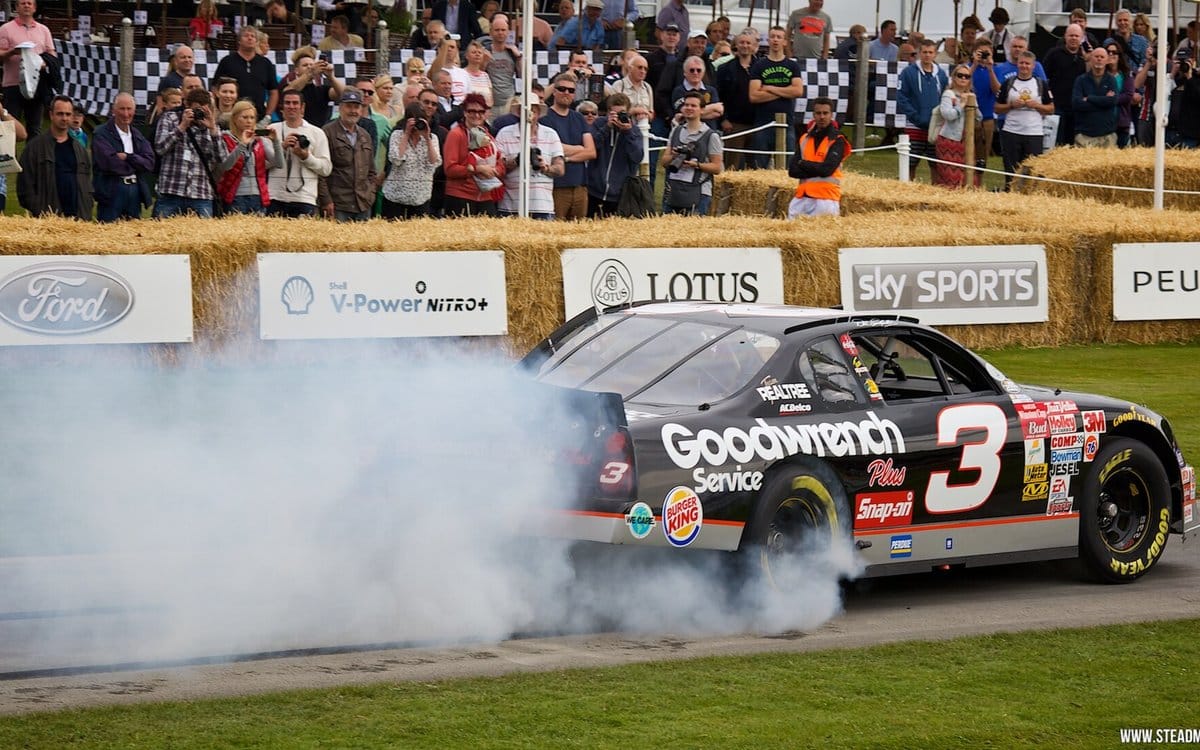
NASCAR was founded in Daytona Beach, Florida, in early 1948 by Bill France Sr., and it grew from a patchwork of beach and dirt races into America’s biggest motorsport.
The timeline covers the first Strictly Stock race in 1949, the opening of Daytona International Speedway and the first Daytona 500 in 1959, the 1979 live flag-to-flag broadcast, the Dale Earnhardt era, the Chase and the 2026 format change.

Key Facts
| Who founded NASCAR? | Bill France Sr., a Daytona Beach garage owner and promoter who gathered drivers and promoters in December 1947 and formed the sanctioning body in February 1948. |
| Where did it start? | Daytona Beach, Florida, where cars raced on a course that ran along the sand and a stretch of public road. |
| When was the first Strictly Stock race? | June 19, 1949, at Charlotte Speedway in North Carolina. Jim Roper won. |
| What is the signature race? | The Daytona 500, first run on February 22, 1959, at the new Daytona International Speedway. Lee Petty won. |
| Who holds the title records? | Richard Petty, Dale Earnhardt and Jimmie Johnson each won seven Cup Series championships. Petty also holds the win record with 200. |
| What changed the sport most? | Live national television. CBS aired the 1979 Daytona 500 flag to flag, and a last-lap crash and a fight in the infield made stock car racing a national story. |
NASCAR History Summary
- ⏳ Origins and Evolution: NASCAR grew out of the informal stock car racing that followed World War II in the American South. Bill France Sr. brought order to a scene of competing promoters, set common rules and built the organization that still runs the sport.
- 🚀 Rise to Prominence: The Strictly Stock series of 1949, the superspeedways at Darlington and Daytona and a long title sponsorship by R. J. Reynolds took the sport from regional dirt tracks to a national schedule. Television carried it into homes across the country.
- 🥇 Noteworthy Growth and Adaptation: Safety reforms after 2001, a playoff format that began in 2004, the Next Gen car of 2022 and a charter system for teams show a sport that keeps rebuilding itself while staying tied to its roots.
Timeline
| Year | What Happened |
|---|---|
| Before 1948 | Drivers race modified street cars on beaches, dirt ovals and country roads across the South. Rules differ at every track. |
| 1947 to 1948 | Bill France Sr. meets drivers and promoters in Daytona Beach in December 1947, and NASCAR is formed in February 1948. |
| 1949 | The first Strictly Stock race, a contest for showroom cars, is held at Charlotte Speedway on June 19. Jim Roper wins. |
| 1950 | The series is renamed Grand National, and Darlington Raceway opens as a paved superspeedway in South Carolina. |
| 1959 | Daytona International Speedway opens, and Lee Petty wins the first Daytona 500 after a photo finish. |
| 1963 | Wendell Scott wins a Grand National race at Jacksonville, Florida, the first Black driver to win at NASCAR’s top level. |
| 1971 to 1972 | R. J. Reynolds becomes title sponsor and the series becomes the Winston Cup. The schedule is trimmed to what is known as the modern era. |
| 1979 | CBS shows the Daytona 500 live from start to finish. Richard Petty wins after a last-lap crash and an infield fight. |
| 2001 | Dale Earnhardt dies in a crash on the last lap of the Daytona 500, which leads to the HANS device and SAFER barriers. |
| 2004 | The Chase for the Nextel Cup introduces a playoff to decide the champion. |
| 2014 to 2017 | The playoffs expand to 16 drivers with elimination rounds, and races are split into stages from 2017. |
| 2022 | The Next Gen car makes its debut. |
| 2026 | The postseason returns to a single cutoff, with the top 16 drivers racing for the title over the last 10 races. |
NASCAR began as a business plan as much as a sport. Bill France Sr. understood that fans, drivers and tracks needed one set of rules and one schedule, and he built the organization that supplied both.
Seven-time champions are rare in any sport, and NASCAR has three of them. For the full ranking, see the best NASCAR drivers of all time, and for the key dates on the calendar read the most important NASCAR races.
1940s
Stock car racing in the South took off after World War II, when young men came home with mechanical skills and a taste for speed. Many drivers modified ordinary cars for local tracks, and promoters ran their own events under their own rules. The result was confusion over safety, prize money and who the champion actually was.
Bill France Sr. moved to Daytona Beach in 1935 and ran races on the beach course. In December 1947 he brought drivers and promoters together at a hotel in Daytona Beach to agree on a common framework, and NASCAR was formed in February 1948. The first Strictly Stock race, for unmodified showroom cars, followed on June 19, 1949, at Charlotte Speedway, and Jim Roper won.
1950s
The series became the Grand National Series in 1950, and Darlington Raceway opened that year in South Carolina as a paved superspeedway and home of the Southern 500. Racing was moving off the beach and off the dirt.
In 1959 France opened Daytona International Speedway, a high-banked 2.5-mile tri-oval. The first Daytona 500 was held on February 22, 1959. Johnny Beauchamp was first named the winner, but three days later, after reviewing photographs, officials declared Lee Petty the winner.
1960s and 1970s
Richard Petty, Lee’s son, became the sport’s first great star and won his first title in 1964. The sport also opened slowly to new faces. Wendell Scott won at Jacksonville in 1963 and was later inducted into the NASCAR Hall of Fame.
In 1971 R. J. Reynolds began its sponsorship, and by 1972 the Winston Cup Series ran a shorter schedule that marks the start of the modern era. Then came the 1979 Daytona 500. CBS aired it live from green flag to checkered flag, a snowstorm kept much of the East Coast indoors, and a last-lap crash between Donnie Allison and Cale Yarborough was followed by a fight in the infield. Petty won the race, and the sport had its first national audience.
1980s to 2000
Dale Earnhardt arrived as the sport’s hardest driver, winning seven Cup titles between 1980 and 1994 and tying Richard Petty’s record. Jeff Gordon, a young open-wheel convert from California, challenged him in the 1990s and helped bring in a new, broader fan base.
Earnhardt finally won the Daytona 500 in 1998, on his 20th attempt. The sport’s reach grew with new tracks in big markets, and NASCAR became a fixture on American television.
2001 to 2013
Earnhardt died in a last-lap crash at the 2001 Daytona 500. NASCAR responded with a safety push that included the mandatory HANS device and SAFER barriers on the walls, and the sport has had far fewer fatal injuries since.
In 2004 the Chase for the Nextel Cup created a playoff to decide the title. Jimmie Johnson then won five straight championships from 2006 to 2010, a record, and added titles in 2013 and 2016 to reach seven. In 2010 the NASCAR Hall of Fame opened in Charlotte.
2014 to Present
A new elimination format came in 2014 with a 16-driver playoff field. Stage racing arrived in 2017, and in 2022 the Next Gen car replaced the previous design with a common chassis and new parts meant to cut costs and tighten the racing. A charter system, introduced in 2016, gave teams a more stable footing.
For 2026, the postseason returned to a single cutoff after 26 races, with the top 16 drivers competing over the final 10 races. The sport also keeps looking beyond the oval, with road courses and street races now part of the schedule.
Compare the sport’s origins with the history of horse racing and BMX racing, or browse the recreational sports list for other activities that grew out of everyday life.
See which circuits hold the biggest crowds in our list of the largest race tracks in the world.

FAQ
Who founded NASCAR?
Bill France Sr. founded NASCAR in Daytona Beach, Florida. He called a meeting of drivers and promoters in December 1947, and the organization was formed in February 1948.
When was the first NASCAR race?
NASCAR held its first event at Daytona Beach in February 1948. The first Strictly Stock race, which became the foundation of today’s Cup Series, took place on June 19, 1949, at Charlotte Speedway.
When was the first Daytona 500?
The first Daytona 500 was run on February 22, 1959, at the newly opened Daytona International Speedway. Lee Petty won after a photo finish with Johnny Beauchamp.


No comments yet
What's your take?
What's your opinion, or think we got something wrong? Tell us and other readers.
Our editors read every comment.