

Kickball field dimensions with diagram: WAKA rules for 60 ft bases, the 42 ft 5 in pitching strip, strike zone, kicking box and how softball fields compare.
Under WAKA rules, the most widely used rulebook for adult kickball, the bases are 60 feet apart (18.29 meters) and the pitching strip sits 42 feet 5 inches from home plate, in the exact center of the diamond. The strike zone reaches 1 foot to either side of home plate and 1 foot high. There is no official outfield size: kickball is usually played on a softball or baseball field and uses its outfield.
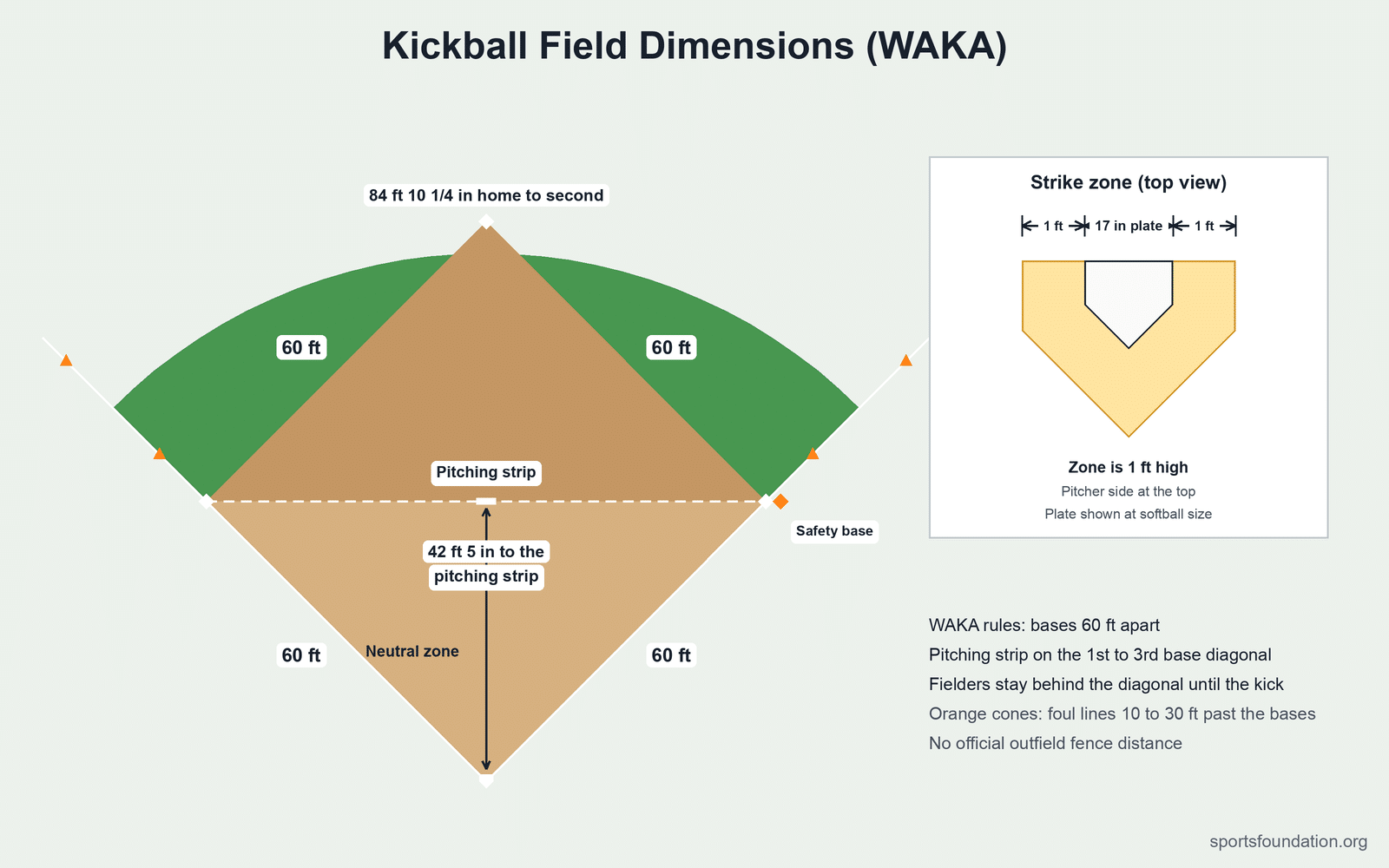
WAKA, the World Adult Kickball Association, wrote the rules that most adult leagues in the United States follow. Many leagues, from city parks departments to social sports clubs, publish their own versions based on WAKA, and school and youth games often shorten the bases to fit the space. Below are the WAKA measurements, with a diagram drawn to scale.
Jump to:
- Kickball Field Dimensions at a Glance
- How Far Apart Are the Bases in Kickball?
- Where Does the Pitcher Stand in Kickball?
- The Kickball Strike Zone
- Kicking Box and Foul Lines
- Neutral Zone and Fielder Positions
- How Big Is a Kickball Outfield?
- Kickball Field vs Softball and Baseball Fields

Kickball Field Dimensions at a Glance
| Measurement | Feet | Meters |
|---|---|---|
| Distance between bases | 60 ft | 18.29 m |
| Home plate to second base | 84 ft 10 1/4 in | 25.86 m |
| Home plate to pitching strip | 42 ft 5 in | 12.93 m |
| Strike zone beyond each side of the plate | 1 ft | 30 cm |
| Strike zone height | 1 ft | 30 cm |
| Foul line cones beyond 1st and 3rd base | 10 to 30 ft | 3 to 9 m |
| Infield area (inside the bases) | 3,600 sq ft | 334 sq m |
| Ball (WAKA-based rules) | 10 in diameter | 25.4 cm |
Watch: How Big Is a Kickball Diamond Compared to Other Sports?
This short animation draws the kickball diamond with its official lines and measurements, then lines it up with 36 other sports surfaces at the same scale, smallest to largest.
How Far Apart Are the Bases in Kickball?
The bases are 60 feet apart, about 20 paces. The four bases form a square with 90 degree corners, just like a baseball diamond. WAKA rules say to measure from the back corner of home plate to the back corner of each base. That makes the distance from home plate to second base, and from first to third, 84 feet 10 1/4 inches.
Most kickball fields use standard softball bases. WAKA rules also call for a safety base next to first base in foul territory, so that the runner and the fielder at first use different bags and do not collide.
Where Does the Pitcher Stand in Kickball?
The pitching strip lies on the line between first and third base, in the center of the infield, 42 feet 5 inches (about 14 paces) from home plate. That is simply half of the diagonal of a 60 foot square. The pitcher must deliver the ball from behind the front edge of the strip and stay behind it until the ball is kicked.
Under WAKA rules the ball must be rolled or bounced to the plate: a pitch that rolls or bounces no more than twice is legal, and one that reaches the plate more than 1 foot above the ground is a ball. Some WAKA-based rulebooks also mark a pitcher’s circle with a 12 foot radius around the strip, used to stop play once the pitcher has the ball back.
The Kickball Strike Zone
The strike zone is the area over home plate, extended by 1 foot to either side of the plate, and it is 1 foot high. Its front edge lines up with the front of home plate. With a standard 17 inch softball plate, the zone is 41 inches wide at the front. WAKA rules do not allow the zone to be marked with cones or other raised objects because they could interfere with play, but painted or drawn lines are allowed.
Kicking Box and Foul Lines
The kicking box is a rectangle around home plate. Its front edge lines up with the front of home plate, and its back and sides are set by cones placed behind the plate. The kicker must have at least part of the planted foot inside the box when kicking. WAKA does not give one fixed size for the box, so leagues set the cones themselves.
The foul lines run from home plate past first and third base. WAKA rules place cones on the foul lines 10 to 30 feet beyond first and third base to make them easy to see.
Neutral Zone and Fielder Positions
The triangle between home plate, first base and third base is the neutral zone. Except for the catcher and the pitcher, all fielders must stay behind the line from first to third base until the ball is kicked. The pitcher may not step past the front edge of the pitching strip. The catcher must stay behind or level with the kicker and may not cross home plate before the kick. This rule keeps fielders from crowding the kicker, and it is a major difference from softball.
How Big Is a Kickball Outfield?
WAKA sets no fence distance. Kickball is played on whatever field is available, usually a softball diamond, and the outfield ends where that field ends. On a typical softball field the fence is roughly 200 to 300 feet from home plate. Because a kickball does not fly as far as a softball, many leagues count a kick over the fence as an out or as a ground rule play rather than a home run. How the game works is explained in kickball rules.
Kickball Field vs Softball and Baseball Fields
A kickball diamond is the same size as a fastpitch softball diamond: both have 60 foot bases. The pitcher is in almost the same place too, 42 feet 5 inches from home plate in kickball and 43 feet in fastpitch softball. That is why kickball leagues use softball fields without changing the bases. A baseball diamond, with 90 foot bases, is too big for kickball. All measurements are in softball field dimensions and baseball field dimensions.
| Field | Bases | Pitching distance |
|---|---|---|
| Kickball (WAKA) | 60 ft | 42 ft 5 in |
| Fastpitch softball | 60 ft | 43 ft |
| Slowpitch softball (adult) | 65 ft | 50 ft |
| Little League baseball (12U) | 60 ft | 46 ft |
| Baseball (MLB, college, high school) | 90 ft | 60 ft 6 in |
More Reading
- Kickball rules: how to play
- Kickball positions explained
- Kickball equipment list
- Kickball lingo and slang
- Kickball quiz

FAQ
How far apart are the bases in kickball?
Under WAKA rules the bases are 60 feet apart, the same as on a fastpitch softball field.
How far is the pitcher from home plate in kickball?
The pitching strip is 42 feet 5 inches from home plate, in the center of the diamond.
How big is the strike zone in kickball?
It covers home plate plus 1 foot on each side, and it is 1 foot high.
Can you play kickball on a softball field?
Yes. A fastpitch softball field has the same 60 foot bases, and most leagues play on softball fields.
How big is a kickball field?
The infield is a 60 foot square. The outfield has no official size and depends on the field used.
What is the neutral zone in kickball?
The area in front of the line from first to third base. Fielders except the catcher and the pitcher must stay behind that line until the kick.
What is the safety base in kickball?
A second base bag next to first base in foul territory, used to avoid collisions between the runner and the first baseman.
Are kickball rules the same in every league?
No. Most adult leagues follow WAKA rules, but many publish their own versions with changes, and school games often use shorter bases.


No comments yet
What's your take?
What's your opinion, or think we got something wrong? Tell us and other readers.
Our editors read every comment.