

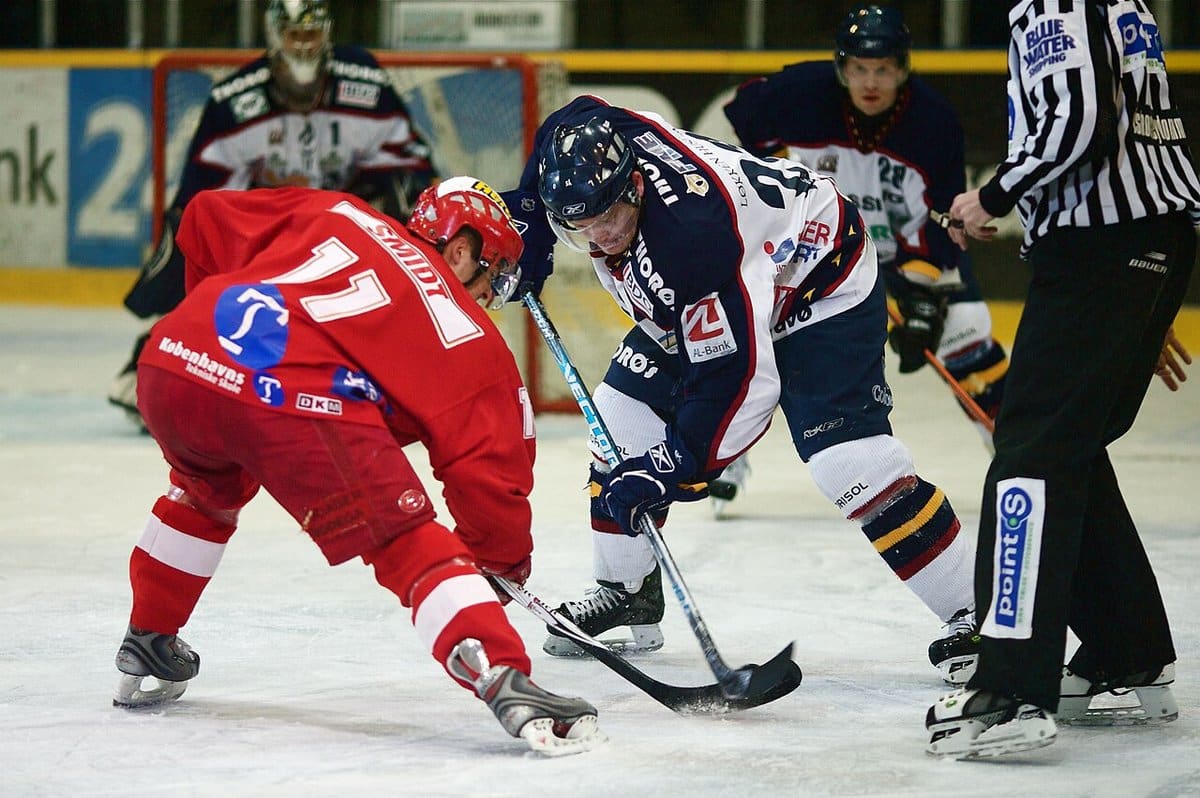
Ice hockey rules explained: periods, offside, icing, faceoffs, penalties and power plays, overtime and shootouts, plus how NHL and international rules differ.
Ice hockey is one of the fastest team sports in the world, and the action rarely stops for long. Most of the whistles in a game come from two rules, offside and icing, and once you understand those, the rest of the game is easy to follow.
This guide explains the rules in the order you see them on the ice: the rink, scoring, offside, icing, faceoffs, penalties and overtime. It follows the NHL rulebook, with a comparison of NHL and international IIHF rules at the end.
Jump to:
- Ice Hockey Rules in 60 Seconds
- The Rink
- Scoring
- Offside
- Icing
- Faceoffs
- Penalties and Power Plays
- Overtime and Shootouts
- NHL vs International Rules
- Tips for Watching Your First Game

Ice Hockey Rules in 60 Seconds
- Six players per side: three forwards, two defensemen and a goaltender.
- Three periods of 20 minutes. The clock stops whenever play stops.
- Score goals. The puck has to cross the goal line completely.
- Offside and icing are the two rules that stop play most often.
- Penalties mean power plays. A penalized player goes to the box and the team plays short handed.
The Rink
An NHL rink is 200 feet long and 85 feet wide with rounded corners and boards all around. The red center line splits the rink in half, and two blue lines divide it into the defensive zone, the neutral zone and the attacking zone. Each goal sits on a red goal line about 11 feet from the end boards. Five faceoff circles and four neutral zone faceoff spots mark where play restarts.
Our comparisons of a speed skating arena and an ice hockey arena and of a hockey arena and a curling rink put the rink in context.
Zones, faceoff circles, the crease and the trapezoid are listed in our guide to hockey rink dimensions.
Scoring
A goal counts when the whole puck crosses the goal line between the posts and under the crossbar. A goal does not count if an attacker kicks the puck in with a distinct kicking motion, throws or bats it in with the hand, or hits it with a stick above the crossbar. A shot that deflects in off any player, including a defender, is a goal.
Offside
An attacking player may not cross the opponent’s blue line into the attacking zone ahead of the puck. It is the position of the skates that counts: a player is onside as long as one skate is still on or behind the blue line, or in contact with it, when the puck crosses it completely.
If an attacker is offside but the defense has the puck, the linesman raises an arm and waits: a delayed offside. The attackers can clear it by all leaving the zone, touching the blue line, and play goes on. If an offside player touches the puck first, play is stopped and the faceoff takes place outside the zone.
Icing
Icing is called when a team shoots the puck from its own side of the center red line across the opponent’s goal line without anyone touching it. Play stops, and the faceoff moves back into the zone of the team that iced the puck. That team is not allowed to change players before the faceoff, so tired players stay on the ice.
- Hybrid icing: the linesman decides who would win the race to the puck, judged at the faceoff dots. If the defender is ahead, icing is called. If the attacker is ahead, play goes on.
- No icing short handed: a team that is killing a penalty may ice the puck without a whistle.
- Waved off: icing is not called if the goaltender plays the puck or a defender could have played it.
Faceoffs
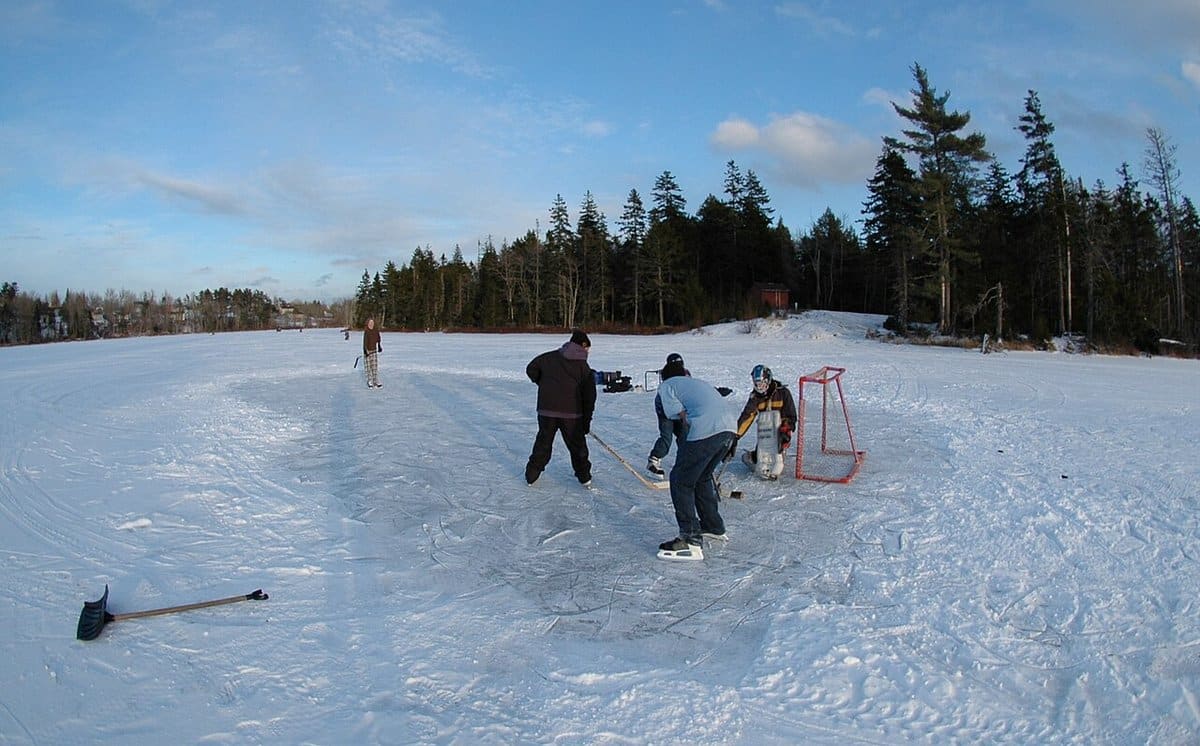
Every period and every stoppage starts with a faceoff. The referee or linesman drops the puck between two players, who try to win it back to a teammate. After a goal, the faceoff takes place at center ice. After icing, it moves to the defensive zone of the team that iced the puck, and after offside, to the neutral zone near the blue line.
Penalties and Power Plays
| Penalty | Time | Typical offenses |
|---|---|---|
| Minor | 2 minutes | Tripping, hooking, slashing, holding, interference, high sticking |
| Double minor | 4 minutes | High sticking that draws blood, spearing attempts |
| Major | 5 minutes | Fighting, serious boarding, charging or high sticking with injury |
| Misconduct | 10 minutes | Abuse of officials and other conduct, the team does not play short |
| Match or game misconduct | Rest of the game | Deliberate attempts to injure, serious incidents |
During a minor penalty, the other team has a power play with one extra skater. If it scores, the minor penalty ends at once. A major penalty must be served in full, no matter how many goals are scored. When the defending team commits a penalty and the attacking team has the puck, the referee raises an arm and waits, a delayed penalty, and the attacking team often pulls its goaltender for an extra skater.
Overtime and Shootouts
In the NHL regular season, a game tied after 60 minutes goes to a five minute, three on three overtime with sudden death. If no one scores, a shootout decides it: three shooters per team, then one each until one scores and the other does not. In the playoffs there is no shootout. Teams play full 20 minute periods five on five until someone scores.
NHL vs International Rules
| Rule | NHL | IIHF international |
|---|---|---|
| Rink size | 200 x 85 ft | Up to 60 x 30 m, many events now on NHL size rinks |
| Goalie puck handling | Behind the goal line only inside the trapezoid | No trapezoid |
| Fighting | Five minute major | Major plus an automatic game misconduct |
| Regular season or group stage overtime | 5 min, 3 on 3, then a shootout | 5 min, 3 on 3, then a shootout |
Tips for Watching Your First Game
- Watch the blue line when a team attacks. That is where offside is decided.
- When a referee raises an arm, a delayed penalty is coming. Look for the goalie heading to the bench.
- Line changes happen on the fly every 40 seconds or so. Watch the benches.
- Learn some hockey terms like hat trick, five hole and one timer.
More Reading
- Ice Hockey positions explained
- Ice Hockey lingo and slang
- Ice Hockey equipment list
- History of ice hockey
- Speed skating arena vs ice hockey arena
- Hockey arena vs curling rink
- Common ice hockey injuries
- Ice Hockey quiz

FAQ
What are the basic rules of ice hockey?
Two teams of six, including a goaltender, try to shoot the puck into the other team’s net. Games have three 20 minute periods, players may not enter the attacking zone ahead of the puck, and penalized players sit in the box while their team plays short handed.
What is offside in hockey?
An attacker crossing the opponent’s blue line before the puck. A player is onside as long as a skate is on or behind the line when the puck crosses it.
What is icing in hockey?
Shooting the puck from your side of the center red line across the opponent’s goal line untouched. Play stops and the faceoff goes back to your zone.
How long is a hockey game?
Three periods of 20 minutes of playing time. With stoppages and two intermissions, an NHL game takes about two and a half hours.
What happens in a power play?
One team has more skaters because the other has a player in the penalty box. A goal ends a minor penalty early.
Can you kick the puck into the net?
No, not with a distinct kicking motion. A puck that deflects off a skate without a kick counts.
How does overtime work in the NHL?
In the regular season, five minutes of three on three, then a shootout. In the playoffs, full 20 minute five on five periods until a goal.
Is fighting allowed in hockey?
It is a five minute major penalty in the NHL. In international and college hockey it leads to ejection.


No comments yet
What's your take?
What's your opinion, or think we got something wrong? Tell us and other readers.
Our editors read every comment.