

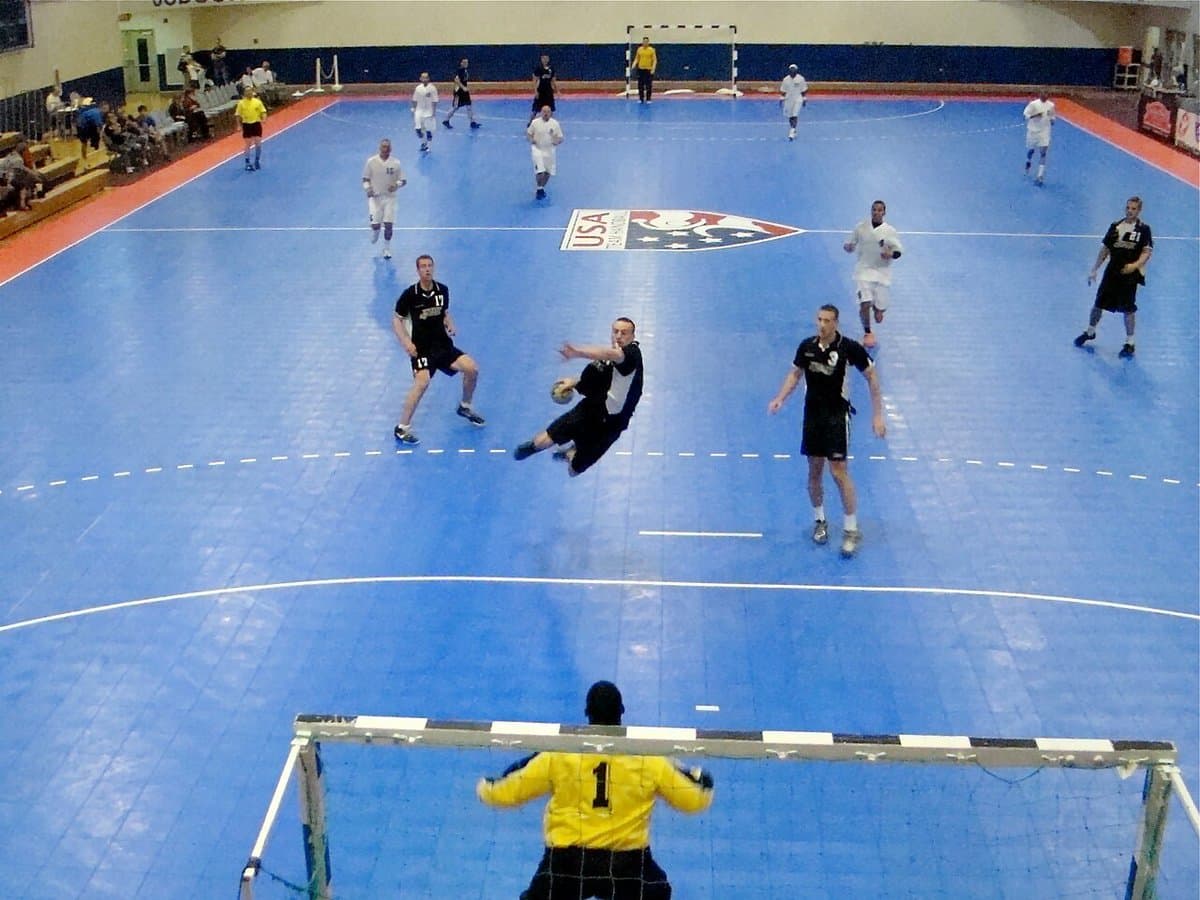
Handball rules explained: the 6 meter goal area, three steps and three seconds, double dribble, passive play, 7 meter throws, suspensions and cards.
Team handball is one of the most popular sports in Europe and still a mystery to many Americans. It feels like a mix of basketball and soccer: players dribble and pass with their hands, but they shoot at a goal guarded by a goalkeeper, and games often end with 60 goals or more.
This guide explains the indoor game in the order the rules come up: the court and the goal area, ball handling, scoring, defending, passive play, free throws and 7 meter throws, and the punishments from yellow card to red. It follows the Rules of the Game of the International Handball Federation, the IHF.
Jump to:
- Handball Rules in 60 Seconds
- The Court and the Goal Area
- Ball Handling: Steps, Seconds and Dribbling
- The Goal Area Rule
- Defending and Contact
- Passive Play
- Free Throws and 7 Meter Throws
- Cards and Suspensions
- Substitutions, Timeouts and Ties
- Indoor Handball vs Beach Handball
- Tips for Watching Your First Game

Handball Rules in 60 Seconds
- Seven players per side: six court players and a goalkeeper.
- Three steps, three seconds. You may take up to three steps and hold the ball for up to three seconds before you pass, shoot or dribble.
- Stay out of the goal area. Only the goalkeeper may stand in the 6 meter area. Shooters may jump in and release before they land.
- Score by throwing the ball into the goal. Every goal is one point.
- Two halves of 30 minutes. The team with more goals wins.
The Court and the Goal Area
A handball court is 40 meters long and 20 meters wide, with a goal 3 meters wide and 2 meters high at each end. In front of the goal, the 6 meter line marks the goal area, and a dashed 9 meter line marks the free throw line. The 7 meter mark is the spot for penalty throws. Our comparison of a gymnasium and a handball court shows how much bigger the court is than a basketball floor.
The court, the goal area, the 7 meter line and the goals are listed in our guide to handball court dimensions.
Ball Handling: Steps, Seconds and Dribbling
- Three steps: a player may take up to three steps with the ball. A fourth step is a turnover.
- Three seconds: a player may hold the ball for up to three seconds, also when it is lying on the floor.
- Dribbling: after bouncing the ball with one hand, a player may catch it and take three more steps. Catching it and dribbling again is a double dribble.
- Below the knee: court players may touch the ball with any part of the body above the knee, but not the lower leg or foot.
The Goal Area Rule
Only the goalkeeper may stand in the goal area. A court player who steps on the 6 meter line or into the area while holding the ball loses possession. Attackers may jump from outside the line and shoot before landing inside the area, which is why so many handball goals come from spectacular jump shots and dives. A defender who enters the area to gain an advantage gives away a 7 meter throw if it stopped a clear chance.
Defending and Contact
Handball allows more contact than basketball. Defenders may block an attacker with the torso and bent arms from the front. They may not push, hold, hit or grab the arm of the attacker, trip the attacker, or attack from behind. An attacker may not charge into a defender who has a stable position.
Passive Play
Teams may not hold the ball without trying to score. When referees see passive play, they raise an arm as a warning. From then on, the attacking team has at most four passes to take a shot. If they do not shoot, the ball goes to the other team.
Free Throws and 7 Meter Throws
| Throw | When | How |
|---|---|---|
| Throw-off | At the start of each half and after a goal | From the center area, the team can start immediately |
| Free throw | After most fouls and violations | From the spot of the foul, or from the 9 meter line if the foul was closer. Defenders 3 m away |
| 7 meter throw | A foul destroys a clear chance to score | A one on one against the goalkeeper from the 7 meter line |
| Goalkeeper throw | The ball crosses the goal line after the goalkeeper or an attacker touched it last | The goalkeeper throws from inside the goal area |
| Throw-in | The ball crosses the sideline | From the sideline with one foot on the line |
Cards and Suspensions
| Sanction | Meaning |
|---|---|
| Yellow card | A warning for unsporting behavior or a hard foul, usually one per player |
| Two minute suspension | The player leaves the court and the team plays one short for two minutes |
| Third two minute suspension | Leads automatically to a red card |
| Red card | Disqualification for the rest of the game, the team plays short for two minutes |
| Blue card | Shown after a red card when the incident will be reported for further punishment |
Substitutions, Timeouts and Ties
Substitutions are unlimited and happen on the fly through the team’s own substitution zone, without telling the referees. Each team has three team timeouts of one minute per game, with no more than two per half. In knockout games, a tie after 60 minutes goes to two periods of 5 minutes of extra time. If it is still tied, a second extra time of two times 5 minutes follows, and then a 7 meter shootout.
Indoor Handball vs Beach Handball
| Rule | Indoor handball | Beach handball |
|---|---|---|
| Players on court | 7 | 4 |
| Court | 40 x 20 m, hard floor | 27 x 12 m, sand |
| Game length | 2 x 30 min | 2 sets of 10 min, each set won separately |
| Spectacular goals | 1 point | 2 points, for example in flight or a spin shot |
| Tie in a set | Not applicable | Golden goal |
Tips for Watching Your First Game
- Watch the pivot, the attacker who fights for space at the 6 meter line.
- When the referee raises an arm, the attack is on the clock for passive play.
- Look for the empty net. Teams often pull the goalkeeper for a seventh court player.
- Learn some handball terms like wing, backcourt and kempa trick.
More Reading
- Handball positions explained
- Handball lingo and slang
- Handball equipment list
- History of handball
- Gymnasium vs handball court
- Common handball injuries
- Handball quiz

FAQ
What are the basic rules of handball?
Two teams of seven pass and dribble the ball by hand and try to throw it into the other team’s goal. Players may take three steps and hold the ball for three seconds, only the goalkeeper may stand in the 6 meter goal area, and games last two halves of 30 minutes.
How many steps can you take in handball?
Three steps while holding the ball. After a dribble, you may take three more.
Can you go in the goal area in handball?
Only the goalkeeper may stand in it. Court players may jump in from outside and release the ball before landing.
How long is a handball game?
Two halves of 30 minutes, with a halftime break of usually 10 minutes, up to 15 in some competitions.
What is a 7 meter throw in handball?
A penalty throw from the 7 meter line, awarded when a foul destroys a clear chance to score.
What happens with a two minute suspension?
The player has to leave the court and the team plays one short for two minutes. A third suspension means a red card.
Can you kick the ball in handball?
Court players may not touch the ball with the foot or lower leg. Only the goalkeeper may use the feet inside the goal area.
What is passive play?
Holding the ball without trying to score. After the referee’s warning, the team has at most four passes before it must shoot.


No comments yet
What's your take?
What's your opinion, or think we got something wrong? Tell us and other readers.
Our editors read every comment.