


Flag football field dimensions with diagram: 5 on 5 field of 25 x 70 yards, 10 yard end zones, no run zones, try marks and NFL FLAG vs IFAF field sizes.
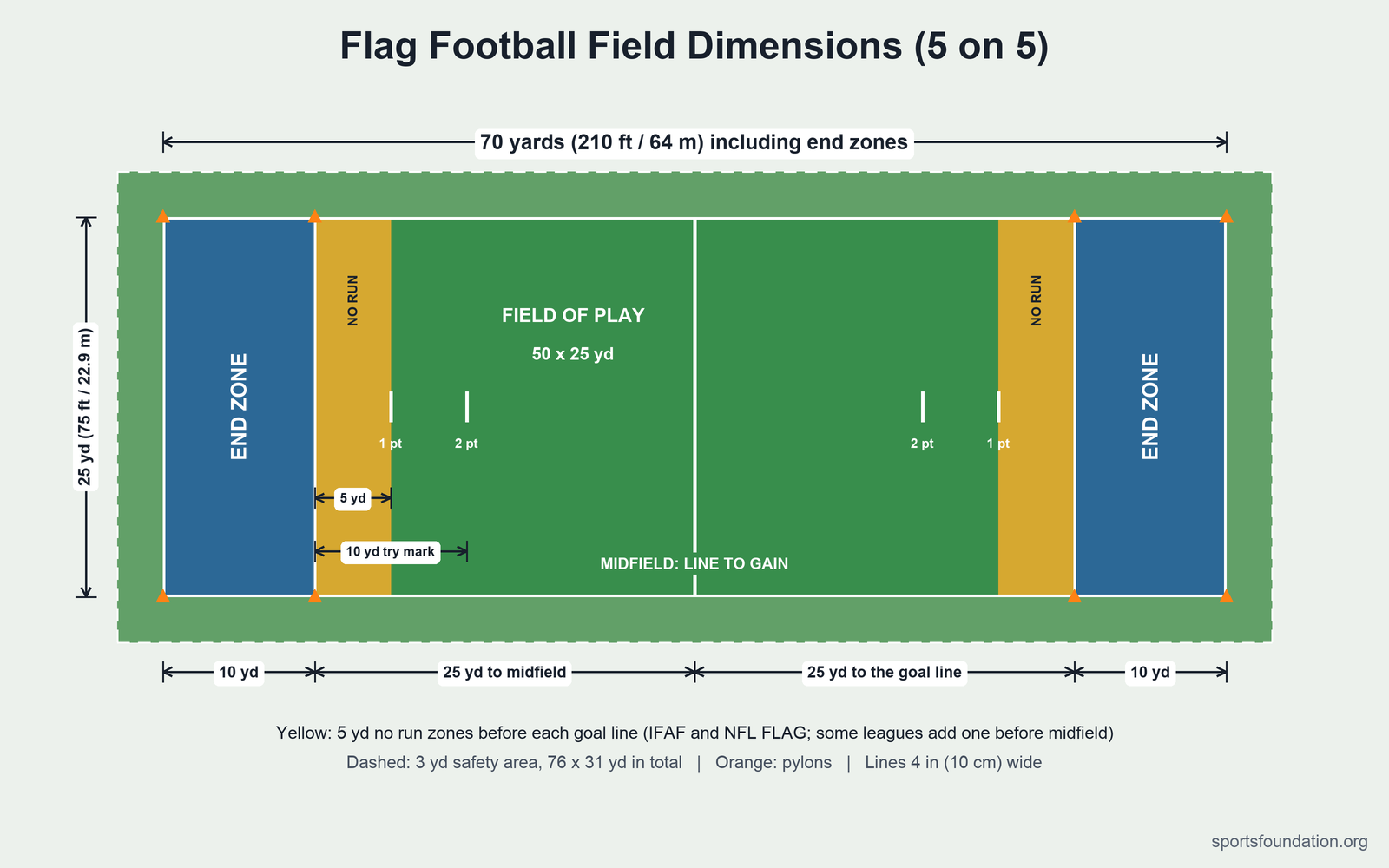
A standard 5 on 5 flag football field is 25 yards wide and 70 yards long, including two 10 yard end zones. That leaves 50 yards between the goal lines, with a line to gain at midfield. The international federation, IFAF, uses the same 50 x 25 yard field of play and 10 yard end zones, and the NFL FLAG rulebook uses the same layout.
Unlike American football, flag football has no single official field. The numbers below show what IFAF and NFL FLAG publish, where they differ, and what you need to mark a field at a park, school or gym.
Jump to:
- Flag Football Field Dimensions at a Glance
- Field of Play, End Zones and Lines
- No Run Zones and Try Marks
- NFL FLAG vs IFAF Field Sizes
- How Much Space Do You Need?
- Markings, Pylons and Flag Belts
- Other Field Sizes and Beach Flag Football
- Flag Football vs American Football Field Size
- How to Mark a Field

Flag Football Field Dimensions at a Glance
| Part of the field | Yards | Meters |
|---|---|---|
| Total field, 5 on 5 (length x width) | 70 x 25 yd | 64.01 x 22.86 m |
| Field of play between the goal lines | 50 x 25 yd | 45.72 x 22.86 m |
| End zone (each) | 10 x 25 yd | 9.14 x 22.86 m |
| Midfield line to gain | 25 yd from each goal line | 22.86 m |
| No run zone | 5 yd | 4.57 m |
| Try mark, 1 point | 5 yd from the goal line | 4.57 m |
| Try mark, 2 points | 10 yd from the goal line | 9.14 m |
| Safety area around the field (IFAF) | 3 yd | 2.74 m |
| Total space with the safety area | 76 x 31 yd | 69.49 x 28.35 m |
| Line width (IFAF) | 4 in | 10 cm |
Field of Play, End Zones and Lines
The field of play is the area between the two goal lines: 50 yards long and 25 yards wide in 5 on 5. The end zones sit behind the goal lines and are 10 yards deep, so the full marked field is 70 yards long. Under IFAF rules the goal line belongs to the end zone, so a ball carrier who reaches it has scored.
A line across the middle of the field, 25 yards from each goal line, is the line to gain. An offense has to cross it to earn a new set of downs, and then cross the goal line to score. This is simpler than American football, which has a first down every 10 yards.
No Run Zones and Try Marks
Most leagues mark no run zones. These are areas of 5 yards in which the offense may not run the ball across the line of scrimmage, which forces a pass when the team is close to scoring or to the line to gain.
- IFAF: the 5 yard area in front of each goal line is a no running zone.
- NFL FLAG: no run zones are 5 yards before each end zone, and some leagues also use one before midfield.
Try marks are measured from the goal line. After a touchdown, a team can choose one point from the 5 yard mark or two points from the 10 yard mark. For the rules around these zones, see our flag football rules guide.
NFL FLAG vs IFAF Field Sizes
The two rulebooks agree on the main layout. The differences are in the details, such as extra no run zones that some leagues add before midfield. NFL FLAG notes that field dimensions vary by location and league, so check your own league’s rulebook.
| Spec | IFAF (5 on 5) | NFL FLAG |
|---|---|---|
| Width | 25 yd | 25 yd |
| Field of play | 50 yd | 50 yd |
| End zones | 10 yd | 10 yd |
| Total length | 70 yd | 70 yd |
| Line to gain | Midfield | Midfield |
| No run zones | 5 yd before each goal line | 5 yd before each end zone (some leagues also before midfield) |
| Try marks | 5 yd and 10 yd | 5 yd and 10 yd |
Some schools and recreation leagues stretch the width to 30 yards or shorten the field for younger players. IFAF lets organizers change the field by up to 5 yards per half, so the regular maximum is 60 x 30 yards and the minimum is 40 x 20 yards, with end zones of at least 8 yards.
How Much Space Do You Need?
IFAF calls for a safety area of 3 yards outside every line. Added to the 70 x 25 yard field, that makes 76 x 31 yards in total, or 228 x 93 feet. Fences, benches and other obstacles should be outside that area.
| Layout | Marked field | With a 3 yd safety area |
|---|---|---|
| 5 on 5, 70 yd | 70 x 25 yd (210 x 75 ft) | 76 x 31 yd (228 x 93 ft) |
Markings, Pylons and Flag Belts
Lines are 4 inches (10 cm) wide, measured to the inside edge so that every line sits inside the area it marks. Pylons or disc markers go on the 8 intersections of the end zone lines and the sidelines. For international championship games, IFAF adds 5 yard lines, numbers at the 10 and 20 yard lines and a logo at midfield, but a local field does not need any of that.
Players wear flag belts with two or three flags, depending on the league. Ending a play by pulling a flag replaces tackling, so the field markings do not need to account for contact. See the flag football equipment list for what else to bring.
Other Field Sizes and Beach Flag Football
IFAF lets organizers shrink or stretch the field of play within set limits, from 40 x 20 yards up to 60 x 30 yards, plus the end zones. Beach flag football is played 4 on 4 on a 25 x 25 yard field of play with two 10 yard end zones and 2 inch lines. The 5 on 5 format is the one used for the Olympic debut at the 2028 Los Angeles Games.
Flag Football vs American Football Field Size
| Measure | Flag football (5 on 5) | American football |
|---|---|---|
| Length of the field of play | 50 yd | 100 yd |
| End zones | 10 yd | 10 yd |
| Total length | 70 yd | 120 yd |
| Width | 25 yd | 53 1/3 yd |
| Players per side | 5 | 11 |
A flag football field is about 40 percent shorter in total length and less than half as wide. Two 5 on 5 fields side by side fit across the width of one American football field, which is why schools often mark several fields at once. For the bigger game, see American football field dimensions.
How to Mark a Field
- Pick a flat, clear patch of grass or turf that is at least 76 x 31 yards, or 70 x 25 yards if you have to skip the safety area.
- Mark one sideline 70 yards long, then measure 25 yards for the width and mark the rectangle.
- Measure 10 yards in from each end to mark the goal lines.
- Mark the midfield line 35 yards from the back line.
- Add the 5 yard no run zones and the 5 and 10 yard try marks.
- Place pylons or disc markers at the eight intersections.
More Reading
- Flag football rules
- Flag football positions and roles
- History of flag football
- Flag football equipment list
- American football field dimensions
- Ultimate frisbee field dimensions
- Flag football quiz

FAQ
What is the size of a flag football field?
A standard 5 on 5 field is 25 yards wide and 70 yards long, including two 10 yard end zones. The field of play between the goal lines is 50 yards.
How big are the end zones in flag football?
End zones are 10 yards deep under IFAF rules. The NFL FLAG rulebook also uses 10 yard end zones.
What is a no run zone in flag football?
It is a 5 yard area in which the offense cannot run the ball across the line of scrimmage. IFAF and NFL FLAG put them in front of the goal lines, and some leagues add one before midfield.
How far is the line to gain?
The line to gain is at midfield, 25 yards from each goal line on a 50 yard field of play. The offense has to cross it to earn a new set of downs.
How much space do you need around a flag football field?
IFAF recommends a safety area of 3 yards beyond all lines, which makes the total space 76 by 31 yards for a 70 by 25 yard field.
How wide are the lines on a flag football field?
IFAF lines are 4 inches (10 cm) wide. Beach flag football uses 2 inch lines.
Can a flag football field be smaller?
Yes. IFAF allows a field of play from 40 x 20 up to 60 x 30 yards, plus end zones, so leagues with little space can shrink the layout. Check your own league’s rulebook for its exact size.
Is a flag football field smaller than a football field?
Yes. A 5 on 5 flag field is 70 yards long and 25 yards wide including end zones, while an American football field is 120 yards long including end zones and 53 1/3 yards wide.


No comments yet
What's your take?
What's your opinion, or think we got something wrong? Tell us and other readers.
Our editors read every comment.