

Figure skating rules explained: the short program and free skate, base values and GOE, program components, falls and deductions, and the four disciplines.
Figure skating mixes athletic jumps with artistry, and its scoring tries to measure both. Since the judging scandal at the 2002 Winter Olympics, the sport uses the ISU Judging System, in which every element has a fixed value and judges add or subtract points for quality.
This guide explains the competition rules of the International Skating Union (ISU), which US Figure Skating also uses. It covers the programs, how the technical and component scores work, the deductions and the four disciplines.
Jump to:
- Figure Skating Rules in 60 Seconds
- The Programs
- The Technical Score
- Program Components
- Falls and Deductions
- The Four Disciplines
- Tips for Watching Your First Competition

Figure Skating Rules in 60 Seconds
- Two programs. The short program and the free skate are added together.
- Elements have base values. A quad jump is worth more than a triple.
- Judges grade quality. Grade of execution adds or takes away points.
- Components score artistry. Composition, presentation and skating skills.
- A fall costs at least 1 point. Plus the lost value of the element.
The Programs
| Program | Length (senior) | What it includes |
|---|---|---|
| Short program | 2 min 40 s, plus or minus 10 s | Seven required elements |
| Free skate | 4 min, plus or minus 10 s | Up to seven jump elements, spins and step sequences |
| Rhythm dance (ice dance) | 2 min 50 s | A set rhythm chosen each season |
| Free dance (ice dance) | 4 min | Free choice of music and elements |
The final result is the total of both programs. At championships, only the top 24 singles skaters after the short program (16 pairs, 20 dance teams) skate the free.
The Technical Score
Every jump, spin, step sequence and lift has a base value. A technical panel identifies each element and its level, and checks whether jumps were fully rotated. Late jumps get a 10 percent bonus on their base value: the last jump element of the short program and the last three jump elements of the free skate, if started after the halfway point. The rule stops skaters from front loading programs.
| Jump (examples) | Base value |
|---|---|
| Triple toe loop | 4.20 |
| Triple axel | 8.00 |
| Quad toe loop | 9.50 |
| Quad lutz | 11.50 |
| Quad axel | 12.50 |
Nine judges then give each element a grade of execution (GOE) from minus 5 to plus 5. Each step changes the value by 10 percent of the base value. The highest and lowest grades are dropped.
Program Components
The program component score rates the whole program, not single elements. Since 2022 there are three components, each scored from 0.25 to 10 and multiplied by a factor that depends on the discipline and program.
- Composition: how the program is built and how it uses the music and the ice.
- Presentation: expression, involvement and how the music is interpreted.
- Skating skills: edge quality, speed, flow and footwork.
Falls and Deductions
| Fault | Deduction |
|---|---|
| First and second fall | 1 point each |
| Third and fourth fall | 2 points each |
| Fifth fall and more | 3 points each |
| Costume or prop violation | 1 point |
| Time violation | 1 point per 5 seconds |
| Interruption of more than 10 seconds | 1 point or more |
The Four Disciplines
| Discipline | What sets it apart |
|---|---|
| Women’s singles | Jumps, spins and step sequences |
| Men’s singles | Same elements, with more quads |
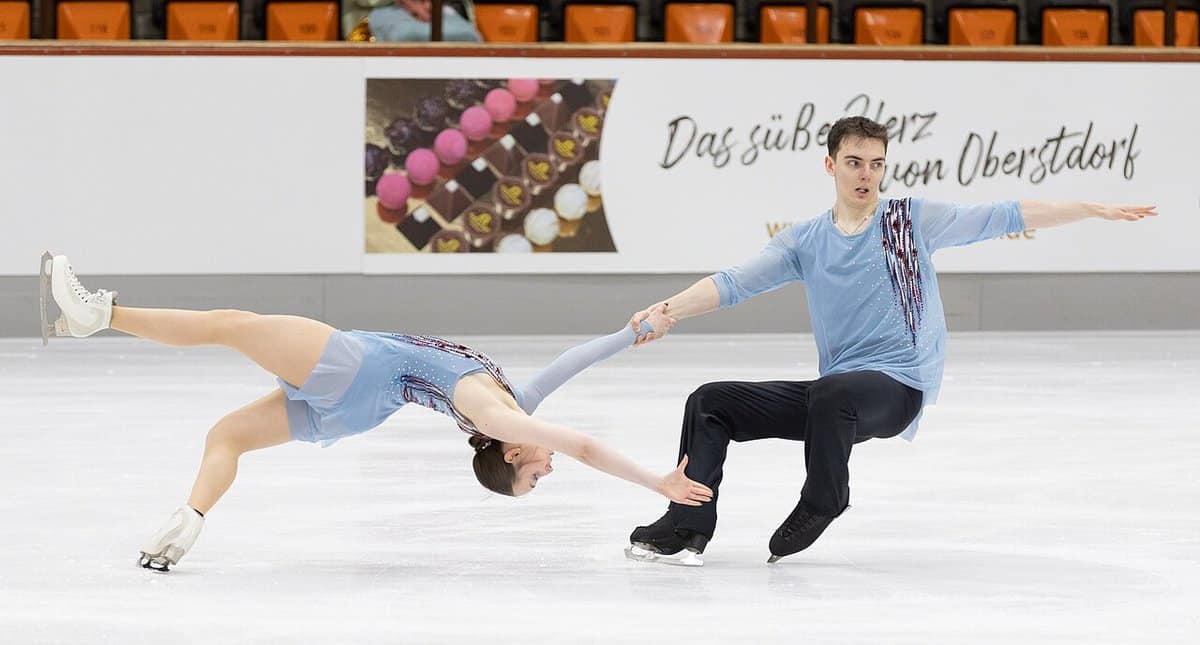
| Pairs | Lifts, throw jumps, twists and death spirals |
| Ice dance | No big jumps, focus on rhythm, footwork and dance lifts |
Tips for Watching Your First Competition
- Learn to tell the jumps apart. The axel is the only one with a forward takeoff.
- Watch the landing edge. A clean landing on one foot on a back outside edge scores best.
- Check the live scoreboard. It shows the running technical score against the leader.
- Learn some figure skating terms like axel, lutz and GOE.
More Reading
- Figure skating lingo and slang
- Figure skating equipment list
- History of figure skating
- Common figure skating injuries
- Figure skating quiz

FAQ
How does figure skating scoring work?
Each element has a base value, judges add or subtract points for quality, and three program components score the artistry. Deductions are subtracted, and both programs are added.
How much is a fall in figure skating?
One point for the first two falls, more for later ones, plus the lost value of the element.
What is GOE in figure skating?
Grade of execution, a grade from minus 5 to plus 5 that adjusts the value of each element.
How long is a figure skating free skate?
Four minutes, plus or minus 10 seconds, for senior skaters.
What is the hardest jump in figure skating?
The quad axel, with four and a half rotations. It was first landed in competition in 2022.
Why are late jumps worth more?
The last jump element of the short program and the last three jump elements of the free skate, if started after the halfway point, get a 10 percent bonus to reward stamina.
What are the program components?
Composition, presentation and skating skills.
What is the difference between pairs and ice dance?
Pairs skating has big lifts, throw jumps and twists. Ice dance has no big jumps and focuses on rhythm and footwork.


No comments yet
What's your take?
What's your opinion, or think we got something wrong? Tell us and other readers.
Our editors read every comment.