

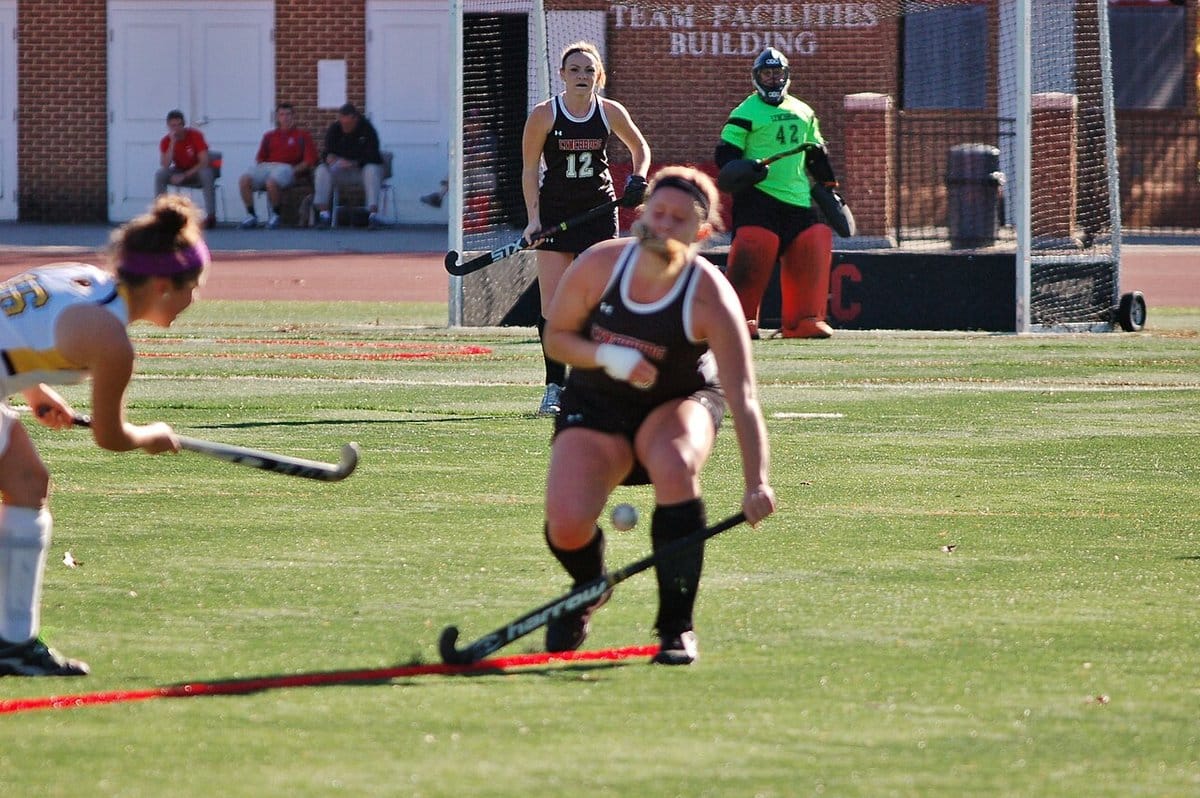
Field hockey rules explained: game length, scoring from the circle, stick and foot rules, free hits, penalty corners and strokes, cards and shootouts.
Field hockey is fast, skillful and, for newcomers, full of whistles that seem to come out of nowhere. Most of them are about three things: using only the flat side of the stick, keeping the ball off your feet, and not lifting the ball in a way that endangers other players.
This guide explains the outdoor game in the order you see it on the pitch: the basics, scoring, how the ball may be played, free hits, penalty corners and strokes, cards and how drawn games are decided. It follows the Rules of Hockey from the International Hockey Federation, the FIH, with a comparison of outdoor and indoor hockey at the end.
Jump to:
- Field Hockey Rules in 60 Seconds
- The Pitch and the Circle
- Scoring
- How the Ball May Be Played
- Free Hits and Restarts
- Penalty Corners and Penalty Strokes
- Cards and Suspensions
- Substitutions and Drawn Games
- Outdoor vs Indoor Hockey
- Tips for Watching or Playing Your First Game

Field Hockey Rules in 60 Seconds
- Eleven players per side, including a goalkeeper.
- Flat side only. The ball may be played only with the flat face and the edges of the stick, never the rounded back.
- No feet. Field players may not stop or move the ball with their feet or body.
- Score from the circle. A goal counts only if an attacker touched the ball inside the shooting circle.
- Four quarters of 15 minutes. The team with more goals wins.
The Pitch and the Circle
A field hockey pitch is 91.4 meters long and 55 meters wide, usually artificial turf that is watered for top level games. Lines mark the center, the two 23 meter areas and, in front of each goal, the shooting circle, which reaches 14.63 meters, or 16 yards, out from the goal. The penalty spot is 6.4 meters in front of the goal.
Our comparisons of a field hockey pitch and a soccer field and of a lacrosse field and a field hockey pitch put the size in context.
The pitch, the shooting circle and the goals are listed in our guide to field hockey field dimensions.
Scoring
A goal is scored when the whole ball crosses the goal line between the posts and under the crossbar, after it was played or touched by an attacker inside the circle. A shot from outside the circle does not count, even if it brushes a defender’s stick inside the circle on the way, unless an attacker plays it inside the circle too. Every goal is worth one point.
How the Ball May Be Played
- Stick: only the flat face and the edges may touch the ball. Players may use push, hit, flick and scoop strokes.
- Feet and body: it is a foul when a field player stops or moves the ball with the foot or body to gain an advantage.
- Dangerous play: a raised ball must not be dangerous, and players may not play the ball above shoulder height in a way that endangers others.
- Obstruction: players may not shield the ball from an opponent with the body or stick to block a tackle.
- Tackling: a tackle must play the ball, without hitting the opponent’s stick or body first.
Goalkeepers wear full protective equipment and may use any part of the body to stop the ball inside their own circle.
Free Hits and Restarts
| Restart | When | Key rules |
|---|---|---|
| Free hit | After most fouls outside the circle | Opponents at least 5 m away. The taker may dribble the ball directly, a self pass |
| Free hit in the 23 m area | Attacking free hit close to goal | All players at least 5 m away. The ball must travel 5 m or be touched by a defender before it enters the circle |
| Sideline restart | Ball crosses the sideline | Free hit to the other team from the spot |
| Backline restart | Attacker sends the ball over the back line | Free hit to the defense |
| Ball off a defender over the back line | Unintentional: free hit to the attack on the 23 m line, in line with where it crossed. Intentional: penalty corner | Attack restarts close to goal |
A free hit may never be intentionally raised with a hit, though a push, flick or scoop may lift the ball as long as it is not dangerous.

Penalty Corners and Penalty Strokes
A penalty corner is awarded for a defensive foul inside the circle that did not stop a probable goal, or for a deliberate defensive foul in the 23 meter area. The ball is placed on the back line 10 meters from the post. Up to five defenders, including the goalkeeper, start behind the back line, and the others wait beyond the center line. The attackers wait outside the circle.
- The ball must leave the circle before the attack may shoot.
- If the first shot is a hit, it must cross the goal line no higher than the 460 mm backboard, even if it touches a defender’s stick or body on the way.
- Flicks and scoops may be higher, as long as they are not dangerous.
A penalty stroke is awarded when a foul in the circle prevents a probable goal, or for a deliberate foul in the circle. One attacker takes it from the penalty spot against the goalkeeper alone, and only a push, flick or scoop is allowed.
Cards and Suspensions
| Card | Meaning |
|---|---|
| Green | Two minute suspension |
| Yellow | Temporary suspension, at least five minutes, often ten |
| Red | Permanent suspension, the team plays one short for the rest of the game |
Substitutions and Drawn Games
Teams may substitute as often as they like, without telling the umpires, except at a penalty corner. In league play, a draw is often a final result. In knockout games, a draw is decided by a shootout: an attacker starts on the 23 meter line and has 8 seconds to score against the goalkeeper in a one on one, with five players per team and then sudden death.
Outdoor vs Indoor Hockey
| Rule | Outdoor field hockey | Indoor hockey |
|---|---|---|
| Players per side | 11 | 6 |
| Playing area | Turf pitch, 91.4 x 55 m | Hall with side boards |
| Hitting | Allowed | Not allowed, push only |
| Raising the ball | Allowed if not dangerous | Only for a shot at goal |
| Game length | 4 x 15 min | Usually 2 x 20 min |
Tips for Watching or Playing Your First Game
- Watch the umpire’s signal after a whistle. An arm pointing in one direction shows which way the free hit goes.
- Penalty corners are the best scoring chances. Look for the injector, the stopper and the drag flicker.
- Keep your stick low and on the right side of your body when you start. It keeps the flat face toward the ball.
- Learn some field hockey terms like drag flick, reverse stick and self pass.
More Reading
- Field Hockey positions explained
- Field Hockey lingo and slang
- Field Hockey equipment list
- History of field hockey
- Field hockey pitch vs soccer field
- Lacrosse field vs field hockey pitch
- Common field hockey injuries
- Field Hockey quiz

FAQ
What are the basic rules of field hockey?
Two teams of 11 try to score by playing the ball into the opponent’s goal with the flat side of their sticks. Field players may not use their feet, goals count only from inside the shooting circle, and games have four 15 minute quarters.
Can you score from outside the circle in field hockey?
No. An attacker must play or touch the ball inside the circle for a goal to count. A deflection off a defender alone is not enough.
Can you use the back of the stick in field hockey?
No. Only the flat face and the edges may play the ball. Using the rounded back is a foul.
What is a penalty corner?
A set play after a defensive foul in the circle or a deliberate one in the 23 meter area. The ball is pushed out from the back line and the attack tries to score against five defenders.
How long is a field hockey game?
Four quarters of 15 minutes, with short breaks after the first and third quarter and a longer halftime.
What does a green card mean in field hockey?
It means a two minute suspension under the FIH rules, the mildest of the three cards.
Is field hockey a contact sport?
No. Body contact, hitting an opponent’s stick and obstruction are fouls.
How are ties decided in field hockey?
In knockout games by a shootout, where an attacker has 8 seconds to score one on one from the 23 meter line.


No comments yet
What's your take?
What's your opinion, or think we got something wrong? Tell us and other readers.
Our editors read every comment.