

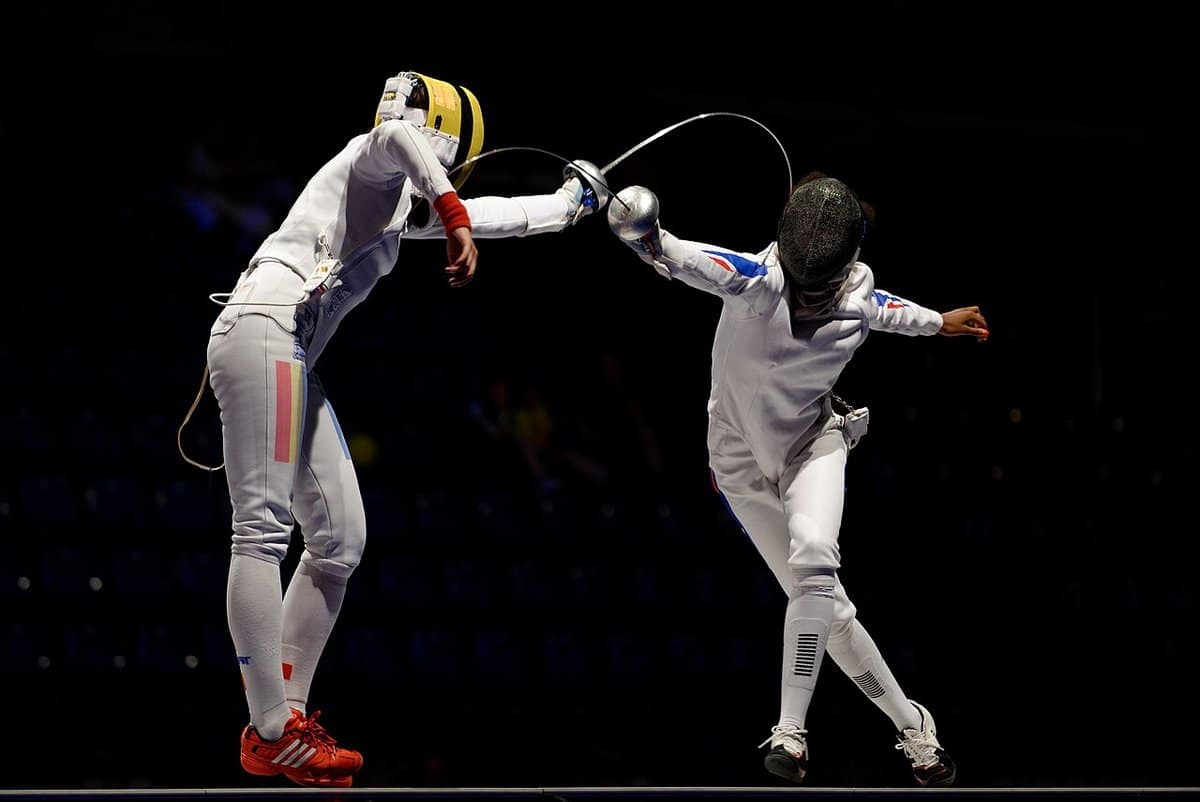
Fencing rules explained: the three weapons, target areas, right of way, how a touch is scored, bout length, the piste, and penalty cards.
Fencing is one of only a handful of sports that have been part of every modern Olympics. Two fencers try to touch each other with the tip, or in sabre also the edge, of a blade, and an electronic scoring system lights up when a touch lands. What makes it hard to follow is that each of the three weapons has its own rules.
This guide follows the rules of the International Fencing Federation (FIE), which USA Fencing also uses. It explains the weapons, the target areas, right of way, bout length and the penalty cards.
Jump to:
- Fencing Rules in 60 Seconds
- The Three Weapons
- Right of Way
- Bout Length and Scoring
- The Piste
- Penalty Cards
- Youth vs Olympic Fencing
- Tips for Watching Your First Bout

Fencing Rules in 60 Seconds
- Three weapons. Foil, epee and sabre each have their own target and rules.
- Touches score. Each valid touch is worth one point.
- 15 touches win. Direct elimination bouts go to 15, pool bouts to 5.
- Right of way. In foil and sabre, the attacker gets the point when both fencers hit at once.
- Stay on the piste. The strip is 14 meters long and 1.5 to 2 meters wide.
The Three Weapons
| Weapon | Target | How it scores | Right of way |
|---|---|---|---|
| Foil | Torso only, front and back | Tip only | Yes |
| Epee | The whole body | Tip only | No, double touches possible |
| Sabre | Everything above the waist, including head and arms | Tip and edge | Yes |
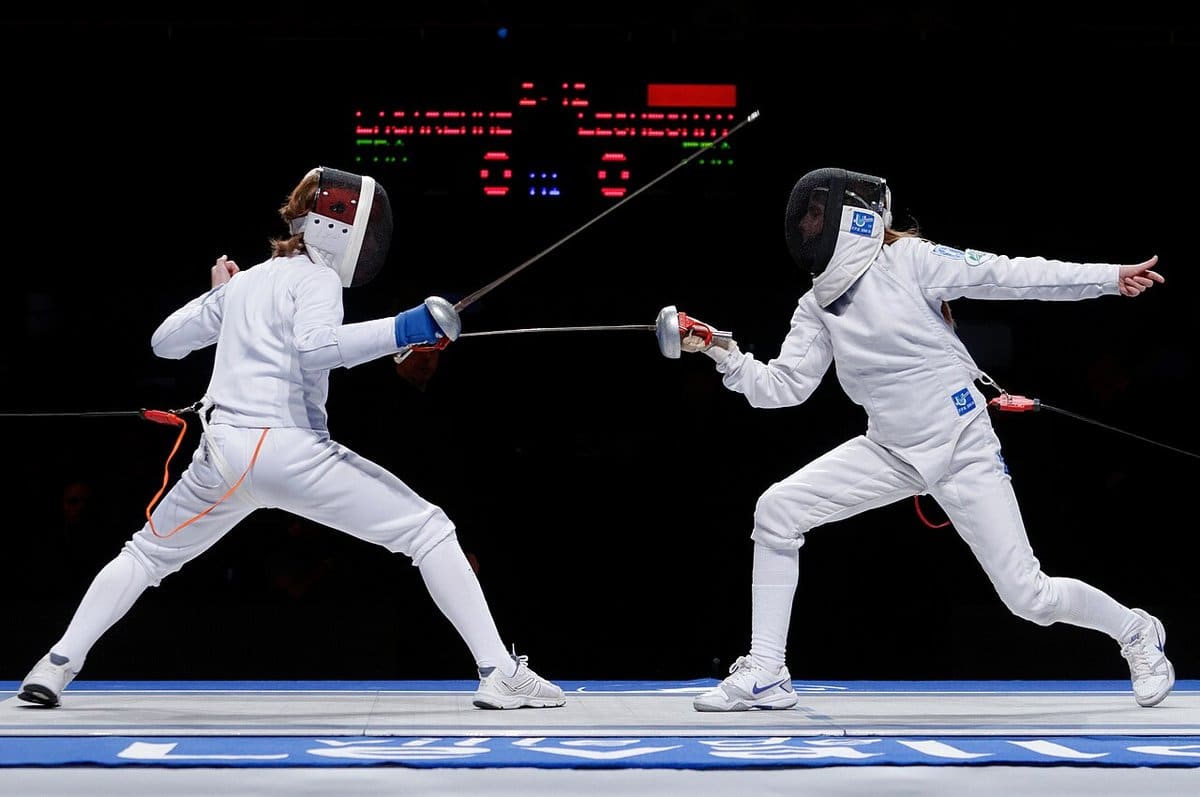
Fencers wear a mask, a jacket, a protective under plastron, a glove and breeches. In foil and sabre, a conductive lame covers the valid target, so the scoring system knows whether a touch landed on target or off target.
Right of Way
Right of way, or priority, decides who gets the point when both fencers hit at the same time in foil and sabre. The fencer who started the attack first has priority. The defender can take it over by parrying the blade or by making the attacker miss, and then riposting. The referee explains the call with hand signals after each action.
- Attack: the first offensive action with the arm extending toward the target.
- Parry and riposte: blocking the blade and hitting back, which takes over the right of way.
- Counterattack: hitting into an attack. It only scores if the attacker misses or if it lands clearly earlier.
- Epee exception: there is no right of way. If both hit within 40 to 50 milliseconds, both fencers score.
Bout Length and Scoring
| Bout | Touches | Time |
|---|---|---|
| Pool bout | 5 | 3 min |
| Direct elimination | 15 | Three periods of 3 min, 1 min break |
| Team relay | 45 | Nine legs of 3 min |
In sabre, bouts are so fast that the break comes when one fencer reaches 8 touches instead of after a set time. If the score is tied at the end of regular time, one fencer is given priority at random, and a one minute overtime period follows. The first touch wins, and if no one scores, the fencer with priority wins.
The Piste
The piste, or strip, is 14 meters long and 1.5 to 2 meters wide. Fencers start behind the on guard lines, 2 meters from the center. Leaving the side of the piste costs one meter of ground, and stepping off the back end with both feet gives the opponent a touch.
The run-backs, the warning zones and the space a full piste needs are listed in our guide to fencing piste dimensions.
Penalty Cards
| Card | Meaning |
|---|---|
| Yellow | Warning for a first minor offense, for example covering the target |
| Red | Penalty touch for the opponent |
| Black | Exclusion from the tournament for serious misconduct |
A black card is shown, for example, for refusing to salute the opponent before or after the bout. Passivity in direct elimination bouts can also lead to a yellow and then red P card.
Youth vs Olympic Fencing
| Rule | Youth (Y10, Y12) | Senior and Olympic |
|---|---|---|
| Blade size | Shorter (size 0 to 3) | Size 5 |
| Bout length | Often shorter | Pool 5, elimination 15 |
| Weapons | Usually foil first | All three |
Tips for Watching Your First Bout
- Watch the lights. Colored lights mean a valid touch, white means off target in foil.
- Follow the referee’s arm. It points to the fencer who gets the point.
- Start with epee if right of way confuses you. The first hit simply scores.
- Learn some fencing terms like en garde, lunge and riposte.
More Reading
- Fencing lingo and slang
- Fencing equipment list
- History of fencing
- Fencing piste vs table tennis court
- Common fencing injuries
- Fencing quiz

FAQ
What are the basic rules of fencing?
Two fencers try to touch each other with a blade. Each valid touch scores one point, pool bouts go to 5 and elimination bouts to 15. Foil and sabre use right of way, epee does not.
What is the difference between foil, epee and sabre?
Foil targets only the torso with the tip, epee the whole body with the tip, and sabre everything above the waist with tip and edge.
What is right of way in fencing?
A rule in foil and sabre that gives the point to the fencer who started the attack when both hit at the same time.
How long is a fencing bout?
Pool bouts last up to 3 minutes and go to 5 touches. Elimination bouts have three periods of 3 minutes and go to 15.
How big is a fencing piste?
14 meters long and 1.5 to 2 meters wide.
What does a red card mean in fencing?
A penalty touch for the opponent.
Can both fencers score at the same time?
Only in epee, where hits within a fraction of a second both count.
Why do fencers wear white?
Tradition, from the days before electronic scoring, when touches were seen on the white jacket.


No comments yet
What's your take?
What's your opinion, or think we got something wrong? Tell us and other readers.
Our editors read every comment.