

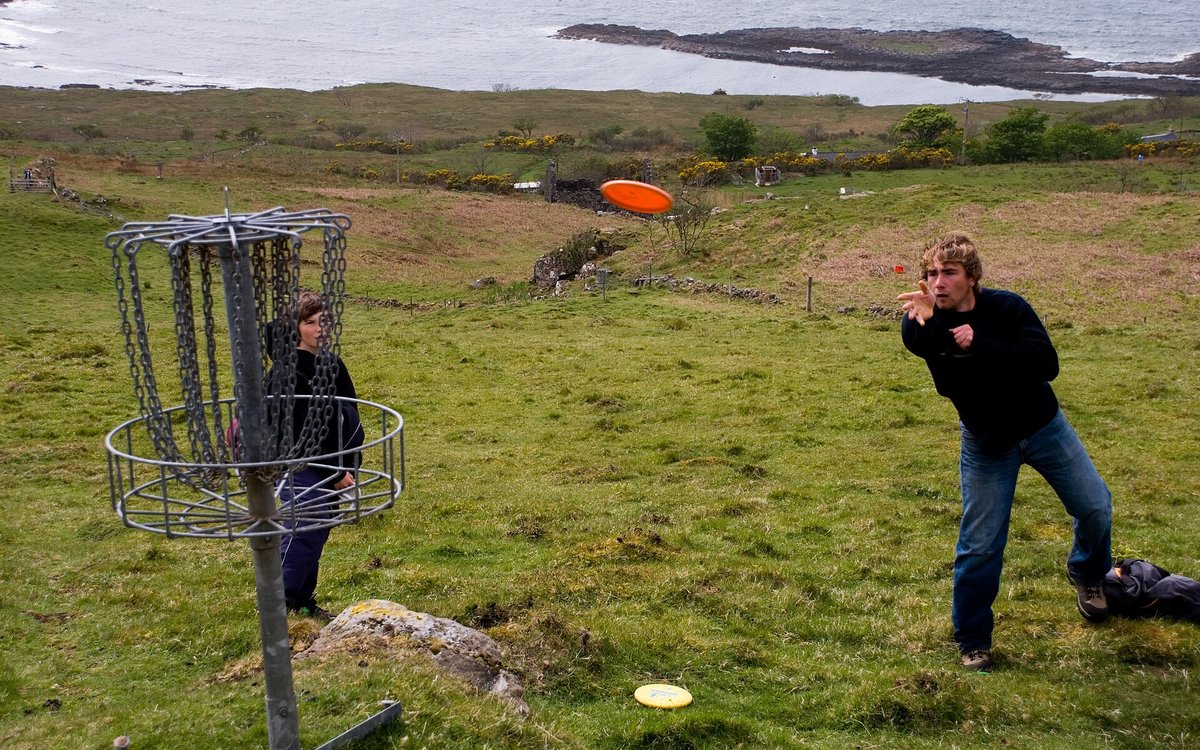
55 disc golf terms explained, from ace, hyzer and anhyzer to mando, C1 and C2, plus the slang players use on the course.
Disc golf borrowed its scoring words from golf, its throwing words from flying-disc sports, and then invented a lot of its own on the course. The words related to disc golf below are the ones you hear at the first tee on a Saturday morning, while the disc golf glossary further down covers the words you pick up later: the flight numbers, the shot names and the slang that nobody explains out loud.
New to the game? Our guide to disc golf rules explains how a round works from tee pad to basket, which makes most of the terms below fall into place. Already know the vocabulary of the ball game? Compare it with golf lingo and ultimate frisbee lingo.
👉 Think you know disc golf? Test yourself with our Disc Golf Quiz.
Must-Know Disc Golf Terms, Phrases and Slang:
- Ace
- Anhyzer
- Approach
- Backhand
- Birdie
- Chains
- Circle 1
- Circle 2
- Fairway
- Forehand
- Hyzer
- Lie
- Mando
- Marker
- Midrange
- OB
- Par
- Putter
- Tee pad
- Throwing order
- Bogey
- Distance driver
- Drop zone
- Eagle
- Fairway driver
- Flight numbers
- Overstable
- Roller
- Skip shot
- Understable
Disc Golf Glossary: Every Term A to Z
Terms A to D
| Term | What It Means |
|---|---|
| Ace | A hole in one. |
| Albatross | A score of three throws under par on a hole, also called a double eagle. |
| Anhyzer | A throw released with the outer edge tilted up; for a right-handed backhand it curves right. |
| Approach | A shorter throw meant to get close to the basket. |
| Backhand | A throw across the body with the back of the hand facing forward. |
| Basket | The target at the end of each hole, made of a pole, a cage and chains. |
| Birdie | One throw under par on a hole. |
| Bogey | One throw over par on a hole. |
| Card | The group of players who play a round together. |
| Chains | The hanging chains in the basket that catch the disc. |
| Circle 1 | The area within 10 meters of the basket. |
| Circle 2 | The area from 10 to 20 meters from the basket. |
| Distance driver | A fast disc built for the longest throws. |
| Double bogey | A score of two throws over par on a hole. |
| Drop zone | A marked area where a player throws from after a disc goes out of bounds. |
Terms E to J
| Term | What It Means |
|---|---|
| Eagle | Two throws under par on a hole. |
| Fade | The finish of a disc’s flight, when a right-handed backhand curves back to the left. |
| Fairway | The playing area between the tee pad and the basket. |
| Fairway driver | A disc between a midrange and a distance driver in speed. |
| Flex shot | A throw that bends a disc one way and then the other during a flight. |
| Flight numbers | The four numbers that describe a disc’s flight: speed, glide, turn and fade. |
| Fore | A shout to warn others that a disc is heading their way. |
| Forehand | A sidearm throw with the palm facing the disc. |
| Glide | A measure of how well a disc stays in the air. |
| Grenade | An overhead throw where the disc flips upside down and falls steeply, used to escape trouble. |
| Hyzer | A throw released with the outer edge tilted down; for a right-handed backhand it curves left. |
| Hyzer flip | A hyzer release thrown with an understable disc so it flips up to flat during flight. |
| Jump putt | A putt thrown while jumping, usually from beyond 10 meters, where the rules put no limits on the stance. |
Terms L to S
| Term | What It Means |
|---|---|
| Lie | The spot where the disc comes to rest. |
| Mando | A mandatory marker that forces players to pass one side of an object. |
| Marker | A mini disc used to mark the lie. |
| Midrange | A disc in the middle in speed and distance. |
| Mulligan | A friendly do-over throw that is not allowed in official play. |
| OB | Out of bounds, with a one-throw penalty. |
| Overstable | A disc that holds its line and fades hard. |
| Par | The expected number of throws on a hole. |
| Pin | The location of the basket on a hole, which can change for different rounds. |
| Putter | A slow, blunt disc used for putting and short throws. |
| Putting circle | The area around the basket within 10 meters, where putting rules apply. |
| Rating | A PDGA score for a round or a player used to compare skill. |
| Roller | A throw that lands on its edge and rolls along the ground. |
| Scramble | A format where players choose the best throw and all throw from there. |
| Skip shot | A throw that skips off the ground or water to travel farther. |
| Spin putt | A putt in which the disc is released with a lot of spin and a flat flight. |
| Stability | How much a disc resists turning during its flight. |
| Stance | The way a player stands when throwing; the rules require a supporting point on or behind the lie. |
Terms T to X
| Term | What It Means |
|---|---|
| Tee pad | The marked area where a hole begins. |
| Tee sign | The sign at the tee pad that shows the hole number, par and distance. |
| Throwing order | The order in which players throw on each hole. |
| Thumber | An overhead throw with the thumb under the disc, used to get under obstacles. |
| Tomahawk | An overhead throw where the disc spins end over end, used to get over obstacles. |
| Turn | The tendency of a disc to curve right during the fast part of its flight, for a right-handed backhand. |
| Turnover | A throw where a disc flips over and curves the opposite way from its normal fade, usually on purpose. |
| Understable | A disc that tends to turn over early in flight. |
| X-step | The footwork used to build momentum before a drive. |
What Is It Called When…? Disc Golf Terms by Situation
Know what happened but not the word for it? Find the situation on the left and the disc golf term on the right.
| When… | It Is Called |
|---|---|
| A throw goes into the basket from the tee | Ace |
| A disc lands outside the playable area | OB |
| The disc is thrown with its outer edge tilted down | Hyzer |
| The disc is thrown with its outer edge tilted up | Anhyzer |
| A player is within 10 meters of the basket | Circle 1 |
| A player shouts to warn someone a disc is coming | Fore |
| A player marks the spot where a disc landed | Marker disc |
| A player makes a score of one under par | Birdie |
| A player makes a score of one over par | Bogey |
| A player throws an overhead shot that flips and drops fast | Grenade |
| A disc lands on its edge and rolls | Roller |
| A player must pass on one side of a tree | Mando |
| The group of players who throw together | Card |
| A disc curves back at the end of its flight | Fade |
| A disc hits the chains and bounces back out | Chain-out |

#1 Ace
A hole in one, sinking the disc in the basket with the first throw from the tee. Aces are rare on longer holes, so players talk about them for years. It is the best score possible on any hole.
In a sentence: “He threw an ace on hole seven and bought the whole card a drink.”
#2 Anhyzer
A throw released with the outer edge of the disc tilted up. For a right-handed backhand throw, the disc curves to the right. It is the opposite of a hyzer and is used to carry a long curve or to fit around a tree line.
In a sentence: “Throw an anhyzer around the trees and let it float to the right.”
#3 Approach
A short throw aimed to land the disc near the basket, often with a lofted flight. Approach shots usually use a slower disc that stops quickly. The goal is to leave an easy putt.
In a sentence: “I hit a good approach and had a five footer for birdie.”
#4 Backhand
The most common throw, in which the throwing arm swings across the chest and the disc is released out in front, like a backhand swing in tennis. It is the first throw most new players learn. It is used for drives, approaches and putts alike.
In a sentence: “A flat backhand down the middle gets you to the basket.”
#5 Birdie
A score of one throw under par on a hole. The term comes from golf and has the same meaning here. A round with many birdies usually wins.
In a sentence: “Four birdies on the back nine put him in the lead.”
#6 Chains
The hanging chains in the center of the basket that catch the disc as it comes in. The sound of a disc hitting them is one of the best parts of the sport. Players say “chains” for a made putt.
In a sentence: “The putt hit the chains and dropped right in.”
#7 Circle 1
The area within 10 meters (33 feet) of the basket. Putts in Circle 1 are the ones every good player is expected to make. Players use the term in stats, as in “C1 putting”.
In a sentence: “He made 95 percent of his putts in Circle 1 today.”
#8 Circle 2
The area between 10 and 20 meters (33 and 66 feet) from the basket. Putts from this range are harder, and fewer are made. Professionals track C2 putting percentage closely.
In a sentence: “A great Circle 2 putt saved his par on the last hole.”
#9 Fairway
The cleared area between the tee pad and the basket where most throws land. Players try to keep their disc in the fairway to avoid trees and trouble. Many fairways are lined with woods on both sides.
In a sentence: “Stay in the fairway and don’t get greedy.”
#10 Forehand
A sidearm throw in which the disc is flicked out with the fingers under it and the arm moving from the side of the body. The disc usually curves the opposite way from a backhand. Many players use it to get around tough lines.
In a sentence: “A forehand was the only way to reach that gap.”
#11 Hyzer
A throw released with the outer edge of the disc tilted down. For a right-handed backhand throw, the disc curves to the left and finishes steeply. Players use hyzer lines for control and to hit a fade.
In a sentence: “Throw a hyzer to the left of the basket and let it fade.”
#12 Lie
The spot from which the next throw is made. The player marks it with a marker disc placed directly in front of the disc that has come to rest, then throws from behind that mark. A throw from the wrong spot can bring a penalty.
In a sentence: “Mark your lie before you pick up the disc.”
#13 Mando
Short for mandatory, an obstacle on the course that forces players to pass on one side of an object. A sign or an arrow marks it. Missing a mando brings a penalty.
In a sentence: “There is a mando on hole five, so go left of the big oak.”
#14 Marker
A small disc used to mark where another disc landed. Players place it before picking up the disc they threw. Many players carry a mini marker for this.
In a sentence: “Put your marker down before you move the disc.”
#15 Midrange
A disc that sits between putters and drivers in speed and distance. It flies straighter than a driver and is easy to control. Many players throw midranges for most of their game.
In a sentence: “The midrange is the best disc to learn on.”
#16 OB
Short for out of bounds, an area that is not playable. When a disc lands OB, the player takes a one-throw penalty and plays from the last point it was in bounds. Water and roads are the most common OB areas.
In a sentence: “My drive went OB in the pond.”
#17 Par
The number of throws a skilled player is expected to need on a hole. Most holes are par 3, with some par 4 and par 5 holes on longer courses. Scores are counted above and below par.
In a sentence: “He shot even par for the round.”
#18 Putter
A slow, blunt-edged disc built for short throws and putts. Putters fly very straight and are also used to drive on short holes. Almost every player carries several.
In a sentence: “Grab your putter, it’s a short hole.”
#19 Tee pad
The spot where a hole starts, a marked pad or area from which the first throw is made. Players must have a supporting point on the pad when they throw. Most pads are concrete, rubber or gravel.
In a sentence: “Stay on the tee pad when you release.”
#20 Throwing order
The order in which players throw. On the tee, the lowest score on the last hole throws first. After that, the player farthest from the basket throws first.
In a sentence: “He’s up first because he had the best score on the last hole.”
#21 Bogey
A score of one throw over par on a hole. It is a small setback and fairly common. Too many bogeys can ruin a round.
In a sentence: “I took a bogey after my approach went long.”
#22 Distance driver
A disc built for the longest throws, with a sharp edge and high speed. It takes strong arm speed and good form to throw well. Beginners often find lighter, slower discs easier.
In a sentence: “My new distance driver flew 400 feet.”
#23 Drop zone
A marked area where a player throws from after a disc goes out of bounds or into a hazard. Courses set drop zones in places where the original lie would be unplayable or unsafe. Using one saves the walk back to the last in-bounds spot.
In a sentence: “There is a drop zone on the other side of the creek.”
#24 Eagle
A score of two throws under par on a hole. It is a rare result on a par 4 or par 5. The term comes from golf.
In a sentence: “He made an eagle on the long par 5.”
#25 Fairway driver
A disc that flies farther than a midrange and is easier to control than a distance driver. It is a good choice for new players who want more distance. The disc has a narrower rim than a putter.
In a sentence: “A fairway driver is the best disc for newer players.”
#26 Flight numbers
The four numbers printed on most discs to describe how they fly: speed, glide, turn and fade. A disc with a high speed number needs more power to fly right. The numbers are a guide and not a guarantee.
In a sentence: “Check the flight numbers before you buy a new driver.”
#27 Overstable
A disc that tends to fade left (for a right-handed backhand) at the end of its flight. It resists turning over and holds a line in the wind. Overstable discs are good for forehand throws.
In a sentence: “Throw an overstable disc into the wind.”
#28 Roller
A throw that lands on its edge and rolls along the ground. Players use it to get a long run down a fairway or under low branches. It is hard to control, which makes a good one look great.
In a sentence: “He threw a roller down the fairway and it ran another 100 feet.”
#29 Skip shot
A throw that skips off the ground or water to carry farther or to get around an obstacle. It usually follows a low, flat angle. Skips can be hard to predict, so players use them on open holes.
In a sentence: “He skipped it across the pond and kept it in bounds.”
#30 Understable
A disc that tends to turn over, curving to the right (for a right-handed backhand) early in its flight. It is good for long, gentle curves and for players with less arm speed. Heavy wear can make any disc more understable.
In a sentence: “This beat-in disc is understable now.”
Disc Golf Slang Players and Fans Actually Use
| Slang | What It Means |
|---|---|
| Plastic | Slang for discs, as in “what plastic are you throwing today?” |
| Beat-in | A disc that has worn down with use and flies more understable. |
| Bag | The pack a player uses to carry discs around the course. |
| Field work | Practice throws in an open field. |
| Ace race | A side pot where players put in money and the first to make an ace takes it. |
| Chain-out | A disc that hits the chains and bounces out of the basket. |
| Blowup hole | A hole where a player scores far above par. |
| Sandbagger | A player who competes in a lower division than their skill deserves. |
| Shank | A throw that goes badly off line because the disc slipped out of the hand. |
| Dome | The top curved surface of a disc. |
Disc Golf Expressions and Sayings in Everyday English
- Fore: The call shouted to warn other players when a disc may hit them.
- Chains: The word players use for the sound of a made putt.
- Frisbee golf: The older name for the sport, still heard casually, although players say disc since Frisbee is a brand name.
- Steady Ed: The nickname of Ed Headrick, called the father of disc golf, who helped found the PDGA in 1976.

FAQ
What is an ace in disc golf?
An ace is a hole in one, when a player sinks the disc in the basket on the first throw from the tee. It is the best score possible on any hole.
What is the difference between hyzer and anhyzer?
A hyzer is released with the outer edge of the disc tilted down, and a right-handed backhand then curves left. An anhyzer is the opposite, with the edge tilted up and the disc curving right.
What does OB mean in disc golf?
OB means out of bounds. A disc that lands there costs the player a one-throw penalty, and the next throw is made from the last point the disc was in bounds or from a drop zone.
What is a mando in disc golf?
A mando is a mandatory marker on the course. It tells players to pass on one side of an object, and missing it brings a penalty.
What are flight numbers on a disc?
They are four numbers that describe how a disc flies: speed, glide, turn and fade. Together they tell you how far, how straight and how stable a disc is.
What is Circle 1 in disc golf?
It is the area within 10 meters (33 feet) of the basket. Putts from there are the ones players are expected to make.
What does par mean in disc golf?
Par is the number of throws a skilled player is expected to need on a hole. Most holes are par 3, and longer ones are par 4 or par 5.
They split into the discs (putter, midrange, fairway driver, distance driver), the throws (backhand, forehand, hyzer, anhyzer, roller) and the course (tee pad, fairway, basket, mando, OB). The disc golf glossary above lists them all.
What are some disc golf terms for beginners?
Start with tee pad, fairway, basket, par, birdie and ace, then learn backhand, forehand, hyzer and anhyzer. OB, mando and flight numbers come next, as soon as you start playing real rounds.
What are some disc golf slang terms?
Beat-in for a worn disc, plastic for discs, chain-out for a putt that bounces out and sandbagger for a player in too low a division. The slang table above has the rest.


No comments yet
What's your take?
What's your opinion, or think we got something wrong? Tell us and other readers.
Our editors read every comment.