

Cricket pitch dimensions with diagram: the 22 yard pitch, 10 ft width, popping and return creases, stump size and boundary distances under ICC rules.
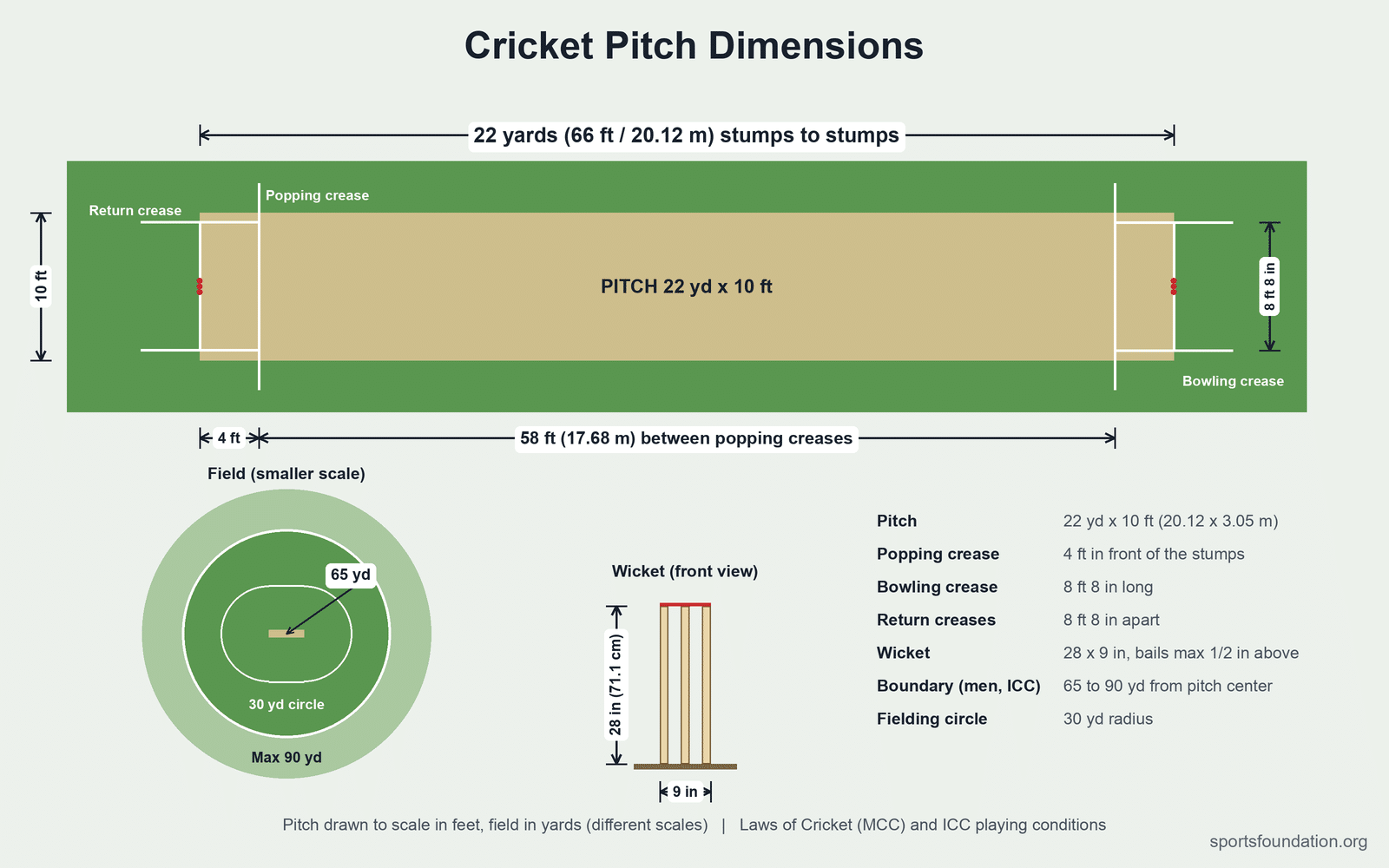
A cricket pitch is 22 yards (66 feet, 20.12 meters) long between the two wickets and 10 feet (3.05 meters) wide. The popping crease, where the batter stands, is 4 feet in front of the stumps at each end. Each wicket is 9 inches wide and 28 inches high. The field around the pitch has no fixed size, but in men’s international cricket the boundary must be 65 to 90 yards from the center of the pitch.
The pitch is set by the Laws of Cricket, written by the MCC, and has not changed in length for centuries: 22 yards is one chain, an old English surveying unit. The field is a different story, since every ground has its own shape. This page covers the pitch, the creases, the wickets and the field, with a diagram drawn to scale.
Jump to:
- Cricket Pitch Dimensions at a Glance
- How Long Is a Cricket Pitch?
- How Wide Is a Cricket Pitch?
- How Many Square Feet Is a Cricket Pitch?
- The Creases
- Stumps, Bails and Wicket Size
- How Big Is a Cricket Field?
- Pitches in the United States
- Cricket Field vs Baseball Field
Cricket Pitch Dimensions at a Glance
| Measurement | Feet / inches | Meters |
|---|---|---|
| Pitch length (stumps to stumps) | 22 yd (66 ft) | 20.12 m |
| Pitch width | 10 ft | 3.05 m |
| Pitch area | 660 sq ft | 61.3 sq m |
| Popping crease in front of the stumps | 4 ft | 1.22 m |
| Distance between popping creases | 58 ft | 17.68 m |
| Bowling crease length | 8 ft 8 in | 2.64 m |
| Return creases apart | 8 ft 8 in | 2.64 m |
| Wicket width | 9 in | 22.86 cm |
| Wicket height | 28 in | 71.12 cm |
| Boundary, men’s internationals | 65 to 90 yd from the pitch center | 59.4 to 82.3 m |
| Fielding circle (limited overs) | 30 yd radius | 27.43 m |
Watch: How Big Is a Cricket Pitch Compared to Other Sports?
This short animation draws the cricket pitch with its official lines and measurements, then lines it up with 36 other sports surfaces at the same scale, smallest to largest.
How Long Is a Cricket Pitch?
A cricket pitch is 22 yards long, which is 66 feet or 20.12 meters. The length is measured between the two bowling creases, the lines that run through the middle of the stumps at each end. Because the batter stands at the popping crease and the bowler delivers from near the other popping crease, the distance between the two popping creases, 58 feet (17.68 meters), is closer to how far the ball actually travels.
How Wide Is a Cricket Pitch?
The pitch is 10 feet (3.05 meters) wide, 5 feet on each side of an imaginary line joining the two middle stumps. Its sides are not painted; the pitch is simply the strip of closely mown, rolled turf between the wickets. The creases are painted in white and reach beyond the pitch.
How Many Square Feet Is a Cricket Pitch?
The pitch itself covers 660 square feet (66 x 10 feet), about 61 square meters. The prepared strip is a little longer, because the creases and the bowlers’ run-ups need hard ground too. Most grounds have a larger central area called the square, with several pitches side by side, so groundskeepers can rotate them during a season.
The Creases
Three kinds of white lines are marked at each end of the pitch:
- Bowling crease: the line through the middle of the stumps, 8 feet 8 inches (2.64 meters) long, with the wicket in its center.
- Popping crease: 4 feet (1.22 meters) in front of the bowling crease and parallel to it. It must reach at least 6 feet on each side of the middle stump, and it counts as unlimited in length. A batter is safe from a run out or stumping with the bat or a body part grounded behind it, and the bowler’s front foot must land with some part behind it, or the delivery is a no ball.
- Return creases: two lines at right angles to the popping crease, 4 feet 4 inches on each side of the middle stump. They are marked from the popping crease back to at least 8 feet behind it, past the bowling crease, and count as unlimited in length. The bowler’s back foot must land inside them.
Stumps, Bails and Wicket Size
Each wicket consists of three stumps and two bails. The wicket is 9 inches (22.86 centimeters) wide and the tops of the stumps are 28 inches (71.12 centimeters) above the ground. Each stump is between 1 3/8 and 1 1/2 inches thick. The bails rest in grooves on top and may not stick out more than half an inch above the stumps. In junior cricket, the governing body of each country sets the size of the stumps and bails.
How Big Is a Cricket Field?
The Laws of Cricket do not set a field size. The boundary, usually a rope inside the fence, can have any shape, and most grounds are oval. For men’s international matches, the ICC playing conditions say the boundary may not be more than 90 yards (82.3 meters) from the center of the pitch in use and should be at least 65 yards (59.4 meters) away. Shorter limits apply in women’s international cricket. Many international grounds have boundaries of roughly 70 to 80 yards.
| Boundary distance | Field across | Area inside a circular boundary |
|---|---|---|
| 65 yd (59.4 m) | 130 yd (119 m) | About 2.7 acres |
| 75 yd (68.6 m) | 150 yd (137 m) | About 3.7 acres |
| 90 yd (82.3 m) | 180 yd (165 m) | About 5.3 acres |
In one day and T20 cricket, a fielding circle with a 30 yard (27.43 meter) radius is marked around the pitch: two semicircles around the middle stumps at each end, joined by straight lines. During the powerplay overs, only a limited number of fielders may stand outside it. Where the fielders stand is explained in cricket positions.
How overs, wickets and powerplays work is explained in our guide to cricket rules.
Pitches in the United States
Many American grounds do not have a permanent grass square. Clubs often play on artificial mats laid over concrete, which use the same 22 yard length. For the 2024 T20 World Cup, the temporary stadium in Nassau County, New York, used drop-in pitches: grass pitches grown elsewhere in trays and moved into the stadium. Junior cricket often uses shorter pitches, with lengths set by the national governing body for each age group.
Cricket Field vs Baseball Field
Cricket and baseball are often compared. The pitcher’s rubber in baseball is 60 feet 6 inches from home plate, close to the 58 feet between the popping creases in cricket. But a cricket field is round and play goes in every direction, so the whole field is fair territory and it is usually larger than a baseball field. All baseball measurements are in baseball field dimensions.
| Field | Key distance | Typical size |
|---|---|---|
| Cricket | 22 yd pitch (66 ft) | Boundary 65 to 90 yd from the center |
| Baseball (MLB) | 60 ft 6 in pitching distance | 325 to 400+ ft fences |
| Soccer (FIFA standard) | 11 m penalty mark | 105 x 68 m (1.76 acres) |
| Rugby union | 100 m between try lines | Up to 144 x 70 m with in-goals |
For the other fields, see soccer field dimensions and rugby field dimensions.
More Reading
- Cricket positions explained
- Baseball field dimensions
- Softball field dimensions
- Rugby field dimensions
- Soccer field dimensions
The pitch is the same everywhere, but the grounds around it are not: see the largest cricket stadiums in the world.
FAQ
How long is a cricket pitch?
A cricket pitch is 22 yards long, which is 66 feet or 20.12 meters, measured between the stumps.
How wide is a cricket pitch?
The pitch is 10 feet (3.05 meters) wide, 5 feet on each side of the middle stumps.
How far is the popping crease from the stumps?
The popping crease is 4 feet (1.22 meters) in front of the stumps at each end.
How big are cricket stumps?
The wicket is 9 inches wide and 28 inches high, made of three stumps with two bails on top.
How big is a cricket field?
There is no fixed size. In men’s internationals, the boundary must be 65 to 90 yards from the center of the pitch.
Why is a cricket pitch 22 yards long?
22 yards is one chain, an old English unit for measuring land. The length has been used since the earliest written laws of the game.
How big is the 30 yard circle in cricket?
It is made of two semicircles with a 30 yard (27.43 meter) radius around each set of stumps, joined by straight lines.
Is a cricket pitch longer than the pitching distance in baseball?
Yes. The stumps are 66 feet apart, while a baseball pitcher throws from 60 feet 6 inches. The popping creases are 58 feet apart.


No comments yet
What's your take?
What's your opinion, or think we got something wrong? Tell us and other readers.
Our editors read every comment.