

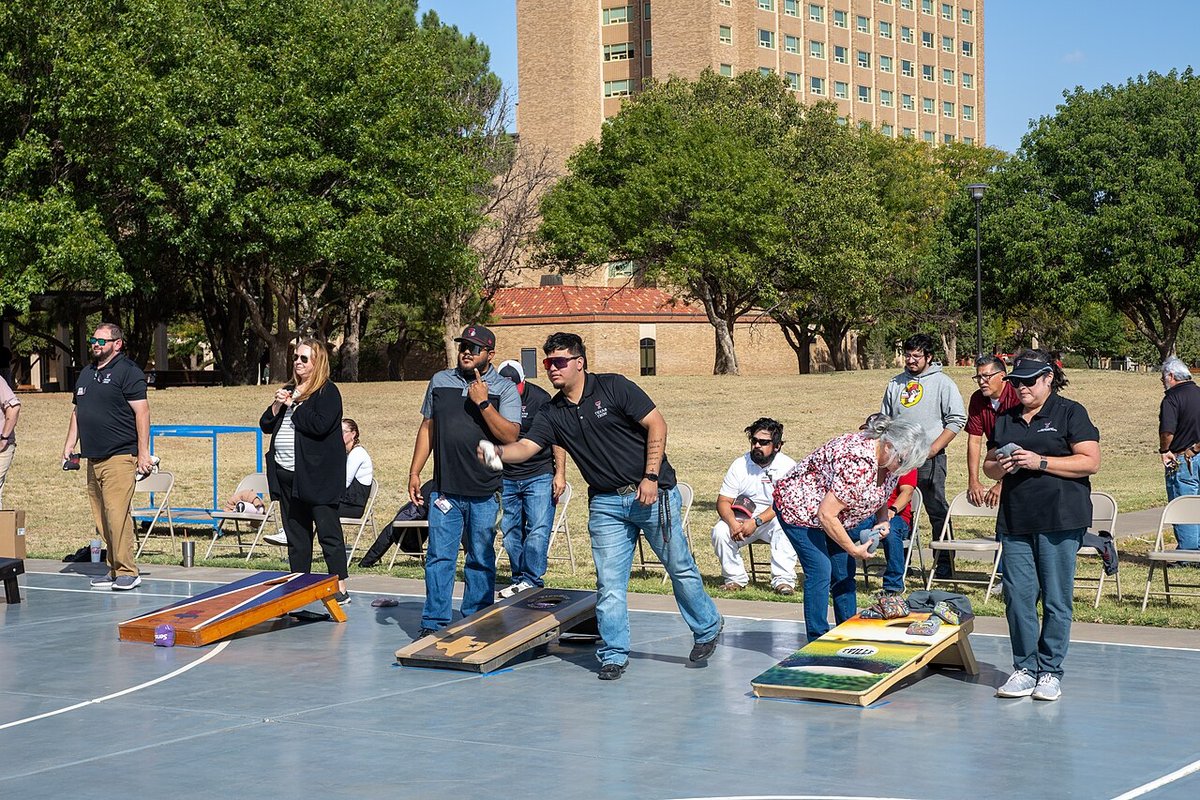
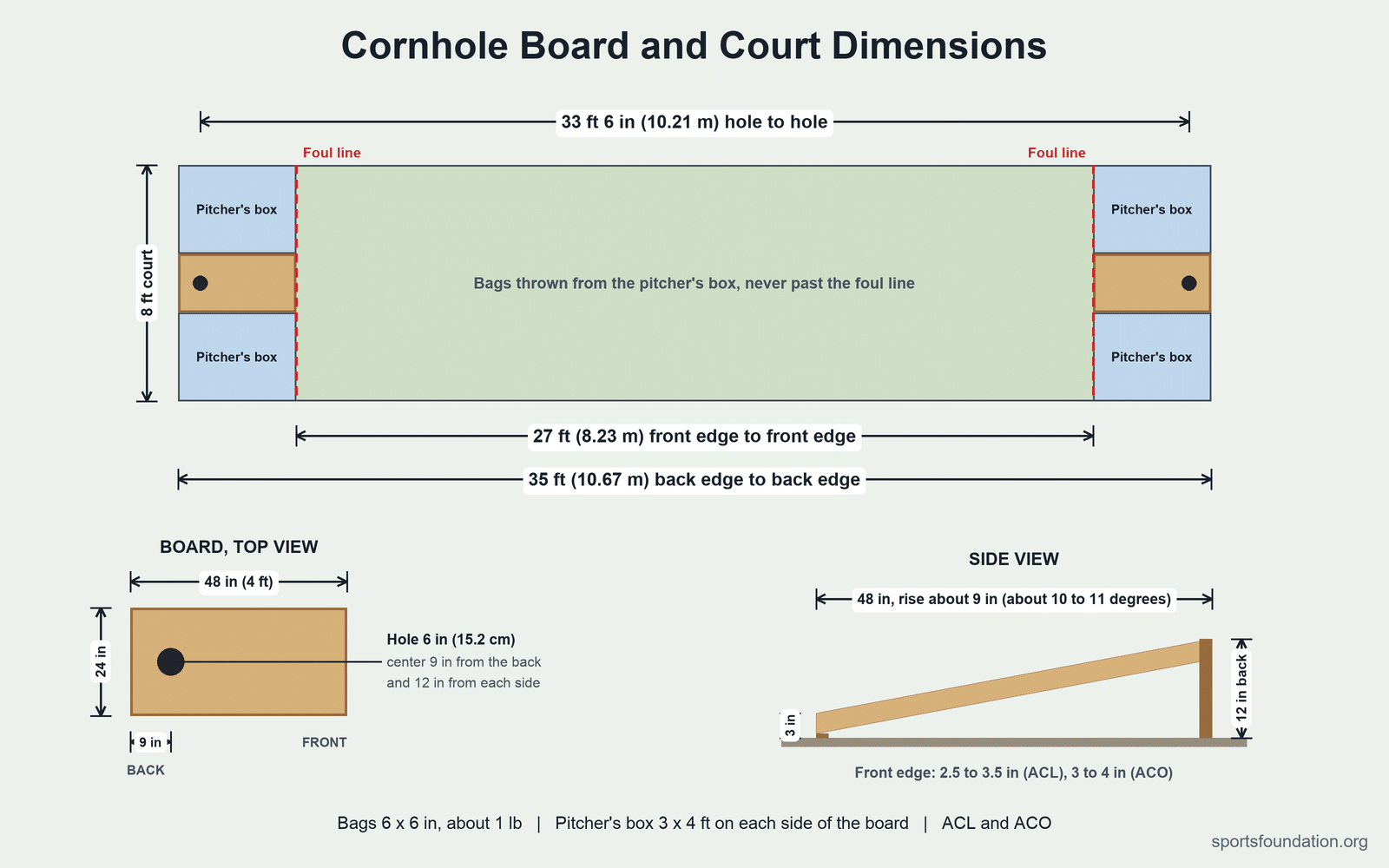
Cornhole board dimensions with diagram: 2 x 4 ft boards, 6 in hole, 27 ft pitching distance, bag size and the space you need, per the ACL and ACO.
A regulation cornhole board is 2 feet wide and 4 feet long (24 x 48 inches). The hole is 6 inches across and sits 9 inches from the top edge, the board rises from about 3 inches at the front to 12 inches at the back, and two boards face each other 27 feet apart, measured from front edge to front edge.
That is the short answer. Below you will find every measurement of the board, the bags and the court, what the two big rule books, the American Cornhole League (ACL) and the American Cornhole Organization (ACO), say, and how much room you need for a backyard set.
Jump to:
- Cornhole Dimensions at a Glance
- The Board: Size, Surface and Frame
- The Hole
- Board Height and Slope
- Bag Size and Weight
- Distance Between the Boards
- The Court and the Pitcher’s Box
- How Much Space Do You Need?
- ACL vs ACO Specifications
- Building Your Own Boards

Cornhole Dimensions at a Glance
| Part | Feet and inches | Meters |
|---|---|---|
| Board (width x length) | 2 x 4 ft (24 x 48 in) | 0.61 x 1.22 m |
| Board surface area | 8 sq ft | 0.74 sq m |
| Hole diameter | 6 in | 15.2 cm |
| Hole center from the back edge | 9 in | 22.9 cm |
| Hole center from the front edge | 39 in | 99.1 cm |
| Front edge height | About 3 in (2.5 to 3.5 in ACL, 3 to 4 in ACO) | 7.6 cm |
| Back edge height | 12 in | 30.5 cm |
| Distance between boards (front to front) | 27 ft | 8.23 m |
| Distance back to back | 35 ft | 10.67 m |
| Distance hole to hole | 33 ft 6 in | 10.21 m |
| Foul line to the far hole | 30 ft 3 in | 9.22 m |
| Pitcher’s box (each side) | 3 x 4 ft | 0.91 x 1.22 m |
| Court width | 8 ft | 2.44 m |
| Bag size | 6 x 6 in | 15.2 x 15.2 cm |
| Bag weight | About 1 lb (15.5 to 16.5 oz ACL, 15.75 to 16.25 oz ACO) | About 450 g |
The Board: Size, Surface and Frame
Both the ACL and the ACO call for a board that is 2 feet by 4 feet. The ACL allows a tolerance of a quarter inch. The ACO specifies a playing surface of 47.5 to 48 inches long and 23.5 to 24 inches wide.
The surface is made of plywood. Under the rules, the top layer must be at least half an inch thick if the board has a support running across the cross section, or three quarters of an inch if it does not. Most builders use a frame of 2×4 lumber (which measures 1.5 by 3.5 inches in reality) and a smooth, hard finish that lets the bags slide.
The Hole
The hole is 6 inches in diameter. The ACL allows a tolerance of an eighth of an inch. It is centered across the width of the board, 12 inches from each long edge, and its center sits 9 inches from the back edge. That makes the center 39 inches from the front, so the hole sits in the upper part of the board.
The bag is also 6 inches wide, so it just fits through the hole. A bag that drops in is worth three points, and one that rests on the board is worth one. For scoring, see our cornhole rules guide.
Board Height and Slope
The board is angled so that bags slide toward the hole. The back edge is 12 inches off the ground, with an allowance of half an inch under ACL rules. The front edge is lower: 2.5 to 3.5 inches under ACL rules and 3 to 4 inches under ACO rules.
Over the 48 inch length, that is a rise of roughly 9 inches, or an incline of about 10 to 11 degrees. Many backyard sets are built with a 3 inch front and a 12 inch back, which fits both rule books at the same time.
Bag Size and Weight
Bags are square, 6 by 6 inches, and filled with resin pellets rather than corn, which keeps their weight stable in any weather. The two rule books differ slightly:
| Spec | ACL | ACO |
|---|---|---|
| Size | 6 x 6 in (plus or minus 1/4 in) | Corners no more than 8.25 in; flat width at least 5.75 in |
| Weight | 15.5 to 16.5 oz | 15.75 to 16.25 oz |
| Thickness | 1.1 to 1.5 in | 1.125 to 1.5 in |
| Filling | Plastic resin | Resin |
A full set is four bags per player or team, in two colors.
Distance Between the Boards
In a regulation game, the front edges of the boards are 27 feet apart. The ACL measures this to within half an inch. That means the throw from the front of one board to the front of the other is 27 feet, while the throw from the pitcher’s box to the far hole is a bit longer: 30 feet 3 inches from the foul line to the center of the far hole.
Many casual and youth games use a shorter distance, but the competitive standard is 27 feet. If you only have room for a smaller backyard game, shortening the distance is fine for fun, and you can always move the boards back to the full length when you want a real game.
The Court and the Pitcher’s Box
Each board has a pitcher’s box on each side. The box is 3 feet wide and 4 feet long, which matches the board length, and the thrower stays inside it. The front edge of the board is the foul line: you may not step past it before the bag is released.
Counting both boxes and the board in between, the court is 8 feet wide (3 + 2 + 3). The ACO describes the full court as 8 by 40 feet. Indoors, the ACL calls for at least 12 feet of vertical clearance, so that lobs do not hit the ceiling.
How Much Space Do You Need?
| Setup | Area | Notes |
|---|---|---|
| Playing court | 8 x 40 ft (ACO) | Boards 27 ft apart, 4 ft deep each, plus room behind |
| Boards only | 2 x 4 ft each, 35 ft back to back | The length of the game from the back edge of one board to the back edge of the other |
| Comfortable yard setup | About 10 x 45 ft | Extra room beside the court and behind the boards |
| Indoor | Court plus at least 12 ft of ceiling | ACL vertical clearance |
The yard setup is our own suggestion rather than a rule: it simply adds a little space around the court so that players and spectators are not standing in the line of a throw.
ACL vs ACO Specifications
| Spec | ACL | ACO |
|---|---|---|
| Board size | 2 x 4 ft (plus or minus 1/4 in) | Surface 47.5 to 48 x 23.5 to 24 in |
| Hole | 6 in, center 9 in from back | 6 in, center 9 in from top |
| Front height | 2.5 to 3.5 in | 3 to 4 in |
| Back height | 12 in | 12 in |
| Distance | 27 ft | 27 ft |
| Pitcher’s box | 3 x 4 ft | 4 x 3 ft |
| Court | Boards and boxes, 8 ft wide | 8 x 40 ft |
The differences are small. A board built with a 3 inch front and a 12 inch back works in either league.
Building Your Own Boards
One 4 by 8 foot sheet of plywood holds four 2 by 4 foot board tops, enough for two sets. You also need lumber for the frame, legs that hinge to give the 12 inch back, and a 6 inch hole saw or jigsaw. Sand the surface smooth, seal it and keep the finish slick. Our cornhole equipment list covers bags, boards and carry cases.
More Reading
- Cornhole rules
- History of cornhole
- Who invented cornhole
- Cornhole equipment list
- Cornhole lingo
- Bowling lane dimensions
- Cornhole quiz

FAQ
What are the dimensions of a cornhole board?
A regulation board is 2 feet wide and 4 feet long (24 x 48 inches). The back edge stands 12 inches off the ground and the front edge about 3 inches.
How big is the hole on a cornhole board?
The hole is 6 inches in diameter. It is centered across the width of the board, and its center is 9 inches from the back edge.
How far apart should cornhole boards be?
The front edges of the boards are 27 feet apart in regulation play. The back edges are then 35 feet apart.
How high is a cornhole board?
The back is 12 inches high. The front is 2.5 to 3.5 inches under ACL rules and 3 to 4 inches under ACO rules.
How big and how heavy is a cornhole bag?
A bag is 6 by 6 inches and weighs about 1 pound. The ACL allows 15.5 to 16.5 ounces, and the ACO allows 15.75 to 16.25 ounces.
How wide is a cornhole pitcher’s box?
The pitcher’s box is 3 feet wide and 4 feet long. The front of the board is the foul line.
How much space do I need for cornhole?
The ACO describes a court of 8 by 40 feet. For a backyard game, plan on at least 40 feet of length and 8 feet of width, with some room to spare.
Are ACL and ACO boards the same?
Nearly. The sizes are the same: 2 x 4 ft boards, a 6 inch hole and 27 feet between the boards. The main difference is the front edge height, which is 2.5 to 3.5 inches for the ACL and 3 to 4 inches for the ACO.


No comments yet
What's your take?
What's your opinion, or think we got something wrong? Tell us and other readers.
Our editors read every comment.