


Competitive cheerleading rules explained: routine length, levels, how routines are scored, deductions for falls, safety rules for stunts and tumbling.
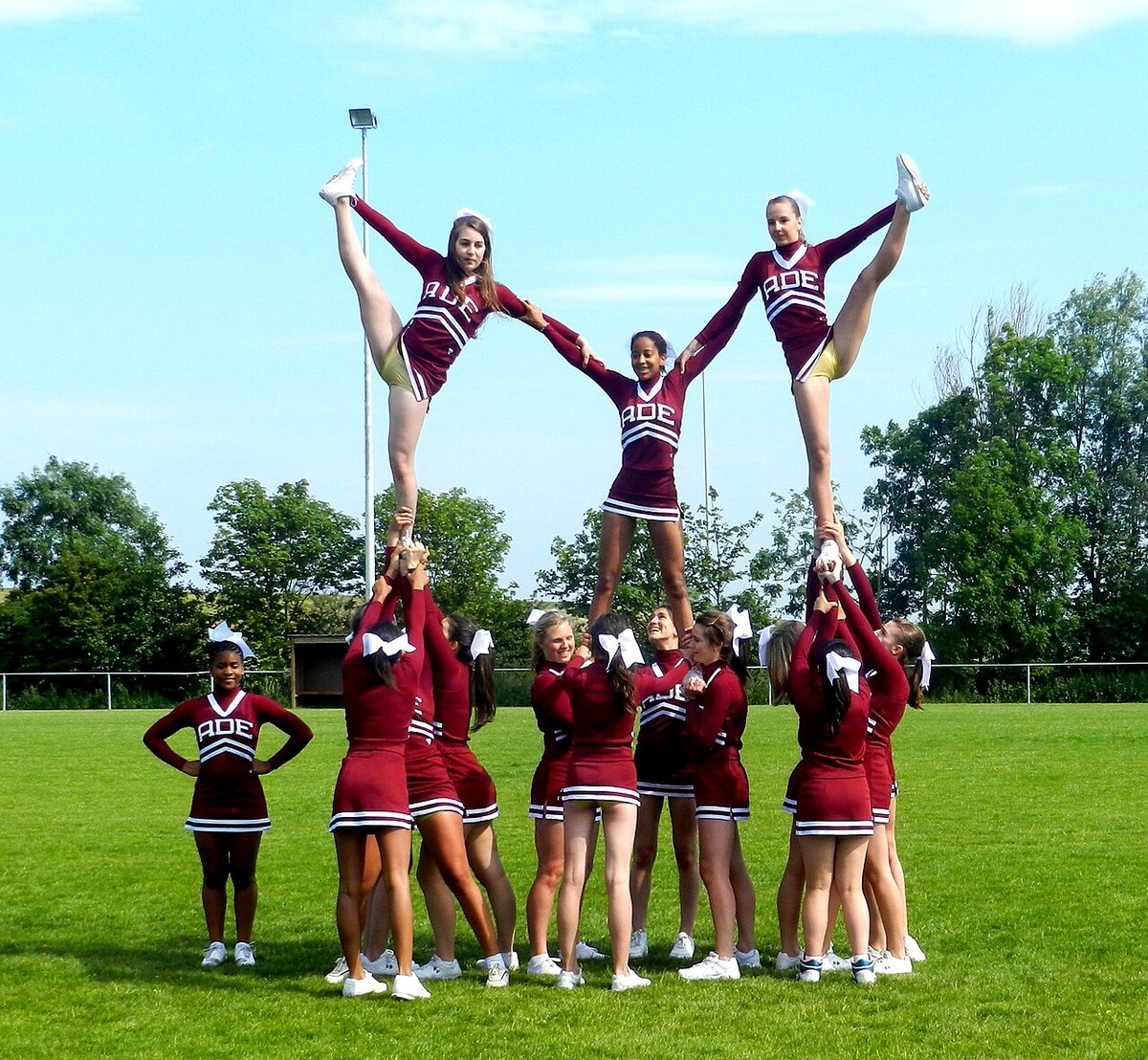
Competitive cheerleading packs stunts, pyramids, tumbling, jumps and dance into a routine of about two and a half minutes. Judges score how hard the skills are and how cleanly the team performs them, and strict safety rules decide which skills a team is allowed to try at its level.
This guide explains how all star and school competitions in the US generally work, based on the rules of the USASF for all star cheer, USA Cheer for school teams, and the International Cheer Union (ICU) for international events. Each event company has its own score sheet, so details vary.
Jump to:
- Cheerleading Rules in 60 Seconds
- The Routine
- Levels
- Scoring
- Deductions
- Safety Rules
- All Star vs School Cheer
- Tips for Your First Competition

Cheerleading Rules in 60 Seconds
- One routine. Usually 2 minutes 30 seconds for all star teams.
- Levels decide the skills. Each level allows only certain stunts and tumbling.
- Difficulty and execution. Judges score both for each part of the routine.
- Falls cost points. Deductions are taken off the score.
- Safety first. Illegal skills lead to deductions.
The Routine
An all star routine is performed on a spring floor to mixed music. Most competitions set a maximum of 2 minutes 30 seconds, and school routines often have their own time limits and include a cheer with crowd words. Teams are judged on what they show in that time, not on how many skills they try.
| Element | What judges look for |
|---|---|
| Stunts | Flyers held up by bases, difficulty and stability |
| Pyramids | Connected stunts and transitions between them |
| Tosses | Height and the skill the flyer performs in the air |
| Standing and running tumbling | Difficulty and how many athletes perform it |
| Jumps | Height, technique and synchronization |
| Dance | Sharpness and timing |
Levels
All star cheer is divided into levels, from level 1 for beginners up to level 6 and 7 for the most advanced teams. The level sets which skills are legal: a level 1 team may not throw a back handspring series, while level 6 and 7 teams can perform full twisting tumbling and high level stunts.
Scoring
Judges usually split the score into difficulty, execution and overall impression. Difficulty often depends on how many athletes perform a skill at the same time, so a full team performing a skill scores higher than a few athletes. Deductions are subtracted at the end.
Deductions
| Deduction | Example |
|---|---|
| Athlete fall | An athlete falls during tumbling or a jump |
| Building bobble | A stunt wobbles or a flyer touches down |
| Building fall | A stunt or pyramid falls |
| Safety violation | A skill that is illegal at the team’s level |
| Time limit violation | The routine runs over the limit |
Safety Rules
- Spotters are required for certain stunts at lower levels.
- Flyers may not be dropped from stunts without being caught.
- Jewelry is not allowed, and hair must be tied back.
- School teams follow separate safety rules for sideline cheer, for example on hard surfaces.
All Star vs School Cheer
| Rule | All star | School |
|---|---|---|
| Governing body | USASF | USA Cheer and state associations |
| Routine | Music only | Music plus a crowd cheer, often |
| Season | Competitions all year | Sideline cheer plus competition season |
| Levels | 1 to 7 | Divisions by school size and skill |
Tips for Your First Competition
- Hit a clean routine rather than trying skills the team cannot land every time.
- Know the score sheet of the event. Each event company weights skills differently.
- Keep smiling through mistakes. Overall impression is part of the score.
- Learn some cheerleading terms like flyer, base and hit zero.
More Reading
- Cheerleading positions explained
- Cheerleading lingo and slang
- Cheerleading equipment list
- History of cheerleading
- Common cheerleading injuries
- Cheerleading quiz

FAQ
What are the basic rules of competitive cheerleading?
Teams perform a routine of about two and a half minutes with stunts, pyramids, tumbling, jumps and dance. Judges score difficulty and execution, and falls and safety violations are deducted.
How long is a cheer routine?
Usually up to 2 minutes 30 seconds for all star teams.
How many levels are there in all star cheer?
Levels 1 to 7, from beginner to elite.
What is a deduction in cheerleading?
Points taken off for falls, bobbles, illegal skills or going over time.
What does hit zero mean?
Performing a routine with no deductions.
Is cheerleading a sport?
Yes. The International Cheer Union runs world championships, and the IOC has recognized it.
Who makes the rules for all star cheer?
The USASF in the United States and the IASF internationally.
Can you wear jewelry in cheerleading?
No. Jewelry is not allowed for safety reasons.


No comments yet
What's your take?
What's your opinion, or think we got something wrong? Tell us and other readers.
Our editors read every comment.