

Boxing ring dimensions with diagram: 16 to 20 ft square inside the ropes, rope heights, apron, platform height and how pro and Olympic rings compare.
A boxing ring is a square between 16 and 20 feet on each side, measured inside the ropes (4.88 to 6.10 meters). Most professional title fights use a ring close to 20 feet, and amateur and Olympic boxing uses 6.1 meters (20 feet) inside the ropes. The ring floor sits up to 4 feet above the arena floor and is closed in by four ropes.
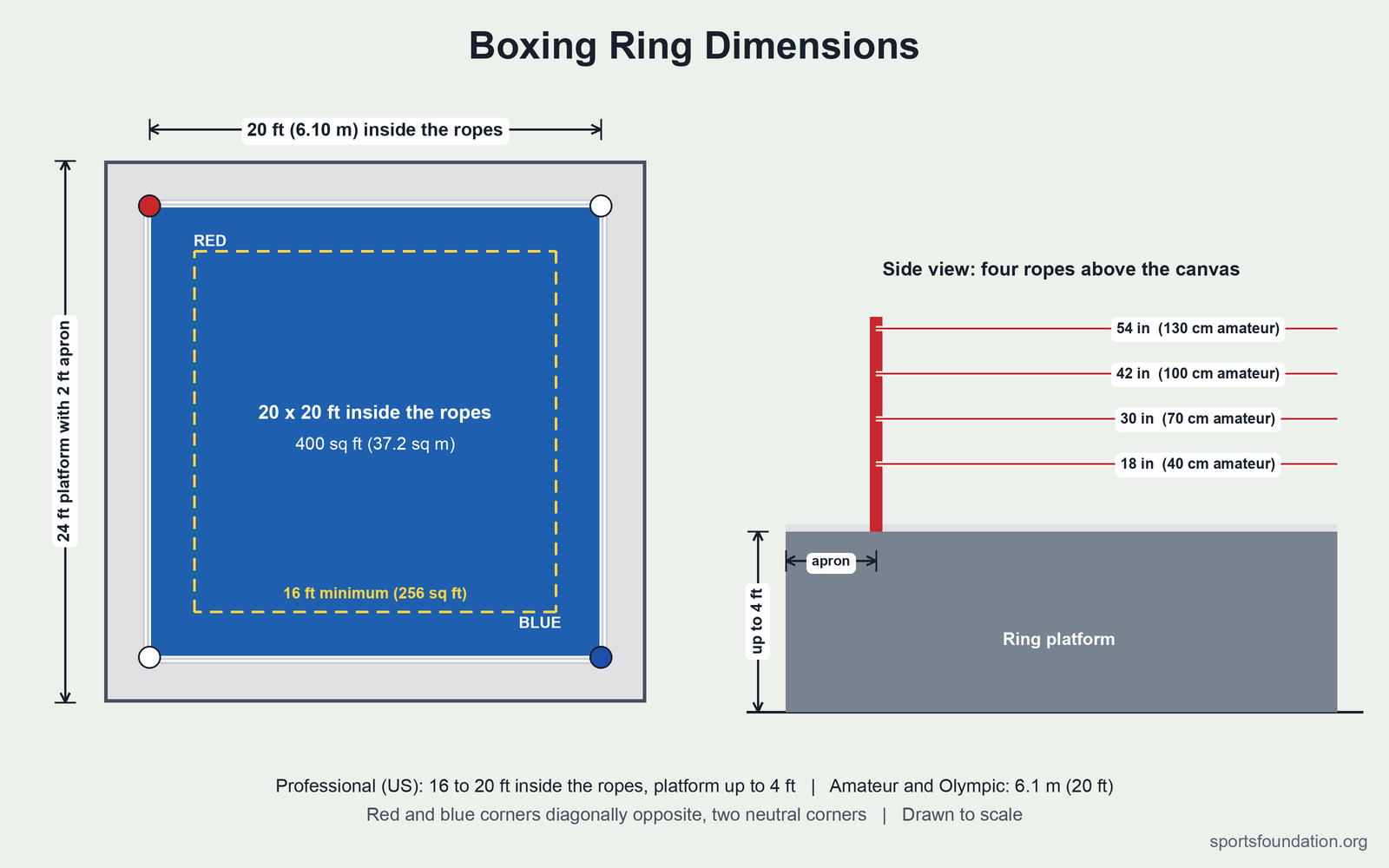
The size inside the ropes is not the size of the whole platform. The canvas runs past the ropes to form an apron, so a 20 foot ring usually stands on a platform of about 24 x 24 feet. Below are the measurements for professional and amateur rings, with a diagram drawn to scale.
Jump to:
- Boxing Ring Dimensions at a Glance
- How Big Is a Boxing Ring?
- How Many Square Feet Is a Boxing Ring?
- Ropes and Rope Heights
- The Apron and the Ring Floor
- How High Is a Boxing Ring?
- The Four Corners
- Professional vs Amateur and Olympic Rings
- Boxing Ring vs Wrestling Ring vs MMA Cage

Boxing Ring Dimensions at a Glance
| Measurement | Professional (US) | Amateur and Olympic |
|---|---|---|
| Inside the ropes | 16 to 20 ft square (some states up to 24 ft) | 6.1 m (20 ft) square |
| Area inside the ropes | 256 to 400 sq ft | 37.2 sq m (400 sq ft) |
| Apron outside the ropes | At least 18 in, often 2 ft | About 85 cm (2 ft 9 in) |
| Platform height | Up to 4 ft | About 1 m (3 ft 3 in) |
| Number of ropes | 4 | 4 |
| Rope heights above the canvas | 18, 30, 42 and 54 in | 40, 70, 100 and 130 cm |
| Padding under the canvas | At least 1 in | About 1.5 to 2 cm |
| Corners | Red, blue and two neutral | Red, blue and two neutral |
Watch: How Big Is a Boxing Ring Compared to Other Sports?
This short animation draws the boxing ring with its official lines and measurements, then lines it up with 36 other sports surfaces at the same scale, smallest to largest.
How Big Is a Boxing Ring?
Many US state athletic commissions require a professional ring to be at least 16 feet and no more than 20 feet square inside the ropes, while others, including Florida, Michigan and Pennsylvania, allow rings of up to 24 feet. Within that range, the promoter picks the size. The choice matters: a 16 foot ring helps a fighter who wants to trade punches up close, while a 20 foot ring gives a boxer who moves and counters more room to work. Big title fights are usually held in rings of 18 to 20 feet.
In amateur and Olympic boxing the standard ring is 6.1 meters square inside the ropes, the metric equivalent of 20 feet. Club shows and smaller amateur events sometimes use smaller rings, as small as about 4.9 meters (16 feet) in some rule sets.
How Many Square Feet Is a Boxing Ring?
A 16 foot ring has 256 square feet of space inside the ropes, an 18 foot ring 324 square feet and a 20 foot ring 400 square feet (37.2 square meters). Adding a 2 foot apron on every side turns a 20 foot ring into a 24 x 24 foot platform, which covers 576 square feet. Arenas also need clear space around the platform for the judges, the timekeeper, the ringside doctor and the corner teams.
Ropes and Rope Heights
Professional rings in the United States have four ropes. Common commission rules set them at 18, 30, 42 and 54 inches above the canvas, so the top rope is 4.5 feet high. The ropes are about 1 inch thick or more and wrapped in a soft cover. On each side, vertical straps tie the ropes together so that a boxer cannot slip between them and fall out of the ring.
Amateur rings use the same four rope layout in metric numbers: 40, 70, 100 and 130 centimeters above the canvas. The ropes are fixed to four padded corner posts, and turnbuckle covers protect the boxers in the corners.
The Apron and the Ring Floor
The apron is the strip of ring floor outside the ropes. US rules ask for at least 18 inches, and many rings have 2 feet, which gives the corner teams a place to stand and keeps a fighter who falls through the ropes on the platform. Amateur rules call for a wider apron of about 85 centimeters.
The ring floor is a stretched canvas over a layer of padding, at least 1 inch thick under US rules. The padding has to be firm: a soft floor tires the fighters and makes footwork harder, which is why the material is set by the rules and not left to the promoter.
How High Is a Boxing Ring?
The ring floor is raised so the crowd and the judges can see the action. Under US professional rules it may be up to 4 feet above the arena floor, and amateur rules set it at about 1 meter (3 feet 3 inches). With the top rope 54 inches above the canvas, the top rope of a 4 foot ring is about 8.5 feet above the arena floor. Steps lead up to the ring so the corner teams and officials can climb in.
The Four Corners
Each ring has a red corner and a blue corner, diagonally across from each other, and two neutral corners, usually white. The fighters rest in their own corners between rounds. After a knockdown, the referee sends the standing boxer to the farthest neutral corner before starting the count.
Professional vs Amateur and Olympic Rings
| Measurement | Professional (US commissions) | Amateur and Olympic |
|---|---|---|
| Inside the ropes | 16 to 20 ft | 6.1 m (20 ft) for major events |
| Ropes | 4 | 4 |
| Top rope | 54 in (1.37 m) | 130 cm (4 ft 3 in) |
| Platform height | Up to 4 ft (1.22 m) | About 1 m |
| Apron | At least 18 in (46 cm) | About 85 cm |
Professional and amateur rings look almost the same from the seats. The real difference is that the professional size is a range set by each commission, while amateur boxing uses one standard ring for major events. Olympic boxing follows the same 6.1 meter standard. How rounds, scoring and fouls work in each version is explained in boxing rules.
Boxing Ring vs Wrestling Ring vs MMA Cage
A pro wrestling ring looks like a boxing ring but is built for falls: the floor has springs or boards under the mat, and WWE rings are about 20 x 20 feet with three ropes instead of four. An MMA cage is much bigger. The full-size UFC Octagon is 30 feet across, almost twice the area of a 20 foot boxing ring. The full comparison is in boxing ring vs wrestling ring vs MMA cage.
| Fighting area | Size | Area | Compared to a 20 ft boxing ring |
|---|---|---|---|
| Boxing ring (20 ft) | 20 x 20 ft | 400 sq ft | Same |
| Boxing ring (16 ft) | 16 x 16 ft | 256 sq ft | 0.64 times |
| Pro wrestling ring (WWE) | 20 x 20 ft | 400 sq ft | About the same |
| UFC Octagon | 30 ft across | About 746 sq ft | About 1.9 times |
| Olympic wrestling circle | 9 m (29 ft 6 in) circle | About 685 sq ft | About 1.7 times |
For the other combat sports areas, see UFC octagon dimensions and wrestling mat dimensions. A very different kind of combat sports space is covered in fencing piste dimensions.
More Reading
- Boxing rules: how to play
- Wrestling ring vs boxing ring vs MMA cage
- Boxing equipment list
- Boxing lingo and slang
- Boxing history
- Boxing quiz

FAQ
How big is a boxing ring?
Usually between 16 and 20 feet square inside the ropes, and some US states allow up to 24 feet. Amateur and Olympic rings are 6.1 meters (20 feet) square.
How big is a professional boxing ring?
Usually 16 to 20 feet square inside the ropes. Big title fights are often held in rings of 18 to 20 feet.
How many ropes does a boxing ring have?
Four. Common US rules set them at 18, 30, 42 and 54 inches above the canvas.
How high is a boxing ring off the ground?
Up to 4 feet under US professional rules. Amateur and Olympic rings are about 1 meter (3 feet 3 inches) high.
How many square feet is a boxing ring?
256 square feet for a 16 foot ring, 324 for an 18 foot ring and 400 for a 20 foot ring, measured inside the ropes.
Why is a boxing ring called a ring if it is square?
Early prize fights were held inside a circle drawn on the ground or formed by the crowd. The name stayed when roped square rings came in.
How big is an Olympic boxing ring?
6.1 meters (20 feet) square inside the ropes, with four ropes at 40, 70, 100 and 130 centimeters.
Is a boxing ring bigger than the UFC Octagon?
No. The full-size Octagon covers about 746 square feet, almost twice a 20 foot boxing ring.


No comments yet
What's your take?
What's your opinion, or think we got something wrong? Tell us and other readers.
Our editors read every comment.