

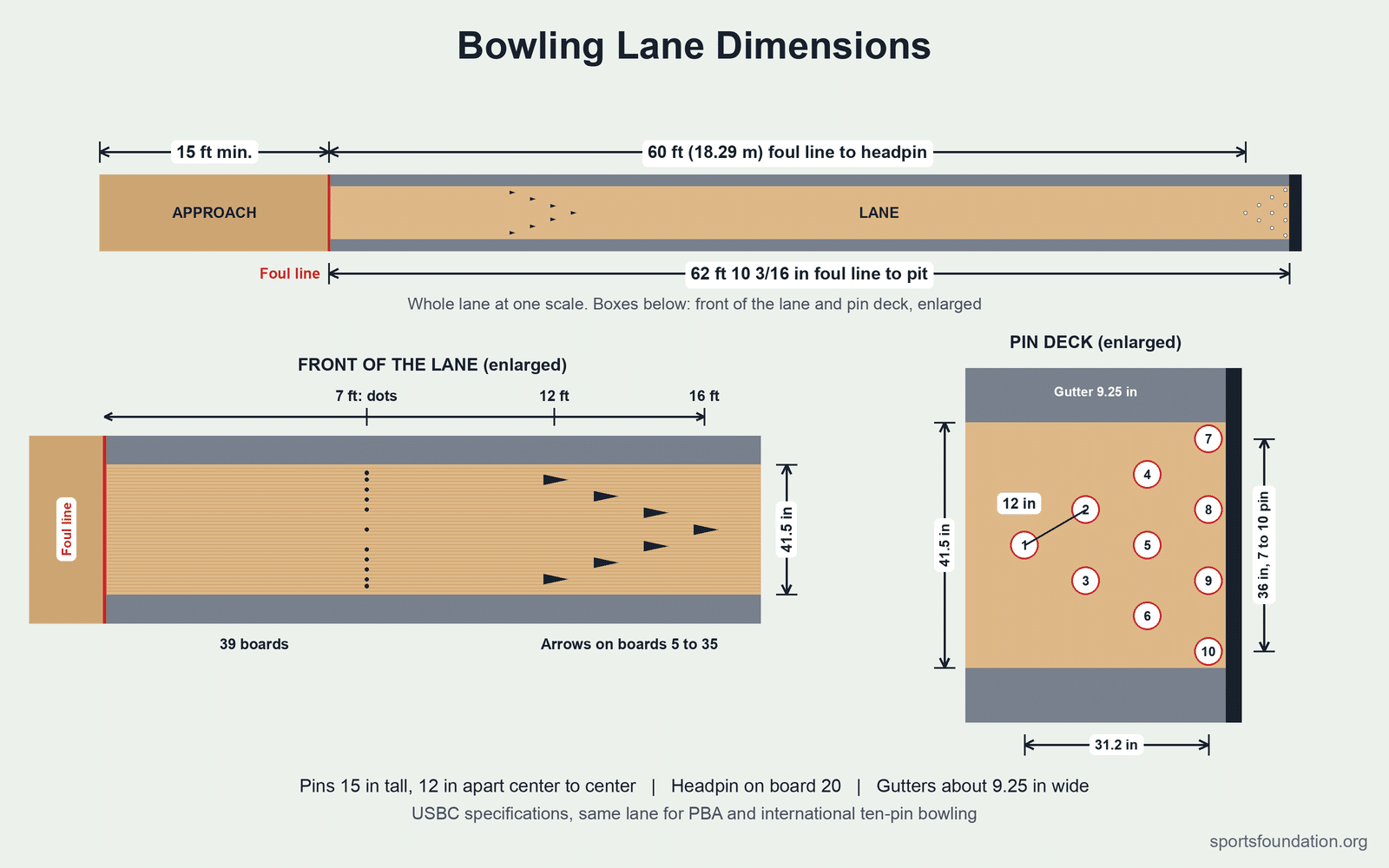
Bowling lane dimensions with diagram: 60 ft from foul line to headpin, 41.5 in wide with 39 boards, 15 ft approach, arrows, pin spacing and gutters.
A regulation bowling lane is 60 feet long from the foul line to the center of the headpin and 41.5 inches wide (18.29 x 1.05 meters). The lane surface is made of 39 boards, and a gutter about 9.25 inches wide runs along each side. Behind the foul line, the approach must be at least 15 feet long.
These numbers come from the United States Bowling Congress (USBC), and the same lane is used in the PBA and in international ten-pin bowling. Below are all the measurements, from the approach to the pit, with a diagram drawn to scale.
Jump to:
- Bowling Lane Dimensions at a Glance
- How Long Is a Bowling Lane?
- How Wide Is a Bowling Lane?
- How Many Square Feet Is a Bowling Lane?
- The Approach and the Foul Line
- Arrows, Dots and Boards
- Pin Deck and Pin Spacing
- Lane Oil Patterns
- Are All Bowling Lanes the Same Size?
- Bowling Lane vs Billiards Table and Other Games

Bowling Lane Dimensions at a Glance
| Measurement | Feet and inches | Meters |
|---|---|---|
| Foul line to center of headpin | 60 ft | 18.29 m |
| Foul line to pit | About 62 ft 10 in | About 19.16 m |
| Lane width | 41.5 in | 1.054 m |
| Number of boards | 39 | |
| Width of one board | About 1.06 in | About 2.7 cm |
| Gutter width (each side) | About 9.25 in | About 23.5 cm |
| Approach length (minimum) | 15 ft | 4.57 m |
| Pin spacing (center to center) | 12 in | 30.5 cm |
| Pin height | 15 in | 38.1 cm |
| Pin deck depth, headpin to back row | About 31.2 in | About 79 cm |
| Targeting arrows | About 12 to 16 ft past the foul line | About 3.7 to 4.9 m |
Watch: How Big Is a Bowling Lane Compared to Other Sports?
This short animation draws the bowling lane with its official lines and measurements, then lines it up with 36 other sports surfaces at the same scale, smallest to largest.
How Long Is a Bowling Lane?
A bowling lane is 60 feet long, measured from the foul line to the center of the headpin. That is the number bowlers mean when they talk about lane length. The lane itself continues past the pins: from the foul line to the edge of the pit it is about 62 feet 10 inches, so the pin deck adds almost 3 feet behind the headpin.
Add the approach and the pinsetter, and one lane takes up much more room. With a 15 foot approach in front and the machine behind the pit, a bowling center typically needs about 83 to 87 feet of building length from the back of the approach to the rear of the pinsetter.
How Wide Is a Bowling Lane?
The playing surface is 41.5 inches wide, about 3 feet 5.5 inches or 1.05 meters. It is made of 39 boards, each a little more than an inch wide. Boards are counted from the outside edge: board 20 is the center board, and the headpin stands on it.
A gutter, officially called a channel, runs along both sides of the lane and is about 9.25 inches wide. Lane plus both gutters comes to about 60 inches, or 5 feet. Lanes are usually built in pairs that share one ball return, so a pair of lanes needs roughly 11.5 feet of width or more.
How Many Square Feet Is a Bowling Lane?
The lane from the foul line to the headpin covers about 207 square feet (60 feet x 41.5 inches), roughly 19.3 square meters. To the pit it is about 217 square feet. Including both gutters, the strip from foul line to pit covers about 314 square feet, and with a 15 foot approach the total is close to 390 square feet per lane, before the pinsetter and seating are counted.
The Approach and the Foul Line
The approach is the area where bowlers take their steps before releasing the ball. USBC rules ask for at least 15 feet, and many centers build 16 feet or more. The approach has rows of dots that help bowlers start from the same spot every time, usually one set near the foul line and one or two more sets farther back.
The foul line separates the approach from the lane. Touching or crossing it during a delivery is a foul, and the ball scores zero. How fouls are called is explained in bowling rules.
Arrows, Dots and Boards
Seven targeting arrows are set into the lane in a V shape, on every fifth board (boards 5, 10, 15, 20, 25, 30 and 35). They sit roughly 12 to 16 feet past the foul line, with the center arrow farthest out. Most bowlers aim at an arrow rather than at the pins, because a target 15 feet away is far easier to hit than one 60 feet away.
A row of guide dots about 7 feet past the foul line gives a closer target for spare shots and line adjustments. Many lanes also have range finders, short lines farther down the lane that help bowlers judge the breakpoint of a hook.
Pin Deck and Pin Spacing
The ten pins stand in a triangle on the pin deck. The centers of neighboring pins are exactly 12 inches apart, so each row sits about 10.4 inches behind the one in front of it. The back row (pins 7, 8, 9 and 10) is about 31.2 inches behind the headpin, and the 7 and 10 pins are 36 inches apart, center to center.
A pin is 15 inches tall and about 4.77 inches across at its widest point. USBC pins weigh between 3 pounds 6 ounces and 3 pounds 10 ounces. The ball can be up to 8.595 inches in diameter and may weigh up to 16 pounds. On both sides of the pin deck, the kickbacks (the side walls) keep pins in play and send them back across the deck.
Lane Oil Patterns
The front part of every lane is coated with a thin layer of oil that protects the surface and controls how much the ball hooks. The pattern length is measured from the foul line. A typical house shot runs about 38 to 42 feet, and PBA patterns range from roughly 32 to more than 50 feet. The dry back end is where a hook ball grips the lane and turns toward the pocket.
Are All Bowling Lanes the Same Size?
| Lane type | Foul line to headpin | Width | Notes |
|---|---|---|---|
| USBC (league and open play) | 60 ft | 41.5 in | 39 boards |
| PBA (professional) | 60 ft | 41.5 in | Oil patterns vary by event |
| International ten-pin | 18.29 m | 1.054 m | Same lane as USBC |
| Home lanes | Usually 60 ft | Usually 41.5 in | Built to USBC spec in most cases |
| Mini bowling | Varies widely | Narrower | No standard size |
Yes, for ten-pin bowling. A sanctioned lane has the same size in every center and every country, which is why averages and records can be compared. Duckpin and candlepin lanes, found mostly in New England and the Mid-Atlantic, are close to the same length, but the pins and balls are much smaller. Mini bowling lanes in arcades and homes have no fixed size.
Bowling Lane vs Billiards Table and Other Games
A bowling lane is long and narrow: it is about 17 times longer than it is wide. A 9 foot pool table has a playing surface of 100 x 50 inches, so one lane could hold about seven pool tables end to end. The full comparison is in bowling alley vs billiards table.
| Playing area | Size | Area |
|---|---|---|
| Bowling lane (foul line to headpin) | 60 ft x 41.5 in | About 207 sq ft |
| Pool table, 9 ft (playing surface) | 100 x 50 in | About 35 sq ft |
| Ping-pong table | 9 x 5 ft | 45 sq ft |
| Basketball court (NBA) | 94 x 50 ft | 4,700 sq ft |
For the other indoor games, see pool table dimensions, dart board dimensions and ping pong table dimensions.
More Reading
- Bowling rules: how to play
- Bowling alley vs billiards table
- Bowling equipment list
- Bowling lingo and slang
- History of bowling
- Bowling quiz

FAQ
How long is a bowling lane?
A bowling lane is 60 feet from the foul line to the center of the headpin, and about 62 feet 10 inches from the foul line to the pit.
How wide is a bowling lane?
The lane is 41.5 inches wide (1.05 meters). With a gutter of about 9.25 inches on each side, the total width is about 5 feet.
How many boards are on a bowling lane?
A bowling lane has 39 boards, each a little more than an inch wide. Board 20 is the center board.
How long is the approach in bowling?
The approach must be at least 15 feet long under USBC rules. Many centers build 16 feet or more.
How far apart are bowling pins?
Bowling pins are 12 inches apart, measured from the center of one pin to the center of the next.
Where are the arrows on a bowling lane?
The seven arrows sit about 12 to 16 feet past the foul line in a V shape, on every fifth board.
How many square feet is a bowling lane?
About 207 square feet from the foul line to the headpin, and close to 390 square feet including gutters and a 15 foot approach.
Are all bowling lanes the same size?
Yes. Every sanctioned ten-pin lane is 60 feet to the headpin and 41.5 inches wide, in the United States and internationally.


No comments yet
What's your take?
What's your opinion, or think we got something wrong? Tell us and other readers.
Our editors read every comment.