

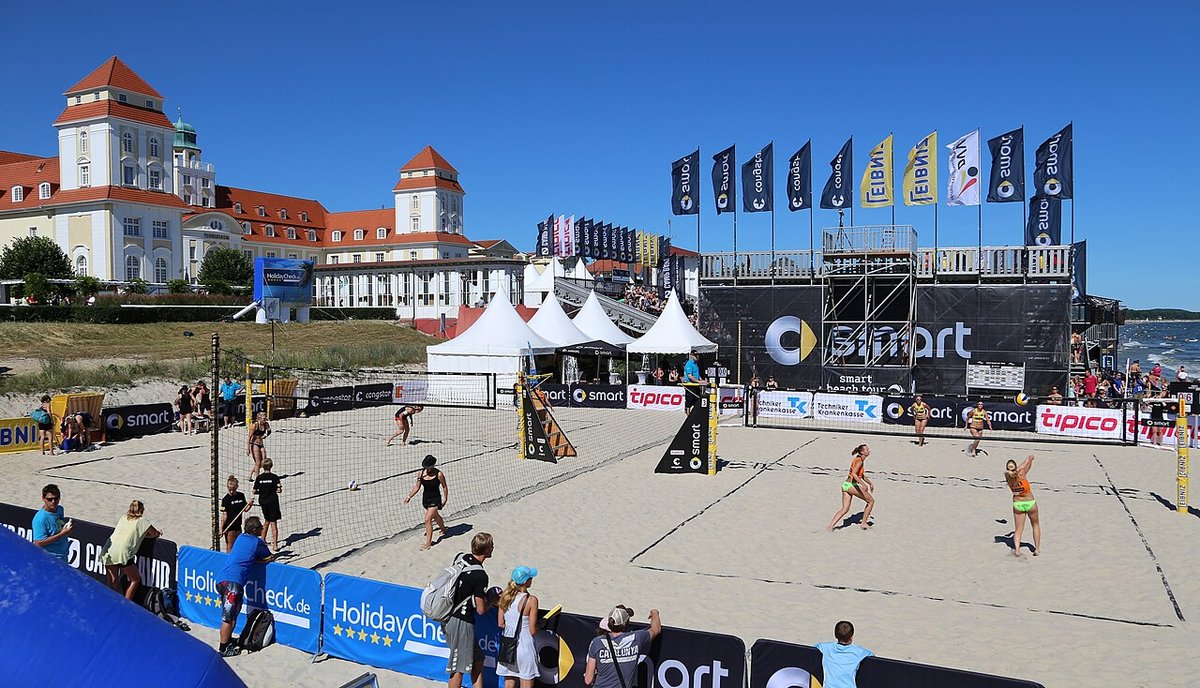
Beach volleyball rules explained: scoring to 21, side switches, the block as a touch, no open hand tips, hand sets, serving order and the indoor differences.
Beach volleyball looks like indoor volleyball moved to the sand, but with only two players per side, the rules had to change. The court is smaller, the sets are shorter, and a few ball handling rules are much stricter, which is why a shot that is normal indoors can cost you a point on the beach.
This guide explains the official rules of the FIVB, the international volleyball federation, in the order you need them: the court, scoring and side switches, serving, the three touches, the shots that are not allowed and the most common faults. A table at the end compares beach and indoor volleyball.
Jump to:
- Beach Volleyball Rules in 60 Seconds
- The Court and the Net
- Scoring and Side Switches
- Serving Rules
- The Three Touches
- Shots That Are Not Allowed
- Common Faults
- Beach vs Indoor Volleyball
- Tips for Your First Game

Beach Volleyball Rules in 60 Seconds
- Two players per side, no substitutions and no fixed positions.
- Every rally scores. Sets one and two go to 21, a third set to 15, always with a two point lead.
- Three touches, block included. A block counts as the first of a team’s three touches.
- No open hand tips. A soft attack must be played with the knuckles, a closed fist or a stiff hand, not the fingertips.
- Switch sides every 7 points in the first two sets, every 5 in the third.
The Court and the Net
A beach court is 16 meters long and 8 meters wide, split into two 8 by 8 meter halves, with no attack line. The net is the same height as indoors: 2.43 meters for men and 2.24 meters for women. The boundary lines are bands on the sand, and a ball that touches a band is in.
Our comparison of a beach volleyball court and an equestrian center shows how compact the court is.
Court size, net heights and the free zone are listed in our guide to beach volleyball court dimensions.
Scoring and Side Switches
- Every rally gives one team a point.
- A match is best of three sets. Sets one and two go to 21, the third to 15.
- A set must be won by two points, with no cap.
- Teams switch sides every 7 points in sets one and two, counting both teams’ points, and every 5 points in the third set, so neither team has the sun or wind for long.
- Each team has one timeout of 30 seconds per set. At FIVB events, a technical timeout is added when the combined score reaches 21 in sets one and two.
Serving Rules
The serve is hit from anywhere behind the end line, within 5 seconds of the referee’s whistle. Partners must alternate serving: when a team wins back the serve, the player who did not serve last time serves next. A serve that touches the net and lands in is in play. The server’s partner may not screen the receiving team’s view of the server, and must move if the opponents ask.
The Three Touches
Each team may touch the ball three times before it goes over the net, and no player may touch it twice in a row. The exception is the block: a player who blocks may make the next contact, but the block counts as the team’s first touch, unlike indoors.
Players may use any part of the body. The first contact of a team, including a hard driven attack, may be a quick double contact in one action, and hard attacks may also be dug with the open hands. This does not apply to the serve, which may not be received with an overhand finger pass.

Shots That Are Not Allowed
| Shot | Rule |
|---|---|
| Open hand tip | Directing an attack with the fingertips is a fault. Use the knuckles, a closed fist, the heel of the hand or stiff fingers, the cobra |
| Hand set over the net | A set with the fingers that goes over the net only counts if it travels in a line straight forward or backward from the setter’s shoulders |
| Double contact on a set | A hand set must be one clean contact. Referees on the beach watch for spin from a double touch closely |
| Catch or lift | Holding or throwing the ball |
Common Faults
| Fault | What happened |
|---|---|
| Net touch | A player touches the net between the antennas while playing the ball |
| Interference | A player enters the opponent’s side under the net and gets in the way |
| Reaching over | A blocker touches the ball on the opponent side before the opponent attacks |
| Four touches | The team touches the ball a fourth time, counting the block |
| Serving order | The wrong player serves |
| Foot fault | The server steps on the end line before contact |
Beach vs Indoor Volleyball
| Rule | Beach | Indoor |
|---|---|---|
| Players per side | 2 | 6 |
| Court | 16 x 8 m, no attack line | 18 x 9 m, attack line at 3 m |
| Sets | Best of three, to 21, third set to 15 | Best of five, to 25, fifth set to 15 |
| Block | Counts as a touch | Does not count |
| Open hand tip | Not allowed | Allowed |
| Positions and rotation | None, players stand where they like | Fixed rotation order |
| Substitutions | None | Allowed, plus a libero |
More on the six player game in our guide to volleyball rules.
Tips for Your First Game
- Talk to your partner on every play: who takes the ball, who blocks, where the hit goes.
- Use hand signals behind your back before the serve to plan the block.
- Play the wind. Serve into it for a float, with it for power.
- Learn some beach volleyball terms like cobra, pokey and side out.
More Reading
- Beach Volleyball positions explained
- Beach Volleyball lingo and slang
- Beach Volleyball equipment list
- History of beach volleyball
- Beach volleyball court vs equestrian center
- Common beach volleyball injuries
- Beach Volleyball quiz

FAQ
What are the basic rules of beach volleyball?
Two players per side hit the ball over the net, using up to three touches including the block. Every rally scores, sets go to 21 with a two point lead, and the first team to win two sets wins the match.
Why can’t you tip in beach volleyball?
An open hand tip with the fingertips is a fault in beach volleyball. Soft shots must be played with the knuckles, a fist or stiff fingers, which makes them easier to read.
Does the block count as a touch in beach volleyball?
Yes. The block is the team’s first touch, so only two more are left.
How many points is a beach volleyball set?
21 points in sets one and two, 15 in a third set, always won by two.
When do you switch sides in beach volleyball?
Every 7 combined points in the first two sets and every 5 in the third.
Is there a rotation in beach volleyball?
There is no positional rotation, but partners must alternate serving each time their team wins back the serve.
How big is a beach volleyball court?
16 meters long and 8 meters wide, smaller than an indoor court.
Can you set the ball over the net in beach volleyball?
Only if the set travels straight forward or backward from the line of your shoulders.


No comments yet
What's your take?
What's your opinion, or think we got something wrong? Tell us and other readers.
Our editors read every comment.