

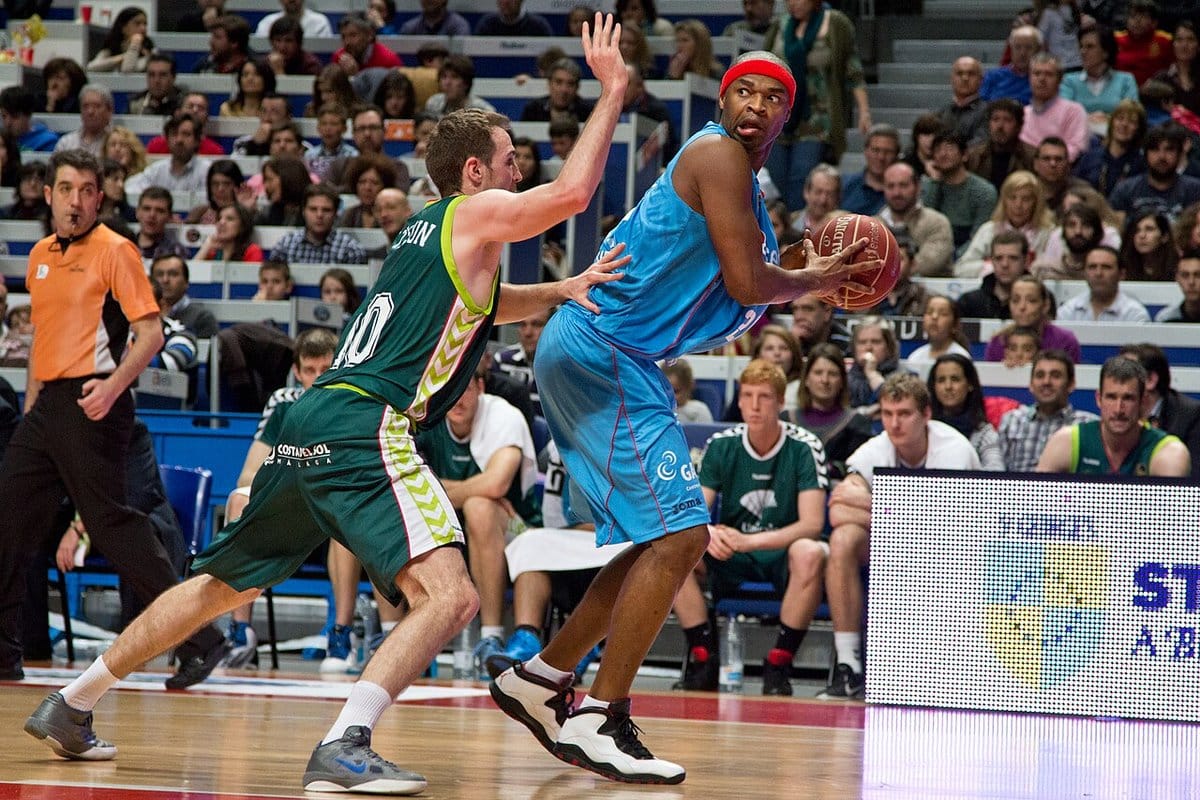
Basketball rules explained: scoring, dribbling, traveling, fouls, free throws, the shot clock and game length, plus how NBA, college and FIBA rules differ.
Basketball is one of the few sports you can learn in an afternoon at a park: two hoops, one ball, and the team with more points wins. The rules mostly deal with two questions. How may you move with the ball, and how much contact is too much?
This guide explains the rules in that order: scoring, moving with the ball, violations, fouls and free throws, the clocks and how games are timed. It is based on the NBA rulebook, and a table at the end shows where college, high school and international FIBA rules differ.
Jump to:
- Basketball Rules in 60 Seconds
- The Court and the Basket
- Scoring
- Moving With the Ball
- Time and Space Violations
- Fouls and Free Throws
- The Clock and Game Length
- NBA vs College vs High School vs FIBA
- Tips for Watching or Playing Your First Game

Basketball Rules in 60 Seconds
- Five players per side. Substitutions are unlimited, made during stoppages.
- Shoot into the opponent’s basket. Two points inside the arc, three points from beyond it, one point for a free throw.
- Dribble to move. You may not run with the ball without bouncing it.
- Limited contact. Pushing, holding and hitting are fouls, and enough fouls lead to free throws.
- Beat the clocks. The offense has a limited time to shoot, and the team ahead when the game clock runs out wins.
The Court and the Basket
An NBA court is 94 feet long and 50 feet wide, and the rim hangs 10 feet above the floor at every level. The three point line in the NBA is 23 feet 9 inches from the center of the basket, and 22 feet in the corners. In front of each basket is the lane, also called the key or the paint, and at its top the free throw line, 15 feet from the backboard.
Our comparison of a basketball court and a volleyball court shows how the two indoor courts compare.
Every line on the court, from the 3-point arc to the lane, is listed in our guide to basketball court dimensions.
Scoring
| Shot | Points | Details |
|---|---|---|
| Field goal | 2 | Any shot from inside the three point line, including dunks and layups |
| Three pointer | 3 | Both feet behind the line when the shooter leaves the floor |
| Free throw | 1 | Uncontested shot from the free throw line after certain fouls |
A shot counts when the ball goes through the hoop from above. A shooter who steps on the three point line gets two points, not three.
Moving With the Ball
- Dribbling: the ball must be bounced with one hand at a time. Once you stop dribbling and hold the ball, you have to pass or shoot.
- Double dribble: dribbling again after stopping, or dribbling with both hands at once, is a violation.
- Traveling: moving the pivot foot or taking too many steps while holding the ball. After a dribble, a player may take two steps to stop, pass or shoot.
- Carrying: turning the hand under the ball and carrying it while dribbling.
Every violation gives the ball to the other team, out of bounds near the spot.
Time and Space Violations
| Violation | Rule |
|---|---|
| Shot clock | The offense must attempt a shot that hits the rim before the shot clock expires |
| Backcourt (8 seconds) | The offense has 8 seconds to bring the ball past the half court line in the NBA and FIBA |
| Over and back | Once in the frontcourt, the offense may not take the ball back over the half court line |
| Three seconds | An offensive player may not stay in the lane for more than three seconds |
| Defensive three seconds | NBA only: a defender may not stay in the lane for more than three seconds without guarding someone |
| Out of bounds | The ball, or a player holding it, touches a boundary line or the floor outside it |
| Goaltending and basket interference | A defender touches a shot on its way down toward the rim, or touches the ball while it is on the rim. The basket counts |
Fouls and Free Throws
A personal foul is illegal contact: pushing, holding, hitting, tripping, or blocking a player’s path without having established position. On offense, running into a defender who is set is a charge. What happens next depends on the situation:
- Fouled while shooting, shot missed: two free throws, three for a three point attempt.
- Fouled while shooting, shot made: the basket counts plus one free throw, the “and one”.
- Not shooting: the fouled team inbounds the ball, until the opponent is in the penalty. In the NBA, every defensive foul after the fourth team foul in a quarter gives two free throws.
- Fouling out: an NBA player is out of the game after six personal fouls. Under FIBA, college and high school rules the limit is five.
- Technical and flagrant fouls: unsporting behavior or excessive contact, punished with free throws and often possession.
The Clock and Game Length
The game clock stops whenever the ball is dead, such as after a foul, a violation or a timeout, and in the final minutes after made baskets. The shot clock gives the offense 24 seconds in the NBA. It resets to 24 when the ball hits the rim and the defense gets it, and to 14 when the offense gets its own rebound.
Games start with a jump ball at center court. If the score is tied at the end, the teams play five minute overtime periods until there is a winner.
NBA vs College vs High School vs FIBA
| Rule | NBA | NCAA men | NCAA women | High school | FIBA |
|---|---|---|---|---|---|
| Game length | 4 x 12 min | 2 x 20 min | 4 x 10 min | 4 x 8 min | 4 x 10 min |
| Shot clock | 24 s | 30 s | 30 s | Up to each state, 35 s where used | 24 s |
| Three point line | 23 ft 9 in | 22 ft 1 3/4 in | 22 ft 1 3/4 in | 19 ft 9 in | 6.75 m |
| Fouls to foul out | 6 | 5 | 5 | 5 | 5 |
| Overtime | 5 min | 5 min | 5 min | 4 min | 5 min |
College and FIBA games also use a possession arrow instead of a jump ball when two players hold the ball at the same time.
Tips for Watching or Playing Your First Game
- Watch the shot clock in the last seconds of a possession. That is when teams take their worst shots.
- On a drive to the basket, watch the defender’s feet. Set feet mean a charge, moving feet mean a blocking foul.
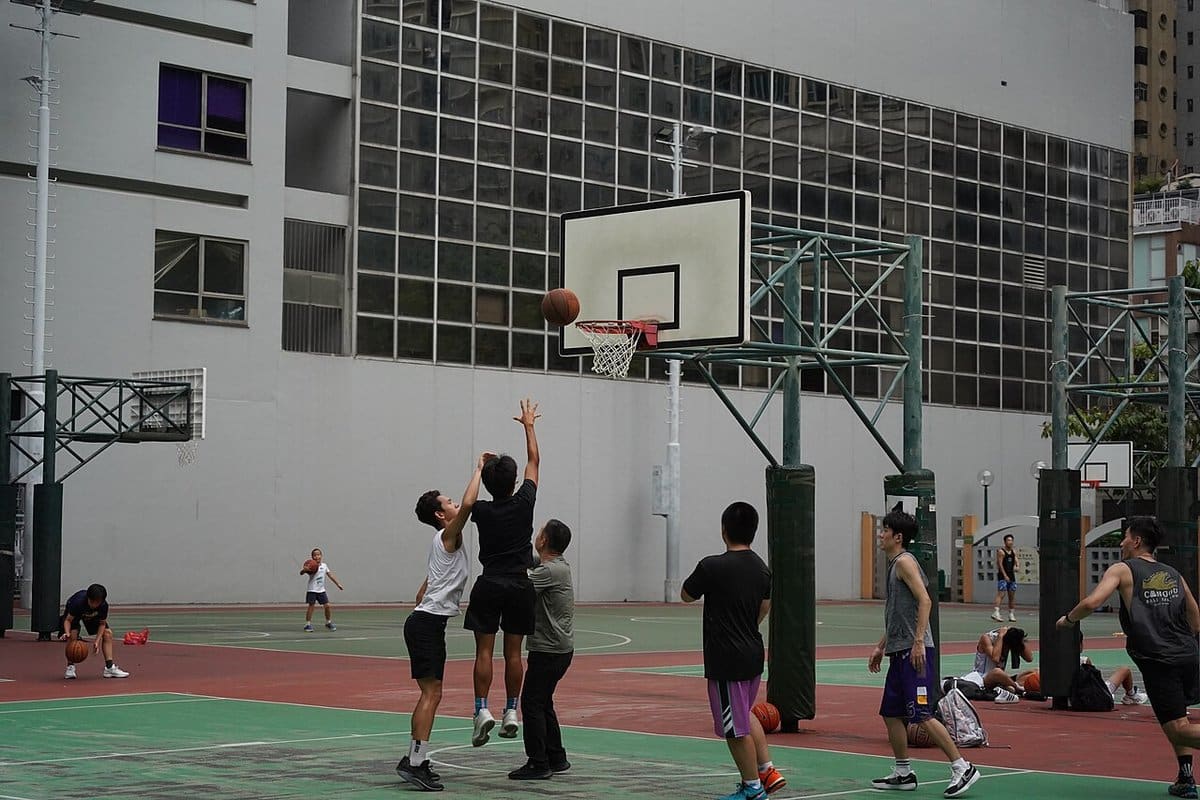
- In pickup games, the scoring is usually ones and twos instead of twos and threes, and players call their own fouls.
- Learn some basketball terms like and one, alley oop and triple double.
More Reading
- Basketball positions explained
- Basketball lingo and slang
- Basketball equipment list
- History of basketball
- Basketball court vs volleyball court
- Common basketball injuries
- Basketball quiz

FAQ
What are the basic rules of basketball?
Two teams of five try to shoot the ball through the opponent’s hoop. Players move the ball by dribbling or passing, shots are worth one, two or three points, and the team with more points at the end wins.
How many steps can you take in basketball?
After ending a dribble, a player may take two steps to stop, pass or shoot. More than that is traveling.
How long is a basketball game?
NBA games have four 12 minute quarters, college men two 20 minute halves, college women and FIBA four 10 minute quarters, and high school four 8 minute quarters.
What is a double dribble?
Dribbling with both hands at once, or starting to dribble again after you stopped and held the ball. The other team gets possession.
How many fouls before you foul out?
Six in the NBA, five in college, high school and FIBA basketball.
How long is the shot clock?
24 seconds in the NBA and FIBA, 30 seconds in college. High school shot clocks depend on the state and are usually 35 seconds where used.
What is goaltending?
Blocking a shot on its way down toward the basket. Touching the ball while it is on the rim is called basket interference. In both cases the basket counts for the shooting team.
When do you get free throws in basketball?
When you are fouled while shooting, and once the other team is in the bonus. In the NBA, FIBA and women’s college basketball that means more than four team fouls in a quarter. College men count per half: a one and one from the seventh foul, two shots from the tenth.


No comments yet
What's your take?
What's your opinion, or think we got something wrong? Tell us and other readers.
Our editors read every comment.