

Baseball field dimensions with diagram: 90 ft bases, 60 ft 6 in pitching distance, mound size, fence distances and how Little League fields compare.
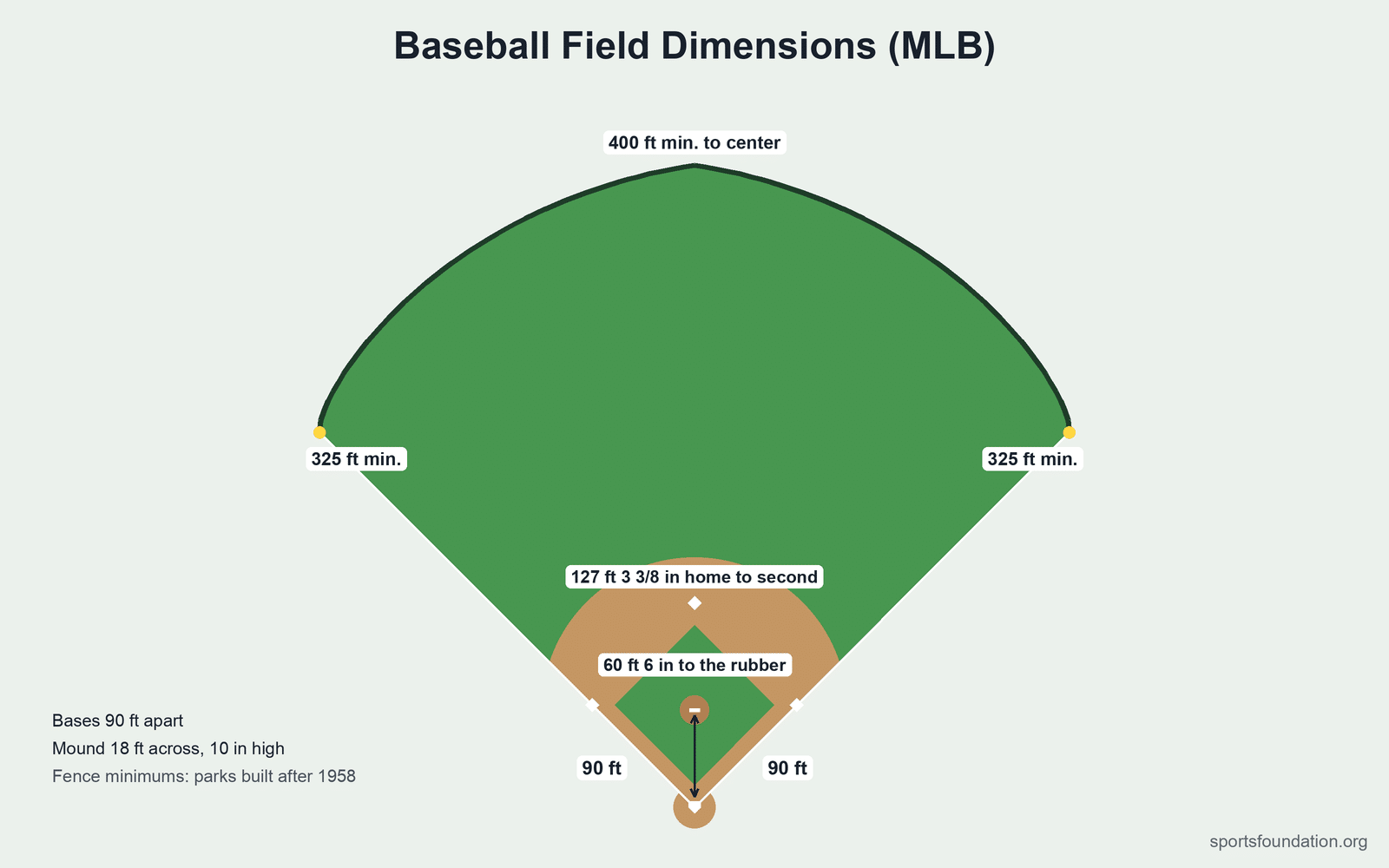
On a regulation baseball field, the bases are 90 feet apart and the front of the pitching rubber is 60 feet 6 inches from home plate. Those two numbers are the same in Major League Baseball, college and high school. The outfield is different: MLB rules ask for at least 325 feet down the foul lines and 400 feet to center field for parks built after 1958, but every ballpark has its own shape.
Baseball is one of the few sports without one fixed field size. The infield is measured to the inch, the outfield is not. Below are all the official measurements, a diagram of the diamond and the field sizes for youth leagues.
Jump to:
- Baseball Field Dimensions at a Glance
- How Far Apart Are the Bases?
- Pitching Distance and Mound
- Home Plate and Batter’s Box
- Outfield Fence Distances
- How Big Is a Baseball Field in Acres?
- Infield Grass and Backstop
- Field Sizes by Level
- Baseball Field vs Softball Field

Baseball Field Dimensions at a Glance
| Measurement | Feet | Meters |
|---|---|---|
| Distance between bases | 90 ft | 27.43 m |
| Home plate to pitching rubber | 60 ft 6 in | 18.44 m |
| Home plate to second base | 127 ft 3 3/8 in | 38.80 m |
| Pitcher’s mound diameter | 18 ft | 5.49 m |
| Mound height | 10 in | 25.4 cm |
| Pitching rubber | 24 x 6 in | 61 x 15 cm |
| Home plate width | 17 in | 43.2 cm |
| Bases (MLB since 2023) | 18 x 18 in | 45.7 cm |
| Batter’s box | 4 x 6 ft | 1.22 x 1.83 m |
| Foul lines (minimum, newer MLB parks) | 325 ft | 99.06 m |
| Center field (minimum, newer MLB parks) | 400 ft | 121.92 m |
| Backstop behind home plate (recommended) | 60 ft | 18.29 m |
Watch: How Big Is a Baseball Field Compared to Other Sports?
This short animation draws the baseball field with its official lines and measurements, then lines it up with 36 other sports surfaces at the same scale, smallest to largest.
How Far Apart Are the Bases?
The bases are 90 feet apart, measured from the back point of home plate to the back corner of first and third base, and to the center of second base. The four bases form a square, which is why the infield is called a diamond. Home plate to second base, and first to third, is 127 feet 3 3/8 inches.
Major League Baseball made first, second and third base bigger in 2023: they grew from 15 to 18 inches square. That shortened the distance between first and second, and between second and third, by 4.5 inches, a small change that helped the number of stolen bases rise.
Pitching Distance and Mound
The front edge of the pitching rubber is 60 feet 6 inches from the back point of home plate. That distance has not changed since 1893. The rubber is a white slab of 24 x 6 inches set into the mound.
The mound is a circle 18 feet in diameter. In MLB, the top of the rubber is 10 inches higher than home plate, and the mound slopes down toward home from a point just in front of the rubber. Before 1969, mounds could be 15 inches high; they were lowered after the “Year of the Pitcher” in 1968.
Home Plate and Batter’s Box
Home plate is a five sided slab of white rubber. It is 17 inches wide at the front, with two 8.5 inch sides and two 12 inch sides that meet at a point toward the catcher. The batter’s boxes on either side are 4 feet wide and 6 feet long, 6 inches away from the plate.
Outfield Fence Distances
The official rules only set minimums. A note in the MLB rulebook says that parks built after June 1, 1958 should be at least 325 feet from home plate down the foul lines and 400 feet to center field. Older parks were exempt, and several newer parks have shorter spots. That is why fence distances are part of what makes each ballpark unique.
| Ballpark | Left field | Center field | Right field |
|---|---|---|---|
| Fenway Park (Boston) | 310 ft | 390 ft | 302 ft |
| Yankee Stadium (New York) | 318 ft | 408 ft | 314 ft |
| Coors Field (Denver) | 347 ft | 415 ft | 350 ft |
| Oracle Park (San Francisco) | 339 ft | 391 ft | 309 ft |
Fenway Park’s left field wall, the Green Monster, is about 37 feet tall to make up for its short distance. Fence heights have no rule either.
How Big Is a Baseball Field in Acres?
There is no exact answer, because outfields vary. A rough estimate: with foul lines around 330 feet and center field around 400 feet, the fair territory of an MLB field covers about 2.5 acres. Foul territory adds more, and it varies even more between parks than the outfield does. A typical high school field with shorter fences is closer to 2 acres of fair territory.
Infield Grass and Backstop
On a professional field, the dirt part of the infield ends in an arc with a 95 foot radius around the pitching rubber. The baselines, the base areas and the mound are dirt; the square inside the bases is grass. The rulebook recommends at least 60 feet between home plate and the backstop behind it.
Field Sizes by Level
| Level | Bases | Pitching distance |
|---|---|---|
| MLB, college, high school | 90 ft | 60 ft 6 in |
| Babe Ruth 13 to 15 | 90 ft | 60 ft 6 in |
| Little League Intermediate (50/70) | 70 ft | 50 ft |
| Little League Majors (12U) | 60 ft | 46 ft |
Little League fields are much smaller. The recommended fence distance is about 200 feet from home plate, and local leagues set their own. Players switch to the full 90 foot diamond around age 13. How the game works on all these fields is explained in baseball rules.
Baseball Field vs Softball Field
A softball field is a smaller copy of a baseball field. Fastpitch softball uses 60 foot bases and a pitching distance of 43 feet, and the fences are around 200 to 220 feet away instead of 325 to 400. The full comparison is in baseball stadium vs softball field, and all softball measurements are in softball field dimensions.
| Field | Bases | Pitching distance | Fences |
|---|---|---|---|
| Baseball (MLB) | 90 ft | 60 ft 6 in | 325 to 400+ ft |
| Fastpitch softball | 60 ft | 43 ft | About 200 to 220 ft |
| Little League baseball | 60 ft | 46 ft | About 200 ft |
More Reading
- Baseball rules: how to play
- Baseball stadium vs softball field
- Baseball positions explained
- Baseball equipment list
- Baseball lingo and slang
- Baseball quiz

FAQ
How far apart are the bases in baseball?
The bases are 90 feet apart in MLB, college and high school. Little League Majors uses 60 feet.
How far is the pitcher’s mound from home plate?
The front of the pitching rubber is 60 feet 6 inches from the back point of home plate.
How far is it from home plate to second base?
Home plate to second base is 127 feet 3 3/8 inches on a 90 foot diamond.
How tall is the pitcher’s mound?
In MLB, the pitching rubber is 10 inches higher than home plate. The mound is 18 feet in diameter.
How far are the outfield fences in MLB?
Parks built after 1958 should be at least 325 feet down the lines and 400 feet to center, but every ballpark has its own distances.
How big are the bases in MLB?
Since 2023, first, second and third base are 18 inches square. Before that they were 15 inches.
How big is a baseball field in acres?
Fair territory on an MLB field is roughly 2.5 acres. The exact size depends on the fences, which differ in every park.
How big is a Little League field?
Little League Majors fields have 60 foot bases, a 46 foot pitching distance and fences around 200 feet away.


No comments yet
What's your take?
What's your opinion, or think we got something wrong? Tell us and other readers.
Our editors read every comment.