

Badminton rules explained: rally scoring to 21, serving rules and service courts, faults, lets, singles and doubles boundaries, plus the official court size.
Badminton in the backyard and badminton in a sports hall are almost two different games. The backyard version is a gentle rally over a sagging net. The real thing is one of the fastest racket sports there is, but the rules behind both are the same and fit on a single page.
This guide explains them in the order you need them: the court, scoring, the serve, the service courts in singles and doubles, faults and lets. It follows the Laws of Badminton published by the Badminton World Federation, which are used in every official match.
Jump to:
- Badminton Rules in 60 Seconds
- The Court and the Net
- Scoring
- Serving Rules
- Singles vs Doubles Service Courts
- Faults
- Lets
- Tips for Your First Match

Badminton Rules in 60 Seconds
- Hit the shuttle over the net so that it lands inside your opponent’s court.
- No bounces. The shuttle must be hit before it touches the floor, and only once per side.
- Every rally scores. The side that wins the rally gets a point and serves next.
- Games to 21. A game is won by the first side to 21 points with a two point lead, with a cap at 30.
- Best of three. The first side to win two games wins the match.
The Court and the Net
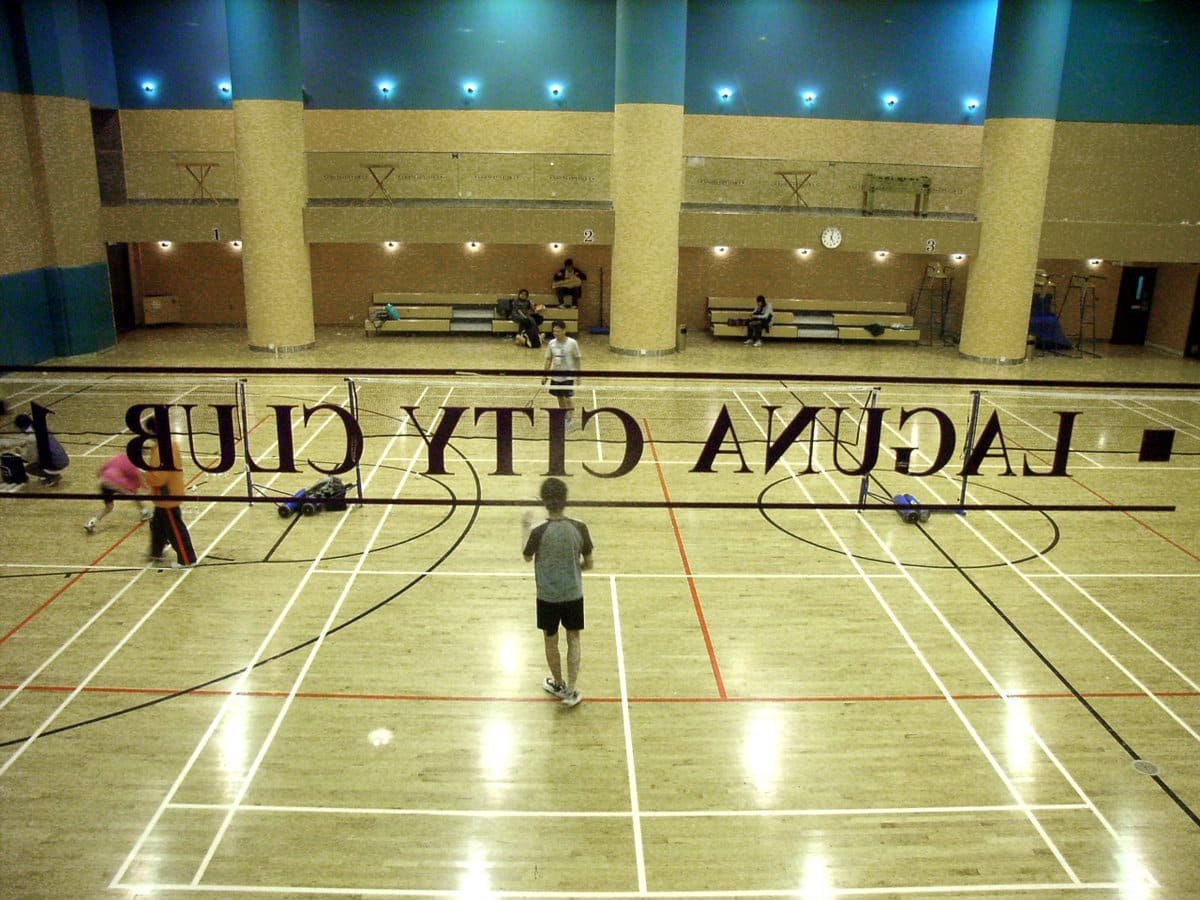
A badminton court is 13.4 meters long. It is 6.1 meters wide for doubles and 5.18 meters for singles, because singles leave out the side alleys. The net is 1.55 meters high at the posts and 1.524 meters in the middle. A short service line runs 1.98 meters from the net on each side, and in doubles a long service line sits 0.76 meters inside the back boundary.
The lines are part of the court, so a shuttle landing on a line is in. Our comparison of a tennis court and a badminton court shows how much smaller the badminton court is.
Singles and doubles lines, the service courts and the net height are listed in our guide to badminton court dimensions.
Scoring
- Every rally ends with a point for one side, no matter who served.
- A game goes to 21. At 20 all, a side has to lead by two to win, so 22 to 20 or 25 to 23.
- At 29 all, the next point wins, so no game goes beyond 30 to 29.
- Players get an interval of up to 60 seconds when the leading side reaches 11, and up to two minutes between games.
- Players change ends after each game, and in a third game when the leading side reaches 11.
New scoring from 2027: the BWF has approved a best of three games to 15 system that applies from 4 January 2027. Games then go to 15 points, won by two with a cap at 21, and the interval and the change of ends in the third game come at 8 points. Everything else on this page stays the same.
Serving Rules
Badminton has stricter serving rules than most racket sports, because a serve hit from high up would be too hard to return. The server must:
- stand inside the correct service court, without touching a line, and keep part of both feet on the floor in a stationary position until the serve is made,
- hit the base of the shuttle first,
- hit the whole shuttle below 1.15 meters from the floor at the moment of contact,
- move the racket forward in one continuous motion, without stopping or faking,
- serve diagonally into the opponent’s service court.
The receiver also has to stand still in the diagonal service court until the serve is hit. Where the server stands depends on the score: with an even score, serve from the right service court, with an odd score from the left.
Singles vs Doubles Service Courts
| Area | Singles | Doubles |
|---|---|---|
| Service court on the serve | Long and narrow: from the short service line to the back boundary, without side alleys | Short and wide: from the short service line to the doubles long service line, with side alleys |
| Court after the serve | Singles sidelines, full length | Whole court, including side alleys and back alley |
| Who serves | The server keeps serving while winning rallies | Only one serve per side. When the serving side wins a rally, the same player serves again from the other court |
In doubles, partners only switch service courts when their side wins a point on its own serve. When the receiving side wins the rally, it simply takes over the serve, and the player standing in the correct court for the score serves.
Faults
| Fault | What happened |
|---|---|
| Out | The shuttle lands outside the boundaries |
| Net | The shuttle fails to cross the net or passes through or under it |
| Touch | The shuttle touches a player, the clothing, the ceiling or the walls |
| Double hit | The same player, or two partners one after another, hit the shuttle in the same rally turn |
| Net contact | A player or racket touches the net or the posts while the shuttle is in play |
| Reaching over | A player hits the shuttle on the opponent side of the net. Following through over the net after hitting on your own side is allowed |
| Obstruction | A player blocks the opponent’s legal stroke or distracts by shouting or gesturing |
| Service fault | Any break of the serving rules above |
Lets
A let means the rally is replayed without a point. It is called when the receiver was not ready for the serve, when server and receiver both commit a fault at the same time, when the shuttle gets caught on top of the net after the serve, or when something unexpected disturbs play, such as a shuttle from the next court.
Tips for Your First Match
- Use a short, low serve in doubles. A high serve gives the other side an easy smash.
- Return to the middle of the court after every shot so you can reach the corners.
- Hit high and deep to the back of the court when you are under pressure. It buys you time.
- Learn some badminton terms like clear, drop shot and birdie.
More Reading
- Badminton lingo and slang
- Badminton equipment list
- History of badminton
- Tennis court vs badminton court
- Common badminton injuries
- Badminton quiz

FAQ
What are the basic rules of badminton?
Players hit a shuttlecock over the net without letting it touch the floor on their side. Every rally scores a point, games go to 21 with a two point lead, and the first side to win two games wins the match.
How many points is a badminton game?
21 points, won by two, with a cap at 30. From 4 January 2027, BWF games go to 15 points with a cap at 21.
How high can you serve in badminton?
The whole shuttle must be below 1.15 meters from the floor when it is hit, which in practice makes every serve an underhand or backhand serve.
Is the shuttle on the line in or out?
In. The lines are part of the court.
Can you touch the net in badminton?
No. Touching the net or the posts with your body or racket during a rally is a fault.
Where do you serve from in badminton?
From the right service court when the server’s score is even and from the left when it is odd, always diagonally.
Can the shuttle hit your body in badminton?
No. If the shuttle touches you or your clothing, you lose the rally.
What is a let in badminton?
A rally that is replayed without a point, for example when the receiver was not ready or a shuttle from another court interferes.


No comments yet
What's your take?
What's your opinion, or think we got something wrong? Tell us and other readers.
Our editors read every comment.