

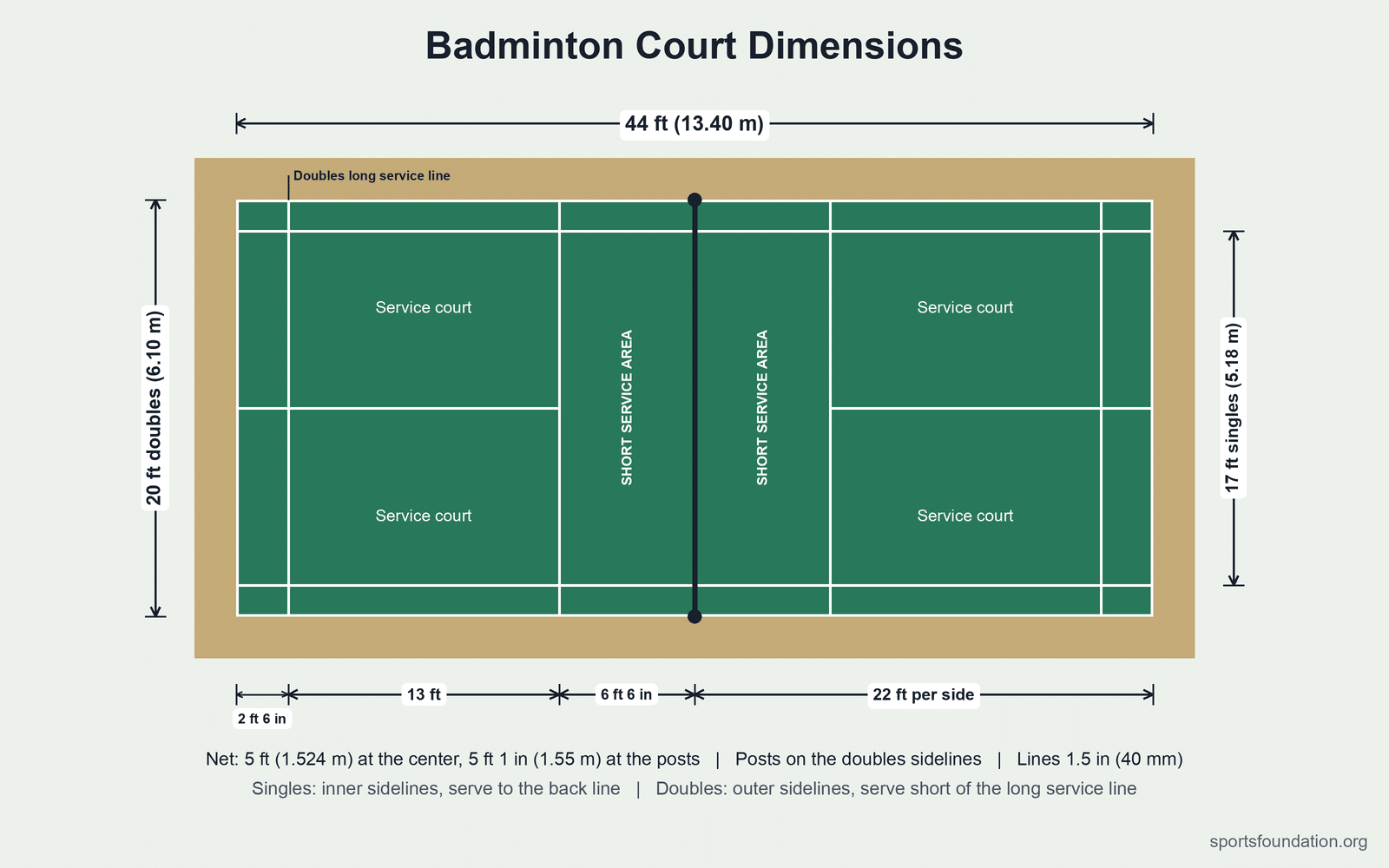
Badminton court dimensions with diagram: 44 x 20 ft doubles court, 17 ft singles width, service lines, net height and the space needed around the court.
A badminton court is 44 feet long and 20 feet wide for doubles (13.40 x 6.10 meters). For singles, the court is the same length but only 17 feet wide (5.18 meters). The net is 5 feet high at the center and 5 feet 1 inch at the posts. These measurements come from the Badminton World Federation (BWF) and are the same at every level of play.
Most of the details are in the service lines. A badminton court has two sets of sidelines and two sets of back lines, and which ones count depends on whether you play singles or doubles and whether the shuttle is being served. This page lists every measurement, with a diagram drawn to scale.
Jump to:
- Badminton Court Dimensions at a Glance
- How Long Is a Badminton Court?
- How Wide Is a Badminton Court?
- How Many Square Feet Is a Badminton Court?
- Service Lines and Service Courts
- Net Height and Posts
- Ceiling Height and Hall Size
- Court Size by Level
- Badminton Court vs Tennis and Pickleball Courts

Badminton Court Dimensions at a Glance
| Measurement | Feet | Meters |
|---|---|---|
| Length | 44 ft | 13.40 m |
| Width, doubles | 20 ft | 6.10 m |
| Width, singles | 17 ft | 5.18 m |
| Side alleys | 1 ft 6 in each | 0.46 m |
| Short service line from net | 6 ft 6 in | 1.98 m |
| Doubles long service line from back line | 2 ft 6 in | 0.76 m |
| Net height, center | 5 ft | 1.524 m |
| Net height, posts | 5 ft 1 in | 1.55 m |
| Line width | 1.5 in | 40 mm |
| Court area, doubles | 880 sq ft | 81.7 sq m |
| Court area, singles | 748 sq ft | 69.4 sq m |
| Diagonal, doubles court | 48 ft 4 in | 14.72 m |
Watch: How Big Is a Badminton Court Compared to Other Sports?
This short animation draws the badminton court with its official lines and measurements, then lines it up with 36 other sports surfaces at the same scale, smallest to largest.
How Long Is a Badminton Court?
A badminton court is 44 feet long from back line to back line, which is 13.40 meters. The length is the same for singles and doubles. The net divides the court into two halves of 22 feet each. Lines count as part of the court, so a shuttle that lands on the back line is in.
How Wide Is a Badminton Court?
A doubles court is 20 feet wide (6.10 meters). The singles court is 17 feet wide (5.18 meters), marked by the inner sidelines. The two strips between the singles and doubles sidelines are 1 foot 6 inches wide each and are only in play in doubles.
How Many Square Feet Is a Badminton Court?
A doubles court covers 880 square feet (44 x 20), about 81.7 square meters. The singles court covers 748 square feet. Players need space beyond the lines as well. The BWF specification asks for at least 2 meters (6 feet 7 inches) behind the back lines and 1.5 meters (4 feet 11 inches) beside the sidelines and between neighboring courts. That brings the total area of one court to about 57 x 30 feet (17.4 x 9.1 meters), or roughly 1,700 square feet.
Service Lines and Service Courts
The short service line runs parallel to the net, 6 feet 6 inches (1.98 meters) from it on each side. A serve that lands short of this line is a fault. The center line runs from the short service line to the back line and divides each half into a left and a right service court.
The back of the service court is where singles and doubles differ. In singles, the serve may go all the way to the back line. In doubles, the serve must land in front of the long service line for doubles, which is 2 feet 6 inches (0.76 meters) inside the back line. After the serve, the full length is in play again.
| Service court | Depth | Width |
|---|---|---|
| Singles | 15 ft 6 in (4.72 m) | 8 ft 6 in (2.59 m) |
| Doubles | 13 ft (3.96 m) | 10 ft (3.05 m) |
So a singles serve goes to a long, narrow box and a doubles serve to a short, wide one. The serving rules and the scoring are explained in badminton rules.
Net Height and Posts
The top of the net is 5 feet (1.524 meters) above the floor at the center of the court and 5 feet 1 inch (1.55 meters) over the doubles sidelines. The net itself is 2 feet 6 inches (760 millimeters) deep and at least 20 feet wide. The posts stand on the doubles sidelines, even when the court is used for singles.
That makes a badminton net much higher than a tennis net, which is 3 feet at the center. The high net is what forces the typical badminton rallies of clears, drops and smashes.
Ceiling Height and Hall Size
Because the shuttle is often hit high, the ceiling matters as much as the floor. For the Olympics and its top-level events, the BWF asks for a clear height of at least 12 meters (about 39 feet) above the courts, and other BWF events can run with about 9 meters. Most school and club gyms are much lower, and around 25 feet is usually considered workable for club play. Low ceilings mostly hurt the high serve and the clear.
Court Size by Level
Unlike basketball or baseball, badminton has one court for everyone. The Olympic Games, college clubs, high schools and backyard players all use the same 44 x 20 foot court and the same net height. Only the space around the court and the height of the hall change.
| Setting | Court | Net (center) | Typical clearance |
|---|---|---|---|
| BWF top-level events | 44 x 20 ft | 5 ft | At least 12 m (39 ft) ceiling |
| College and high school gyms | 44 x 20 ft | 5 ft | Often 25 ft or more |
| Backyard and beach | 44 x 20 ft | 5 ft | Open sky |
Outdoor sets are often sold with a smaller court, but a regulation backyard court uses the same lines. The wind is a bigger problem outdoors than the size.
Badminton Court vs Tennis and Pickleball Courts
A tennis doubles court is 78 x 36 feet, so a badminton court covers less than a third of its area. The full comparison is in tennis court vs badminton court, and the tennis measurements are in tennis court dimensions.
A pickleball court has exactly the same outer size as a badminton doubles court, 44 x 20 feet. That is no accident: pickleball was invented in 1965 on a badminton court. The lines inside differ, though. Pickleball has a 7 foot kitchen instead of the 6 foot 6 inch short service line, and its net is only 34 inches high at the center. The details are in pickleball court dimensions.
| Court | Size | Area | Net height (center) |
|---|---|---|---|
| Badminton (doubles) | 44 x 20 ft | 880 sq ft | 5 ft |
| Pickleball | 44 x 20 ft | 880 sq ft | 34 in |
| Tennis (doubles) | 78 x 36 ft | 2,808 sq ft | 3 ft |
| Volleyball | 59 x 29.5 ft | 1,744 sq ft | 7 ft 11 5/8 in (men) |
Many gyms paint badminton lines across a basketball or volleyball court, and one basketball court has room for several badminton courts side by side.
More Reading
- Badminton rules: how to play
- Tennis court vs badminton court
- Badminton equipment list
- Badminton lingo and slang
- Common badminton injuries
- Badminton quiz

FAQ
How big is a badminton court?
A badminton court is 44 feet long and 20 feet wide for doubles, 17 feet wide for singles.
How big is a badminton court in meters?
13.40 meters long and 6.10 meters wide for doubles, 5.18 meters wide for singles.
How high is a badminton net?
5 feet (1.524 meters) at the center and 5 feet 1 inch (1.55 meters) at the posts.
How far is the short service line from the net?
6 feet 6 inches (1.98 meters) on each side of the net.
What is the difference between the singles and doubles court?
Singles uses the inner sidelines (17 feet wide) and the full length for the serve. Doubles uses the outer sidelines (20 feet), but the serve must land in front of the long service line, 2 feet 6 inches inside the back line.
How many square feet is a badminton court?
A doubles court is 880 square feet and a singles court 748 square feet. With free space around it, one court needs roughly 1,700 square feet.
Is a pickleball court the same size as a badminton court?
Yes, both are 44 x 20 feet. The lines inside and the net height are different.
How high should the ceiling be for badminton?
The BWF asks for at least 12 meters (39 feet) at the Olympics and top-level events. For club play, around 25 feet is usually considered workable.


No comments yet
What's your take?
What's your opinion, or think we got something wrong? Tell us and other readers.
Our editors read every comment.