

American football rules explained: downs, scoring, kickoffs, penalties, timing and overtime, plus how NFL, college and high school rules differ.
Playing the no-contact version instead? Our flag football rules explain how flag pulls, no-run zones and smaller teams change the game.
American football can look like chaos the first time you watch it: 22 players, constant stops, flags on the field and a score that jumps by 3, 6 or 7. Behind all of that sits a fairly simple idea. One team tries to move the ball down the field, the other team tries to stop it, and every play is a short battle over a few yards.
This guide explains the rules in the order they matter: the goal of the game, downs, scoring, how a play works, penalties, the clock and overtime. The details follow the NFL rulebook for the 2026 season, with the most important college and high school differences at the end.
Jump to:
- Football Rules in 60 Seconds
- The Field
- How a Game Starts: Coin Toss and Kickoff
- Downs and Yards
- Scoring
- How a Play Works
- Players and Positions
- Common Penalties
- The Clock
- Overtime
- NFL vs College vs High School Rules
- Tips for Watching Your First Game

Football Rules in 60 Seconds
- Two teams of 11. Each side has 11 players on the field: the offense with the ball, the defense without it.
- Four downs to gain 10 yards. The offense gets four plays to move the ball 10 yards. If it does, it gets four new downs.
- Score in the end zone. Carry or catch the ball in the end zone for a touchdown, or kick it through the goalposts for a field goal.
- Lose the ball, switch sides. If the offense fails, punts, scores or turns the ball over, the other team gets the ball.
- Four quarters. An NFL game has four 15 minute quarters. The team with more points at the end wins.
The Field
A football field is 100 yards long between the goal lines, with a 10 yard end zone at each end, so 120 yards in total. It is 53 1/3 yards wide. Lines every 5 yards and numbers every 10 yards show how far the offense has to go. The goalposts stand at the back line of each end zone.
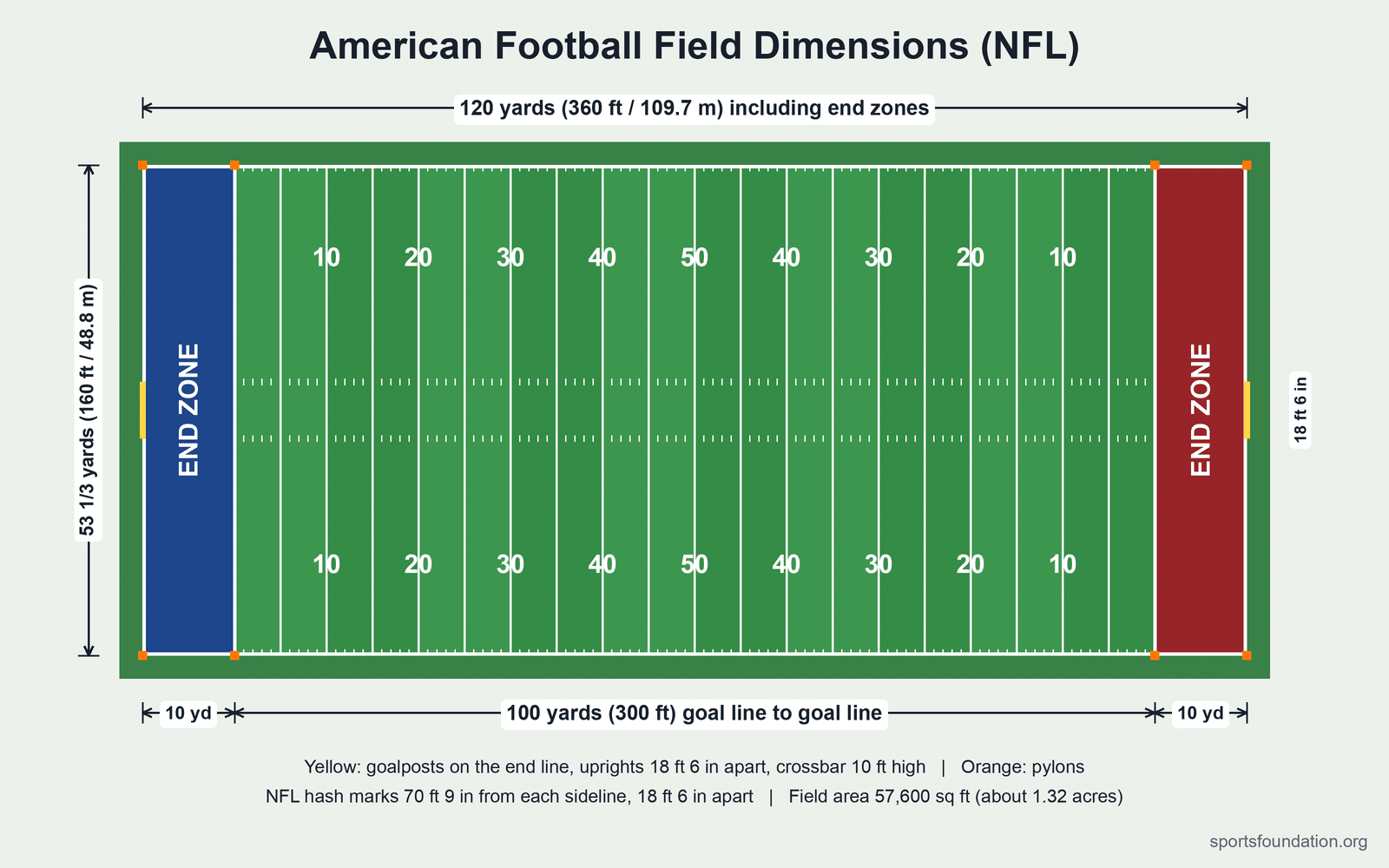
All measurements, from hash marks to goalpost height, are in our guide to American football field dimensions.
How a Game Starts: Coin Toss and Kickoff
Before the game, the captains meet for a coin toss. The winner chooses whether to receive the opening kickoff or kick off, and most teams defer their choice to the second half. The other team then picks what it did not get.
Play starts with a kickoff. The NFL uses the dynamic kickoff, which became a permanent rule after its trial years: the kicker kicks from his own 35 yard line, while the rest of both units line up much closer together, and nobody but the kicker and the returners may move until the ball is caught or hits the ground. This keeps returns alive while cutting down on high speed collisions.
If the kick goes into the end zone and the returner does not run it out, it is a touchback, and the receiving team starts at its own 35. A kickoff also starts the second half, and the team that just scored kicks off to its opponent.
Downs and Yards
Downs are the heart of the game. The offense has four tries, called downs, to move the ball at least 10 yards. When it gets there, it earns a first down and the count starts again. Announcers describe the situation as down and distance: “third and 4” means it is the third try and the offense still needs 4 yards.
A bright line on TV and a set of sideline markers, the chains, show where the offense needs to get. If the offense has not made it after three downs, it has a choice on fourth down:
- Punt: kick the ball away to push the other team back. The safe choice deep in your own territory.
- Field goal: try a kick through the goalposts for 3 points, if the offense is close enough.
- Go for it: run one more play. If it fails, the other team takes over right there.
Scoring
| Score | Points | How it happens |
|---|---|---|
| Touchdown | 6 | Carrying the ball into the end zone, or catching a pass there |
| Extra point | 1 | Kick through the goalposts after a touchdown, snapped from the 15 |
| Two-point conversion | 2 | One play from the 2 yard line after a touchdown, run or pass |
| Field goal | 3 | Kick through the goalposts during normal play, usually on fourth down |
| Safety | 2 | The defense tackles the ball carrier in his own end zone |
That is why football scores look the way they do: a touchdown with an extra point is worth 7, and many games are decided by 3 points, a single field goal.
How a Play Works
Every play starts with the snap: the center hands or tosses the ball back between his legs, usually to the quarterback. From there, the offense either runs or passes.
- Running play: a player carries the ball until he is tackled, steps out of bounds or scores.
- Passing play: the quarterback throws the ball forward to a receiver. Only one forward pass is allowed per play, and it must be thrown from behind the line of scrimmage.
- Incomplete pass: if nobody catches the pass, the ball goes back to where the play started and the clock stops.
- Catch: in the NFL, a receiver must control the ball and get both feet, or another part of the body other than the hands, down in bounds.
- End of the play: the play is over when the ball carrier is down by contact, goes out of bounds, a pass falls incomplete or someone scores.
The defense can also take the ball away. An interception is a pass caught by a defender, and a fumble is a ball dropped by the carrier and recovered by the other team. Both are called turnovers, and the defense keeps the ball where it took it.
Players and Positions
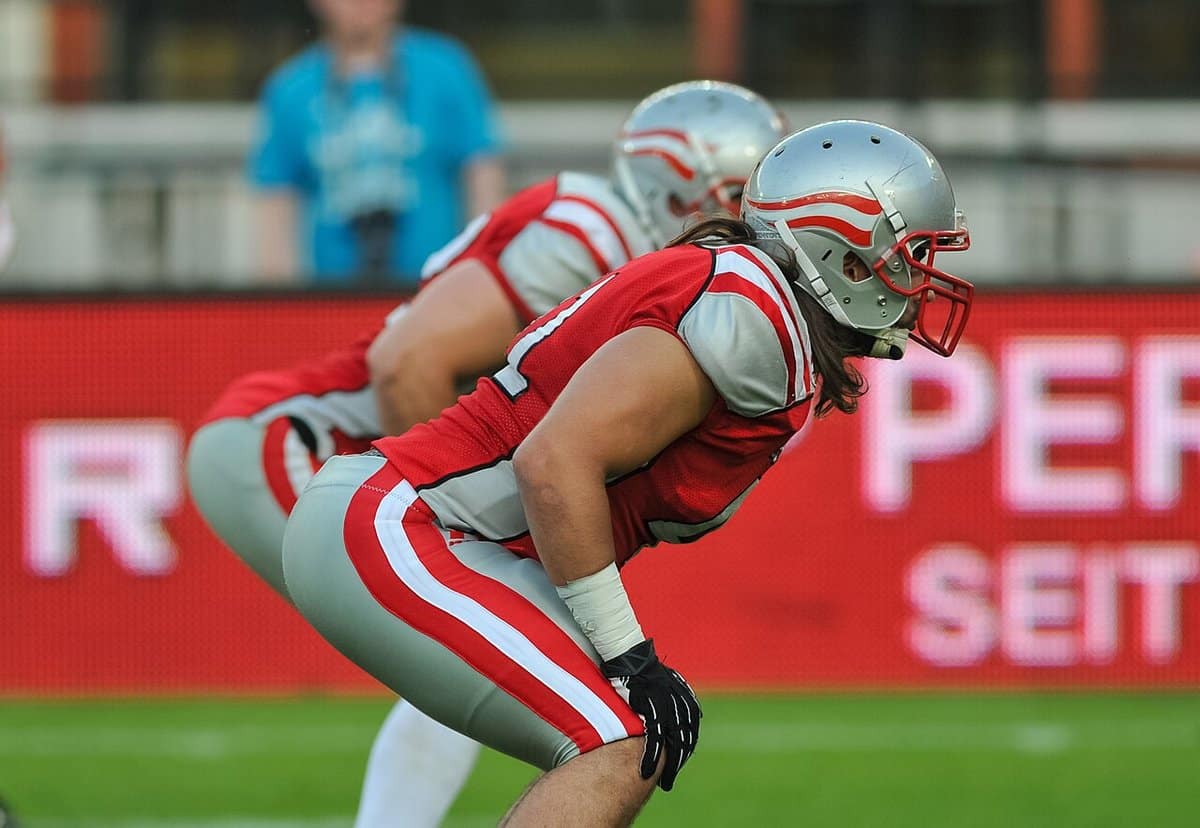
Each team has three units: the offense, the defense and special teams for kicks. An NFL roster has 53 players, so most players only play in one unit. The offense needs at least seven players on the line of scrimmage at the snap, and only some of them are allowed to catch a forward pass.
The key roles in short: the quarterback runs the offense, running backs carry the ball, receivers and tight ends catch passes, and the offensive line blocks. On defense, linemen rush the passer, linebackers stop the run and cover short passes, and cornerbacks and safeties guard against long passes. Our guide to American football positions covers every role in detail.
Common Penalties
When an official throws a yellow flag, a player broke a rule. The penalty usually moves the ball forward or back, and some fouls also give the offense an automatic first down. These are the ones you will see in almost every game:
| Penalty | Yards | What happened |
|---|---|---|
| False start | 5 | An offensive player moved before the snap |
| Offside | 5 | A defender was across the line of scrimmage at the snap |
| Delay of game | 5 | The offense did not snap the ball before the play clock ran out |
| Holding (offense) | 10 | A blocker grabbed or held a defender |
| Holding (defense) | 5 | A defender held a receiver or blocker, plus an automatic first down |
| Pass interference (defense) | Spot of the foul | A defender illegally blocked a receiver from the ball, plus an automatic first down |
| Pass interference (offense) | 10 | A receiver pushed off or blocked a defender while the pass was in the air |
| Face mask | 15 | A player grabbed and twisted the face mask of an opponent |
| Roughing the passer | 15 | A late or illegal hit on the quarterback, plus an automatic first down |
| Unnecessary roughness | 15 | A hit that went beyond normal play, such as a late hit |
The team that did not commit the foul may decline a penalty if the result of the play is better for it than the yards.
The Clock
An NFL game has four quarters of 15 minutes, with a halftime break in the middle. The real time is much longer, usually around three hours, because the clock stops often:
- after an incomplete pass,
- when a player runs out of bounds (in the last minutes of each half, and briefly at other times),
- after a score, a turnover or a penalty,
- when a team calls one of its three timeouts per half,
- at the two minute warning before the end of each half.
Between plays, the offense has 40 seconds on the play clock to snap the ball. In some situations, such as after a timeout, the play clock is set to 25 seconds.
Overtime
If an NFL regular season game is tied after four quarters, the teams play a 10 minute overtime period. Since 2025, both teams get at least one possession, even if the first team scores a touchdown. If the score is still tied after both possessions, the next score wins. If nobody has won when the 10 minutes are up, a regular season game ends in a tie.
Playoff games cannot end in a tie. Overtime periods there last 15 minutes, both teams are guaranteed a possession, and play continues until a team wins.
NFL vs College vs High School Rules
The basic game is the same at every level. These are the differences you are most likely to notice when you switch from Sunday to Saturday or Friday night:
| Rule | NFL | College (NCAA) | High school |
|---|---|---|---|
| Quarter length | 15 minutes | 15 minutes | 12 minutes |
| Feet in bounds for a catch | Two | One | One |
| Two-point try from | The 2 | The 3 | The 3 |
| Overtime | Timed period, both teams possess | Alternating possessions from the 25 | Varies by state, usually from the 10 |
| Hash marks from each sideline | 70 ft 9 in | 60 ft | 53 ft 4 in |
| Pass interference (offense) | 10 yards | 10 yards | 15 yards |
In college overtime, each team gets a possession from the opponent 25 yard line. From the third overtime on, teams alternate two-point attempts instead of full drives until one team leads after both have tried.
Tips for Watching Your First Game
- Watch the down and distance graphic before each play. It tells you what the offense needs and whether a run or a pass is more likely.
- On third down, watch the line to gain. That is where most drives are won or lost.
- When a flag flies, wait for the referee announcement before you celebrate a big play.
- Fourth down decisions are where coaches show their style: some punt, some go for it.
- Learn the football lingo as you go. Terms like blitz, audible or pick six show up in every broadcast.
More Reading
- American football field dimensions
- American football positions explained
- American football lingo and slang
- American football equipment list
- History of American football
- American football field vs soccer field
- Common American football injuries
- American football quiz

FAQ
What are the basic rules of American football?
Two teams of 11 play on a 100 yard field. The offense has four downs to gain 10 yards and keep the ball, and tries to score touchdowns and field goals. The team with more points after four quarters wins.
How many downs do you get in football?
Four. The offense has four plays to gain 10 yards. Most teams punt or kick a field goal on fourth down instead of risking the last try.
How much is a touchdown worth?
A touchdown is worth 6 points. The team then tries an extra point kick for 1 point or a two-point conversion for 2.
How long is an NFL game?
An NFL game has four 15 minute quarters, 60 minutes of game time. Because the clock stops often, a broadcast usually runs around three hours.
How does NFL overtime work?
In the regular season, overtime is one 10 minute period in which both teams get at least one possession. A tie after both possessions goes to the next score, and the game can end tied. Playoff overtime uses 15 minute periods and continues until there is a winner.
Where does the ball go after a touchback?
After a touchback on a kickoff, the receiving team starts at its own 35 yard line.
How many players are on a football team?
Each team has 11 players on the field at a time. An NFL roster has 53 players.
What is a safety in football?
A safety is worth 2 points for the defense. It happens when the ball carrier is tackled in his own end zone, and the team that gave up the safety then has to kick the ball away.


No comments yet
What's your take?
What's your opinion, or think we got something wrong? Tell us and other readers.
Our editors read every comment.