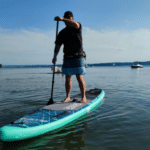
All 17 common paddleboarding injuries, from sprains and strains to shoulder damage, back pain, knee trouble, sunburn and foot injuries.
Falls off the board bring cuts, bruises, concussions, dislocations and fractures, and the list also covers dehydration, hypothermia, marine animal injuries and the risk of drowning.

Injury Rates and Numbers
The figures below come from injury surveillance data and peer reviewed studies. Each row names the population it was measured in, because rates from elite athletes and from recreational players are not comparable.
| Finding | Measured in | Source |
|---|---|---|
| Competitive stand-up paddleboarders reported 5.39 injuries per 1,000 training hours. | 330 competitive SUP athletes in China (211 male, 119 female, ages 8 to 67), March 2024 to April 2025 (published 2026) | Epidemiological characteristics of injury among stand-up paddleboarding athletes, Injury Epidemiology (2026) |
| Two thirds of competitive paddleboarders reported at least one injury, with 220 of 330 athletes logging 482 injuries in total. | 330 competitive SUP athletes in China, March 2024 to April 2025 (published 2026) | Epidemiological characteristics of injury among stand-up paddleboarding athletes, Injury Epidemiology (2026) |
| The shoulder was the most common paddleboarding injury site at 20.1 percent, followed by the lower back at 15.4 percent. | 330 competitive SUP athletes in China, March 2024 to April 2025 (published 2026) | Epidemiological characteristics of injury among stand-up paddleboarding athletes, Injury Epidemiology (2026) |
| Adult paddleboarders were injured at 5.87 per 1,000 training hours, nearly twice the rate of adolescents at 3.08. | 276 adult and 54 adolescent competitive SUP athletes in China, March 2024 to April 2025 (published 2026) | Epidemiological characteristics of injury among stand-up paddleboarding athletes, Injury Epidemiology (2026) |
| Stand-up paddleboards were involved in 29 US boating deaths in 2024, and 26 of those, or 90 percent, were drownings. | US recreational boating incident victims, all ages, calendar year 2024 | US Coast Guard, Recreational Boating Statistics 2024, Table 24 |
Overview
| Injury | Body area | Typical time out |
|---|---|---|
| Sprains and Strains | Whole body | 2 to 12 weeks, months if repaired |
| Cuts and Bruises | Skin and soft tissue | Days to 2 weeks, longer if infected |
| Shoulder Injuries | Shoulder | 6 to 12 weeks, 4 to 6 months post-op |
| Back Injuries | Lower back | 1 to 3 weeks, longer with leg pain |
| Knee Injuries | Knee | 2 to 12 weeks, up to a year post-op |
| Sunburn | Skin | 3 to 7 days, 1 to 3 weeks if blistered |
| Foot Injuries | Foot | 2 to 4 weeks, months for heel pain |
| Wrist Injuries | Hand and wrist | 2 to 8 weeks, 3 to 6 months if scaphoid |
| Dehydration | Whole body | Hours to 3 days, more after heat illness |
| Hypothermia | Whole body | Hours to days, longer if severe |
| Concussions | Head | 2 to 4 weeks, longer if repeated |
| Dislocations | Shoulder and other joints | 6 to 12 weeks, 4 to 6 months post-op |
| Eye Injuries | Eye | 1 to 3 days, weeks if vision affected |
| Fractures | Bone | 6 to 8 weeks, 3+ months to full sport |
| Marine Animal Injuries | Skin and soft tissue | 1 to 3 days, up to 3 weeks for punctures |
| Drowning | Whole body | Hours of observation to months |
| Tendonitis | Shoulder, elbow and forearm | 6 to 12 weeks, 3 to 6 months if chronic |
| Toe Fractures and Blisters | Toe | Blister: days; fracture: 3 to 8 weeks |
Sprains and Strains
A sprain is a stretch or tear of a ligament, the tissue that holds two bones together at a joint, while a strain affects a muscle or the tendon that anchors it to bone. On a paddleboard both happen in two ways: slowly, when the same stroke loads the shoulder, trunk and forearm thousands of times per session, and suddenly, when the board drops off a wave or a wake and you catch yourself with a twisted ankle, knee or wrist. Cold water and a long session make the tissue less tolerant, so the sudden version often comes late in a paddle.
Symptoms
- Pain that starts at one specific spot rather than spreading over a whole limb.
- Swelling within a few hours, sometimes with bruising a day or two later.
- The joint or muscle feels weak or unwilling to take load.
- Moving in one particular direction reproduces the pain exactly.
- Stiffness that is worst first thing in the morning and eases with gentle movement.
How serious it is: Both follow the same three grades: grade 1 is a stretch with a few torn fibers and near normal strength, grade 2 is a partial tear with clear weakness and often a feeling of instability, grade 3 is a complete rupture where the joint gives way or the muscle no longer pulls. Grade 1 and 2 are managed without surgery in almost every case.
Typical time out: Two to four weeks for a grade 1 sprain or strain, six to twelve weeks for a grade 2, and three to six months when a grade 3 tear is repaired surgically. The spread is wide because a small hamstring strain and a torn ankle ligament sit in the same grading system but heal on very different timelines.
See a doctor if: Get it looked at if you cannot put weight on the leg for more than a few steps, if the joint looks crooked, or if numbness or pins and needles spread past the injury.
What helps
- Load it early within a pain limit: gentle movement in the first days builds better tissue than several days of complete stillness.
- Short cooling in the first hours is fine for pain, but do not build the whole plan around ice.
- Rebuild strength through the full range, including the end positions where the tissue was injured, before going back on the water.
- Return to paddling in steps: flat water and short sessions first, then distance, then chop and wind.
- See a physiotherapist if strength has not returned after two to three weeks, or sooner if the joint feels unstable.
Cuts and Bruises
Cuts break the skin, bruises are bleeding inside the muscle or under the skin from a blunt blow. On a paddleboard the usual culprits are the fin and the rails of your own board, which are hard fiberglass or plastic edges moving at speed when you fall, plus rocks, shells and oyster beds at the launch. A fall onto the deck also drives the shin or hip into the board, which is a classic deep bruise rather than a cut.
Symptoms
- Bleeding or a visible open edge in the skin.
- A tender, firm lump under the skin that changes color over several days.
- Pain when the muscle under the bruise contracts.
- Grit or sand you can feel inside the wound.
- Reduced range of motion if the bruise sits over a large muscle such as the thigh.
How serious it is: A shallow scrape that stops bleeding with pressure and closes on its own is minor. It becomes serious when the wound gapes, when fat or muscle is visible, when it was caused by coral, oysters or a fin cut in warm salt water, or when a bruise is so tense that the limb feels tight and numb.
Typical time out: A few days to two weeks for a simple cut or bruise, three to six weeks for a deep muscle bruise, and longer if a wound becomes infected and needs treatment. Warm salt water wounds are the ones that most often turn a two day problem into a two week one.
See a doctor if: See a doctor if redness spreads outward from the wound, if it becomes hot or discharges pus, if fever appears, or if a bruised limb becomes tight, pale or numb.
What helps
- Irrigate a cut with clean running water or saline under pressure, which removes far more debris than dabbing at it.
- Skip hydrogen peroxide and alcohol on the wound bed, they damage healing tissue as well as bacteria.
- Cover the wound and keep it slightly moist rather than letting it dry into a hard scab, which heals faster and scars less.
- Stay out of natural water until the wound is closed, and get medical advice for any wound from coral, oysters or a fin in warm salt water.
- Keep moving a bruised muscle gently through range from day one so the scar tissue does not set short.
Shoulder Injuries
The rotator cuff is four small muscles whose tendons wrap the head of the upper arm bone and hold it centered in the shallow socket while the big muscles move the arm. Paddling loads them on every stroke, particularly the supraspinatus at the top and the biceps tendon at the front, because the catch phase puts the arm overhead and slightly forward under load. Poor technique that pulls with the arm instead of rotating the trunk multiplies the number of high stress repetitions per mile.
Symptoms
- A deep ache on the outside of the upper arm rather than on the point of the shoulder.
- Pain when reaching overhead, behind the back, or during the catch phase of the stroke.
- Weakness lifting the arm out to the side against resistance.
- Pain at night, especially lying on that shoulder.
- Clicking or catching as the arm passes shoulder height.
How serious it is: Most paddling shoulders are tendinopathy, an overloaded tendon that hurts but is intact, and these respond well to graded loading. A partial tear hurts more and is weaker but still functions; a full thickness rotator cuff tear, which is more likely after a fall in someone over fifty, leaves the arm unable to hold itself out to the side.
Typical time out: Six to twelve weeks of modified paddling for tendinopathy, three to four months for a significant partial tear treated conservatively, and four to six months after surgical repair of a full thickness tear. Tendon tissue adapts slowly, so a shoulder that feels fine after two weeks is usually only pain free, not yet rebuilt.
See a doctor if: See a doctor if you cannot hold your arm out to the side after a fall, or if pain wakes you every night for more than two weeks.
What helps
- Keep paddling at a reduced volume rather than stopping: tendons need load to remodel, they just need less of it.
- Add slow, heavy rotator cuff and scapular work two or three times a week, holding the lowering phase for three seconds.
- Fix the stroke: rotate the torso, plant the blade and unwind, so the trunk does the work and the shoulder guides the blade.
- Check the paddle: a blade that is too large or a shaft that is too long raises the load on every single stroke.
- Corticosteroid injection can quiet a very painful shoulder short term, but tendon outcomes at one year are often worse, so treat it as an exception and not a first step.
Back Injuries
The lower back takes paddling load through the erector spinae and quadratus lumborum muscles, the small facet joints at the back of each vertebra, and the discs between them. Standing on an unstable board keeps these muscles working continuously, and the forward hinge at the catch, repeated on both sides for an hour, is a sustained flexion load on the discs. Beginners who paddle with a rounded back and straight arms concentrate that load in the lumbar spine instead of sharing it with the hips.
Symptoms
- A band of ache across the lower back that builds through the session.
- Pain on standing up straight after bending forward.
- Stiffness getting out of the car or out of bed the next morning.
- Pain, tingling or numbness running into the buttock or down one leg.
- One side of the back tightening more than the other.
How serious it is: Most paddling back pain is muscular and joint related and settles within weeks. A disc problem is suggested by leg pain below the knee, numbness in a defined patch of skin, or weakness such as a foot that drags; that version needs assessment rather than patience.
Typical time out: One to three weeks for a muscular strain, six to twelve weeks or more when a disc is irritating a nerve root. Recovery varies widely because the same scan finding can produce anything from mild stiffness to leg pain that stops you working.
See a doctor if: Seek help the same day for numbness around the groin or saddle area, new trouble controlling bladder or bowel, or weakness in a leg.
What helps
- Stay moving. Bed rest makes back pain last longer, and walking on the first days is one of the better interventions.
- Build hip hinge strength and endurance in the trunk, so the hips absorb the forward reach instead of the lumbar spine.
- Change the stroke: hinge from the hips with a long spine, and drop to your knees for a stretch of the session when the back starts to load up.
- Vary side and cadence rather than paddling twenty minutes on one side.
- See a physiotherapist if pain is still limiting you at four to six weeks, and get imaging only if there is nerve involvement or a red flag, since scans of painless backs also look abnormal.
Knee Injuries
Paddling itself is kind to the knee, but the sport puts it at risk in three positions: kneeling on a hard deck, which irritates the bursa in front of the kneecap, the constant small corrections of the quadriceps to balance, which loads the patellar tendon and the kneecap joint, and a twisting fall in shallow water with the foot fixed, which is how the meniscus and the cruciate or collateral ligaments get injured.
Symptoms
- Pain around or behind the kneecap that worsens on stairs and squatting.
- A soft, tender swelling directly over the front of the kneecap after kneeling sessions.
- The knee swelling within hours of a twisting fall.
- Catching, locking or a sense that the knee will give way.
- Pain deep in the joint line on one side when you rotate the leg.
How serious it is: Kneecap pain and kneeling bursitis are irritations that settle with load management. Ligament injuries use the same grade 1 to 3 scale as elsewhere; a knee that swells within an hour of a twisting injury and feels unstable suggests a cruciate ligament tear or a meniscus tear and needs assessment.
Typical time out: Two to six weeks for kneecap pain or bursitis, six to twelve weeks for a grade 2 collateral ligament sprain, and nine to twelve months after cruciate ligament reconstruction. The gap is large because the first two are irritation and the last is a rebuilt joint stabilizer.
See a doctor if: Get it assessed if the knee swelled up within an hour of the injury, locks so you cannot straighten it, or gives way when you turn.
What helps
- Load the quadriceps progressively rather than resting the knee, since weak quadriceps are the common thread in most front of knee pain.
- Use a foam kneeling pad or a deck pad and change kneeling position often on longer paddles.
- Reduce the total volume for a few weeks rather than stopping, then add distance back in increments of roughly ten percent.
- Enter and exit the water on a stable footing, since the twisting falls that damage ligaments almost always happen in knee deep water near shore.
- See a physiotherapist for a locked or unstable knee straight away, and for front of knee pain that has not improved in six weeks.
Sunburn
Sunburn is direct ultraviolet damage to the DNA in the outer layer of skin, which triggers inflammation over the next several hours. Paddleboarding is one of the worst exposures in sport: water reflects light back up onto the face, chin and underside of the arms, there is no shade, sessions run for hours, and the cooling breeze removes the heat cue that normally tells you to get out of the sun.
Symptoms
- Skin that turns red and feels hot and tight, usually four to eight hours after coming off the water.
- Stinging when anything touches the skin, including clothing or a shower.
- Burn on the underside of the chin, nose and forearms from reflected light.
- Peeling and itching several days later.
- Blisters, chills or nausea after a heavy exposure.
How serious it is: A first degree burn is red and painful and heals without scarring. Blistering means a second degree burn, and blistering sunburn in youth is the exposure most strongly linked to melanoma later, so it is a genuine injury rather than a cosmetic one.
Typical time out: Three to seven days for a mild burn, one to three weeks when the skin blisters. You can paddle sooner if you can cover the area completely, but burned skin should not get a second exposure while it is healing.
See a doctor if: See a doctor for widespread blistering, fever, confusion or fainting after sun exposure, which points to heat illness rather than a skin problem alone.
What helps
- Cool the skin with cool water or damp cloths, then use a plain fragrance free moisturizer while the skin is still damp.
- Drink to replace fluid, since burned skin loses water faster than intact skin.
- An oral anti-inflammatory in the first hours reduces pain, but it does not undo the damage.
- Leave blisters intact and let peeling skin come off on its own.
- Prevent the next one properly: a long sleeve UPF top and a wide brim hat outperform sunscreen, because sunscreen on a paddler is rubbed and washed off within the hour.
Foot Injuries
The plantar fascia is a thick band under the arch that tensions every time you push off, and it works constantly on a board because you are making small balance corrections barefoot on a soft, moving surface for the whole session. The small muscles of the arch and the toe flexors fatigue in the same way. Separately, the launch is where the foot meets sharp shells, glass and rocks, and a puncture through a wet sole seeds bacteria deep.
Symptoms
- Sharp pain under the heel on the first steps out of bed the morning after a paddle.
- Aching or cramping through the arch late in a session.
- Burning under the ball of the foot from gripping the deck pad.
- A puncture or cut on the sole that hurts more with each day rather than less.
- Toes cramping when you try to grip the board.
How serious it is: Arch and heel pain that eases after a few minutes of walking is early and settles quickly; heel pain that stays through the day and has been present for months takes far longer. A puncture wound through the sole is the serious version, since it can carry debris into deeper tissue.
Typical time out: Two to four weeks for a fatigued arch or a minor cut, three to twelve months for established plantar heel pain, and longer if a puncture wound becomes infected. Plantar heel pain is stubborn because the tissue is loaded again with every step you take all day.
See a doctor if: See a doctor for a puncture wound through the sole, for spreading redness, or if you cannot put weight through the foot after a fall.
What helps
- Load the calf and foot with slow, heavy raises, including with the toes propped up on a rolled towel, which is the best supported treatment for plantar heel pain.
- Wear supportive shoes for the rest of the day rather than being barefoot on hard floors after a barefoot session.
- Wear water shoes for launching and landing, which removes most of the cut and puncture risk without affecting the paddling.
- Break up long sessions with time on your knees to unload the feet.
- Get any deep puncture wound cleaned professionally and check your tetanus status.
Wrist Injuries
Two very different injuries share the wrist. The first is tendinopathy of the thumb side tendons, called de Quervain syndrome, from gripping the paddle shaft too hard and cocking the wrist at the catch; the second is what happens when you fall forward and land on an outstretched hand, which drives the whole body weight through the wrist and can sprain the ligaments or break the scaphoid, a small carpal bone at the base of the thumb.
Symptoms
- Pain on the thumb side of the wrist when you grip or twist a door handle.
- Aching along the top of the forearm after a session in wind or chop.
- Immediate pain and swelling after landing on the hand.
- Deep tenderness in the hollow at the base of the thumb.
- Weak grip, so mugs and the paddle slip out of the hand.
How serious it is: Gripping related tendinopathy is an irritation and improves with technique and load changes. The one to take seriously is a scaphoid fracture: it is often only mildly painful, x-rays in the first days can look normal, and if it is missed the bone can fail to heal and cause permanent problems.
Typical time out: Four to eight weeks for tendinopathy, two to four weeks for a mild wrist sprain, and three to six months for a scaphoid fracture, which is slow because the blood supply to that bone is poor.
See a doctor if: Get a wrist x-rayed after a fall onto the hand if there is tenderness in the hollow at the base of the thumb, even if the pain seems mild and a first x-ray was clear.
What helps
- Loosen the grip: hold the shaft with relaxed fingers and let the top hand push the paddle rather than the bottom hand strangling it.
- Check paddle diameter and blade size, because a shaft that is too thick for your hand keeps the forearm muscles working the whole session.
- Progressive strengthening of the wrist and forearm through a full range once the acute pain settles, rather than long splinting.
- A short spell in a thumb spica splint can settle de Quervain, but weeks in a splint weakens the wrist and slows recovery.
- Practice falling flat and away from the board rather than putting a hand out.
Dehydration
Dehydration is a net loss of body water and sodium through sweat that is not replaced. Paddleboarding hides it: you are surrounded by water, the breeze evaporates sweat before you notice it, and it is easy to leave the bottle on shore because it is one more thing to strap down. Reduced blood volume then means less blood reaching working muscle and skin, so both performance and heat control fall away.
Symptoms
- Thirst and a dry, sticky mouth.
- Dark yellow urine, or not needing to go all session.
- Headache and difficulty focusing on the horizon.
- The paddle feeling much harder at the same speed.
- Dizziness when you stand up or step off the board.
How serious it is: Mild dehydration means thirst and reduced performance and corrects itself with drinking. It becomes an emergency when there is confusion, no sweating, a fast weak pulse, or fainting, which is heat exhaustion moving toward heat stroke.
Typical time out: A few hours for mild dehydration once you rehydrate, one to three days after a serious bout, and a week or more after true heat illness because heat tolerance stays reduced.
See a doctor if: Call for help if someone becomes confused, stops sweating despite the heat, or faints, since that is heat stroke rather than simple dehydration.
What helps
- Strap a bottle to the deck bungee where you can reach it without stopping, and drink on a schedule instead of by thirst.
- Add electrolytes for sessions over an hour, in heat, or when you finish with salt crust on your skin.
- Check urine color after the paddle, which is a more reliable guide than how thirsty you feel.
- Start hydrated, since drinking on the water only tops up what you already have.
- Move sessions to early morning or evening in a heatwave rather than trying to out-drink midday sun.
Hypothermia
Hypothermia is a fall in core body temperature below the point where the body can rewarm itself. Water pulls heat from the body many times faster than air of the same temperature, so a fall into cold water is the real risk, not the air temperature you dressed for. Before that, sudden immersion in water under about 15 degrees Celsius triggers cold shock, an involuntary gasp and rapid breathing in the first minute that is the phase in which people drown.
Symptoms
- Uncontrollable shivering.
- Hands that will no longer grip the paddle or work a buckle.
- Slurred speech and slow, muddled thinking.
- Clumsiness and stumbling when you get back on the board.
- Shivering that stops while the person is still cold, which is a worsening sign, not an improving one.
How serious it is: Mild hypothermia means shivering and clumsiness with a clear head. It becomes severe when shivering stops, thinking becomes confused, and consciousness fades; at that point the person cannot rewarm themselves and needs medical help.
Typical time out: A few hours to a day after a mild episode once fully rewarmed and fed, several days to a week after moderate hypothermia, and longer if it required hospital rewarming.
See a doctor if: Call emergency services if shivering has stopped while the person is still cold, if speech is slurred, or if they are drowsy or confused.
What helps
- Dress for the water temperature, not the air: a wetsuit or drysuit in cold water is the single decision that matters most.
- In the first minute after falling in cold water, hold onto the board and control your breathing before trying to swim or remount.
- Get out of the wind, remove wet clothing and wrap the whole person including the head in dry insulation.
- Rewarm gradually with warm, sweet, non alcoholic drinks if the person is fully alert and can swallow.
- Never rub cold limbs or put someone in a hot bath, and handle a badly cold person gently.
Concussions
A concussion is a brief disturbance of brain function after a blow or a rapid acceleration of the head; the injury is to the way brain cells work, not to their structure, which is why scans are usually normal. On a paddleboard the head hits the board, the paddle blade or shaft as it swings past, or the bottom in shallow water. Falling backward while standing on a rigid board is the classic mechanism, since there is no time to protect the head.
Symptoms
- Headache, pressure in the head or feeling stunned.
- Dizziness or the horizon seeming to move.
- Nausea, and light or noise feeling too intense.
- Slowed thinking, difficulty finding words or answering questions.
- Feeling unusually emotional, irritable or flat in the days after.
How serious it is: Concussions are no longer graded on the field; every suspected concussion means stopping for the day. The difference that matters is between a concussion, which resolves, and a bleed inside the skull, which is signalled by worsening headache, repeated vomiting, one pupil larger than the other, seizure or increasing drowsiness.
Typical time out: Most adults are back to normal activity within two to four weeks, and a graded return to sport starts after the first 24 to 48 hours of relative rest. A minority take months, and repeated concussions take progressively longer, which is why the return is staged rather than immediate.
See a doctor if: Go to an emergency department for a headache that keeps getting worse, repeated vomiting, a seizure, unequal pupils, or increasing drowsiness.
What helps
- Stop paddling for the day. Continuing after a concussion lengthens recovery and risks a second impact before the brain has recovered.
- Take 24 to 48 hours of relative rest, then start light activity such as walking, since prolonged dark room rest delays recovery.
- Return in stages: light aerobic work, then sport specific movement, then full paddling, moving up only if symptoms do not flare.
- Avoid alcohol and, for the first night, get someone to check on you.
- See a doctor if symptoms are still present after two weeks, or after any repeat concussion.
Dislocations
A dislocation is a joint whose surfaces have come completely apart, tearing or stretching the capsule and ligaments as they separate. The shoulder is by far the most common in paddling because the socket is shallow, and it usually goes forward when the arm is caught out to the side and rotated back, which is exactly what a bracing arm does in a fall. Fingers and the kneecap dislocate less often, usually from a direct catch on the leash, paddle or deck.
Symptoms
- Sudden severe pain and an immediate sense that something is out of place.
- A visibly changed shape: a squared off shoulder or a crooked finger.
- Total unwillingness or inability to move the joint.
- The arm held tightly against the body and supported by the other hand.
- Numbness or tingling in the arm or hand below the joint.
How serious it is: A first shoulder dislocation that reduces cleanly and has no fracture is the straightforward version. It becomes complicated when a piece of bone or the labrum is torn off, when nerve or blood supply is affected, or when it happens again, and the younger the person at the first dislocation, the higher the chance of recurrence.
Typical time out: Six to twelve weeks for a first shoulder dislocation treated without surgery, and four to six months after a stabilization operation. Fingers are faster at two to six weeks. The range is wide because it depends entirely on what tore on the way out.
See a doctor if: Go to an emergency department immediately, and go straight away if the hand is cold, pale, numb or you cannot feel a pulse in it.
What helps
- Do not try to force the joint back yourself; a dislocation with an unrecognized fracture can be made much worse.
- Support the arm in the position it is comfortable in and get to hospital, since the sooner it is reduced the easier it is.
- Come out of the sling early, within days rather than weeks, and start guided movement, because long immobilization does not reduce recurrence.
- Rebuild rotator cuff and scapular strength for at least three months, which is the main protection against the next one.
- Discuss surgical stabilization if you are young and it has happened more than once, since repeat dislocations damage the joint each time.
Eye Injuries
Most paddling eye problems are corneal: the clear front surface of the eye gets scratched by sand or grit, or burned by ultraviolet light reflected off the water, which is the same injury as snow blindness. A hard blow from the paddle shaft or the board edge is less common but can bruise the eyeball itself or fracture the thin bone of the eye socket.
Symptoms
- A gritty feeling as if something is still in the eye, even after rinsing.
- Watering, redness and difficulty keeping the eye open in daylight.
- Blurred vision or halos around lights.
- Both eyes burning and streaming several hours after a bright day on the water.
- Double vision or blood visible in front of the iris after a direct blow.
How serious it is: A surface scratch or ultraviolet burn is very painful but heals completely in a day or two. It is serious when there is blood inside the front of the eye, a change in vision, a pupil that is no longer round, or an object that has penetrated the eye rather than sitting on it.
Typical time out: One to three days for a corneal abrasion or ultraviolet burn, one to two weeks after a significant blunt injury, and weeks or months if the eye is penetrated or the socket is fractured.
See a doctor if: Get seen the same day for any change in vision, blood inside the eye, an irregular pupil, or an object stuck in the eye.
What helps
- Rinse gently with saline or clean water and resist rubbing, which turns a speck into a scratch.
- Do not remove anything embedded in the eye; cover it lightly without pressure and get to an eye doctor.
- Wear wraparound sunglasses with genuine ultraviolet protection and a retainer strap, since reflected light off water is the underestimated exposure.
- Rest the eye out of bright light for a day after an abrasion, and use lubricating drops rather than any leftover steroid drops.
- Get any abrasion in a contact lens wearer checked, because those can become infected quickly.
Fractures
A fracture is a break in the continuity of bone, from a hairline crack to a bone in several pieces. In paddleboarding they come from falls onto hard surfaces rather than from paddling: the ribs and collarbone when you land on the rail of the board, the wrist and scaphoid when you land on an outstretched hand, and toes and ankles from stepping into rocks or dropping the board.
Symptoms
- Pain that starts instantly and stays sharp at one point on the bone.
- Swelling and bruising that develop quickly.
- Being unable to use the limb normally or take weight on it.
- A visible bend, shortening or lump where there should not be one.
- Pain on deep breath or cough when a rib is involved.
How serious it is: A stable, undisplaced fracture where the pieces are still lined up heals in a cast or splint. Displaced, angulated, multi-fragment and open fractures, where bone has broken the skin, need surgical treatment, and open fractures are an emergency because of infection risk.
Typical time out: Six to eight weeks for most simple limb fractures to unite, three to six months to return to full sport, and longer for the scaphoid or after surgery. Bone healing time is fairly fixed; the variable part is how long the surrounding muscle takes to come back.
See a doctor if: Go to hospital straight away for an obvious deformity, bone through skin, an inability to bear weight, or a limb that is numb, cold or pale below the injury.
What helps
- Immobilize as found and get imaging; do not try to straighten the limb yourself.
- Keep the rest of the body training while the fracture heals, since general fitness and the uninjured side hold up well.
- Start moving the neighboring joints as soon as the treating team allows, because stiffness is often the harder problem than the bone.
- For rib fractures, deep breathing and coughing exercises matter, since shallow breathing to avoid pain leads to chest infections.
- Get bone health checked, including vitamin D and, for women with irregular periods or anyone with low energy intake, hormonal and nutritional causes, if a fracture happened with little force.
Marine Animal Injuries
These are envenomations and puncture wounds rather than mechanical injuries. Jellyfish fire stinging cells into the skin on contact, which fire again if the tentacle is disturbed; stingrays drive a barbed, venomous spine into the foot or ankle when stepped on in shallow sand; sea urchin spines break off inside the tissue. Paddleboarders are exposed mostly while wading in and out and while sitting with legs in the water.
Symptoms
- Immediate burning pain with a line or print shaped mark on the skin.
- Pain from a stingray wound that becomes severe over the following minutes.
- A puncture wound on the sole or ankle with a dark fragment in it.
- Swelling and redness spreading around the site.
- Nausea, cramps, breathlessness or a rash away from the sting, which points to a whole body reaction.
How serious it is: Most stings in temperate waters are painful but local and settle within hours. Serious cases involve a stingray spine to the trunk, retained spines in a joint, a severe allergic reaction, or a sting from one of the highly venomous species in tropical waters.
Typical time out: One to three days for a typical jellyfish sting, one to three weeks for a stingray puncture, and longer if spines are retained or the wound becomes infected. Marine wounds are prone to unusual bacteria, so a wound that worsens after day two often needs specific antibiotics.
See a doctor if: Call emergency services for breathing difficulty, a rash spreading over the body, chest pain, or a spine wound to the chest or abdomen.
What helps
- Rinse a sting with seawater rather than fresh water, since fresh water makes the remaining stinging cells fire.
- Lift off tentacles with a gloved hand or the edge of a card instead of rubbing or scraping hard.
- Immerse a stingray or stonefish wound in water as hot as can be tolerated for 30 to 90 minutes, which breaks down the venom and is the main pain treatment.
- Have any puncture wound checked for retained spine fragments, which will not resolve on their own.
- Shuffle your feet through shallow sand rather than stepping, which pushes rays out of the way instead of onto them.
Drowning
Drowning is respiratory impairment from being submerged or immersed in liquid; it does not require going under for long, and it is usually quiet rather than dramatic. In paddleboarding the sequence is almost always the same: the paddler falls in without a flotation device, separates from the board in wind or current, and cannot swim back to it. Cold water shock and alcohol are the two factors that turn a manageable fall into a fatal one.
Symptoms
- A paddler in the water who is upright, silent, and not making progress toward the board.
- Head tilted back with the mouth at water level.
- Arms pressing down on the water instead of waving.
- Coughing, choking or breathlessness after any water inhalation.
- Confusion, extreme tiredness or difficulty breathing in the hours after a near drowning.
How serious it is: Anything from a mouthful of water with coughing that settles, through to submersion requiring resuscitation. Stand-up paddleboards were involved in 29 US boating deaths in 2024, and 26 of those, or 90 percent, were drownings, which is why the flotation and leash advice is not overcautious.
Typical time out: Anyone who inhaled water and has symptoms needs observation for several hours, and a serious event means days in hospital and weeks to months of recovery. There is no fixed timeline because lung and brain effects vary enormously.
See a doctor if: Any persistent cough, breathlessness, chest pain or unusual drowsiness in the hours after inhaling water needs urgent medical assessment, even if the person seemed fine when they got out.
What helps
- Wear a flotation device. An inflatable belt pack is unobtrusive and is the difference between a swim and an emergency.
- Wear the right leash for the water: a straight leash for open water, a quick release waist leash on any moving water, since a leash caught on a submerged obstacle in a river is itself a drowning mechanism.
- Stay with the board. It is the biggest and most visible flotation you have, and it can be paddled lying down when standing is no longer possible.
- Rescuers should reach or throw rather than swim, and call for help before entering the water.
- Start rescue breaths first in a drowning arrest, since the problem is lack of oxygen rather than a primary heart problem.
Tendonitis
The current understanding is tendinopathy rather than tendonitis: a chronically overloaded tendon shows disorganized collagen and cells trying to remodel, with relatively little classic inflammation, which is why anti-inflammatory strategies alone rarely fix it. In paddleboarding it shows up in the rotator cuff tendons, the biceps tendon at the front of the shoulder, the forearm extensors at the outside of the elbow from gripping the shaft, and sometimes the wrist. The cause is a jump in load: more sessions, longer distance, a bigger blade or wind resistance, faster than the tendon can adapt.
Symptoms
- Pain that warms up during the first ten minutes and returns worse afterward.
- Stiffness and soreness the morning after a session.
- A specific tender spot you can press on rather than a diffuse ache.
- Pain when gripping, lifting or rotating against resistance.
- Gradual onset with no single moment of injury.
How serious it is: Early reactive tendinopathy, where the tendon hurts after load but recovers overnight, responds quickly to load reduction. Long standing tendinopathy with structural change takes months, and the tendon can eventually tear, particularly in the rotator cuff.
Typical time out: Six to twelve weeks of modified training for an early case, three to six months for a long standing one. It varies so much because the tendon adapts to what you actually do, so someone who keeps flaring it up every weekend stays in the early stage indefinitely.
See a doctor if: See a doctor if there is sudden weakness or you feel a snap during a stroke, which suggests a tear rather than an irritated tendon.
What helps
- Reduce load rather than stopping: complete rest weakens the tendon and pain returns as soon as you paddle again.
- Do progressive loading, starting with slow isometric holds for pain and moving to heavy slow strength work with a controlled lowering phase.
- Accept some pain during the exercise, up to a level you would call tolerable, as long as it settles within 24 hours.
- Fix the trigger: the change in blade size, distance, cadence or paddling into wind that came a few weeks before the pain.
- Corticosteroid injection helps in the short term but is associated with worse outcomes at six and twelve months in tendinopathy, so keep it as an exception rather than a plan.
Toe Fractures and Blisters
Two things happen to toes in this sport. Barefoot toes catch the fin, the carry handle or a rock at the launch, and the small bones of the little toe in particular break easily from that kind of stub. Separately, the deck pad is a grip surface, and hours of the toes clawing into it while balancing produces friction blisters on the tips and undersides of the toes, which is a separation of skin layers with fluid in between.
Symptoms
- Immediate sharp pain and swelling after catching the toe on something.
- Bruising along the toe and into the front of the foot over the next day.
- A raised, fluid filled bubble on the tip or pad of a toe.
- Rawness under the toes that stings in salt water.
- Dark discoloration under the toenail, with a throbbing pressure.
How serious it is: Most toe fractures are stable and treated by buddy taping to the neighboring toe. The exceptions are the big toe, which carries load when you push off, and any toe where the bone is angled, the joint is involved, or the nail bed is broken open. A blister is minor unless it becomes infected or is over a weight bearing surface.
Typical time out: Three to six weeks for a small toe fracture, six to eight weeks or more for the big toe, and a few days to two weeks for a blister depending on whether it is over a pressure point. The blister range depends mainly on whether you keep rubbing the same spot.
See a doctor if: See a doctor if the toe points in a new direction, if there is blood under the nail with severe pressure, or if a blister becomes red, hot and increasingly painful.
What helps
- Buddy tape a broken small toe to the one beside it with a pad in between, and wear a stiff soled shoe for a few weeks.
- Leave an intact blister alone as a sterile dressing of its own; if it is large and painful, drain it at the edge with a sterile needle and leave the roof on.
- Cover a drained or torn blister with a hydrocolloid dressing, which cushions and keeps the wound moist.
- Wear thin neoprene socks or water shoes for launching, which stops both the stubs and most of the friction.
- Ease off the toe clawing habit: balance comes from the hips and ankles, and a relaxed foot on the deck pad blisters far less.
First Aid for Soft Tissue Injuries: PEACE and LOVE
Sports medicine has moved on from RICE. The current guidance, published in the British Journal of Sports Medicine in 2019, splits care into the first days after the injury and everything that follows.
PEACE, the first two to three days
- Protect: unload the area and limit movement that hurts, but only briefly.
- Elevate: keep the limb above heart level when you can.
- Avoid anti-inflammatories: they may blunt the healing you need.
- Compress: a bandage or taping limits swelling.
- Educate: your body heals this on its own; passive treatments rarely speed it up.
LOVE, from day three onward
- Load: return to movement as pain allows, early loading builds tissue.
- Optimism: expectations shape recovery more than most people assume.
- Vascularization: easy cardio that does not hurt brings blood to the area.
- Exercise: restore strength, mobility and balance before returning to play.
Ice still helps with pain in the first hours. What changed is the evidence that long icing and routine anti-inflammatory drugs slow tissue repair.
How to Lower Your Risk in Paddleboarding
- Drive the stroke from the trunk and legs: plant the blade, unwind the torso and let the arms stay long, which takes load off the shoulder that is the most injured site in this sport.
- Increase distance or session time in small steps rather than jumping from a short paddle to a long one, since tendon problems almost always follow a sudden change in load.
- Match the paddle to you, not to the shop default: a blade that is too large and a shaft that is too long add load to every single stroke of the session.
- Dress for the water temperature rather than the air, and always paddle with a flotation device and a leash appropriate to the water, straight for open water and quick release on rivers.
- Wear water shoes for launching and landing, which removes most cuts, punctures and stubbed toes, and shuffle your feet through shallow sand where rays lie.
- Cover up for the sun with a long sleeve UPF top, a hat and a strapped pair of ultraviolet blocking sunglasses, and keep a drink strapped to the deck where you can reach it.
- Build shoulder, hip and trunk strength off the water two or three times a week, so the tissue can take the repetition that the sport demands.
When to Stop and Get Medical Help
Most of the injuries on this page are treated at home. These signs are not.
- A visible deformity, bone through the skin, or a joint that will not move at all after a fall.
- A blow to the head with confusion, memory loss, repeated vomiting or any loss of consciousness.
- Numbness, pins and needles, or weakness in a limb, especially around the groin or with loss of bladder or bowel control.
- A limb below the injury that is cold, pale or has no pulse.
- Shivering that has stopped while the person is still cold, slurred speech or drowsiness in cold water conditions.
- Breathlessness, a persistent cough or chest pain after inhaling water, even if the person seemed fine when they got out.
Sources
- Epidemiological characteristics of injury among stand-up paddleboarding athletes, Injury Epidemiology (2026)
- US Coast Guard, Recreational Boating Statistics 2024, Table 24
This article is general information, not medical advice. If you are hurt, a doctor or physiotherapist who can examine you is worth more than any web page. Last reviewed: August 2026.

Frequently Asked Questions
How dangerous is paddleboarding really?
The everyday injuries are minor and gradual: sore shoulders, sore backs, sunburn and cut feet. The genuine danger is drowning, and it is the one that is consistently underestimated because the water often looks calm. Stand-up paddleboards were involved in 29 US boating deaths in 2024, and 26 of those, or 90 percent, were drownings. Wearing a flotation device, using the correct leash and dressing for the water temperature removes most of that risk.
Why are my legs so sore after learning to paddleboard?
Balancing on a moving board means your calves, quadriceps and the small muscles of the feet make constant small corrections for the entire session, which is a type of continuous low level work most people never do otherwise. Beginners also stand stiff legged and grip with the toes, which adds to it. The soreness peaks a day or two after and settles within three to five days. It fades quickly as you learn to stay loose through the knees and ankles.
Can I paddleboard with a blister on my toe?
Usually yes, if you can cover it so it does not rub. Leave an intact blister unopened, cover it with a hydrocolloid dressing, and wear a thin neoprene sock or water shoe to stop the deck pad from working on the same spot. Skip the session if the blister is torn open and the water is not clean, or if it is red, hot and increasingly painful, which suggests infection.
What should I do if thunder starts while I am on the water?
Get off the water immediately and head for the nearest shore, because standing upright on open water holding a long paddle makes you the highest point around. Do not wait for rain or for the storm to look close, since lightning strikes ahead of the visible weather. Once ashore, get away from the waterline and from isolated trees, and into a building or a vehicle if there is one. Wait at least 30 minutes after the last thunder before going back out.
What does it mean when paddling causes a tearing pain?
A sudden tearing or snapping sensation during a stroke, especially at the front of the shoulder or in the back, suggests an actual tear of muscle or tendon rather than the gradual ache of an overloaded tendon. Stop for the day and note whether there is weakness afterward, since strength loss is the sign that separates a tear from an irritation. If the arm is weak or the pain does not settle within a few days, get it assessed rather than paddling through it.
How long does a paddleboarding shoulder injury take to heal?
An overloaded rotator cuff tendon typically needs six to twelve weeks of reduced but continued paddling combined with strength work, not complete rest. A significant partial tear treated without surgery takes three to four months, and a repaired full thickness tear four to six months. Tendons adapt slowly, so feeling pain free after two weeks means the pain has settled, not that the tissue has rebuilt.